REACHING FOR THE STARS
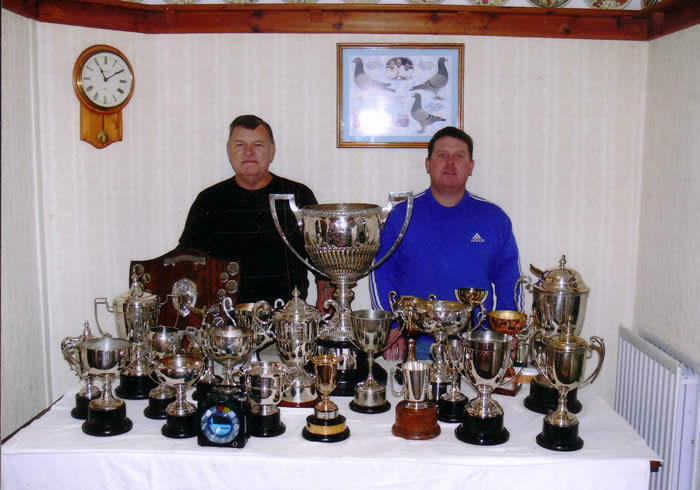
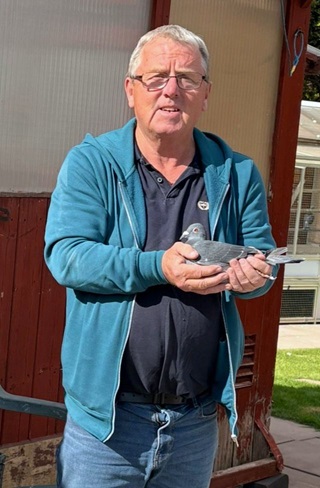
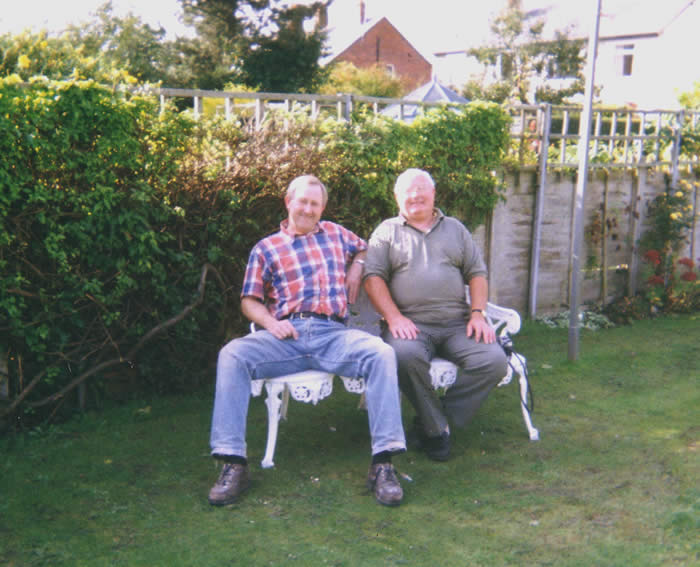
RAY & GARY TILL
of Rugeley
talking to Cameron Stansfield
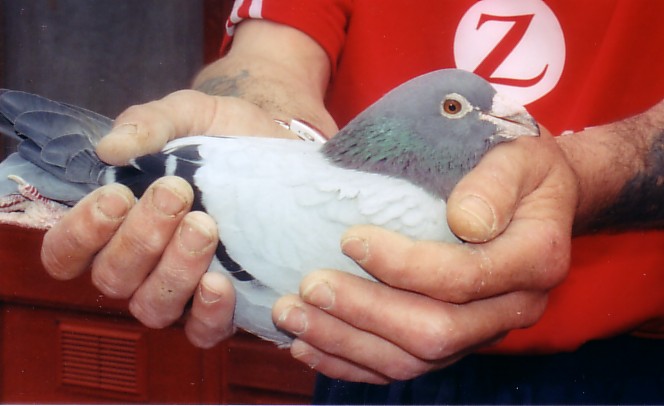
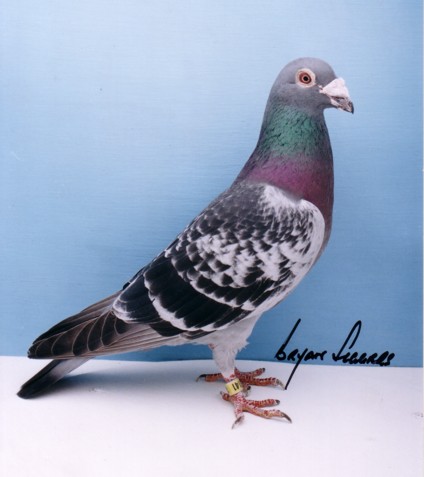
The Pau Cock. 1st Section I, 60th Open NFC Pau, 653 miles.
The first time I spoke to Ray Till was in 2000 when I rang him in the wake of the Nantes National for some information on his Section winner, Bopper, to learn that it was in fact the second time Bopper had topped the Section in the NFC and he’d also been 24th Open MNFC. Some pigeon! As I began to delve, it soon became apparent that the Tills have had plenty of good pigeons in their time.
I think it was at a National Flying Club annual prize presentation over a year later that I then met Ray in person, along with his wife Vivian, son Gary, and Brian and Annette Leadbeater – the Rugeley crowd. We had a great night then and have enjoyed others since because Ray, Gary and Brian have a passion for all things pigeon – and a level of ambition which, as the years pass, seems to grow.
The Tills, having won at all levels, and having been 5th & 7th in the running for the NFC’s much coveted Langstone Gold Cup in 2003 and 2004 (awarded for the best average from Pau, Nantes and the young bird race), do not accept that there are limits to what a pigeon can achieve and, accordingly, having dipped their toes into International racing in the past two seasons, sending to Barcelona, Marseilles, Dax, Perpignan and Biarritz. It’s hard enough to score at this level if you live in the south of England so it is harder still when you live in Midlands, which obviously explains why so few are willing to try it. Nevertheless, they have been well and truly bitten by the International bug.
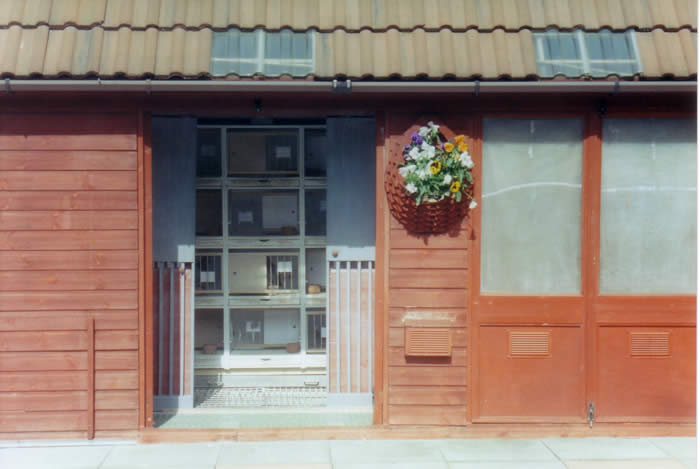
One of the widowhood sections.
To clarify their flying name, although at times there have been as many as four different Till brothers involved, today the team is basically Ray Till and his son Gary.
I asked Gary for his thinking behind setting the whole loft up for long distance National and Internationals and he said that he and Ray know they can beat x, y and z in National Flying Club races so why not in the Internationals? Fair enough, put like that it sounds simple but let’s have a look at the reality…
Here’s what Gary had to say...
‘Brian Sheppard and Mark Gilbert have shown we can win Internationals in the UK and that is the beauty of pigeon racing – there are no limits to what can be achieved. You’ve got to push yourself. We all know we will come unstuck and people will be quick to say “They haven’t timed in again” but if you send the right pigeons there will come a time when you will get them. I love to talk to the BICC fliers because they think the same way.
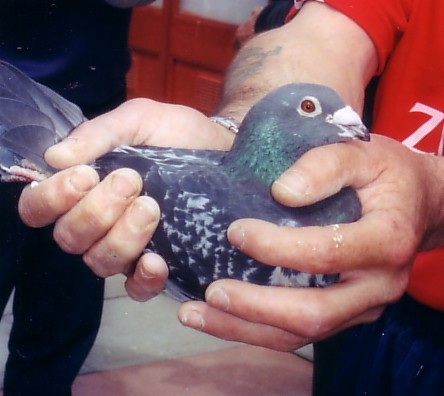
Bopper. 1st Section I, 68th Open NFC Saintes, 3,906 birds; 1st Section I, 18th Open NFC Nantes, 9,074 birds; 10th Section, 24th Open MNFC, 3,064 birds.
We are big supporters of the National Flying Club and have won the Section on five occasions (twice from Nantes, once from Pau and twice from Saintes) but we do not think the National is the be all and end all. To get your name in the International result is the ultimate. We haven’t done it yet but perhaps one day we will.
We’ve been 6th Open NFC Pau and it got to the stage where we could send to Pau reasonably confident we’d get a good un. We were looking in the book and seeing how the likes of Jim Biss and the Nicholsons were winning in the BICC, and we thought we know we can beat them on occasions in the National Flying Club so why not in the BICC?
In an attempt to strengthen our team we brought in some new pigeons, but they were not as good as our own at the distance and have gone. We’ve now stocked five sons of our old 6th Open Pau cock, all of which have won a 1st and flown either Pau or Bergerac. This year we have paired them all to hens of our Pau Cock line to give us 100% Pau Cock line pigeons. In other words we are breeding the same pigeons we had five years ago. But I think it’s going to take us three years to get back to where we were. We made a huge, massive cock up, but thank God it didn’t take us ten years to realise it. It was probably the darkest time we’ve ever had in our loft. Not all our introductions have been a waste of time however. We went to see Herman Brinkman, who flies 800 miles from Barcelona to northern Holland, and came away with two youngsters. We’ve faith in them because the first year we clocked one off one of them in the young bird National and last year we held 5 out of 6 off the cock and 5 out of 5 from the hen – at the same time as we were losing those others – in fact they had the same feed and the same chucks. The hen is a daughter of Brinkman’s Brinky Boy, 1st Limoges, which we bought for more speed without losing stamina, and the black cock from Brinkman is the same way bred as his first bird from Barcelona in 2005. We also have a brother of Marc Pollin’s 1st Limoges National winner.’
Gary says the failure of their new introductions to cut the mustard has led to the darkest time in their loft’s history but that is to downplay some early promising forays into International competition...
'Our highlight last year was timing from Perpignan International on the 4th day with a double inbred granddaughter of ‘02’, the grandam of our loft. This Perpignan hen won twice as young bird from Bath, 90 miles, then was 5th Section Young Bird National. She was unraced as a yearling then took a fortnight from Pau as a two-year-old. She had never laid so we assumed she was barren but then as we were getting her ready for Perpignan she went and laid – so she was racing to the first eggs of her life. When she dropped at ten past six at night I was ecstatic because to me it was as good as winning the National, flying 120 miles further than the next bloke. It might not sound a lot but it’s an awful lot after 590 miles. There were only 11 clocked on the second day, the wind was in the north and it was raining but when she dropped she was perfect. The International convoy is fed 100% maize and they must put on so much weight in the basket. We got three out of our four home from Perpignan and their preparation was this: they were paired up 1 month before Perpignan, exercised once a day, and then trained from 15 miles in the last five days before basketing. They had no other tosses during the season and NO races before Perpignan. Because of the distance, we believe they need all their reserves in them, and if you take anything out of them by racing or hard training you can’t put it back in time. At Perpignan they are loosed in the afternoon so can only do 7 to 8 hours on the first day. When they get up next morning they still have another 500 miles to go. They are not going to fly for 14 hours which means they must get up again on the third morning and so on. They must therefore have the reserves of energy.
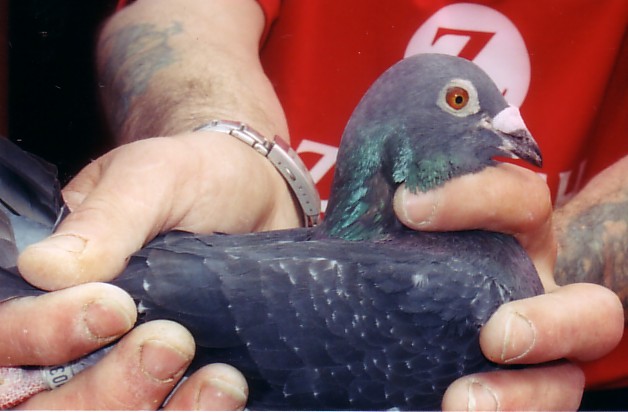
Black cock bred by Herman Brinkman.
We sent to Perpignan for the first time in 2004, entering three. We waited for days and then on the Friday one dropped, 8 hours out of race time. In 2005 we sent four to Biarritz, which is a semi-International and it was a very hard race. We had them all home.’
To summise, the Tills have not set the world on fire yet in International racing, but they are already onto the lower rungs of the ladder. Their method of preparing pigeons for these races has been a departure from their norm, for reasons Gary has outlined, but don’t forget the Tills are proven conditioners of racing pigeons from 100 to 650 miles, so now let’s take a look at their normal approach...
‘Our approach for the Internationals is not the same as our approach for National races from Nantes through to Pau, because in the Nationals you need birds on the day, or from Pau early on the second morning. Our widowhood cocks are rested in the 4 weeks before Pau. They have no basket work just 1 hour am and pm, which is then increased to an hour and a half twice a day in the last five days before basketing. They have to be fully fit – as fit as you can possibly get them. You could say that sending them fine-tuned to Pau means you are risking it if it is a very hard race but it’s the chance you have to take. If you look there only tends to be a really bad race once every ten years, so the likelihood of a smash is low, especially given an early morning lib. We’ve tried giving them the Nantes National before Pau but those pigeons have not come as well as those which missed Nantes. Now we prefer to give them a short Channel race four or five weeks before Pau.
We have won the Section twice in the National Flying Club from Nantes and our method is to stop the Nantes pigeons two weeks beforehand. On the following Tuesday, Wednesday and Thursday they have as much as they want. They are broken down on Friday and Saturday, built up on Sunday and Monday, then have three days on depurative, then on Monday, Tuesday and Wednesday they are built up. Breaking them down purifies the blood, otherwise the skin and the blood goes blue.
We loose them for half an hour, let them in to eat, then let them back out and they fly for an hour.
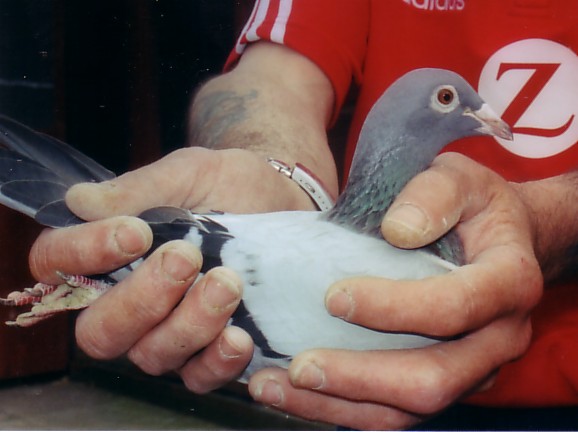
Blue hen. 8th Section, 99th Open NFC Dax International.
Starting one month before Pau we put them on barley for 10 days, then for 10 days they have as much widowhood mix and as much maize as they want – although we’ve not had a cock that’s gone mad on maize yet. The hens for the Internationals are fed differently to the cocks because they don’t do much flying. They are given a protein young bird mix.
When the cocks for Pau come back from their final prep race they have BS disinfectant in the drinker through to Sunday evening then they have clean water for a week. In the second week they have WN on Monday and Belgatae on the Tuesday and Wednesday. You can see a massive difference when using it. Then they have nothing till the last 10 days when the routine is: Monday – multivits; Tuesday - clean water; Wednesday - WN & Belgatea; Thursday - WN & Belgatea; Friday – clean water; Saturday – clean water; Sunday - WN; Monday - WN & Belgatea; Tuesday (marking day) - WN & Belgatea.
We think respiratory is the biggest issue, especially in hot weather and when your birds are forced to mix with others. The respiratory products we use come from Henk De Weerdt. We didn’t, however, use them at all in 2005. We also treat once a year, at the start of the season, for canker.
We don’t use natural products but medications are different. If you don’t use them you are taking a massive risk – well you are if you want to win Nationals. I think of the money we have to spend to keep our birds fit and well because others won’t spend it. They bring pigeons to the club and openly say they don’t treat for anything yet their pigeons might be sick and shouldn’t be in the basket. I haven’t got the guts to say to them “you can’t send it” because it is their hobby too – but I should do.
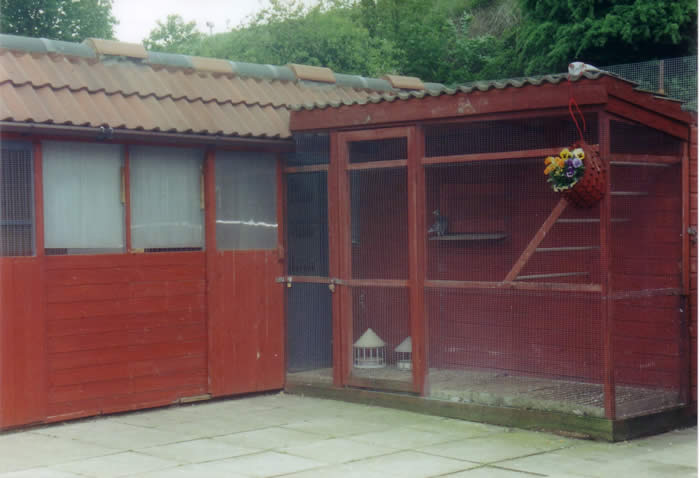
The stock pen.
The pigeons from our Pau Cock line become very light in your hand and that’s when we know they are in whack-on condition. The hens become heavier than the cocks. We’ve found that flying the distance takes nothing out of the pigeon if it is sent fit and when they arrive home they have often lost no weight at all. If one comes back after a bad mistake and it’s still down to its keel after three or four days you can’t breed off it because its constitution is not as good as the others.
We are looking forward to sending three year old widowhood cocks to Perpignan. They come from Pau batting round the sky after 650 mikes, so we are sure we can get them from an extra 80 miles. This year we are putting different pigeons in different sections to try and build specific teams for specific races and in time we will aim to have 50 or more widowhood cocks.
We don’t send 2 year old cocks to Pau because we don’t think they have the experience. We would have to give them a couple of Channel races but the thing about widowhood cocks is they will fly 15 hours to get home if they make a mistake and blow themselves out whereas a natural pigeon is more likely to look after itself. Instead they go to Saintes or Bergerac five weeks later, and Bergerac in particular is a good stepping stone because most turn up on the second morning – which is what you will later be wanting from them from Pau.
From springtime until well into the racing season, I don’t think there is much change in a pigeon until it has cast its first flight. Under our system our cocks cast in the first week of June and then change completely. They start to come into form.
The widowhood cocks are always paired for the first time on February 14th, then they rear until the hens and youngsters are taken away before the hens lay again. We don’t race any natural cocks. You must be joking. It’s too much work to train them every day.
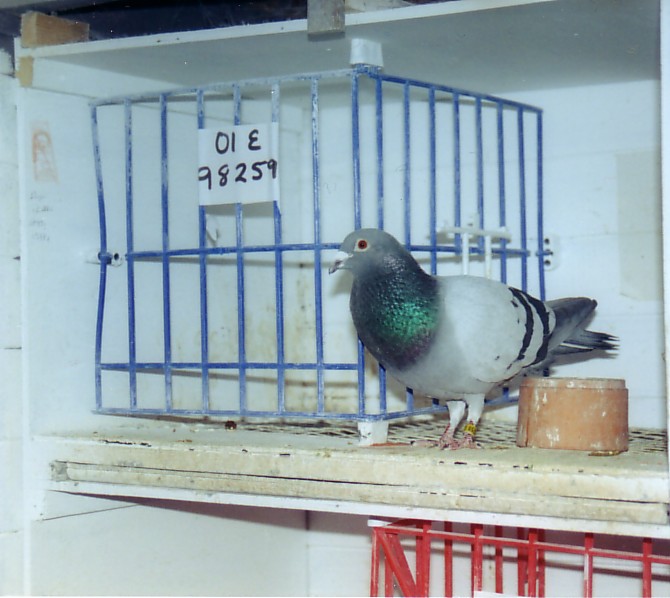
3rd Section I, 46th Open NFC Pau, 653 miles.
Our pigeons have set times. The older birds are out from 5am to 6am, the yearlings are out from 6 to 7, and then I have an hour off before the young birds are loosed. The old cocks, when in form, will drop on a house and if I were to let the yearlings exercise with them, they’d follow them and get into the bad habit of sitting on rooftops. The skies around Rugeley used to be full of widowhood cocks exercising – as many as 100 in the sky at a time – but not any more. Peregrines nest locally so now most fanciers prefer to road train rather than let their birds out around home. Not me though. It’s a hobby and part of the reason I keep pigeons is because I love to watch them fly. I figure there is more chance of them being taken by a hawk coming from Perpignan so they have to take their chance at home. Plus I can’t tell what’s flying well from training but I can by watching them around the home skies.’
Does Gary and Ray’s approach differ for sprint racing?
‘We’ve no motivation now for sprinting. To be fair we’ve done it all – won clubs, feds, the Banks’ Classic, but all that went out of the window when in 1986 we sent to the big National for the first time and topped the Section from Nantes in a north-east wind with a Mattheeuws. The bug bit. Next thing my Dad was on an organised coach trip to Belgium in search of better pigeons. He visited the, then, up-and-coming Marc Pollin, returning with 4 pairs. These filled our pen with winners. Amongst them were a son and daughter of The Veroote and we’ve been back again this year for more of this particular line.
At one point Dad was going over to Belgium every month and we tried a lot of pigeons but the Pollins were the only good ones. Then in 1988 Dad went to the Barcelona International supper and met Desbuqious Bros who invited him over to watch their pigeons return from Barcelona in 1989. In the event they timed 19 of their 22 entries on the winning day, which got Dad to thinking “I could do with some of these!” He picked a pair of eggs, which mum brought home in her make-up bag, and it was one of these eggs which turned out to be the dam of our 6th Open Pau cock.
In October 1989 I went and stayed with the brothers for a fortnight. I was to help them with the birds and in return they would educate me about racing pigeons. I remember having a debate with someone once, telling them an early lib from Pau did not suit us in the midlands and the north but Desbuqios told me to forget the wind and lib time. He said if the pigeon is good enough it will win regardless, so now I’ve no worries.’
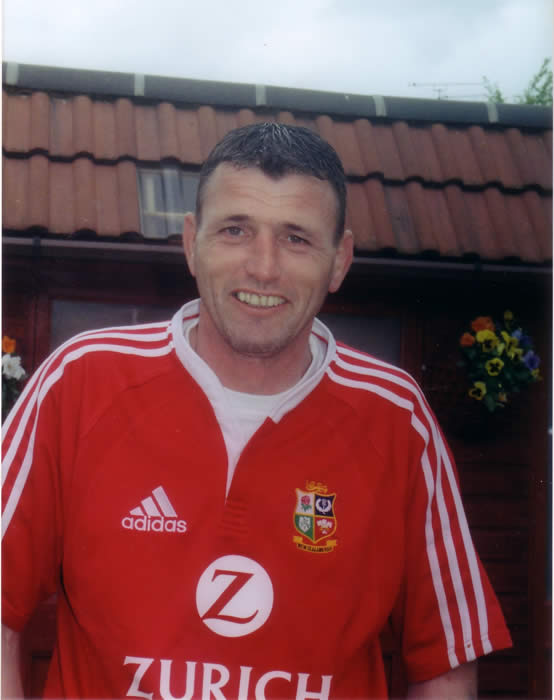
Gary.
How does Gary see himself as a pigeon fancier?
‘I’m a good judge of our own pigeons and I’d like to think I could pick out the best cocks in another fancier’s loft, but I’m not good with hens. I’ve made a point of race-marking pigeons over the last 25 years so that I can learn about type and condition. I used to make a practice of writing the numbers down of those I thought were in the best condition, and also those that were in poor condition, then I ‘d check the result to see how I’d fared. The good ones nearly always came but none of the poor ones ever did! Geoff Kirkland is the one fancier who stands out. I’ve never put a bad one of his through yet! They are widowhood cocks with their throats out but light as feathers – never any weight. It is like handling gold dust.
We are way behind the continentals because they liberate everything together which makes for better competition and consequently better birds. Here we have 15 feds all at the same racepoint and all liberating at different times. They should all go up together. And so should the major National clubs. To win we will all have to get better, and if someone doesn’t want to get better, well, they’ll have to get out of the sport.
Dad is a bird man. If he cannot see it I will and vice versa. We bounce off each other and we do have our ups and downs but he has the final say on things, being the senior partner. He has been to a lot of lofts - mostly in Belgium - lofts that have done it. He doesn’t like to go to a loft where the fancier speaks a load of rubbish. He would, for example, talk to Brian Leadbeater forever and a day but he wouldn’t seek out someone who was just talk.’
That provides a nice lead in to the senior partner, Ray Till, and I started by asking Ray to explain more about his meeting with the Desbuqois brothers which altered his whole take on pigeon racing...
‘I was fortunate that I met Fernand Desbuqois and he became my mentor. He said to me, “Look at those such as Catrrysse Brothers who have departed the world but have left a legacy. When you go, make sure you leave a family that will last the next 30 or 40 years.” That stuck with me and made me broaden my horizons. My ambitions tend to mirror Gary’s. We both believe the bigger the competition the better the pigeons. I want to win 1st International Barcelona – you’ve got to have something to look forward to. To be honest, I’d like to win any National but for it to happen everything has to go your way. First of all you’ve got to win your Section and, to me, a Section winner is as important as a National winner. You need those Section winners to breed you your other Section winners.
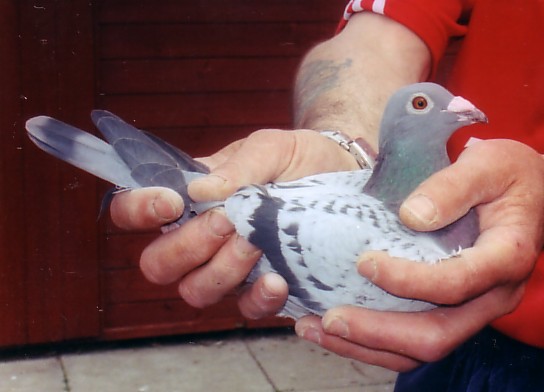
Cheq hen. 1st Section, 19th Open BICC Barcelona, 806 miles.
It’s fabulous to win your Section in any National because it means you’ve the best pigeon in your area. It’s not our fault if others don’t send. You can do no more than beat what you are up against. Fortunately, National racing is getting more popular around here, with perhaps 50% of Rugeley fliers now being members of the big National, a club which is improving quickly.
Pigeon racing is definitely a numbers game, especially at the distance. For us to compete in the NFC, the BICC, the MCC and the MNFC we would need 70 to 80 cocks – and to this end we will, all being well, have at least 50 next year. At the distance, you can send 10 pigeons and if you hit a bad race you can lose them all, so you’ve got to have more coming through. It’s OK sending just two or three but it lessens you chances considerably of beating the big boys. I think once we’ve got the basics of a 700-mile family it will be possible for us to send a proper team to places like Perpignan but it will be small steps all the way.
I can see a time when Pau is done and dusted as quickly as the International Barcelona race because long distance fanciers and pigeons are getting better and faster. The modern feeding system has made a big difference.’
Ray has been in and around pigeons for 60 years and has won at all distances and at all levels, so how does he evaluate the birds he has timed in the Internationals after several days?
‘I put tremendous value on those pigeons which we have had home from Barcelona, Perpignan and Biarritz because they have shown the courage to get up again and keep going. If they have flown 800 miles, it may be that they have had to get up and do 200 miles a day for four days. The pigeon that can do that is far superior in my opinion to one which comes on the second morning from 550 miles. It’s got to have guts, stamina and the homing ability to fly on its own. There are a good many racing pigeons that fly all day, but not so many of them that can get up and carry on another day. And we’ve all got a pen full that can fly 300 miles.
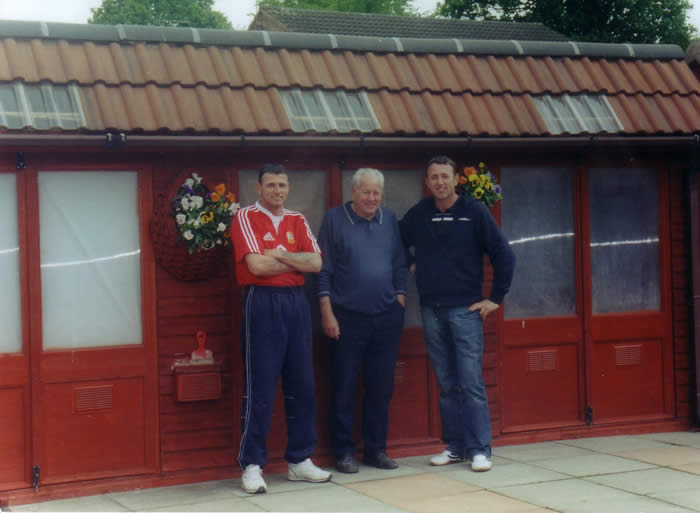
Gary, Ray & Peter.
A pigeon has either got it or it hasn’t. You can try things like giving them their hen the night before basketing but it’s the pigeon and the breeding behind it that matters. If it’s not in their pedigree to do it, they won’t do it. The trouble with motivating is the days in the basket. If the pigeon is too excited it won’t eat, and if it doesn’t eat it won’t come. Then you might also get a 3-to-5 day holdover. A pigeon has got to have the constitution to be able to hold its corner. But those that fight are no good. They need basket craft. You can put them in baskets for two or three days as youngsters with the troughs on – we all do that – but it goes a bit deeper than that. If you send long distance pigeons to short sprint races the sprinters can knock the hell out of them but you’ve got to work them somehow. You are probably better off taking them yourself. We like midweek racing as they are only gone a few hours. An excitable pigeon might be OK for a one-day race but not for two days or more.’
Ray was as animated as Gary when the subject turned to the failure of their new introductions to cut the mustard. What had he learnt from the failed venture?
‘Now, if I’m going to spend money on a pigeon, it’s got to be off a National winner or a brother or sister to one. The pedigree is the most important thing. On top of that they have to have the conformation too. I like medium-sized pigeons with the wings of swallows but not over developed muscles. The wing tips should come no further than the black bar on the tail. I don’t like to see the wings cross at the back either. I like a snipe nose, the eye forward and high in the head. I won’t keep grunters.’
By Gary’s own admission he is not a hen man, so the hens which they have had home from the Internationals have been under the control of Ray...
The first time we used our hens’ method was at Perpignan. Pigeons don’t need much to get them fit and it is bred in them to be able to home so there’s no need to give them lots of work. They get the experience of what it’s all about as youngsters, and once they’ve got the basics it comes down to whether they are good enough and have the necessary guts. These hens for the BICC are fed high protein corn and only have maize in the three days before basketing. This is because the International birds are fed 100% and I don’t want our hens to miss a meal while they adjust. I’ve tried different methods but one thing I’ll never do, although I know others swear by it, is send hens on youngtsters. Every time I’ve tried it I’ve either lost them or they’ve come late. I much prefer sitting 8 to 10 days.
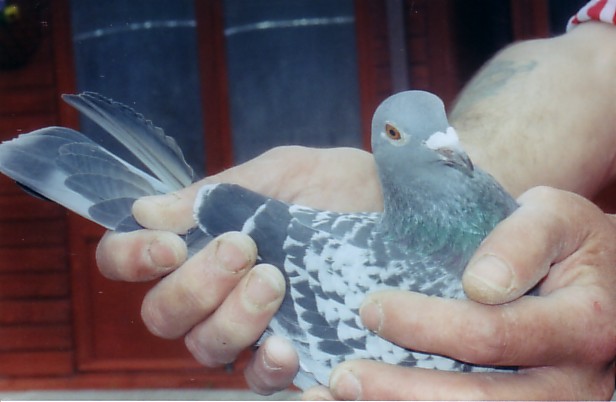
Cheq hen. 1st Section, 32nd Open BICC Perpignan, 730 miles.
Unlike Gary I’m not a great believer in treating but it’s the other fanciers who don’t keep their birds healthy who cause the problems. I think respiratory is the biggest problem. If you get it in your loft you will be struggling from the word go. I recommend anyone to use a vet – or rather use two vets to get a second opinion – and I speak from experience! It’s a fact of life that your pigeons can be 100% but give them contact with diseased pigeons and you will lose all form within a day. But the bottom line is you’ve got to have good pigeons and there’s nothing you can do to win if you don’t have them.’
I’m going to leave the last word to Gary. Hand on heart, how does he evaluate the various International racepoints and their chances of success up into Rugeley?
We think our best chance of winning the BICC will be from either Perpignan or Biarritz because of the lateness of the lib and the fact that we could reasonably expect to clock on the second and winning day. Marseilles is off our line and the pigeons are likely to go down into Germany. We were talking to a top fancier about it and he said that from Marseilles his pigeons came out of Belgium. Well, that’s way off line for us. It’s not that it’s too hard a race, only that it’s too hard a race for us to be able to win.
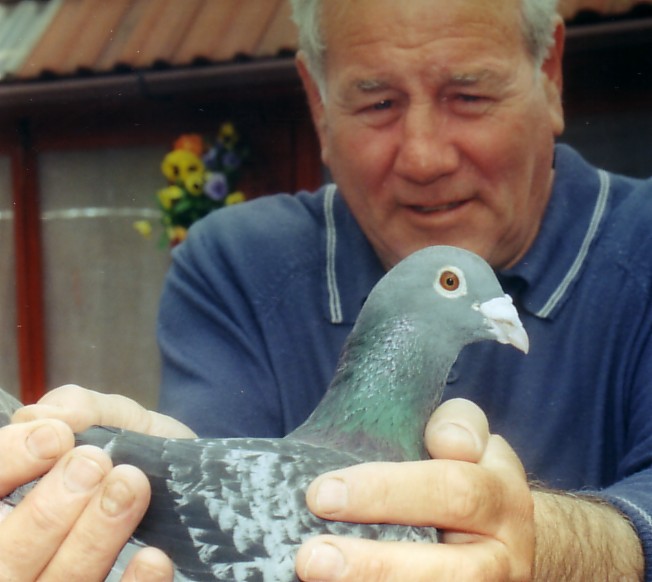
Ray.
They have now raised the birdage limit for the Pau International so the drag into Belgium will be greater than ever, which will make it even more difficult for the UK but Dave Posey, Kevin Hitchcock and others have shown what can be achieved.
My main ambition is to win the Grand National, then it’s to win the Langstone Gold Cup and then it’s to win one of the long BICC races. I remember up at the National Flying Club’s dinner in Blackpool when Paul Kendall punched the air as he was handed the Langstone Gold Cup. To think a trophy only five inches high can get you to do that!