DAVE GODDARD
OF READING
BY CAMERON STANSFIELD
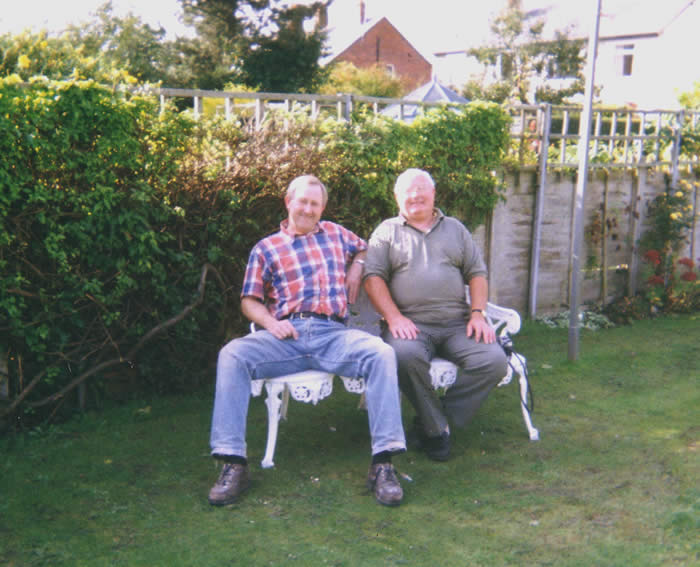
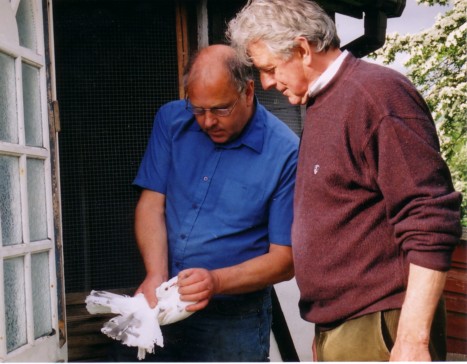
Dave with his great friend Geoff Hunt of Westmarsh.
Some would say Dave Goddard is a 24-carat oddball – in pigeon terms – and I’d be one of them. But then so many of the long distance top dogs belong in this box. You don’t have to delve too deeply to work out why: to fly pigeons one step removed from the straightforward weekly programme of club and fed racing while remaining focused on the ‘big one’ takes self-discipline, a thick skin and a singular mind. After all, we’ve all heard the comment from club fliers when talking of National performers, ‘Yes, but he wins nowt in the club.’ This puts me in mind of something one of the country’s best extreme distance fanciers, who lives in one of the NFC’s more northerly outposts, once said to me: ‘It’s amazing you know, my clubmates think I’m hopeless, but people ring me up from all over the world to buy pigeons off me and they think I’m a god!’
Dave Goddard has a love affair with one race above all others – Palamos with the British Barcelona Club, all of 688 miles. Those seven letters – PALAMOS – have stars around them in his eyes and he is in awe of the place, as will become apparent when you read through this piece.
It was a great pleasure for me to pen this piece because I believe Dave is an artist with pigeons. Put it like this: Nature has blessed us with a bird – the pigeon - that can find its way home over great distances. Man has developed this bird into a racer, but Nature has kept a hold and said, ‘Hang fire, you won’t get them all to race… in fact the further out in distance you go, the fewer will do it.’ Man has responded and gradually we have increased the number of birds capable of racing 600-800 miles. But Nature has said ‘OK, if you think you’re so clever, take this on…’ So in our way she has put the mountains of the eastern fringe of the Pyrenees, the high terrain and craggy gorges of the aptly-named Massif Central, the intense heat throughout the whole course, and as a final obstacle she has given us the English Channel, which might be a doddle for fresh pigeons flying in a batch but is altogether more intimidating for a tired pigeon, on its own having flown the best part of the previous day and 500 miles.
Into this arena steps Dave. He has spent a pigeon lifetime working with the tools that Nature has given him to try and overcome the obstacles that Nature has, at the same time, put in his way. He knows that Palamos is the hardest race flown into the UK and he is frightened of it but he wants to push back the boundaries – and that is the essence of long distance pigeon racing. And he has also learnt another thing, which is that the conventional approach to pigeon racing is not the answer.
He first attempted Palamos in 1972, the year Cyril Medway’s pencil cock Palamos Pathfinder won what was a disaster, by two clear days, and he remembers it well…
‘It was a disaster for me too - I sent two pigeons and never saw either of them again. It was the thought of it being farther than Pau which attracted me, and I prepared the two birds the same way which had brought me success from Pau, particularly if it was an “easy one”. This meant I gave them a lot of stick and wound them up. I later came to understand that this is not the way to fly Palamos but it took a long time for the penny to drop.
The racepoint was just too hot for me to handle and I was a bit afraid of it so it wasn’t until 1975 that I had another go. That winter I went to see a Wokingham fancier who was packing up called Dr Meyrick. I went through his loft in the dark and came out with a pigeon that felt right in the hand. He told me she had been 60th Open Palamos that season and that she was of the Latimer Queen lines of Dr Anderson. Anyway, I bought her, broke her and sent her to Palamos and she won me 15th Open. She then went on to be verified in the 1976 Palamos race – a year when I also won 4th BICC Pau. Subsequently she developed a growth in her back end and died without leaving her mark.
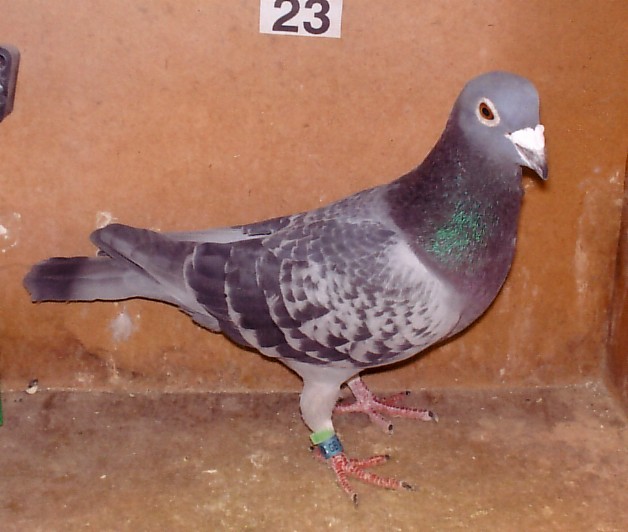
Toe Nails. 1st Section, 3rd Open Palamos.
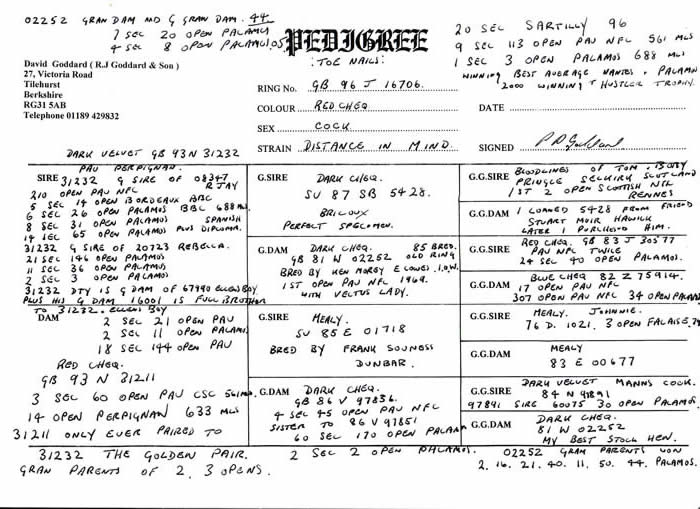
The pedigree of Toe Nails, 1st Section, 3rd Open Palamos.
My next major success from Palamos was the result of a similar story. A fancier by the name of Mike Smith was packing up so I bought three pigeons from him. Two made no impression but the other was to earn me a Spanish Diploma, winning 63rd Open in 1980, 46th Open in 1981 and 34th Open in 1982, when Perpignan was flown instead of Palamos. The year she was 46th open I sent her to Seaton, 102 miles, for her final prep and she came at 5pm. I remember it distinctly because the chap next door was mending his fence and when I told him her next race was going to be Palamos, he just laughed and said she’d be even further behind! Like the Dr Meyrick hen, she too failed to leave her mark and I have no trace of her blood today. Mike Smith, by the way, is now my corn man.
Other than these pigeons, nothing else was coming forward – I had no family, just odds and sods – but my ambition to be successful from Palamos was growing. It baffled me that I couldn’t get a family together. The one thing I am sure of though, is that I’ve always had quality pigeons, so looking back I can only say I wasn’t good enough to do them justice. Then one day my great friend Geoff Hunt said something to me that stuck: “Slow down Dave, take your time, get a team around you.” And that is exactly what I’ve done. Geoff said something else which stuck with me, too: “If they ain’t right, don’t send them.”
The next time I went to Palamos with “a proper job” was in 1989, this being a pencil blue cock that I bred out of the first hen I ever had from Mort Manns of Stroud. This cock had been in two Pau National results and had also won 2nd Combine Nantes and 35th Combine Niort so when he was five years old I earmarked him for Palamos. I think this was the first time I was switched on to the task of preparing a pigeon for Palamos. In my earlier days I’d had Lady Luck on my side but by now I had become a “pigeon man” – in a nutshell that was the difference. It was another hard Palamos and only 12 birds made it home on the winning (second) day. I clocked the pencil cock at 6pm to finish 8th Open. What a feeling!
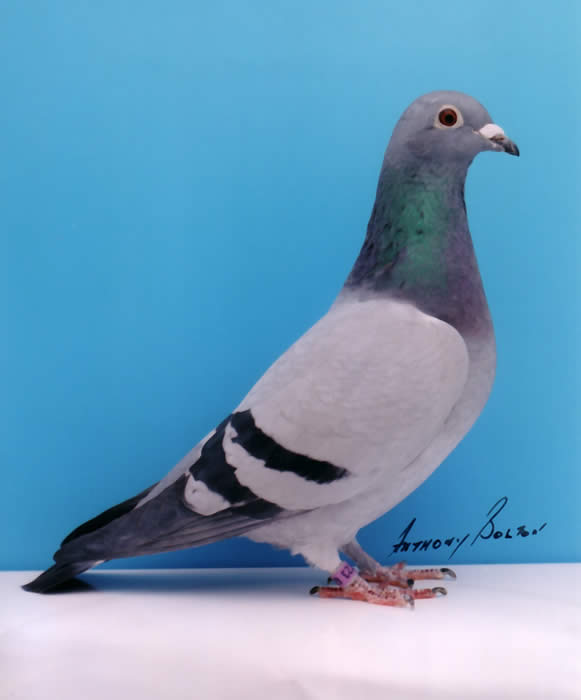
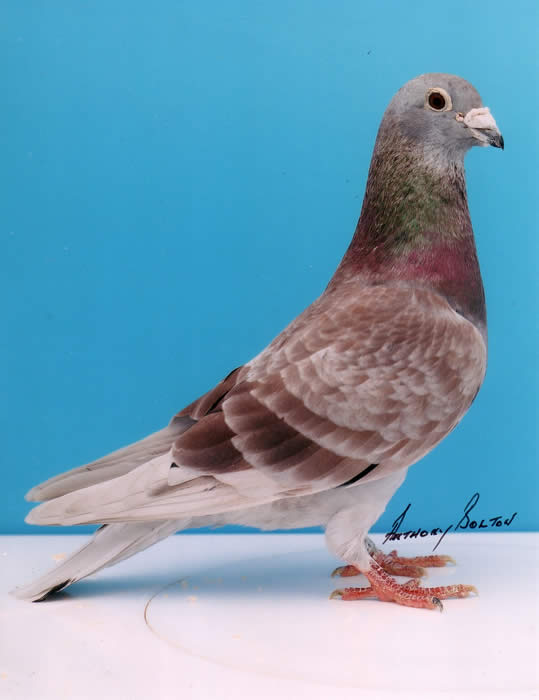
Rebecca. 2nd Section, 3rd Open Palamos.
When you clock a pigeon from Palamos it’s a feeling that stays with you for the rest of your life. It brings tears to my eyes and does something to me that is amazing. I stand in the loft looking at them and it’s unbelievable. And I feel just the same when I’m verifying a bird that may have taken over a week to get home. In fact in that race in 1989, my second pigeon did take over a week, being verified at 160th Open, but the following year it went and won 2nd Open. It has become something of a pattern for me to verify a pigeon that later goes on to greater things, which is why I’m so excited when they come home, no matter how late.
The pencil cock, by the way, never went back to Palamos and his blood is in a few of my family to this day. His dam was bred by Mort Manns and I went back to Mort’s and bought five more off him, one being a cock bred the same way, and he was to be the sire of my 2nd Open hen of 1990 (a year I was also 82nd Open Palamos). That year we had a very bad Pau race – I clocked on the Wednesday and there were only three in the clock station even then! My timer was a cheq w/f hen that had been 2nd Bergerac as a yearling. Anyway, in 1991 I set her up for Palamos. This time it was a 7.15am lib and I clocked her at 9.15 next morning – and the thrill was just as great as ever. Later that day, at 3pm, I clocked a red hen to be 50th Open, this one being a full sister to 02252, the dam of my 2nd Open hen. My third entry was verified 148th Open. 02252 was bred by Ken Morey and is the pigeon which has had the greatest influence on my loft as she is in everything I have today. She was out of Ken’s 17th Open Pau and 40th Open Palamos cock, which was basically of Kirkpatrick/Dream Girl lines.
Over the next few seasons I took positions such as 162nd Open Palamos, 25th Open Perpignan, 174th Open NFC Pau, then in 1996 I was 60th Pau Classic and 19th Open Perpignan. The latter was the dam of my next good Palamos pigeon, Toe Nails. In 1999 Toe Nails had shown me his potential by winning 103rd Open NFC Pau so I prepared him for Palamos. It turned out a very hard race (again!) but he rewarded me with 1st Section, 3rd Open. After that I retired him. Unusually for me his preparation for Palmos was two Nantes races, which is far more than I normally give them.
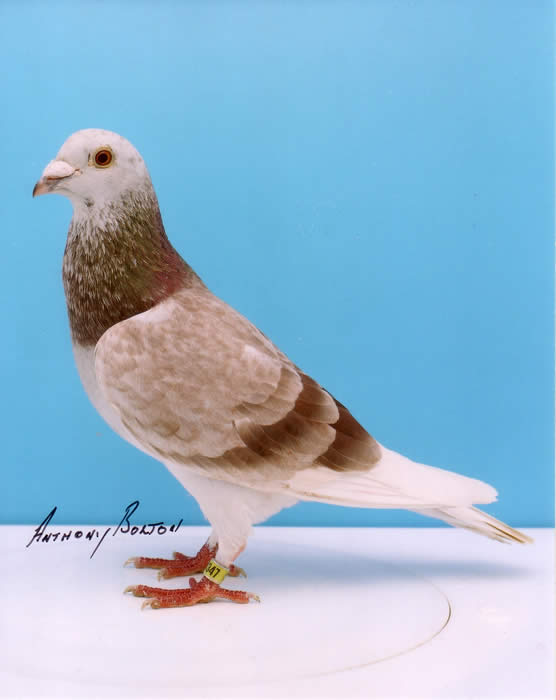
R. J., winner of 26th, 31st & 65th Open Palamos; 14th Open BBC Bordeaux; 210th Open NFC Pau.
In 2001 I sent two to Palamos – R. J. and Birthday Greetings, both cocks. The race turned out a touch easier than the previous year and I clocked them both within an hour of one another on the winning day to be 31st and 34th Open. R. J. had shown his potential when winning 210th Open NFC Pau in 1999 and 14th Open BBC Bordeaux in 2000. These two cocks had one prep race, this being from Rennes. The following year, 2002, I gave them the same preparation but this time I was disappointed. R. J. took 65th Open but came on the 4th day - I’d expected better. And I lost Birthday Greetings. He’d gone wrong that winter and though I thought he’d got over it, perhaps he hadn’t and that was why he failed to return. I think a pigeon has to right in every respect for Palamos or it’s had it.
The highlight of that year was just around the corner though when Ellen’s Boy won 2nd Section, 21st Open NFC Pau. This meant that I could go through the winter of 2002/2003 with plenty to be hopeful about. Come Palamos, I sent three. Ellen’s Boy was clocked at 2.15 on the Sunday to take 2nd Section, 11th Open, R. J. made amends for the previous year with 7th Section, 26th Open, and, as is the pattern, my blue hen was verified.
This now brings us to 2004, when I entered my biggest ever team – five! I clocked a dark hen, ‘44’, for 4th Section, 20th Open, followed by the verified blue hen of the previous year to be 36th Open…and you’ve guessed it, I verified a dark velvet cock. This was a real hard race and I clocked ‘44’ at 5.35am on the third morning – which got the secretary, Jim Hooper, out of bed! I’d thought she’d be a good pigeon from day one – she was born to be a star.
That winter the dark velvet cock that I’d verified in 2004 went wrong after being injected for paramyxo. I got him over it but then he was hawked on a toss from the coast. I thought he’d got over that too but I sent him to Palamos and he didn’t come. However, the blue hen came to take 2nd Section, 3rd Open, winning me the Patron’s Trophy for the third time. This is awarded to the first fancier who times his first nominated bird and no other fancier has won it more than once, so to have won it three times is something of which I’m very proud. She was clocked at 5.45am on Sunday which meant getting Jim Hooper out of bed again – I’m sure that’s why he doesn’t like me! This was again a very hard race. The birds were liberated on the Friday and when I went to bed on Saturday night I knew only two birds had been recorded into the UK. I went down to the loft on Sunday morning and, as I looked up, there was the blue hen. She just took my breath away. At 1pm I clocked ‘44’, badly injured, and, to give you some idea of how hard the race was, she finished 8th Open. I once again verified another entry, a blue hen ‘01880’ of Geoff Hunt lines but my other two, sadly, did not return. ‘01880’ is from the nest brother of 2nd & 7th Barcelona and the Burgos Hen from Dray when paired to a sister to Capacity.
Later in 2005, ‘44’s’ half-sister won 3rd Open Perpignan with the BICC, and this hen will hopefully be going to the Barcelona International in 2006. For Palamos I might send my biggest ever team but my 3rd Open hen won’t be amongst them and that’s because if I was to win the race with another entry but lose her in the process, it would take a lot of the gloss off it.’
There we are then. That was a run through the history of the Goddard loft vis a vis Palamos – which clearly shows how Dave’s fortunes are on the up. Now for Dave’s thoughts and methods – to see how he has evolved as a pigeon fancier over all these years. As a boy, he visited the legendary Ron Michieson of Winchester and though the story now makes him cringe, he tells it anyway. ‘You can tell how dopey I was. I said, “Mr Michieson, will I make a pigeon man?” He replied: “Yes son,” but who knows, he might just have been being kind!
MISTAKES
Nearly all my pigeons make bad mistakes – and I love them to. Rebecca was lost for a year, ‘44’ was lost for 6 months from a short toss from Eastleigh, and the 5th Open hen was lost for so long that when she came home, I didn’t even recognise her. I could go on and on. They all learnt something that I couldn’t teach them. My methods contribute to their making mistakes. I’m unpredictable and sometimes I ask them too big a question. In the winter, for example, I might jump in the car and drive to Bristiol to give my late-breds a toss. Throughout their careers I overstep them but I’m sure of this, if I nursed them I’d find no more champs than I already do. My basic approach is: I lose them, they come back (at some point) and then I work on them.
TYPICAL PREPARATION
Pigeons that have been to Palamos before are brought out at the end of May, which if Palamos is to be flown at the end of June, is approximately one month beforehand. Prior to that they have reared a round of youngsters but have done nothing at all in the way of exercise. I should explain my pigeons do not go out in the winter except for the odd weekend. When the clocks go forward in March, they go out briefly twice a day, but they hardly fly at all. In fact, I’ve never had a pigeon fly vigorously yet! In the month before Palamos I let them out at 5.20am, taking the hens off the nest each time, and locking them out along with the cocks. They barely fly. They might do 10 minutes but they are more inclined to try and get back over my head and into the loft. If they were to do 20 minutes I’d be over the moon but, to be honest, all I’m really trying to do is to get them to move their wings, no matter how briefly. They are locked in then until around 6pm, when I again take everything off the nest and lock them out, but again, they barely exercise.
A month before Palamos, I give them a few tosses, these typically being 6 x 14 miles (which is where I happen to work), 2 x Hayling Island at 45 miles and 2 x Christchurch, 60 miles, then perhaps they will have a couple more 14-milers, the last one being in the week before the following Monday’s basketing for Palamos. These are the only times they are in the basket as they do not have any races.
KEEP THEM FRESH
Over the years I’ve gradually been reducing the number of times they go in a basket and have now got it down to around twelve times. And if I’m honest, I only give them these tosses to make me feel better, as it probably doesn’t make a scrap of difference to the pigeon. I’m actually getting to think that when they are right, they don’t need to go out of the loft at all. The year the pigeon is going to do some damage, you don’t need to get the whole paint tin out, it just needs touching up.
Pigeons that have not been to Palamos before have the same preparation except they will be given a short Channel race and a couple of extra tosses from work. It probably doesn’t make any difference because the pigeons you will get from Palamos are outstanding pigeons anyway. I have come to the conclusion that when your pigeons are bred right, and your feeding is right, you can keep exercise to the minimum. I don’t think putting on muscle is a consideration. You could probably keep exercise to a minimum even if you were giving incorrect food - and this is the crunch - it all depends on how good the pigeon is.
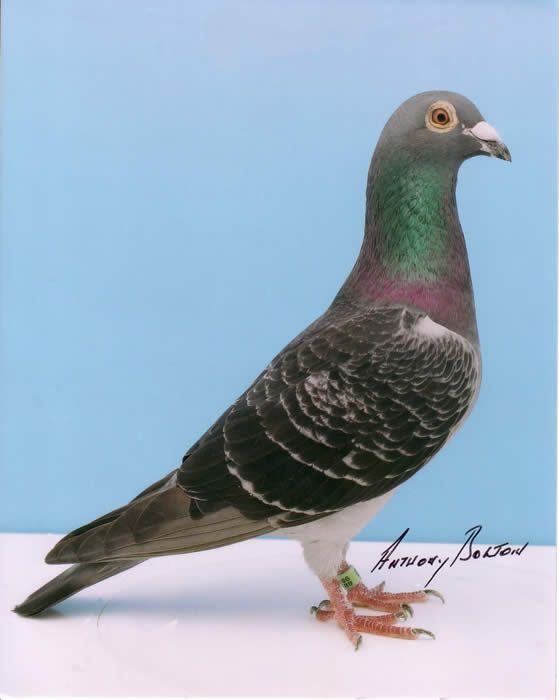
Ellen’s Boy. 14th Section, 144th Open NFC Pau; 2nd Section, 21st Open NFC Pau; 2nd Section, 11th Open Palamos.
HARDER WORK
If I gave my pigeons a different preparation, say five races before Palamos, I wouldn’t time in! I know I’m right about this – at least as far as my own birds are concerned because I know I’ve got to be careful not to overdo it. My 3rd Open was having only her 12th time in a basket that season, and the 8th Open hen was on her 13th time in a basket. Pau with the National is a different ball game altogether. If I were concentrating on that I would have to change my system. Widowhood would be the way and, although I absolutely hate to say it, I think I would need different pigeons – foreign blood instead. I have tried widowhood but I couldn’t cope with it because it frustrated me. Probably I’m not a good enough fancier to use it. The only Continental blood I have is some Julian Matthys and a little bit of Roger Vereecke’s Young Felix lines, both of which came from Geoff Hunt. Geoff’s a great friend of Roger Vereecke and I was lucky to borrow a daughter of Young Felix.
LOFT
I honestly think the most important factor is the loft. Mine is fantastic now that I’ve got it how I want it. It’s so bad it’s good! I’ve been to see some fanciers and they’ve had beautiful lofts but I’ve hated the places. I visited Tom Clarke years ago and his loft had little nooks and crannies and was ‘comfy’. Mine’s like that. I have 16 boxes in the main loft, and 12 at one end which I never use. I seldom fill the 16 boxes because the minute I go above 8 or 10 I lose condition because of the lack of air. Here’s an important point: in the two weeks before Palamos, I remove every bird that isn’t going to the race. Nothing is allowed to disturb the Palamos pigeons. I chuck them in a middle section, even those intended for Pau, which I realise is not an ideal situation for them, but then again, from Pau, I’m just looking for them to come home.
The pigeons can’t see out of the loft at all. The front has no air coming in and it has a verandah that has polycarbonate at the front. The only air comes in through two 18 x 18 inch vents in the gables at either end and there is a small vent at one end below the floor grill. I let them out through the verandah and I don’t go to bed without closing this door because I like to think of them being comfortable.
All bar one section has a metal grilled floor four feet off the ground with a concrete base underneath. The sections are 8ft deep plus the depth of the nest boxes. I put the grills in about fifteen years ago and it made an amazing difference. Any fouled corn is immediately out of the way and obviously it’s easier to clean and there’s less dust. When I first put the grills in I thought they made the loft less homely and it drove me mad but now I would never go back to a solid floor. There are no perches in the Palamos section so my pigeons spend 90% of their time in their nestboxes. When off the nest they can stand on a wooden block to the side of the nest bowl. The concrete base is regularly sprayed with Jeyes’ Fluid now that we can’t get creosote.
NUMBERS
I have 38 pigeons. Nine are stock birds, four of which are retired Palamos birds. Ten are three years old or older which are for 700-mile races this season. Five are two year olds that are for the Pau National and the rest are ten trained yearlings and four late-breds.
PERCENTAGES
I regularly ring 40 youngsters for my own use. Mine are bad for getting lost off the loft and always have been. It wouldn’t be uncommon for me to lose as many as fifteen off the top. I’ve puzzled over it and it could be because they can’t see out of the loft. I’ve gone to the extent of housing them further down the garden, waiting for their eye colour to change and giving them access to an aviary, but I found that with an aviary they then tended not to want to exercise at all. Because I always want them to live in the loft to which they will later have to race to, I abandoned the idea and now put up with the losses.
I don’t race youngsters but with what I lose training and what not I will normally winter around 12-15 of the 40 I started with. I don’t keep wild youngsters, nor those which stick their tail up nor any which I don’t like for whatever reason because I believe if I don’t like it as a youngster I will never like it.
As yearlings these 12-15 will have one or two short Channel races with the Solent Fed I will lose, on average, half of them. Though it sounds daft, it’s a hard Fed to fly with and consequently, because of their lack of experience, most of my pigeons make a cock up of these Channel races. This leaves me with around 8 that will then go to Pau as two-year-olds. Mine are wearing L-plates up to this point. Depending how things have gone, this may be only the fourth or fifth race of their life. I’d expect to get, say, 5 of them home. They may go to Pau again at three, or I may leave them alone entirely as three years old, and those that are left are my Palamos team as four year olds. After a pigeon has walked home from Pau, that’s when I’ve got something to work on!
PALAMOS TIME
The first time I work on a pigeon is when it is four. When it then comes off you look at the bird’s pedigree and you think that it couldn’t ever have failed! In the last two years I have sent 5 pigeons to Palamos on each occasion, but I’ve been sort of embarrassed doing it because, believe you me, 5 is more than enough as it takes me all of my time to work on them. Preparing pigeons is a mental thing with me and I get agitated if things get out of my control.
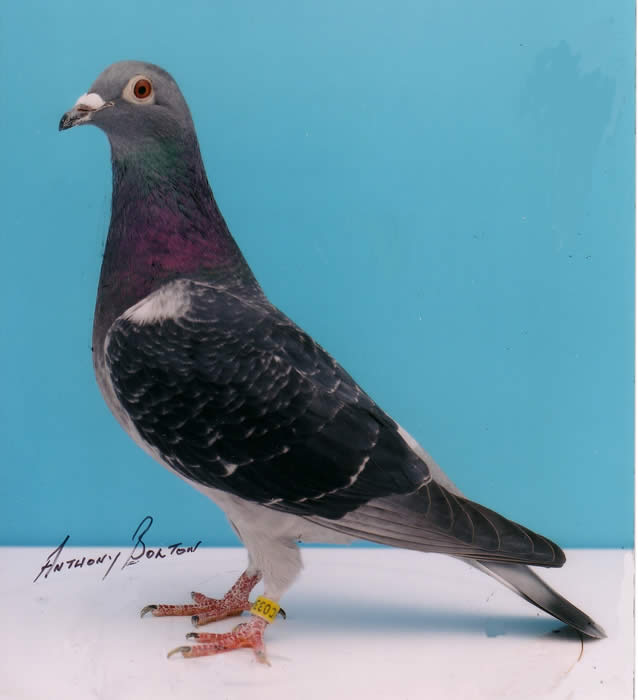
‘44’. 20th & 8th Open Palamos.
FINE TUNING
I couldn’t prepare five individual pigeons for five different races over a six-week period that’s why I admire the Nicholsons. I haven’t a lot of time for people who send a lot. I admire those who keep a few and are consistent. I wouldn’t be able to cope with greater numbers simply because my mind couldn’t handle it. Perhaps I think about it a lot more closely than most other fanciers. I’m a bit of a control freak. I am meticulous. Everything has to be spot-on.
THE LITTLE THINGS
Sometimes you need only a minor adjustment to get them home, not wholesale changes. Sometimes it’s the loft that’s wrong. I’m a bit crazy about pigeon lofts. A lot of the time when fanciers are doing no good, it’s because they are overdoing things. They should slow down and let things happen.
ALL SYSTEMS GO
The minute the mornings open out, I change. The alarm goes off at 5.20 and I’m down the garden before the sun comes up. I believe my success at Palamos owes a lot to me getting my birds out of bed early. I don’t think it is a coincidence that in the last two years I have clocked Palamos birds at 5.35am and 5.45am. As I said earlier, they are all chucked out, but I don’t believe they have to fly around the loft – I just want them to move their wings. They do perhaps 10 minutes flying and this, if I’m being frank, is why I moved onto Gerry Plus. I got it into my head that they needed to exercise more and I was talking to Brian Sheppard about it. He said: ‘Give them some Gerry Plus’. I did but it made absolutely no difference to their wanting to fly. Then Cyril Medway said to me, ‘The way yours are flying Palamos, I wouldn’t worry about it.’ – so I don’t. The only time they get left alone is in the week before basketing when they are sitting a 4-5 day old baby, my favourite nesting condition.
JOB DONE
On the last day of preparation I’m frightened to let them out of the loft. It’s a relief when I hand the basket over at Salisbury (where they race mark the Palamos pigeons). Each time I do, I kiss the basket and say, ‘See you Saturday’. I’m confident I will but because of what Palamos is, really we are all hoping above anything else. You can’t say for sure you will get one and if you think you’ve cracked it you are in for a shock – it will thump you. It is the graveyard of champions. You can get them spot-on and still lose them.
As I’ve said, when they come home words can’t express how I feel. I’ve wondered if it’s because I only wait for this one race, but no, I don’t think it would be any different if I competed in lots of races. Getting one from Palamos will always take the breath away.
When you ring up to verify it’s magic to hear Jim Hooper’s voice. He lives it and suffers it and when you phone in he makes you feel like a king because he is fully aware of what you have achieved.
CONDITION
When you get a big performance from a pigeon – say in the first 10 of the Open – it never looks any different to when you sent it and the following day it will come out of the loft and take a fly. Its bodyweight is pretty much the same as when you sent it, too. When it drops from Palamos, it looks at you as if to say, ‘what’s all the fuss about? Why are you running around like that? Why are you so wound up?’ That’s because if you send them right, you don’t hurt them. Sometimes when they come home they are in a supreme level of condition that they can hold for another 2 or 3 weeks. I think I could perhaps pinch another performance from them but I’ve always been frightened to risk it.
OBSERVATION
Each year is different. Some years you go down the garden and you know that a pigeon is going to be able to achieve a level of condition it hasn’t been able to achieve before. Some years, before you even touch one, you know it will be your Palamos pigeon - even though it has shown no previous form and will also be up against some pigeons of mine that have already proven themselves.
EITHER IN THE AIR OR IN THE LOFT
Mine never, ever go on the garden (partly because of the cat situation) - in fact they are very rarely out of the loft. All the nesting materials is provided inside the loft. I don’t miss not seeing them walking about. On the contrary, I can sit in the loft all evening with them, just watching them. I love to do that.
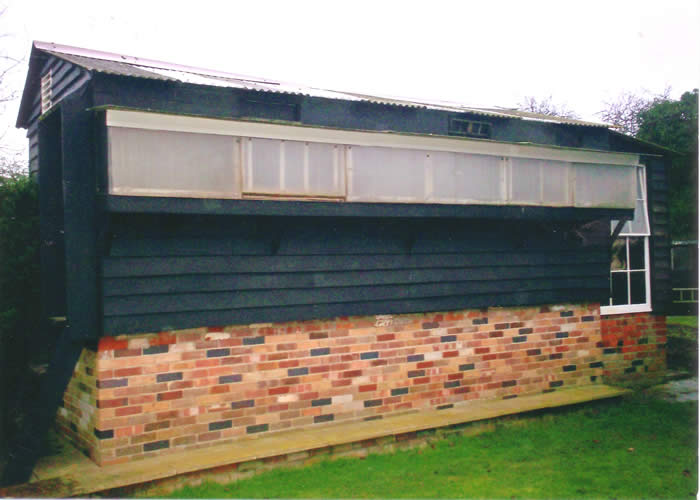
Dave’s loft. The floor of the loft is made up of grills and the droppings pass below to a chamber the depth of the brickwork shown.
FOOD
Years ago I fed a lot of beans, then through the 1990s I raced on a widowhood-type mix as by then I’d been swayed off beans – probably because I wasn’t flying well enough. I seldom failed to get pigeons home but they would invariably be low down on the result. In 2000 I began feeding Gerry Plus in the morning and widowhood mix in the evening. I didn’t go completely over to Gerry Plus because, if I’m honest, I was concerned by how ‘light’ it looked. For the last two seasons, however, I have been giving each bird an egg-cup full of Gerry Plus in the morning and an egg-cup full in the evening, which works out to be one ounce in total. They are fed like this from when their youngsters have been weaned through to 4 weeks before Palamos, and then I go to the local health shop and buy some brown rice and some peanuts. The rice is added to the Gerry Plus to make up about 10 per cent of the mix and the peanuts are fed in the evening only - after they have eaten the Gerry Plus and rice. I start them off with just an odd peanut, gradually increasing the amount. Ten days before Palamos they’ll have around 10 peanuts each and in the last couple of days I fill their gallipots with them. Partly this helps create a bond as I feed them in their boxes. Each box has a little block of wood in it so I put the peanuts on this and nudge it towards the sitting bird so that it pick them up without coming off the nest. On return they get a light feed and perhaps some Red Band, but nothing else as recovery is a natural thing. They have nothing else except Red Cell every Wednesday throughout the year (which I have been giving for many years) and pigeon tea, perhaps once a month but never more regularly.
After Christmas they are fed 100% Beyers’ barley until I pair up, then they go onto Gerry Plus and peas. The youngsters are fed Gerry Plus as soon as they are weaned - as much as they want. From the end of racing, the old birds are fed Gerry Plus, supplemented with Red Band when they are heavy in the moult. I might also buy a bag of Hormoform.
In my early days of hopper feeding beans I was a bit rough and ready in my approach but I am a much better fancier now. Fed on Gerry Plus, they are definitely better. I wouldn’t say their weight is any different only that they carried more muscle when bean fed because I had to work them harder – for less joy. I think I would find it hard to better my current method and I would truly love to have some of the pigeons I had back then and race them under my methods of today. I would guess that 90% of distance fanciers I know have now moved over to a Gerry Plus-type feed.
WEIGHT
My pigeons generally handle the same weight all year round. In fact if at any time of the year you said to me, ‘these pigeons have got to fly Palamos next week’, I think they would be right for it.
The thing with using Gerry Plus as your staple diet, is that when you want to, you can click your fingers and blow them up to whatever you want them to be like. Some blow up more than others, it depends how they are built. The 3rd Open hen, for example, blows up beautifully. But the most important thing is, when I take a hen off the nest for a fly, she claps her wings with a thump when I let her go. To me if she’s doing that she’s telling me she’s ‘on’. The thing I dread seeing is ‘butterfly wings’, in other words there’s no snap – I wouldn’t even send them.
ROUTINE
If I didn’t have my current work pattern, I wouldn’t time in. If it was Saturday every day I would do things with the pigeons they wouldn’t want me to do. I don’t think they want me around them.
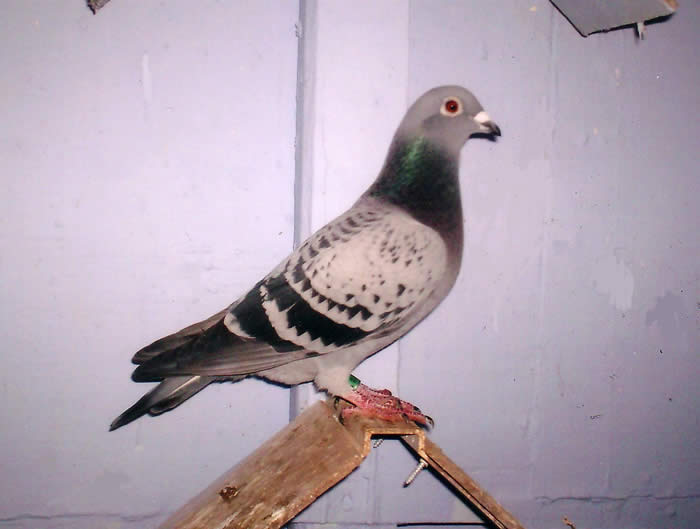
Team Spirit. 4th Open BICC Perpignan. A g.dtr of Toe Nails.
LOFT LOCATION
I’ve always said, if we were better fliers around here, we’d have won the Pau National by now because this is a good spot. As for Palamos, and this might wind a few up, the best place to live is east of me but not too far east!
TREATMENT
They are injected for Paramyxo every January, then immediately afterwards go onto Sulphatrim (a treatment against cocci, enteritis and general bacterial problems), and then they are on multivits before being wormed. The next time they are treated, assuming nothing goes wrong, is when they land from a fly four weeks before Palamos, when they have another 5-day treatment of Sulphatrim or, depending on what my hunch tells me, it could be Ronidazol for canker. I also used pigeon-approved smoke bombs for the first time last year, one month beforehand, and I’ll definitely be doing so again. When I treat in January I can’t honestly say I notice a difference in the pigeons, nor necessarily when I treat a month before Palamos, so it might be the blind leading the blind. I’ve not always been a treater – I would say I was pretty ignorant in my earlier days – but I have modernised over the last fifteen years.
LUCK?
How much does luck play a part in getting pigeons home from Palamos? I know this, when Palamos is really hard, people say there must have been something wrong with the liberation, or it was the wind, or the heat, but why is then that the likes of Leggatt, Hine, White and Nicholson are always around? Why does the cream keep coming to the top regardless of any problems?
BREEDING
It is impossible to get bad pigeons from Palamos. My brother Tony says I’m so clever I could get fantails out of there, but there’s no chance. Once you get good pigeons around you it becomes easier. Breeding is the answer but luck in finding them plays a part. The most influential breeding pigeon I’ve had was ‘02252’, yet because she was a wild pigeon I sent her as a yearling to Nantes – basically to lose her, but she made light of it. Then she spent most of her life in my loft as a feeder so I only ever bred half the number of pigeons from her that I should have. That’s bad fanciership. All the time she was acting as a feeder, I was out buying fresh pigeons thinking they would be better than her. – what a prat!
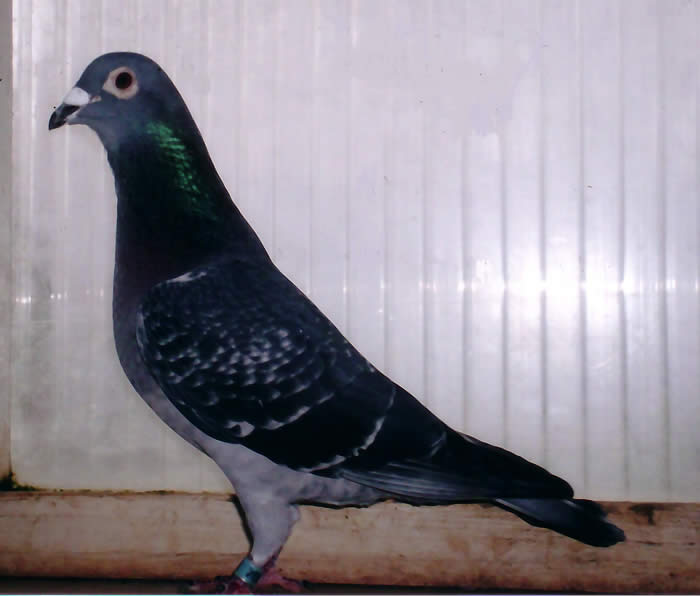
Geoff. Bred by Geoff Hunt of Westmarsh. Sire of ‘44’, 20th & 8th Open Palamos & Team Spirit, 4th Open BICC Perpignan. The sire of Geoff is Capacity, a son of Gallito.
ALWAYS ON THE LOOK OUT?
I have spent thousands on pigeons over the years. One year we had no doors on the house and I was spending money on birds – that’s how determined I was to find the right pigeons. Back then they would have put me in a mental home if they’d got to me.
I remember one day, my brother was waiting for Pau pigeons. Time was ticking on and he hadn’t had one, so he said: ‘I’m not having this, go and get that Squills and I’ll find some proper pigeons.’ Anyway, he thumbed through all the adverts and came to one for a fancier in Kent whose birds were meant to be this and that. He grabbed the phone and rang him there and then to order some youngsters, only when the chap picked the phone up he said, ‘I can’t talk now, I’m waiting for a Pau pigeon.’ It turns out he hadn’t clocked either! My brother put the phone down as quickly as he could.
GENES
Genes are the priority when bringing in a new bird but I also have to like it. If the family tree is right, good pigeons will keep emerging. But you don’t have to follow the maxim ‘the apples never fall far from the tree’ because providing there are plenty of good pigeons in the more distance history, it’s got to come out again. It disappoints me when people say, ‘Ah, but it’s only 10 per cent of that blood’, or ‘Such and such is way back in the pedigree’, as if that 10 per cent doesn’t count or that when you get to great-grandparents and beyond they have no influence. They are wrong because without the 10 per cent and every ancestor, you would not have arrived at the end product.
TYPE
I don’t think my type has changed over the years. I rubbed shoulders with the best in my formative years. I was taken by my brother Alan to Somerset and Uttoxeter to see the likes of Victor Watts of Street and the Steele pigeons and they were all of the same type – and this is the type I’ve always liked and aimed for. All my life, my cock birds have been henny looking – so much so that it’s sometimes impossible to sex them as young birds. I would not recognise them by the time they are four. I took a henny cock I call ‘39’ to marking once and he was also heavily fretted, so I was a bit embarrassed to be sending him. The marking chap told me what a nice hen it was so when I then had to tell him it was a cock it made it even worse!
Mine are also slow maturers mentally (they are heartbreakers). My 2nd Open Palamos hen was very slow maturing. On her first trip she walked home to be verified 160th Open but she had nothing taken out of her so I sent her back to Perpignan. She walked home again – and still she had nothing taken out of her. The next year she was 2nd Open when there were only 5 on the winning day and she’d lost no weight. She is a short cast, good bodied hen who is neither tame nor wild, and her sister is the grandam of my 3rd Open, Toe Nails.
I don’t like big pigeons so mine have always tended to be medium to small. I like length but most of my good pigeons have been cobby so I’ve had to like that shape! Whether the cobbiness comes from inbreeding I don’t know. Toe Nails is cobby and so is the 2nd Open hen.
Nearly all of my birds are well natured and there’s not one of them which, if it dropped from Palamos, I’d think ‘Oh no, it’s not that one.’
I would now describe them as a family and I think I could go the rest of my life with what I’ve got and not have to bring fresh pigeons in. Really, it’s only boredom that makes me try other pigeons. If I did I would only bring in a hen as this would not alter my family line.
RECIPE FOR ENDURING SUCCESS
I think being tight and being skint are big contributing factors in being a good fancier. It makes you work with what you’ve got.
EYES AND OTHER THINGS
I always look at the eye for health and expression and when I pair I like to pair light to dark, the same with feather colour – aiming for a balance all the time, but I do not believe there is anything in eyesign. I know one thing, if I so wanted I could keep a beautiful team of pigeons with eyes like the old Bricoux, but I don’t think I’d get them from Palamos.
I don’t like pigeons that stick their tail up, I don’t like wild pigeons, and I don’t like gay pieds. I don’t have any views on vents, and as for a step in the wing, the only step I know is the one into my loft.
SIGNS
In the winter evenings I often pop outside, basket a couple of pigeons – usually late-breds – bring them back into the house and sit them on the kitchen table. Of course, the shavings spill out onto the floor and it drives Christine mad – but not to worry! I make myself a cup of tea, pull up a chair and just watch how they behave. I’m just looking for them to show me something, a kind of sign, and I know this will sound corny, but a few times I’ve looked at them and thought, ‘Yes, you’ve got it’, and I’ve been proved right.
At the moment I have a pigeon I call ‘24’ and he is perfection. He’s two years old and won’t get any better. But he’ll be better at Pau than Palamos. He’s never made a mistake and just takes everything in his stride, but he’s not streetwise and my worry would be that when he had to go down at Palamos that would be it. I picked him up the other day and almost turned to show him to someone, to say, ‘Here, take a look at that for a pigeon’, but there was only me in the loft!
JUDGEMENT
I’d give myself 8 out of 10 as a conditioner of pigeons - I’ve had a lot of high performance pigeons so I must be doing something right. I’m fortunate to have owned some outstanding pigeons so also I must have some idea of what I’m looking for as a stockman. I think I could go in another really good loft and pick out that fancier’s best pair of pigeons. What’s more, if Geoff Hunt and I went to that loft together, we’d both walk out the other end, without conversing, with the same two pigeons - I’m sure of it. And another thing, when you pick up what you think is a good pigeon based on looks, they rarely disappoint you in the hand – just like a women!
MAN OR PIGEON
Of course you’ve got to have the pigeons, but a lot of it is the man. Without ability and the pedigree the pigeon won’t get home, but they also need my help.
THE GODDARDS
In Reading I think the Goddards’ record will never be bettered at long distance racing. Goddard Bros is our Tony, Mr & Mrs Goddard is our Alan and R. J. Goddard & Son is myself, the one and only R. J. being the initials of my late dad. I was the last to get involved, aged 19, and when I did to wind me up my brothers said I would never do any good! Up to then I knew all the colours and things, and our garden had always been full of Steeles and Victor Watts so I knew the nuts and bolts. Alan was the pedigree man and stockman and Tony was the racing man with a great record over many years. Tony and I share the same desire and passion and we have had some fun on the way. I have been lucky in that respect.
At the outset in 1967 I went buying pigeons – every week – but I didn’t have a clue! Then in 1970, more through luck than anything else, I won 1st Section, 7th Open and 4th Section 56th Open NFC Pau. I sent those two pigeons to Bournemouth on the train every day for a month beforehand and I clocked the first one at 6.55pm on the day of toss. Naturally I thought I had cracked the way to prepare pigeons and it took me ages to understand that pigeon racing is not like that.
PAU
Nowadays my pigeons fly the same from Pau as they do from Palamos but because Pau is that bit faster it just makes them look slower. I could get them to do better at Pau, but it wouldn’t happen overnight because I’ve made their habits suitable for Palamos.
Pau is not the race it used to be. Years ago if you got one home inside three days you thought you had a good ‘un but three days now and people wouldn’t even say ‘well done!’ to you. I’m inclined to think fanciers have got better.
My brothers and I grew up dreaming of winning the Pau National on the day of toss but I’ve always said to them that if that happens it would be with a widowhood system and foreign pigeons not with the pigeons and the methods that they have adopted. I think Pau is also a race a yearling can win, as has been proved. If a yearling gets with the right batch it isn’t likely to come off the rails and will keep up all the way. Palamos is altogether different because I believe the problems at Palamos come in the first 50 miles and the batches are already pretty small by then. I think the pigeons have to fly 90% of the route solo so it soon becomes ‘fend-for-yourself’ time. People keep coming up with ideas to make it easier but you don’t want it to be easier Difficulty is the essence of it and why there is no other race like it. I even think they should make the Spanish Diploma even more difficult to win, with a pigeon having to score 3 times in the first 50 to qualify.
OTHER FANCIERS
Mort Manns has influenced me a great deal. I think he’s a genius and when I first went there he had pigeons I had only dreamed of. I’d go home afterwards and just thinking about his pigeons would keep me going for a fortnight. Another big influence was Tom Clarke of Frampton-on-Severn. In the modern era you’d have to say Eric Cannon for his Pau record, Ray Hammond of Albury in Surrey who was 1st L&SECC Pau in 2005, Michael White of Bournemouth and, of course, the Nicholsons of Rochester. But if I had to start up all over again tomorrow I would go to my great friend Geoff Hunt of Westmarsh.
Locally I consider Roger Lowe of Caversham to be a great middle-distance man (the best). In the past we rated the Thatchers, Fred and George, Fred being 3rd Open Pau with Kentwood Princess. These went into the Venners of Street family. Last but not least, there’s John Horler, a top pigeon man but most of all, a true gentleman and a good avert for our sport.
The Palamos greats that have made a real impression on me were Knightsdale Lady, The Berwick Hen of Tony Hodge’s and Trevor Perrett’s The Mad Muller, a mealy hen who was 1st Section, 5th Open Barcelona 1965, 2nd Section 6th Open 1966 and 3rd Section, 7th Open Palamos 1967. When I joined the club you got a book that contained results of the previous years in it and this hen stood out. This book was like a bible to me in those days and I even knew the velocities of past years – and I’m not just talking of the winners. Sadly my memory is not so good now.
THE BEST OF THE BEST
The best Palamos pigeon I’ve had is my 2nd Open hen Almost There. Geoff Hunt subsequently bought her from me and, looking back, it was one of the best things I ever did as she was paired to his best cocks. We speak on the phone every night - we never miss. Our pigeon philosophy is identical and I don’t think there is a better family anywhere than Geoff’s – even now. Our pigeons are of an identical type, too. He paired my hen to Gallito and bred Capacity, the sire of Geoff who bred Team Spirit and my 8th Open Palamos hen of last year. And the dam of Geoff is 219, who is from the mother of Geoff’s Super Nova. I went down there one day and there were two young dark chequers in the corridor of his loft. Geoff said: ‘take them both’, so I did. One didn’t make it and the other I called Geoff and he’s now my stock cock.
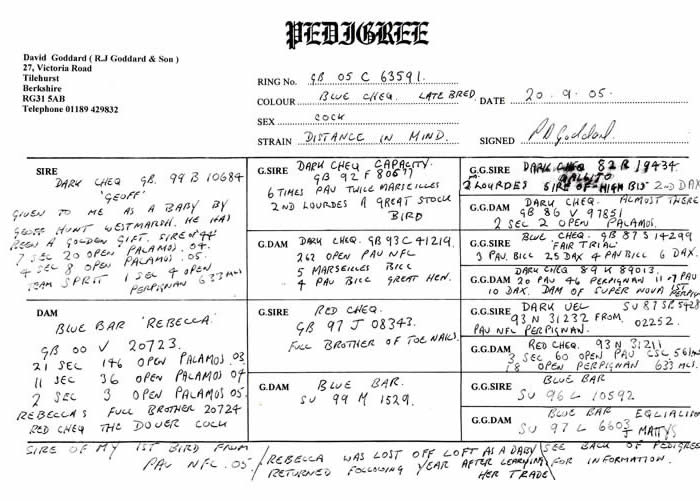
A pedigree showing the calibre of bird in Dave's loft.
AMBITIONS
My desire – my obsession - is so strong and so deep-rooted that nothing can distract me from my goal one day to win Palamos. If I did, I would just love to make the speech at the dinner - even though I’d probably crack up. If Palamos was no longer on the programme I would focus on the Barcelona International, but if that race went to the wall I’d finish tomorrow and just keep a few pigeons as pets. I don’t think we have finished exploring the boundaries of what pigeons are capable of but if we keep having so many short races we will have.
If I were to win Palamos I might then be swayed towards concentrating on the Barcelona International, and if I did I think I would have to fine-tune my system a little bit to make my birds sharper. I think 700 miles is enough for anybody – beyond that scares me.
Consistency is much more important to me, however, than winning Palamos outright. If I never won it but was 20th Open every year I’d be one of the greatest, yet one year I was 20th and someone said to me I must have been disappointed – not at all!
I can go to bed depressed, but I’ve only got to read an article on the Nicholsons and it whets my appetite for Palamos all over again. I say this respectfully, they are my target. If they weren’t sending it would be sad because you need to fly against the best.
PERSPECTIVE
It wouldn’t break my heart if I failed one year, because I know I have everything in place to bounce back, but at one time one failure and I would have reached for the tablets! Now I’ve moved on. Once you have a team in place it’s unlikely you will get caught with your trousers down.
MY WAY
I spent a heck of a lot of years picking other fliers’ brains, copying their systems, thinking I couldn’t fail and what happened? I flew worse than ever. So now I use my own system and I don’t get swayed by what someone else says or does. I’ve heard it all. For example, a month before Palamos I bleach all the drinkers and I do this because I’ve been flying well since doing it. It might not make any difference but it’s my method and, one way or another, my methods work.
THE END OF THE RAINBOW
Years ago, I’d go to another loft and on the way home I’d think, ‘I’d love to have a team like that’, and in the last few years I think I have developed one. I’m not bragging, but being able to go into my loft and look at a 3rd Open, another 3rd Open, an 8th Open and an 11th Open – oh, the joy it brings! It is a dream. It’s a lovely feeling to be able to write a pedigree with all these good pigeons on it. Steele of Uttoxeter could do it, and now I can do it.
PERCEPTION
The biggest accolade is to be respected by your fellow fanciers. If you asked my club-mates what they thought of me, they’d no doubt say they beat me every week – and they wouldn’t be lying – because I’ve not had a clock set for 15 or so years. I honestly think that bad fliers would say I was a bad flier, but the genuinely good fliers respect me - and so they should for what I’ve achieved. I don’t mean to sound big headed - what I’m saying comes from my heart.