CHRIS GORDON
talks to Cameron Stansfield
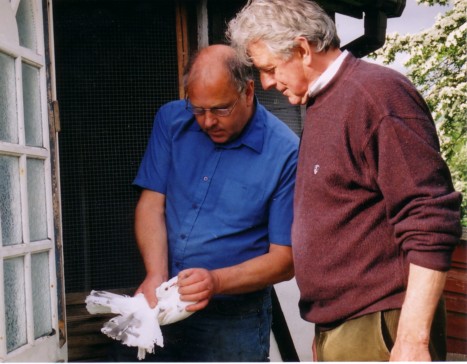
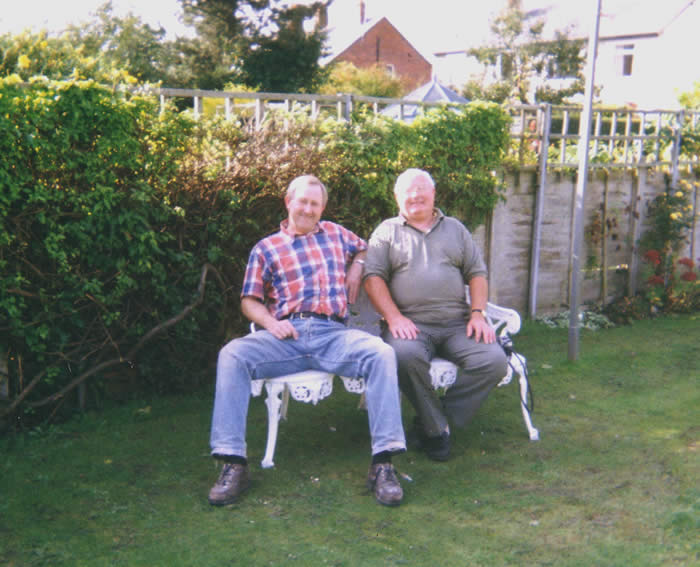
Chris Gordon 'educating' Brian Stansfield
How about this for a CV? 11 x 1 st Section E in races with the British Barcelona Club; 5 x 1st Section and 11 x 2nd Section K in the National Flying Club; 3 rd Best Average in 2002 for the NFC's much-coveted Langstone Gold Cup, awarded for the Best Average from Nantes, Pau and the Young Bird National; holder of the record for the furthest flying bird ever recorded on the day of toss in any race staged by the BBC - over 600 miles out of Bordeaux to Old Snydale in Yorkshire. With performances like those there's no need for me to add anything further so let's crack on and see what Chris has to say about various aspects of pigeon racing, beginning with one of his passions - barley!
Barley
I'm a florist and also rent off a number of properties. Doing up houses around twenty years ago, there were times when I was so busy that I ran out of corn and I didn't have time to go to the farms to get any more. All I had to hand was barley so onto barley they went. A little while later, I went in the shed and had a good look at the pigeons and I thought to myself, their condition is as good as if not better than when they were fed on mixed corn! Their feather wasn't dry, nor were their flights brittle; in fact they handled perfectly. They were silky, so much so that I could go in and basket a few up, take them to the local shows and they would win; this without any additives, just barley. Today they have nothing but barley from after they have reared a round of youngsters at the end of old bird racing right through to a couple of days before hatching the following spring. They complete the big moult on barley only - no oilseeds or 'moulting mix' or supposed 'balanced' diet. In earlier days I tried them on linseed but found their droppings stuck to their back ends, and also rapeseed but discontinued it because I saw no difference in the condition of the birds. The need for oil seeds is a myth. I've also tried oils on the barley but again it made no difference. Going back years, I used to feed them on beans when they had laid and what happened? When let out they would go off to the fields... to eat barley! My conclusion is that, despite what it says in the books, as a 'resting feed' there is enough of everything in barley that you don't need to feed anything else. I should point out that my pigeons are 100% healthy but I don't know which way round it is: are they healthy because I feed 100% barley, or is it that they take no harm being on just barley because they are healthy in the first place. Would my system work the same if my birds were less than 100%? I don't know. As I said, they are still on barley when I pair up, then two or three days before the eggs hatch, they go onto 100% blue peas straight from the local farm. The peas cost £3 a bag and the barley £2 a bag so you can see there is no expense spared here! The racers rear on only these peas; the stock pigeons rear on 100% peas, except during the first round when the days are short and there is less sun about - when I also give them a bit of Hormoform. I've never been one for other additives, probably due to lack of time.
Barley In The Racing Season
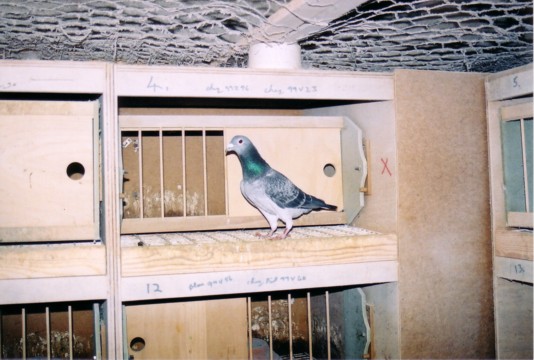
I pair my sprinters on January 1st and the distance pigeons in mid-February. When I part the racers, the youngsters either stay with the cocks or are taken away with the hens. This depends on the age range of the youngsters. If they are all of more or less the same age they go with the hens but if there is, say, 10 days between their ages, they stay with the cocks. This is because after about a week of being parted the hens seem to lose interest in the youngsters and won't feed them properly. Either way, once all the youngsters are properly weaned I put tea in the water and feed all the old birds on safflower. I do this to 'flatten them out' so that I can start them off from nothing. Safflower is the finest thing there is to take weight off a pigeon. The reason I don't simply cut back on their quantity of food is because I believe that in nature a pigeon is meant to have a full crop of corn, and if it doesn't it will go scavenging to make sure it does. They have the safflower for three or four days then they are back on 100% barley and they begin to exercise well. Barley makes pigeons fly. Feed them a widowhood mix and they won't fly the same! My sprinters are trained on barley in early April, and in the lead up to the first race they have their last feed of barley on Tuesday morning. On Tuesday evening they have 5/8 of an ounce of widowhood mix and as much barley as they can eat. Wednesday morning 5/8 of an ounce of widowhood but no barley (any more and they won't fly like I want them to), then on Wednesday evening they have as much widowhood mix as they want, anything up to 2 ounces. On Thursday I give them 5/8 of an ounce of widowhood mix and some hemp seed to 'hot them up'. On Thursday night they have the hemp first then plenty of corn again, being allowed to eat which grains they want, then I take away anything that is left. On Friday morning I feed hemp and peanuts at 9.00am and that's it.

On Return
They come back from a race to peanuts, the idea being to get them back up to what they were like pre-race as quickly as possible. I don't feed depurative on return. What is the point of keeping them down? I should point out that I don't train my sprinters. If I did I would alter their feed accordingly. On Sunday and Monday they are back on 100% barley. They have half an ounce in the morning and as much as they like in the evening. A point worth making: half an ounce of barley is the equivalent in bulk to 5/8 of an ounce of mixed corn. I feed the sprinters in their boxes but the distance pigeons don't have their food measured and are fed in troughs. I think they benefit from communal feeding in so much as I don't want them as aggressive as sprinters. Likewise my sprint loft is 5ft deep and the distance loft is 8ft deep. The smaller the loft, the more aggressive they are likely to be, depending also of course on how many pigeons are being housed. I liken it to people. Country people have more space and, generally speaking, they have a gentler, more relaxed temperament than townspeople!
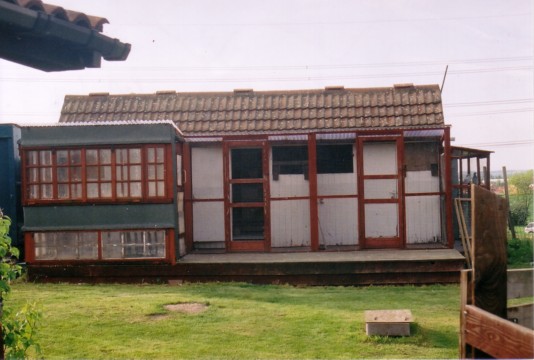
The distance loft. Home to multiple top-class distance birds.
Early Targets
The first main target for my distance pigeons is the British Barcelona Club's Nantes race, which falls around about May 20th, which is early in the season to be flying 455 miles. The pigeons I'm aiming for this race have simply got to have the work put into them if they are going to be able to contend with a potential north-east wind from Nantes at this time of the year, so they will have four or maybe five preparatory inland races with one or more of these being from the coast - just to get the hours on the wing into them. Before these inland races they are fed barley until the Wednesday morning when they have widowhood mix, the same on Thursday, then peanuts on the Friday. They are back on barley by Sunday morning and have barley again on Monday, then have the widowhood mix on the Tuesday and so on.
Ideally the last prep race will be flown 10 days before basketing for Nantes. In those ten days they have two days on barley, then I switch to a widowhood mix with peas added to thicken it up and I fill a trough at the back of the door with beans. As basketing gets nearer they have peanuts, the quantity being gradually increased. I've been feeding fats since 1994 when I used peanuts on the young birds and saw the difference when they came back from long, hard races. The thing is, if you give something to youngsters you can see the effect more quickly than if giving it to the old birds so it's an idea to try things out on your youngsters first. For fats I have experimented with peeled sunflower seeds but prefer peanuts because they are easily digestible and the pigeons eat them more readily. By the way, during the breeding period, when I split the cocks and hens, leaving one of them to finish the youngsters off, I give them peanuts and it helps the youngsters to come on.
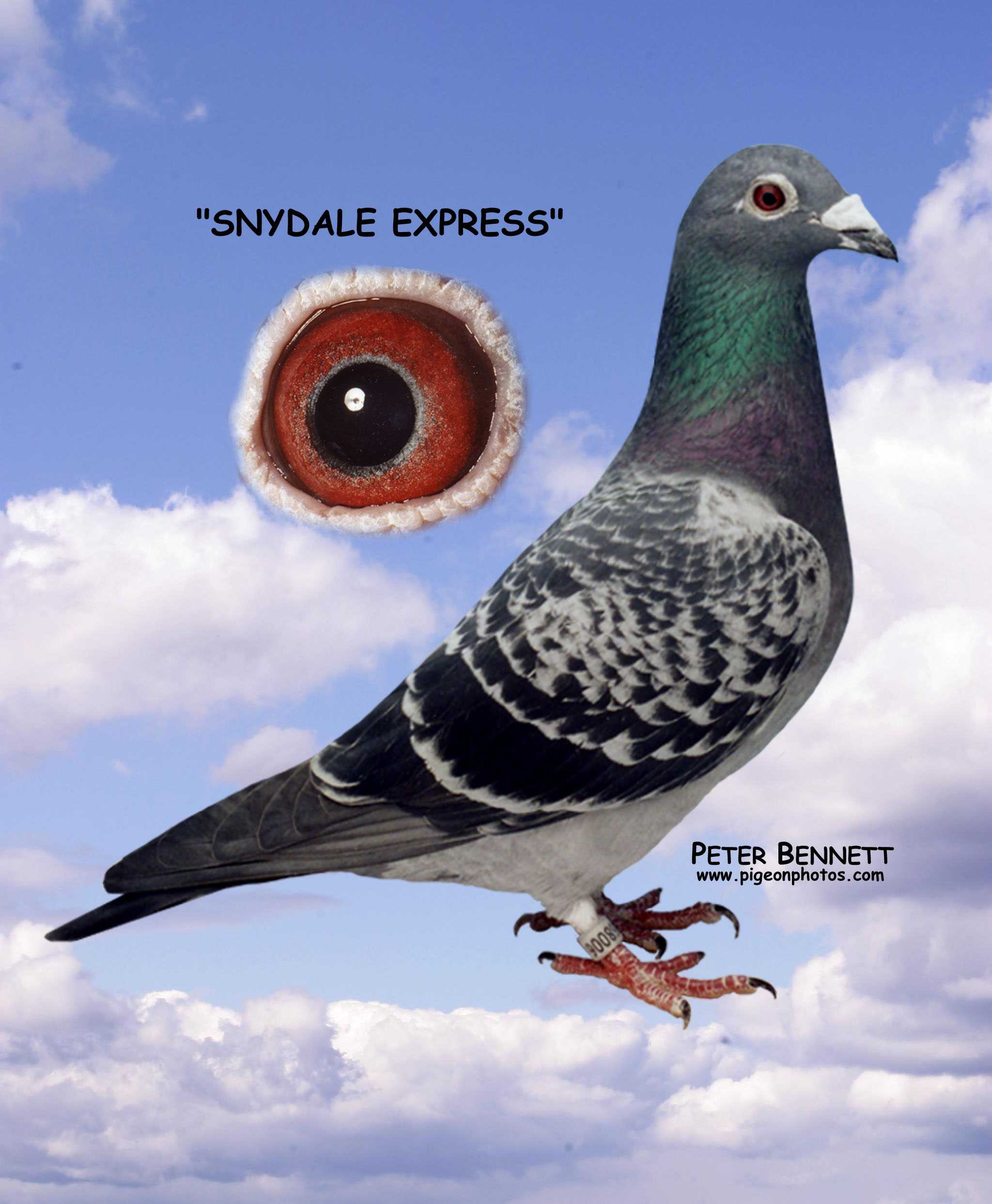
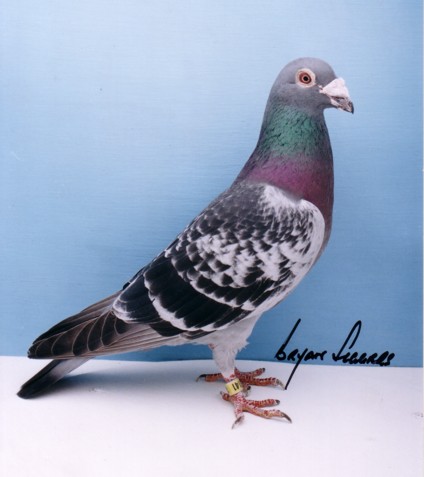
SNYDALE EXPRESS
1st Open National Flying Club Pau 2005, 725mls.
Bred and raced by Chris Gordon of Old Snydale, Pontefract,
Yorkshire.
Exercise
In the last 6 or 7 days before basketing for Nantes the birds will be exercising around the shed for 2 hours a day. Prior to this they will have been doing perhaps half an hour twice a day. To get them into super form you must get the balance right and this can be difficult. They usually race around the skies and I don't have to flag them too much but I've found that if I get them exercising for 2 hours too prematurely they lose their enthusiasm and go off the boil. Ideally they are sent to Nantes celibate and if I enter 10 birds the majority will be sent to win, whilst one or two will be Pau or Palamos pigeons going for the work. The latter are fed and treated just the same as the others but won't win because genetically they are not going to win inside 10 hours at 455 miles - they need further. Some of my Pau type pigeons would have won at 455 miles ten years ago but nowadays they need 550 miles. Not because they have become slower but because 'sprint' pigeons are sprinting further. Likewise some of the ones being sent to win at Nantes wouldn't win at Pau. If we get a straightforward day for this early Nantes race I would expect 90% back by nightfall. If it's an iffy day, then 50%.
The Next Step
Some of the BBC Nantes pigeons will be going to NFC Nantes a fortnight later so they won't have another race in between; in fact they won't have much work at all. After BBC Nantes they are on barley for a couple of days and then I gradually build them back up again. The Palamos and Pau pigeons on the other hand will have another race or two to keep them ticking over. To bring pigeons into form you've got to give them some wellie and in my experience most pigeons that have been across the Channel are better for it. However, whereas distance pigeons come on for work, I have to keep some of my sprinters locked up after an inland race to build them back up again! Knowing what to do is down to the man. I have tried lifting pigeons straight from England into Pau and I didn't do well, but on reflection these were pigeons that weren't bred for it anyway. They didn't have the necessary muscle. Having said all that, at Pau it's the pigeon that counts because even in a blow home you still don't get many that can do that distance in good time. The build up in the last 10 days before Pau and Palamos is the same as the build up to Nantes when they have as many peanuts as they want. For the Palamos marking I have to leave early to get to Salisbury Livestock Market by late morning and I can't feed the birds before leaving home, therefore I take peanuts with me and feed them half an hour after getting to Salisbury. A crop full of peanuts provides two and a half times as much energy as a crop full of mixed corn.
Early Form
My pigeons are in better condition/form for the Nantes races than they are when the BBC Bordeaux race comes along because by the end of July a pigeon's feather has begun to dry out. If I altered my system, starting later, I don't know if it would make much difference. Everything depends on the sun. I would be struggling for May form if we had a dank early spring. We all feel better for having the sun on our backs.
Absolute Fitness
When I send pigeons I send them as fit as I can get them, and fit is fit, fit enough to go anywhere be it Nantes or Pau or wherever. We all know of relatively unsuccessful fanciers who might do well after a long holdover because their pigeons are neglected at home and come on for the better corn in the basket, but these are exceptions. A properly prepared pigeon will only deteriorate in the basket, it won't improve, so you need to get it as fit as you can and hope it maintains a high level of that fitness.
Confidence
With my sprinters I'm 100% confident they'll perform. With distance pigeons, whatever confidence I have at basketing time tends to dwindle by race day and in the end I'm not confident at all because there are so many things that can go wrong. In the National you learn what time they are in on the south coast and can work out when you need one and, as time passes, I think to myself, 'I'm not going to get one here... they've failed again'. But then one invariably pops up... and then another one! It's not very often they come home in the order I think they will. I do pick the first one quite often, however, so usually if something beats my fancied pigeon I know it's gong to be in the prizes. After that though, I'm usually wrong about the order of arrival.
Fatigue
Usually from the long ones they don't drop straight away and if they've won something their condition is good - they look as if they could go on flying for longer. A winner always has more fuel in the tank. Even the more tired pigeons are usually okay the next day. You can tell by how a pigeon drops from a particular distance whether it will get further. On the face of it all my best Pau pigeons have looked as if they could have handled another 130 miles (the equivalent of Palamos), but although from Palamos I'm on the look-out at the end of the second day (though I didn't used to be) so far I haven't managed to get one by then. Palamos is just a different kettle of fish: the weather's hotter and there are fewer birds in the race for company.
The Wild Loft
I set up my wild loft to try and improve my Palamos performances. Although I wasn't sending my best, I was still sending good pigeons and coming unstuck. With only having 24 pairs for racing the distance I could not afford to keep taking these knocks so I put a loft up in my field, well away from my other birds. They are open hole, my thinking being they will be better off from Palamos if they are more streetwise. I've twice sent birds from this wild loft to Palamos and have been 3rd Section (decimals out of race time), and last year 2nd and 4th Section (in race time). The birds I put in the wild loft are late breds, and all age groups mix together. I don't train the late-breds at all. I always intend to but by that time of the year I've had enough so they are just left to it. As yearlings they get 4 or 5 tosses and by the 7th or 8th time they are in a basket they are at the coast! They are allowed to pair as they want and I've noticed the better pigeons tend to choose the better pigeons. Sometimes I think to myself why has that one picked that one, but with time you see it picked a good one! The pigeons know best. Perhaps they see vitality in each other which we can't. They are hopper fed peas or beans and then before a targeted race I put fats in the trough. The only problem is, the birds not going anywhere also get the fats so they eat me out of house and home! They pair in March and rear whatever hatches in the first nest, then are on pot eggs for the rest of the season. I don't aim for a particular nest condition, I just try to make sure hens are not in egg. I feel with having an open loft and being out in all weather, even fog, they develop a better homing instinct. There are some days when I won't let my other birds out, but the wild loft is always open. However, although they 'home' under this system, you won't get the pace out of them so that they race - they won't have it. Pigeons are fitter when split up. At Pau last year Eddie Wright beat me with a widowhood cock, and Brian Denney beat me with a widower too, then came mine on natural.
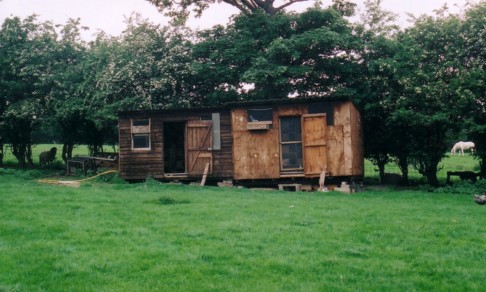
The 'wild loft'. Now starting to pay dividends at the real distance.
Comparisons
For keenness and fitness I think celibacy, which is how I race my other Channel birds, is the way to go. The pigeons in my 'wild loft' carry more disease than my other birds because being on an open loft all the time they come into contact with strays. It may also have something to do with the number of late-bred which the wild loft houses. I think with living together, the older pigeons definitely pass something on by way of experience and habit to the youngsters. One thing I have noticed is that although the pigeons in the wild loft start off the season with good feather, thereafter their feather gets drier more quickly than in does on my other birds.
Experience
Every year I breed late-breds out of my best performers. Some I put away in the stock loft and forget about until they have matured, others I put in my wild loft and race. It doesn't matter that they are not trained as youngsters. I can win with youngsters at 370 miles but it doesn't mean they will be any better as yearlings than these late-breds; it has no bearing whatsoever. The late-breds might take a while to get the hang of yearling racing so you have to make allowances for them but after 3 or 4 races they will be knocking about. I'm not bothered how the distance pigeons perform as yearlings as long as they show a bit of something.
My general approach is to race all my youngsters which are bred early enough for racing, at least down to the coast, with some going across the Channel. The unraced late-breds however, only have one short Channel race of say 350 miles as yearlings, in Fed races, and then, depending on the weather, a few more coast races. At two they have a short Channel race and are then expected to shape at 500 to 550 miles. Because of their relative immaturity I haven't pushed any of these 2y to Pau. For Palamos, if you look at the results year after year, they want to be at least 3 or 4. I think if you want to put up a team performance at the long races you need to send experienced pigeons, but you can have individual success by sending inexperienced pigeons because a really good pigeon is always a really good pigeon.
If it turns out to be a good flying day from Pau, a pigeon having its first trip is likely to be my first arrival, but if it's a dicky day previous experience counts. When I was 22 nd Open it was a hard one and my pigeon was going there for the second time. I've also found that that once you've got a pigeon to come out of Pau once they will usually do it again - for me anyway because mine are bred for it. Some people have flash-in-the-pans, pigeons that weren't bred for it in the first place, which can't repeat their performance. So far I haven't sent a pigeon back to another race in the same season it has flown Pau so I can't tell how they would handle it. I know they send them to 600 and 700 miles twice or more in a season on the continent but I think with the wind and terrain their birds are flying over you can knock 200 miles of their distance compared to us. Mine do, however, go to Nantes 3 or even 4 times in a season, whereas 20 years ago they only went to Nantes once and that was it. And these 3 Nantes races might only come in a 4 or 5-week period. '14' was 14th Open BBC Nantes and then went on to fly MNFC and NFC Nantes inside 4 weeks. The reason pigeons can take more work these days is because they are healthier. Years ago 500 miles on the day was seen as a special pigeon and you couldn't get them on the day at 550, but today 550 is the same as 500 was back then.
Keep Sending Them
It takes a good pigeon just to fly Pau, no matter how long it takes it. And bad pigeons pigeons simply don't win from Pau. If they come back late, I just keep sending them back. Sprinters get loads of chances but a Pau pigeon only gets one chance a year so you can't condemn it for 'failing'. What I would do, is if it was late twice form Pau, is send it on to Palamos, 840 miles. Even if it takes them a week from there it's commendable. They have had to orientate on their own, and find a drink and so on. Those who condemn such pigeons have never tried to fly these race points. They are the kind of people who hand you one of their birds and say 'This will fly Pau' but they wouldn't even see it. They have no idea what it takes - an extra special pigeon. I think 3 times at Pau at 715 is enough for good pigeons; two average performances would not be enough for me to retire them. My good cock flew Pau, then was 22nd Open Pau, then flew Pau/Saintes, and was well up from Pau last year. His half sister has done Pau three times too.
Foundation Pigeons
My distance pigeons go back to 1984 and my sprinters to 1980; the lines I had before then have all gone now. My sprinters are based on a pair of Janssens which bred 30 different birds to win prizes, some winning up to 20 x 1sts, but even better pigeons came a few years later in the form of a pair of Leen Boers, these being a daughter of Boers' Mirage (a car winner) and Rough Vogel (also a car winner). I then bought a son of Boers' Supervisor. Paired together they bred pigeons to win different Feds and the Great Yorkshire Amal, and a grandson topped the Welsh Combine against 18,000 birds. It seemed everything off them was winning, even more so when the wind was on their nose. On a Saturday I could tell what sort of wind it was by which pigeons arrived home first. In tail winds it was always the Janssens, in headwinds always the Boers. From this I learnt about type and feather. The Boers had harder feather (yellow) and the Janssens had buff feather. And the Boers were heavier pigeons. I paired them together and their children came on any type of day and since then I've line bred back to the two sides.
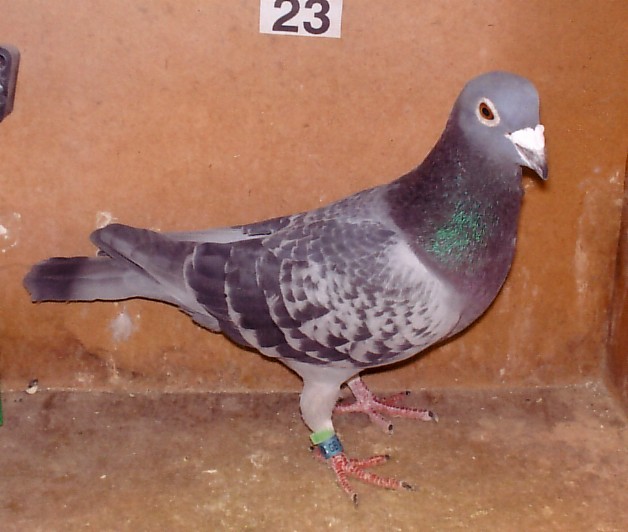
In 1984 I had 7 distance birds from Eric Fox & Son of Bakewell. One left its mark and became the sire of my long distance loft. His sire was 1st Section, 15th Open Pau and his dam 1st Section, 7th Open Pau. This 7 th Open hen carried the Irish Delmotte and Hansenne lines of Billy Irwin and Bob Harkness. Initially I paired him to a hen I bought from Louella which I bought not on pedigree but because I liked her - she was a lovely long caste hen. Her sire was Dark Flash, a 500-mile winner on the north road, and her dam was off Motta and Pauline. They bred 'My 28', the best racer I've ever had. He won 4 x 1sts as a young bird and, amongst other positions, flew Nevers, 504 miles, on the day three times, once being clocked at 9.55pm and once at 10.20pm. I eventually lost him and, looking back at his photo, I think he was never in the sort of condition I can get pigeons in now; he won because he was just such a strong pigeon. 'My 28' is the double grandsire of my 17th Open Pau hen, who in turn is the dam of my blue pied cock, 22nd Open NFC Pau, a hen I call '70' who has flown Pau three times and another good hen, '14', 1 st Section, 13 th Open BBC Nantes. It would be fair to say that the 17th Open Pau hen is the dam and granddam of my loft. Just as with my sprinters, I've line breed back to the main Fox cock.
In 1994 I bought in the Busschaerts from Pearson & Dransfield and all of them left their mark in one way or another. I also borrowed from them a son and daughter of their famous Belgian Cock who carried the lines of Little Black and Crayonne. The daughter is the one who breeds the birds that score for me in the young bird Nationals, whilst the son, who I call 'Tom', is the father of my three times Pau hen when he was paired to my 17 th Open Pau Hen, who in turn was a granddaughter of 'My 28' and an SB Copper hen that came from a lad in our local club who had her after she won at 500 miles to three different loft locations! The 17th Open Pau hen is therefore from a half-brother and sister mating. My double-Section winning hen is off Tom's sister and another Pearson & Dransfield cock.
Kept 'pure' these Busschaerts won't do Pau. Another thing is, although the yearlings off 'Tom' can cope with Nantes and I have no qualms sending them to 500 miles, the ones off 'Tom's' sister I don't even send. They are not strong enough at that stage of their lives - and they have to be three before I send them to 550 miles! I have also experimented with the Boers pigeons at the long distance, crossing them into my distance birds. I took the experiment to two generations but they were good for nothing.
Eighty-five per cent of my distance birds contain the Pearson & Dransfield blood, but all of my birds which fly 550 miles plus contain some Eric Fox blood. The Fox cross Busschaert pigeons haven't got a prayer against the 'pure' Pearson & Dransfields in on-the-day type races but the pigeons I clock out of Pau are either my long distance Fox line or that line with a Pearson cross. I also had some John Carmichael blood but these were no good till they got to 550 miles. When I first tried them they would take 13 hours to fly Nantes and I used to think that's okay, I'll send them further and they will get their head down, but they didn't... until I crossed them. My 9th Open BBC Bordeaux winner was 50% Carmichael (also being a grandson of my Pau hen). All the other birds I have tried up against these over the last 15 years have failed so really I've now stopped buying. You realise that pigeons better than you already have take some getting!
Yearlings For Breeding
The best pigeon I ever raced out of the original Fox cock was 'My 28', bred when he was a yearling. Without doubt champions come out of yearlings. In my experience these yearlings may go on to breed other good pigeons but the best one will invariably be bred when they are yearlings. As pigeons get older their offspring slow down but their offspring in turn still carry the genes so will breed faster pigeons once again. If you don't breed out of your yearlings you are chucking their best breeding years away. I breed off the children of good pigeons and these are then tested as youngsters. If they in turn are still here they are bred off too - provided they conform to my type.
Percentages
Nowadays the percentages are lower because the atmosphere has changed and the homing ability isn't as good in present-day conditions. I lose half of all my youngsters by the time they have been to 200 miles, then out of what's left, as far as sprinters go 90% will win a prize of some sort thereafter. Of the distance birds left, around 50% will score from somewhere. But for Pau the percentage is very low, in fact actually getting them there is very difficult.
Softly Softly?
Whether you hammer pigeons or nurture them I've come to the conclusion that ultimately the percentage you will be left with will be the same. Good pigeons are born and in spite of you they will still be good pigeons
Type
I don't know what it is but I can tell a good pigeon as soon as I get it in my hands. Quite possibly it's the sense of strength that they give off. At John Carmichael's clearance sale I remember I put my hand into the pens and onto each pigeon's back and I could tell the good ones without picking them up. I can't, however, do the same with sprint pigeons. That's because a good sprint pigeon might only have to fly for 2 to 4 hours so it doesn't need the same strength. For the distance, a good pigeon is built like a stick - corky and straight. The best pigeons have one tail feather showing and the covers on either side of the tail go right the way down. I want them with short legs and to be longish cast. When I started off with the Fox pigeons some were short cast, with shorter wings, 23 to 24 centimetres in length. Later I paired some with the Pearson & Dransfield Busschaerts, producing longer cast pigeons with 25 centimetre wings. What I've also noticed is that in the old-fashioned distance pigeons the wing used to fan straight out, but now wings point back.
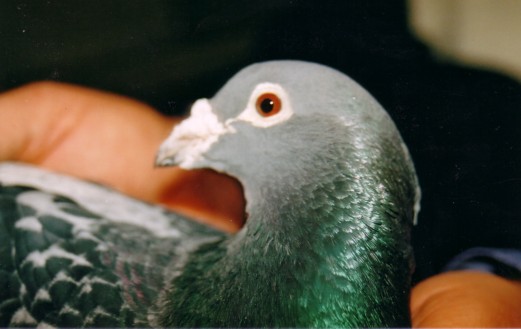
You can tell a real good pigeon in the nest. Pigeons are like people, some look in good nick all the time; it's usually the brightest people that look in the best condition. I like the cere to go all the way around the eye. Some deteriorate towards the back of the eye and you see a V, as if the cere has been nipped. They may still be good pigeons if they have this fault but champions always have a full, unbroken cere. I don't know why it should matter but it does. The champions also always have a thick cere - so much so that sometimes you can't see all of their eye. On breeding cocks I like to see a 'swelling' under the beak. A good racer may have a good amount of wattle on top of the beak but it doesn't necessarily have to have much underneath. Good breeders have both - and breeding hens must have tusks. I wouldn't buy a hen if she had reached the age of four and she didn't have tusks! Sometimes you can see the beginning of these swellings when they are only youngsters. Usually pigeons with a good eye cere develop them. I don't think the presence of tusks is down to family; pigeons of all different origins have them.
Good pigeons don't have a long neck - it would alter their equilibrium - and the neck usually appears to be thick. I want the vents bones as near to the keel as you can get them - and tight - everything wants to be as one. A wavy keel won't impair performance; it's a sign that the pigeon was sick when young but was strong enough to overcome it.
I want the area where the iris meets the white of the eyeball to be beige or black - as far as distance birds are concerned. It denotes strength. Good distance pigeons always have it and you can see it by the end of young bird racing. Pigeons that haven't got this feature will not breed pigeons with it. Most sprinters don't have this feature in their eyes but, as I've already said, they don't need to be as strong as distance birds. In my opinion, the colour of the iris doesn't matter. My family just happens to have a violet base.
With regard to the wing, the knuckle on my distance birds is nearer to the back than it is with sprinters, and the wing butts are thicker. Distance pigeons feel more corky and weigh less. My 22 nd Open Pau cock weighs 1lb 2 ounces; my best sprint cock 1lb 7 ounces.
Smaller pigeons may be better over sea where they take more buffeting but for normal flying I prefer bigger pigeons with longer tails; a tail is something with no weight which holds them up so the more the better.
My present type is now bigger than the originals, based not on my breeding to type but on survival of the fittest.
Brian May
I value the day I met Brian May. He put me 20 years on with what he taught me about feather type and what it meant with regard to the speed at which pigeons would win. Even whether the pigeons were likely to be north roaders or south roaders in so much as north road pigeons tend to have harder (yellow) feather. He taught me that pigeons with longer flights did better in tail winds, also that pigeons with yellow eyes tend to have harder feather. My Leen Boers sprinters differ from my Pau pigeons in that the Pau birds' feather is not as hard and you also get the impression that they have more feathers.
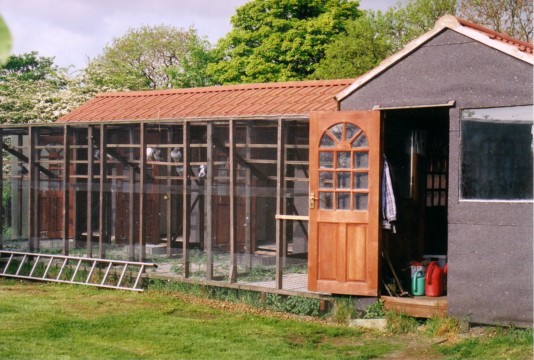
The breeding loft. Grilled floors and plenty of fresh air. The stock pigeons rear on 100% blue peas!
500 milers, 600 milers and 700 milers
600 milers feel stronger than 500 milers, however in type 600 milers are more like 500 milers than 700 milers. The 700 milers have a greater capacity to store fuel reserves and they feel lighter. There are 600 milers that won't get 700 milers. I hold the record in the British Barcelona Club for the longest flying bird ever recorded on the winning day in any of their races, 608 miles out of Bordeaux two years ago. But that pigeon, who incidentally was 2nd Section NFC Nantes as a yearling, is not quite as strong as my Pau pigeons. I sent it back to Bordeaux last year. It was a harder fly and it came on the 3rd day. It is off a daughter of my Pau hen paired to a son of Tom when Tom was paired to his own sister - which shows that I'm not bothered how close I breed for the stock loft. I have several half brother and sisters off the Pau hen in the stock loft paired together which are breeding good pigeons, and the Pau hen herself was off half brother and sister. When breeding close, you can see you are going wrong if the feather starts to lack that lustre and becomes too hard or too buff and if the eye cere becomes thinner.
Fed Pigeons and National Pigeons
Most of the pigeons which score for me in the Nationals at Nantes can't win the Fed from Nantes and, likewise, most Nantes Fed pigeons can't win from Nantes in the Nationals - because they've nowt to follow! It may have something to do with the eye. The eyes of National pigeons are stronger and the pigeons themselves are more determined. I would not bring in new stock off Fed pigeons, in fact I don't even look at Fed pigeons that are for sale. Similarly, I wouldn't buy National pigeons if I wanted to win Fed cards. I don't think some sprint pigeons know which way to go when sent to the distance. If they did they would set off in the right direction and you'd get them eventually but they don't come back at all! That's the theory anyway but I have to say in the last ten years or so pigeon racing has changed and now highly motivated sprint-bred pigeons are winning the races at 500 miles; 10 years ago they were only good up to 400 miles!
Using Your Own Microscope
The first thing is to get your microscope into focus. If looking for canker, use warm water (to keep the canker organism alive) to wet the swab before you put it down the throat, then put the sample on a slide. Put a cover slide over the top and press the top slide. Through the microscope you will see air bubbles and you can tell they are bubbles because they will all move the same way. Then focus and you will be able to see the canker. I test pigeons on behalf of a lot of fanciers and 98% of them will have something, but even that's a false reading because most people only bring their birds to me when they think they have a problem in the first place. Some 'experts' think pigeons can tolerate a level of canker but I know that under ideal conditions canker can double every 20 minutes!
The problem with disease diagnosis and treatment is that those who write about it have simply read it somewhere else and are just repeating what they've read. All of what I say is based on what I've found out for myself. In the process of learning, I tried a lot of experiments with herbal remedies, such as wormers, and none seemed to work. I'm not saying you can't use products that will help build a level of resistance but they won't be 100% effective. For example, I used to use a lot of garlic but still found the birds had worms. However, if I stopped the garlic for a while and then gave it again, it would flush worms out. This is why people think it's a good wormer but what they don't know is how many worms are still inside the pigeon!
My approach now is to keep the birds healthy at all times. A high cocci count means there is some other problem which needs addressing. During the close season they are clear of everything then during racing they are treated every four weeks or so depending on whether they need clearing of canker and colds, using a mixture of Metranidazole, Doxycycline and Trimetoprim. They are on this for 6 days initially, then during the season for 3 days at a time. I test every pigeon that is going to a big race for canker and also do a general loft test, but all treatments stop 10 days before a big race so the birds have time to build themselves up again. I don't tolerate even a low level of disease. After treatment the birds fly better around home, becoming tighter feathered and more buoyant, with more bloom. Treatment gives them a 'lift'.
I'm unsure about how to approach paratyphoid. I've jabbed them this year for the first time because I have seen too many signs pointing towards it, not just in my own loft but all over. If birds with dropped wings had simply banged them they would not get back home as quickly. The injection had no visible effect on my sprinters but some of my distance birds moped for a day or two, which made me wonder if they hadn't all ready got it to some degree and with injecting I was giving them some more! I only do them for Pox as youngsters.
Years ago when pigeons carried more disease it used to be the strongest pigeon that won; today with treatments readily available, it is the fittest pigeon that wins. It's ruined the sport really, as has widowhood. If no one had progressed we'd still have a situation where everyone could win a bit.
One thing I will say is, you cannot tell if a pigeon is 100% healthy just by looking at it. You might think you can but I have proved otherwise. When all is said and done, however, even though I'm certain I've got them clear of everything, I still don't know if they are psychologically right.
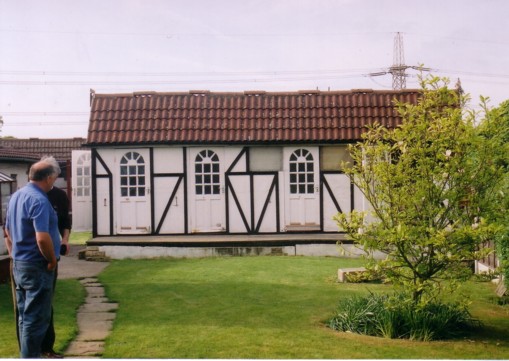
The young bird darkness loft. These youngsters are expected to compete in the cross-Channel National events.
Form Signs
I don't think it matters whether the slit in the top of the mouth is open or closed. It opens when a bird is nervous and closes when it is rested. I sent 20 birds to Nantes once, noting on basketing whether the slit was open or closed, and there was no pattern to how they performed.
Man or Pigeon?
For the shorter races it's nearly all man. The man is still important as the distance increases but I couldn't get a pigeon to come out of Palamos no matter what I did, if it was no good in the first place. For the real distance you can just leave your loft doors open and let them get on with life and they will turn in.
2005 Targets
This year I will try and fly 4 long races: BBC San Sebastian, Dax International, NFC Pau and BBC Palamos. I will be sending a lot to BBC Nantes to get some work into them, as I normally do, and will then get them ready for whichever race. My plans will take a battering if Nantes turns out bad, but you tend not to get many smashes with the BBC. I have never sent a big team to any of the long races but now my 'wild loft' is becoming established I've more that I can send. If I find I'm short of pigeons come the time, I will knock Dax on the head. My best pigeons will be going to NFC Pau.
Lessons Learnt
What have I learnt? That if you've got a small team you've got to fly widowhood, roundabout or celibacy if you want to win consistently. If you just leave them alone you won't compete unless it's a bad race or an extra long one. In my early days, I once had too many cocks, so I put what I thought were the worse ones in a section on their own and paired the others up - with the result that the spare pigeons raced the best. The other big thing I've learnt is that their health has got to be right. Years ago most people didn't treat and the bugs weren't as hardy so nowadays you are asking a lot more of untreated pigeons to be able to ward off unwanted bugs. Today, if you don't keep an eye on your pigeons, it's not the odd one that goes off it's your whole flock. When they get to three and are more the finished article, maybe they can cope with a level of worms and canker better than younger pigeons -but they still won't give you that super performance if they are carrying something!
Copyright© Cameron Stansfield 2005.
No part of this site may be re-produced without the permission of
Elimar Pigeon Services