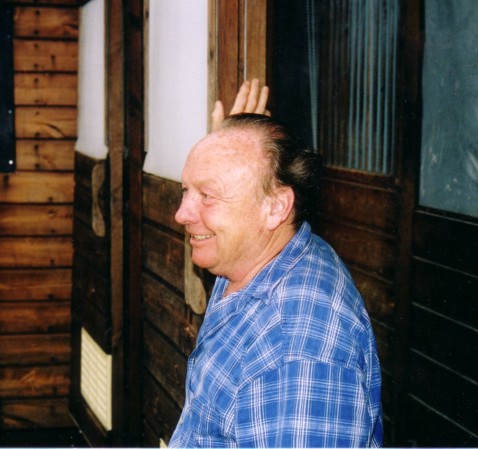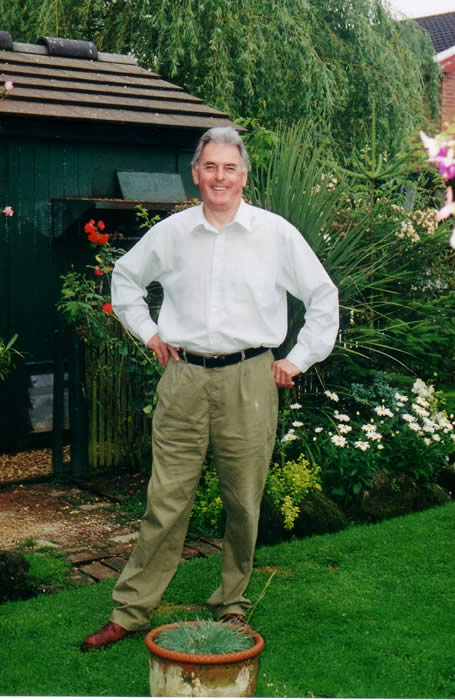
PAUL WOOLLISS
talks to Cameron Stansfield
Paul Woolliss lives in Grimsby, not an ideal spot for someone with aspirations of doing well in long distance national races. His success, therefore, should act as a spur to anyone similarly disadvantaged by loft location to have a go in races at the highest level. Paul has been lucky, if that's the right word, to have unearthed three outstanding racers in recent years: Ambition, 1st Section National Flying Club Pau, 703 miles; Lona, 3 times Spain and a total of 8 national positions; and Palona, 1st Section, 7th Open British Barcelona Club Palamos, 815 miles. Finding pigeons like these and others that will fly many miles solo is extremely difficult, as Paul's ensuing thoughts convey.
IS THE FANCIER MORE IMPORTANT THAN THE PIGEON?
First and foremost the two go hand in hand. You cannot do a job without the correct tools - you would not employ a baker to build you a house - so firstly decide what distance of racing you are interested in. I believe for sprint racing up to the coast, which is 192 miles to where I live, of course you need top-quality pigeons but the fancier makes up a larger percentage of the winning formula because these races are won by motivation, feed and method, and many different strains are capable of winning in these 'A to B, a quick flap and they are home' races. As for 500 miles on the day winning pigeons, the amount of birds capable of this on a working day (not with the wind up their backside) can be counted on one hand, however even then 500 mile club and federation racing is a different kettle of fish compared to 500 mile national racing, which is a totally different ball game altogether. The reasons are obvious: in federation racing the birds are all racing home to one area, but in national racing the birds are coming on a wider front (the length and breadth of the UK) so the pigeon has to have a mind of its own and be able to break away from the pack and not play follow the leader, otherwise it is doomed to failure. This brings us to loft position. Now, no fancier can help where he lives (apart that is from the many fanciers who have moved to a more favourable loft location to achieve their goal!) but for me a difficult loft location is more of a challenge. Take our loft. If I am flying from Pau it's 703 miles, roughly 180 miles further than the shorter flyers, and distance kills. My bird is not going to go faster over the last 180 miles after it has flown 523 miles already. Commonsense tells us that the further a bird flies the quicker its velocity drops off. But I know this before I enter into this type of competition and I'm also aware that the longer flying lofts have put up some fantastic performances over the years. In national racing you have to look at the full picture. Yes, the winner of 1st Open cannot be denied its fantastic achievement but look much deeper into the result and you will find some great pigeons. Look for a pigeon flying its head off to the opposite side of the country. If, say, the wind in the UK is west and a bird was clocked into Lancashire and I clocked here at Grimsby fifteen minutes before the Lancashire bird and I just beat the Lancashire bird on velocity, both might have done great on the Open result but I know where the best pigeon was on the day and it wasn't Grimsby. Back to the importance of pigeon or fancier, how to condition a pigeon to win at 500, 600, 700 and 800 miles is an art, otherwise in national racing you would not see the same names there or thereabouts, year in year out. It's a joint effort between top pigeons and top conditioning and knowledge. It's like baking a cake. You need the right ingredients to begin and then you need the correct amount of baking time! Many times you will have read the expression 'You can buy the birds but you cannot buy the fancier,' and it's very true. Just because your birds are bred from top winning blood does not mean you will be successful, it's the pigeons and the man combined. You must work hard and have dedication, patience and belief. Do not worry about failure; it's part and parcel of success. Remember, if at first you don't succeed, try, and try again.
DO NUMBERS COUNT?
Some fanciers will say so and so gets them because he sends a lot. Well, believe me, you can send twenty and on a hard day at 600 miles if they are not sent in top condition and bred for the job you will be looking for them. It's not the quantity it's the quality that counts. Ok, yes, if like me you often only send a single entry or perhaps just two, you are vulnerable because a hawk strike or your bird hitting a wire will result in me not timing in. You need lady luck on your side at all times. I think if you had an entry of 5 quality birds you would be dangerous if you had conditioned them correctly and they were of the right origin for the job, but not many lofts have 5 or more proven national prize-winning pigeons at 600 miles or above in their lofts, if they are truthful. Remember, it's horses for courses so you want birds bred from parents and grandparents that have performed over the distances you are sending the offspring to.
ARE GOOD 500 MILERS AND GOOD 700 MILERS ONE AND THE SAME?
In my opinion, NO. A 500 miler is not a 600, 700 or 800-mile pigeon. Distance kills. I know some fanciers out there will have a bird that has won at 500 and also 600 or 700 miles but these are gold dust pigeons. We ourselves have had them but the point I am trying to make is a 500 miler is not a 700 miler, and in all probability it's not a 600 miler either. It's about reading the pigeon correctly and knowing its limits, which is very difficult and where many of us fall down. So from 500 miles to 600 miles and then 600 to 700 miles the number of birds capable of flying this and still 'racing' drops dramatically. Even a bird with the right constitution, if not right mentally and physically, will give up, so the fancier needs to prepare it correctly to succeed. I believe in type. Yes, like racehorses, they do come in all shapes and sizes, but for 600, 700 and 800 miles I like a certain type. I study long-distance runners and liken my birds to them. They are small-to-medium, often thin looking, and they move effortlessly. In my opinion the further the bird goes beyond 650 miles the smaller it needs to be, but I don't mean like a sparrow. For me the balance and size of framework is important. They need to be small, compact and well balanced but can be long caste too. And they must have intelligence and be single minded - I think this is very important. Put this with the will, guts, stamina, love of home and correct mental aptitude and you should have a good sporting chance of success at the distance
HOW MANY DO YOU HAVE TO BREED TO FIND A GOOD ONE?
In my opinion, the greater the distance the more birds you will have to go through to find that elusive winner. And when you get to 600, 700 and 800-mile winners, well, some fanciers could go a lifetime without breeding one. They really are one-off special birds and to find multiple winners at these distances is very rare although in the British Isles they do exist. Realistically, I think most of the birds we breed are below average. It's a hard thing to say but I mean it, they just don't cut it where it matters - in the basket. To sort the wheat from the chaff I let the basket be the decider, as it does not lie. I really could not put a figure on the amount you have to breed to find a winner because the man with a small loft of 20 birds should be less likely to breed winners than a loft of 200 birds, but there again he might have a golden breeding pair. If you do find a golden breeding pair - and I never have, I only ever read about them in the press - you are very lucky. In our loft there is one hen that crops up all the time in the breeding of our prize-winners at national level so perhaps she is half a golden breeding pair!
We breed 25 young birds a year for our own racing and a few late-breds so our long distance winners have come from this amount or often less. If I could find one a season out of this number I would be highly delighted - I'm talking about national racing here - but in reality I do not get one per season. I would like to stress on this point that we are very small team fanciers and our winning has been done working with only a dozen or so old pigeons to race, but, and this is very important, I think we have a very strong stock loft. Twelve years ago we had no stock loft so if we lost a top racer (and you will lose them if you race them as hard as we do, it's a hazard of the job I'm afraid) it knocked us back. Now, though, if and when we take losses I can breed from proven stock birds of the correct type and keep rebuilding again. Because you have to go through the process of elimination via the basket, remembering it can take four years or even longer to find the fruits of your labour, I think the stock loft is of paramount importance. By the time you have found a good long distance pigeon its sire or dam may well be 7 or 8 years old and in many a 'racing only' loft the sire or dam would have been lost or culled by this age, however if you have a stock loft it may still be around.
HOW DIFFICULT IS IT TO FIND FRESH PIGEONS THAT CAN WIN INTO YOUR AREA IN NATIONAL RACING?
As I'm sure most fanciers are aware, when you bring in new stock they really do need time to acclimatise to the new area. For example, some lines may fly fantastically from France to lofts in Wales, but I might buy these same lines from Wales and try racing them to Grimsby and they won't want to know and that's because racing pigeons that perform well to one region may not to do so to another. Also, as I said earlier, you can buy the birds but not the man.
My loft is situated on the east coast of England. In April and May we can get very cold east winds and these can carry on for a while. I suspect it's the same scenario, but even worse, in Scotland. Now I know for a fact that when I go into the Midlands it's perhaps 5 degrees warmer than it is here. They may have an east wind but the chill factor is different due them not being on the coast. Also birds flying into central England fly a warmer route so fanciers there can condition their birds more quickly and so achieve form earlier in the season. So for me to buy new stock, I'm not saying that the birds in the Midlands would be no good - there are some fantastic distance men there - what I'm saying is, I would need to give the birds time to acclimatize and adapt to my management. Another problem for me bringing in new stock is what I spoke about earlier and that is, if I buy from a loft or a stud based down south they would fly 560 miles maximum from Pau whereas I need birds that can do 703 miles. Could those birds go on another 143 miles and cope with another 5 hours' flying time? Again the breeding of those birds would need to be studied to see the origin and distances flown by their parents and grandparents. Taking it on a stage further, if I want birds to fly Palamos or Barcelona, 815 and 842 miles respectively, would buying birds that only fly 700 miles at Palamos be the right answer? (I say 'only' but that takes some flying.) Could those birds carry on and fly the extra 142 miles? It's like another race and this when they are shattered.
SO WHAT IS THE ANSWER?
Well to be honest my birds originate from Holland. I always look, if possible, to buy from a family of birds that have won at similar distances to the distance I would hope to win at. The Dutch and Germans fly from 700 to over 800 miles from Barcelona and also fly into the night i.e. flying in the hours of darkness. The big plus factor here for me is they are putting in the hours on the wing, often 20 hours or more for the longer flying birds, which is the similar amount of time on the wing I would be looking to achieve, after all it's the hours on the wing that stop the pigeon. There is, however, one big minus, and it is a big minus, the continental birds don't have to fly over any water, and all the land they encounter is of a flat nature once they are out of Spain and France. And I'm sure all fanciers know that water does funny things to pigeons heading to the UK! So for me they have a much easier ride than we British fanciers have, also they have the drag factor, with perhaps 23,000 birds at somewhere like Barcelona. It is easier for them because with the liberation being so large the birds have a massive confidence boost in the earlier stages. Even when the convoy has flown 300 miles the batches would still be of significant size compared to our convoy of 3,500 at Pau and 850 at Palamos. Imagine what size batches our Palamos birds would be in after 300 miles, maybe down to small pockets and still with 400 or 500 miles to go! Pigeons are creatures of habit and like to fly in batches because they feel less vulnerable. The answer for me would be to buy from Holland or Germany from the most consistent national winning lofts (not necessarily the most well-known lofts), avoiding large-team senders. Do your homework first. Remember, there are some very good salesmen so study their loft position and how many birds they send, and go back 5 to 10 years to check their consistency, also check what 'national' it was, as there are many. No fancier would sell his best old birds unless they were towards the end of their racing life so it's late-breds or young birds off the best according to your pocket size.
Then the task, as I mentioned earlier, is to mould them into flying into your area and getting them to cross the Channel. My own loft is based on the Van Wanroy pigeons of Joe Hendricks of Twello, who still holds the record of the furthest distance for winning the Barcelona International in 1980 at 780 miles. I was lucky because I bought mine in 1984 when Mr Hendricks was at his peak, and I have crossed these with the Stichelbaut strain to form my national family. I have just purchased some new blood from Holland off famous Barcelona flyers but time will tell if they will be good enough flying to Grimsby on my methods! Without sounding contradictory though, I believe the best or toughest pigeons are in the UK. I think they have to be more resilient than their foreign counterparts but because the Dutch pigeons work for me I stick with them. However, I would not think twice about crossing them with top English winning blood. Good pigeons are good pigeons. Really there are only two sorts, good and bad, simple as that. I'm sure fanciers will have noticed the origin of the last two winners of the Dax International for Brian Sheppard and Mark Gilbert. They both carried famous continental bloodlines, although I believe Brian's was fifty per cent his English family. They have made the rest of the world look at British fanciers in a different light. On a one to one we are as good as our continental counterparts or, as the Dax International proves, simply the best.
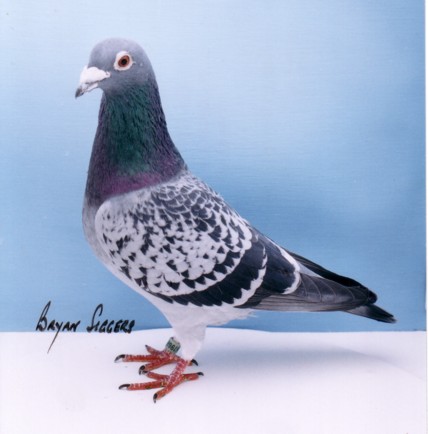
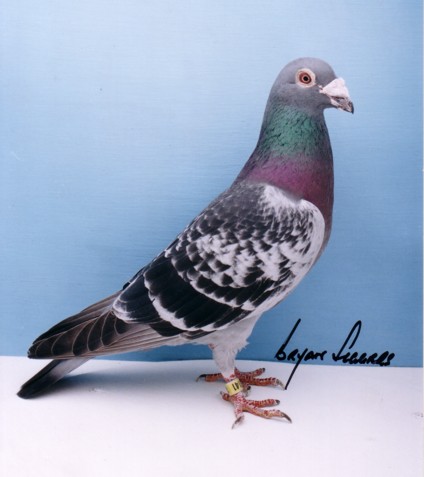
Palona
1st Section, 7th Open BBC Palamos, also winning 1st Greater Distance Single Bird Club. A grandson of Ambition.
DO GOOD PIGEONS COME ABOUT BY ACCIDENT?
In my case certainly they can come by accident. Let me explain. In 1992 I was at an all time low with my pigeons. Every time I went into the loft I felt ill - and I mean ill. This had been going on for quite a while and I ignored it, like us pigeon men do. Anyway, I went to the doctor's for a blood test and bang, the dreaded pigeon lung. A reading of 132 which, by all accounts, was very high. Feeling very rough and thinking about packing in, I could not be bothered to pair up. April arrived and, still feeling rough and still not having paired up, one day I opened up the joining door of the two compartments and let them get on with it. A lovely well-balanced yearling hen took a shine to the longest caste, large-keeled bird in the loft who, I may add, had flown well up to 540 miles, particularly on hard days. From this maiden hen, and yes I believe in maiden hens, hatched a little dark cheq hen that we raced as a youngster in 4 races and then stopped. By this time I was carrying on with my birds but trying to be very careful about the amount of time I spent in the loft. I was wearing a hat, coat, mask and wellies and looked like Darth Vader! I also opened my loft right up ventilation wise. I don't know about drafts, it felt like a hurricane when the wind blew, but I had always wanted tough pigeons and my dad always said fresh air won't hurt them. As a yearling the little dark hen had grown a bit and gone nice in the hand and slightly long caste. She was raced in my club up to the coast and then flew all four Channel races up to 473 miles, taking minor cards in two of them, and two of these races were very tough - the longest two. After the four Channel races she still looked great so I sent her to Saintes, 540 miles, with the N.F.C. and she was my first bird back. I thought this hen has what it takes so as a two year old I prepared especially with the Pau National in mind. I did what I thought was the correct preparation with light racing to the coast, one Channel crossing of 308 miles (where she was my clock bird), rest and light training only, then into Pau. It was a day I will never forget because near Grimsby we have Humberside airport and on the day I was expecting the birds, which was Saturday afternoon after they had been liberated at 1.30 p.m. on the Friday, Concorde was making a special visit to Humberside airport so I had the radio on listening to the coverage and I could actually hear Concorde coming into the airport. Also I had a tennis net rigged up the full width of my small garden and we were playing tennis. I know you may think 'Tennis while waiting for birds?' but I have always played football or tennis in the garden with my sons whilst waiting. It passes the time and if you're doing something daft like we do then that's when you get a pigeon! Jonathan said, 'Dad, there are two birds flying around.' I stopped and looked upwards and they went past the house, then flew around together for quiet a while. I did not know if it was a Pau bird or a late one from the earlier club race. Then one of the bids came back on its own after disappearing out of sight for a while and landed on next door's roof, a thing my birds never do. After calling the bird it came down and it was the 2 year old dark hen but this time not so dark, she was two shades lighter than when I sent her due, I suspect, to flying in the heat for many hours. For her efforts she finished 1 st Section, 37 th Open Pau, 703mls, vel 1063, flying 19 hours 23 minutes, 5,976 birds competing, also winning 1 st North East 700 Mile Club and a North East R.P.R.A Region Award. She was named Ambition after that performance and she has gone on to be the mother of my present day national family. She has bred winners for us and other fanciers the length and breadth of the UK, from 68 miles to 815 miles and indeed is the granddam of Palona, our 1 st Section, 7 th Open Palamos and 1 st Single Bird National Palamos winner in 2003. The question was 'Do good pigeons come about by accident?' Well Ambition certainly did. I would never have paired up that cock and hen if I had not been poorly, hence they picked each other, although on paper their bloodlines were spot on. Do the birds know better than us?
IS A MISTAKE EARLY IN LIFE OFTEN WHAT 'MAKES' A PIGEON?
100% YES. I actually like my pigeons to make a mistake to see how they handle it. I must stress though that they cannot keep making them, it either makes them or breaks them. All of my good birds have made mistakes early in their flying life and have come on leaps and bounds for it. I don't mean coming late every race or coming home in a box, but maybe they have been picked up exhausted outside another fancier's loft, been fed, watered, and left a week before being liberated and coming back home under their own steam. I can also recall several instances of where late in the evening, after a 3-hour race in the daytime has come and gone, a bird has arrived out of the north instead of the south after about 10 hours' flying, showing that at least it's rectified itself after getting in the wrong batch and flying miles offline. You could answer this by saying 'stupid bird, it should not have done that anyway,' but I'm talking of a young bird here or an inexperienced bird not a seasoned campaigner. These birds have learned from these early mistakes and gone on to be worthy distance performers for us. One of our greatest racers, Lona, in the second race of her life as a young bird was lost at 80 miles, a race which was a disaster with 70% of the entries in the whole federation missing. She came back the following year as a yearling looking a total mess with every feather frayed and with heat burns on all her flights. When telling fellow club members about her, a couple said, 'Bin it Paul,' but Paul had other thoughts so I left her to moult out. I gave her a bit of training as a 2 year old, two inland races from which she came fine then entered her in the Nantes National, 438 miles, where she was my third pigeon on the day, 12 hours on the wing. Then she went straight into Barcelona, 842 miles, finishing 3 rd Section, 55th Open. This race was a total stinker (not the convoyer's fault I may add) with heavy non-stop rain in the UK and strong north-east winds to finish into. That was 1997 and the British Barcelona Club haven't been back to Barcelona since! I believe the mistake as a young bird made Lona into an individual and gave her the confidence to fly many hours on her own, as she often did, and put up some fantastic performances, the pinnacle for us being 1 st Section, 46th Open Palamos, the only bird in the Section in race time. The next season she took 2 nd Section, 68 th Open Palamos, making it 3 times Spain to Grimsby. Indeed she scored in 8 different nationals from distances ranging from 370 miles to 842 miles.
But where did she get to as a young bird?
RALPH BRADURN
Well, not until Lona was 5 years old did I find out where. It was summer 2000 and I was laying a concrete drive at my house, wondering in my mind how Lona would be getting on on her way home (hopefully) from the Bordeaux National. It was the first day of the race and there was no hope of an arrival to Grimsby at 600 miles in unfavourable head wind conditions, hence the concrete bashing of my driveway when a car pulled up and a tall, smiling gentleman asked, 'Mr Woolliss?' I replied, 'Yes'. 'Hello,' he said, I've come to tell you what happened to Lona.' I was baffled, thinking he was going to pull her out of his boot dead or something, and I said, 'What do you mean what happened to her, I'm expecting her home tomorrow from the Bordeaux National with the BBC.' He continued: 'My name is Ralph Bradburn and I live and race pigeons at Loughborough in Leicestershire. I'm retired now but I worked at a foundry where metal was melted down. The factory, for whatever reason, was a magnet for tired racing pigeons and they would sit on the building. When the fires were lit they would give off poisonous fumes and unfortunately the pigeons would fall to the ground either sedated or dead.' Ralph explained he had saved hundreds of birds over the years and every time he picked one up he would write its number down in his little book. This book was like a bible and there were literally hundreds of pigeons recorded in it. Some, unfortunately, could not be saved, others he would take home until they recovered and he would then liberate them or report them to their owners. Whilst reading the B.H.W., Ralph noticed Lona's ring number in the results and noted she was one he had looked after. Ralph said he promised to himself that he would drive to New Waltham one day and tell me his story. He told me he had retired when he received Lona but his friend rounded her up with some other birds whilst on the night shift, his friend thinking she would not pull through. He took Lona to Ralph and he revived her. After a few weeks, Ralph took Lona to his holiday caravan at Chapel St. Leonard's, which coincidently is one of the places I trained her from as a young bird, and home she duly came.
To me Ralph Bradburn is one of the true giants of the sport, loving and caring for thousands of lost racing pigeons without their owners ever knowing and being able to thank him because he declined publicity for his good work. Meeting Ralph and his lovely wife Terri and knowing what he did for my bird has been my most pleasing thrill to date. I asked Ralph if he would come back in a few days when I hoped and prayed Lona would be home from Bordeaux so Ralph could handle her. Luckily she came on the Sunday lunch of the race, finishing 9 th Section, 283rd Open, this after flying 815 miles four weeks earlier when finishing 2 nd Section, 68th Open Palamos. So, do birds learn by their mistakes? Well the good ones do. Finally I would say it's kind acts like this one which make our sport so great and unique.
No part of this site may be re-produced without the permission of
Elimar Pigeon Services