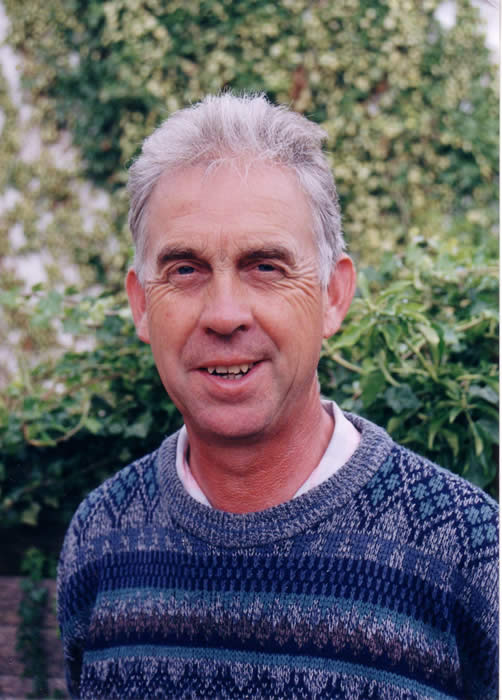
PETER HAGLAND
of Doncaster
Talks to Cameron Stansfield
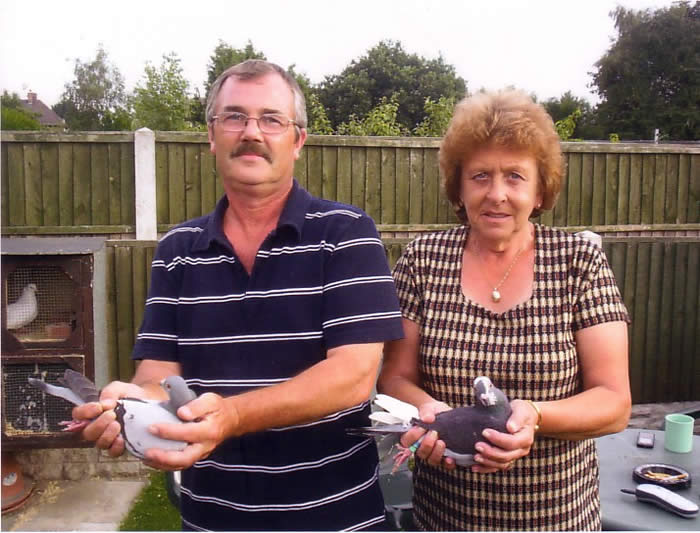
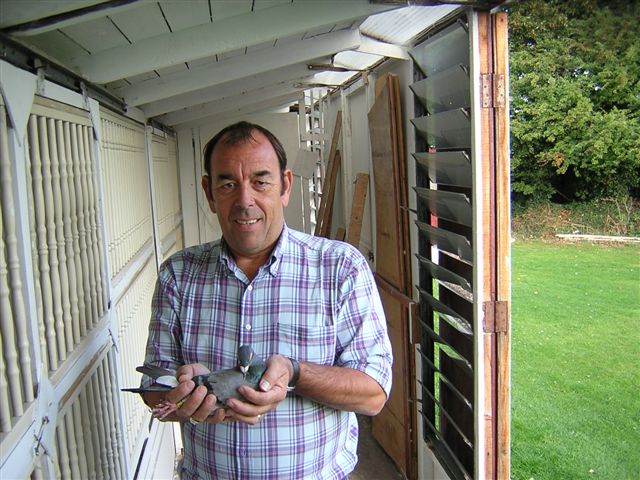
Peter & Cynthia.
When a fancier of such long standing as Peter Hagland says to you, ‘I have never had pigeons in such fantastic condition in all my life’ you have to sit up and take notice. That was what Peter told me when I rang him in the wake of his 1st & 2nd Section K, 2nd & 3rd Open National Flying Club Saintes, 530 miles on the day, his two hens arriving together. I made a mental note to ring him again in the close season with a view to a write up – and in the interim he went and won the Section from Chale in the Young Bird National. Not only that, he was also 2nd, 4th, 8th, 9th, 10th, 12th, 13th and 27th Section!
The thing I wanted to get to the bottom of was his system of racing hens and the reasons for why they are in such ‘fantastic condition’. Let’s look at what Peter does, starting in the autumn, for the benefit of those of you reading this who might want to give the system a go, starting right away.Peter’s birds never go out of the loft from the start of October through to the following March. He has four lofts but condenses the birds into two of them to make winter management simpler, the racing and stock cocks going in one loft and the racing and stock hens in another. The widowhood cocks therefore do not winter in the boxes to which they race, which allows Peter to introduce the yearlings to the widowhood section and let them claim a spare box before the older cocks are re-introduced. He feeds everything the same, the feed dictated by the need to get the darkness youngsters through their moult. Remember, by September they may have only dropped one flight. They have a normal mix of Gerry Plus and Marimans Diet and plenty of conditioning seed and Peter says he hasn’t failed to get a youngster through the moult by Christmas yet.The hens are always paired in spring, as are his widowhood cocks. In the past when only racing widowhood he paired in December but he has changed tack and has found it has made difference to his performances. He pairs his best 8 racing hens to stock cocks and transfers their eggs under the yearling cocks. All hens are allowed to sit for 10 days then the eggs and the cocks are taken away and the hens are effectively on widowhood. The next day they will be let out for the first time since the previous autumn. For a day or two they are feeling their feet but after a week are exercising well. From the moment their cocks are removed they are locked in their boxes when inside the loft, these being normal widowhood boxes, but they are able to see each other. They perch on upturned nest pans and are always fed and watered in their individual boxes.The hens race to a 12ft x 10ft shed that has a vent in each corner of the front and a vent on either side and at the back. These are not always open because he likes the shed to be semi-dark as the birds are a lot calmer that way. The widowhood cocks’ loft has an open front of wire mesh but sheets of perspex are fitted over the front in the early part of the week to darken the loft, then removed later in the week, which seems to get the cocks on their toes prior to a race. The cocks’ floor is made of MDF and the nest boxes in both lofts have just normal wooden floors – the birds standing on bowls not grills. The birds are cleaned out twice a day, this being a two-minute job. I’ll now let Peter explain his system in more details:‘I’m always reading and when I came across the system of locking hens in their boxes I thought it sounded a good way of keeping pigeons in condition. It is so simple and the people who come and handle these hens can’t believe how well they are.
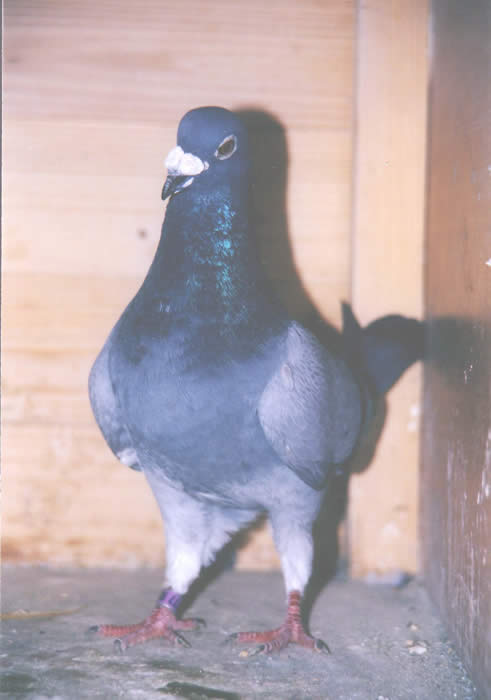
Peggy’s Boy, 1st Section 2nd Open National Flying Club Saintes and sire of 1st Section, 2nd Open National Flying Club Saintes.
‘I race them on an ordinary widowhood mix inland then a fortnight before the first Channel race, which is 315 miles, I add 15 per cent extra maize, peas and beans and they also start having peanuts, crushed in a liquidiser, which amounts to two peanuts per pigeon per night. I think this gives them more vigour and stamina. I don’t feed like this for the early inland races because I would have to go 40 mile up the road every day to get them fit! On the inland diet they handle like a typical widowhood cock, in other words nice and light and blown up. They are still light and buoyant for the Channel but the difference is they become rounder and more solid. I believe good pigeons have a good recovery rate so I expect them to be exercising well the day after a Channel race. Sometimes they amaze me by how well they fly.‘I can tell you this: my two hens from Saintes were very little different in weight to when they were sent and that’s being truthful. Twenty years ago on the methods I used that wouldn’t have been the case. Today you’ve got to treat pigeons like athletes because things have changed dramatically. Even in a nose-ender they are doing 1400ypm. Things are more hi-tech in the way of feeding and treatments and I think there has been a 50 per cent improvement in performance levels. I don’t believe you can be consistently successful today if you don’t treat.
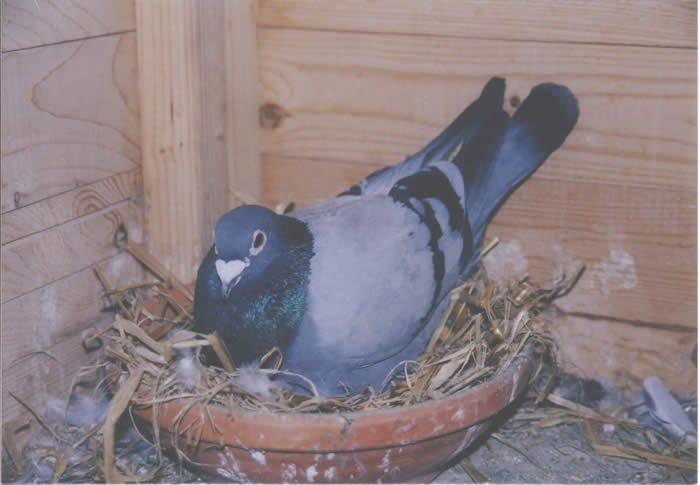
The Van Coppenolle stock cock.
‘In 2006 I followed the following routine: Monday – Chevi-col for canker, or Cocci-Plus, both given at half-dose on alternate weeks; Tuesday Orego-Stim; Wednesday Orego-Stim; Thursday Turbovit 1 & 2; Friday – clean water; Saturday – Orego-Stim or Chevi-Col. If marking on a Thursday I miss out the Orego-Stim on one of the days. I swear by Orego-Stim to be honest. I’d seen it advertised so when I went for my corn one day about two or three years ago I took a smell of it and it really cleared my throat, so I thought I’d give it a go. There are no magic tonics, however. For example, I used to use CLO on the corn and I was the highest prize-winner but I’ve not used it for years. I now use wheatgerm oil and garlic oil once a week. You have to find a system that suits your pigeons and then stick with it. People ring me to say they have a problem with their birds and when I start to probe I find they are giving them just about everything they can buy off a shelf. Their pigeons simply don’t stand a chance. That’s the difference between a good flier and a bad flier.‘It’s very rare mine aren’t right and if I wasn’t happy with them I wouldn’t send them, but that’s not the case with some fanciers. They just haven’t a clue; you see that by the condition of the birds they put in the basket. To me the welfare of pigeons is paramount. If you’d witnessed the arguments I have had you would know what sort of pigeon man I am. ‘I stick to a system religiously because pigeons don’t like change, whether it be corn or feeding time or whatever. My hens have always got food in their pots and I also use a hook-on pot as a drinker. One advantage of this is that they are not all supping out of the same drinker so if one has picked something up it can’t spread. If one drinks more than the norm I become suspicious.’Peter has not club raced since 1998 and these days he sends his birds in the Northern Provincial for training purposes (he does not have a clock set). They are given a couple of chucks pre-season then have no more training. Once started, his hens go every week and this includes over the Channel unless, of course, they hit a bad race. In 2005, 99% of his hens flew 5 Channel races, including the yearlings. He believes that good Channel pigeons don’t come into form until after they’ve had their first water race as this knocks the cobwebs off, so once they have had one he gets more confident.
Peter continued: ‘I love my pigeons to bits but I can be very hard with them; the hen that topped the Section at Saintes, topped the Section from Tours with the MNFC as a yearling and that was her fifth time across. I wish I could tell you why it is they keep their appetite and enthusiasm. In all my years of racing I’ve never known hens to love what they are doing so much. I’ve really studied them and they are so bonded to their nestbox it is unreal. You can put any cock in with them and it doesn’t matter – even a fantail. When I walk in the loft they all start spinning and I have to hide when I let them out for exercise. They are still as keen come the last race. If I had the resources I could definitely see me racing 40 hens and not bothering with any cocks. They are just so happy and content.’
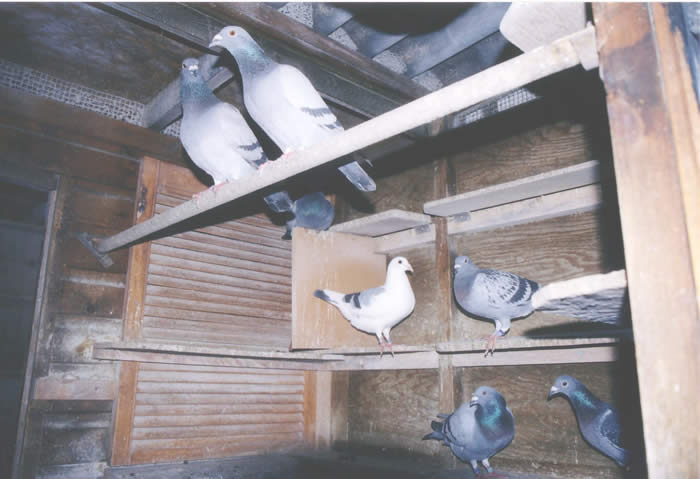
Peter’s young cocks.
Peter does not even turn their nest bowl over on basketing night, the only time he does so being on their return from a race when their cock is waiting. Because he does not want to break this bond to the box he is careful not to leave the cocks in too long, only allowing them to stay overnight if it has been a very hard race. He has also noted that their recovery rate after a race is definitely better than it is with a natural pigeon – the 5 Channel races per season per hen being evidence of this. He believes this is because they are sent fitter, with this fitness being brought about through their mental state. Unlike natural hens they have not got as much pressure on them because they have fewer things to think about.When Peter first adopted this system he was concerned the hens were not exercising like they should around home but he has come to the conclusion that this is because of their desire to be back in their box. They are now force exercised am and pm for half an hour, and as soon as the loft doors are opened they dart back into their boxes.How long can he keep pigeons motivated on this system? All he could is that he has been doing it for three years and has a spread of good performers up to four years of age. He doesn’t lose many, despite their heavy programme, which seems to suggest the hens don’t get fed up.I asked Peter if the condition of his hens was better than that of his widowhood cocks, and he said ‘definitely’, so I queried whether this was perhaps because his widowhood system left something to be desired, but he told me he didn’t think so as he has flown widowhood successfully over many years, winning inland and Channel averages along the way. He races 17 widowhood cocks and it’s not very often one beats his hens and when one does it usually means it takes a good position. He might, one year, try locking the cocks in their boxes, in the same way he does with the hens, to see if this brings about an improvement.
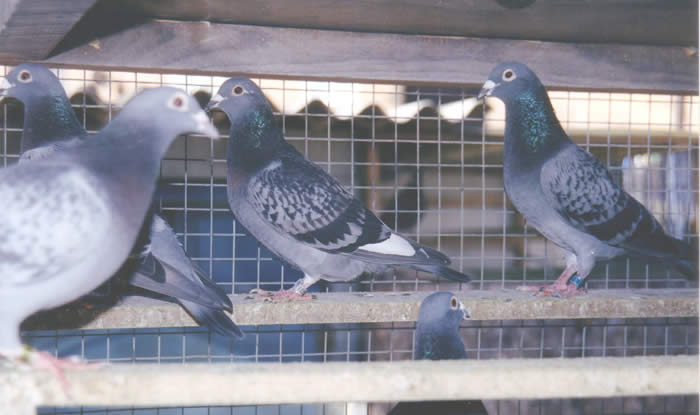
Some crackers.
Peter says, ‘I’m a person who will try anything to get that bit extra out of a pigeon. I think contentment and motivation is 50% of the way there, the system you use being a big factor in the making of the pigeon. If you’ve got good pigeons you know the calibre of the birds you are putting into the boxes. I have 27 years of breeding behind me and can pair good to good and that’s the only way to go forward.’In the past, before he adopted his new system, he had re-paired his widowhood hens, only for them to go flat, so why then did he re-pair for the Saintes National and was he confident? ‘I just thought it would give them an edge after not having reared a youngster all year but I wasn’t confident, otherwise I’d have pooled them in the Open! A good pigeon is a good pigeon but when you change something there is that bit of doubt in your mind!’Peter’s two Saintes hens were separated by just seven seconds on the clock. The Section winner, ‘Cynthia’s Pride, has previously been 1st Section, 12th Open Midland National Flying Club Tours, and her sire is Peggy’s Boy who also won 1st Section K (only bird on the day), 2nd Open National Flying Club Saintes. He is a Herman Beverdam x Andre Berte Janssen. The dam of the Section winner is a Haelterman of Frank Tasker lines which Peter brought in many years ago. His second hen is out of a Herbot cock and a Busschaert hen from Peter’s brother John. Both hens were due to chip on the day of the race but Peter slipped their first youngster of the year under them on the Tuesday before marking. This is the first time he has tried this method as his boxed hens have flown dry for the last three years. He has never had an egg in that time.
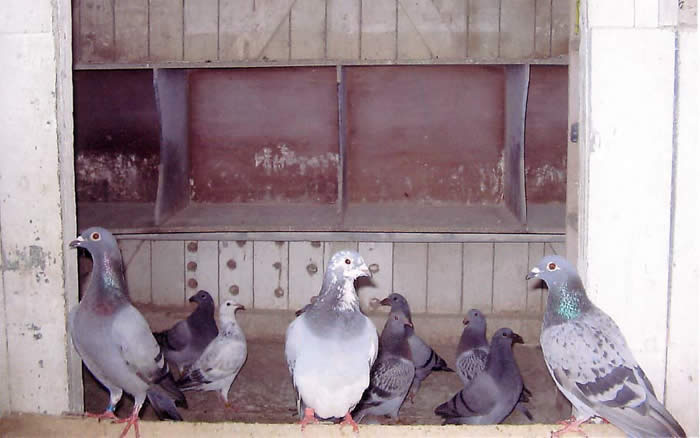
The future.
Another upside of the sytem, is that they are likely to be no further on than their second primary by late July.His Section winner in the Young Bird National from Chale is a Janssen/Herman chequer hen raced on roundabout; she was one of 9 loftmates timed. Her sire is out of Peggy’s Boy when he was paired to a daughter of a Herman cock who won 18 x 1sts.‘I give my young birds loads of training. This year I had 10 January-bred youngsters and the others were weaned in April. The January youngsters were in training by April 7th and the others by the time they were doing an hour around the loft at 8 or 9 weeks of age. I think it’s very important to train them as early as possible. This year before racing my youngsters had around 40 tosses, all on the line of flight, all being short and frequent, with plenty at 8 miles, plenty at 15 miles and about 5 at 20 miles. I got to the stage where they were out of the basket and bang, they were home so I was confident I had a good team. They had no more tosses once racing began. I started with 75 and after some really hard races I had 56 left before the National, with most having had 4 coast races. I sent 30 to Chale and had 25 home. I don’t think good fanciers lose many youngsters.‘In the past I’ve tried giving them two or three races and stopping them and I’ve tried not racing them at all – with little success – so I now believe the more experience you can give them the better. Yes a good pigeon is born but a good pigeon man can make a mediocre pigeon into a better one. My belief for quite a while now is that they are better to have raced the Channel as youngsters so I have no fear of sending them 350 miles, nor any fear about sending yearlings over 500 miles.‘Everybody gets Young Bird Sickness, and all I do is hold off their corn for 12 hours then feed them lightly with yoghurt in the water. This works and I have no further problems. I wean young birds on Gerry Plus and race them on it until they get across the water, when I feed them like I do the old birds. They are reared on breeding mix. Normally my young birds are January-bred and are on darkness from weaning until July 2nd but this year most of my youngsters were April weaned and were on darkness till the second week in July. This is the shortest period I have darkened them and it has made no difference to their performances. I race on a straightforward roundabout system, the sexes mixing before a race - there’s nothing more to it than that. Some years I have paired them for the final race after they have been flying well on roundabout but they have gone downhill so now I don’t do it.
‘Though not all my best pigeons have shown themselves as young birds my best hens have always won as yearlings. The box system finds them out more quickly - and I have an instinctive feel for those that are going to win based on what they are off.’
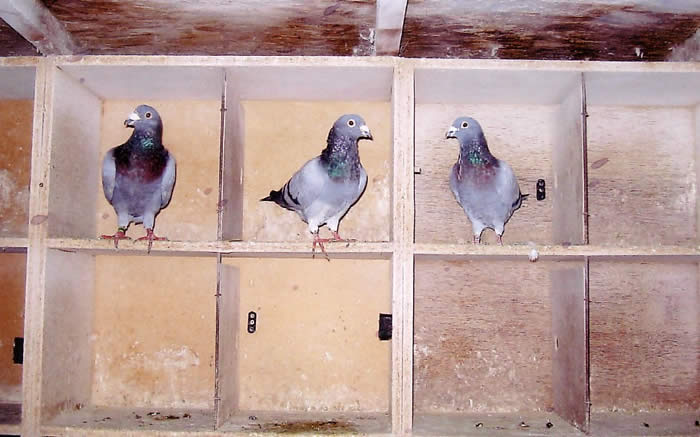
Three lovely cocks.
Peter doesn’t think the breed of a pigeon is relevant to how it will adapt to the system but he does have reservations as to whether the family he has evolved will be effective if pushed out to Tarbes. This is because he has developed pigeons which will put it all in on day one, which are racing under a system which encourages them do so. From Tarbes he feels he will need a pigeon which won’t put it all in, even though it’s on the same system, and so he has brought in some new birds, these being Bruce Millard (1st & 2nd Open British Barcelona Club Palamos), Mike Young and Fear Brothers pigeons from Eric Askew of Moorends, Doncaster. Peter says he has never seen pigeons with wings like them, certainly they are different to what he has enjoyed success with himself at 500 miles so he doesn’t know what to think; the broadness of the flights is striking and there are no significant gaps in the wing. These birds will be raced pure and crossed and they will have to adapt to his system as he will not be changing it to accommodate them; he feels the make-up of the pigeon will be what gives it that get up and go on day two. He says: ‘I’m confident I will get a team for Dax or Tarbes but I’m not going to say how long it will take me because I know how long it took me to get my current team together. I do know that I will have to crawl before I can walk. That is not to say mine are just easy day pigeons: When Peggy’s Boy was 2nd Open NFC Saintes in 2002, he was 13 hours and 57 minutes on the wing in a north-west wind and he could have gone on for another two hours. And he was the only bird in Section K to make the first 200 of the Open. But do I push them to Tarbes to see if they can do it or keep them to 530 miles, which I know they can do? Is the risk of spoiling good 500 mile pigeons too great?’ When you get good fanciers talking freely, it’s refreshing when they avoid going down the path of self-effacing humility just so they don’t leave themselves open to being criticised. This is what Peter had to say about bringing in fresh pigeons and type in general: ‘I’ve always had pigeons off good local people, picking my own based on what I liked by looking at them and handling them – the pedigrees don’t interest me. I have never bought pigeons over the phone. It might make me sound obnoxious but my judgement is brilliant and I have never picked a bad one yet. I think we are all born with a gift and that is mine. I can see quality before picking a pigeon up, but I am a better judge of a cock than a hen. I’ve bought cocks and they have been really outstanding breeders – something just hits me when I see them. They have to have the eye I want – no, that’s a bit of a fib because I wouldn’t have bought these Fear Bros/Millard pigeons on their eyes. They are yellow with not as much in the iris as I would like but whether it’s because they have been inbred I don’t know. My best stock birds have a deep iris, a full circle on the outside of the iris, unbroken and the thicker the better, and the eyes are nice and bright. Peggy’s Boy does not look to have the richest eye at first glance but when you put him under a glass it’s different. A good stock bird has it all – good eye, good feather, good balance. On my Channel birds I like to see a nice step from the secondaries to the primaries and the feathers to be silky.’
I asked Peter which fanciers he rated and he made me laugh when he replied: ‘Myself!’ before adding ‘I never underestimate the pigeon men in Britain – you don’t have to go to Belgium to find the best pigeons and the best fliers. If I had to re-start tomorrow with completely fresh pigeons I’d be very confident I’d be back to where I am now within three to four years – It sounds like I’m bragging, I know, but I’ve learnt a lot over the years. I spend 24/7 thinking about how to improve and I know one thing, the man who puts in the extra 5% will win. I’m in the garden for six in the morning but how many fanciers are prepared to do that or to train before they go to work? But even having said that, I couldn’t achieve my performances without the help of my wife Cynthia. 17/11/06