TOMMY BAKER & SON
of Ruabon
1st & 6th Chester Two-Bird Sartilly Yearling Race
by Cameron Stansfield
Regular readers of J. R.'s notes in the British Homing World will know that this year's Chester 2B Sartilly winners, Mr & Mrs T. Baker & Son, are one of Wrexham Federation's foremost pigeon partnerships. Suffice to say, Tommy and son Rich are past winners of four 1st Opens in the Welsh South Road National, from Dover, Falaise twice and Guernsey, and on the same day they won the Chester 2B they also topped the Section from Nantes in the WSRNFC. They never send more than five or six to a National and their four National wins have come from a total send of 17 pigeons.
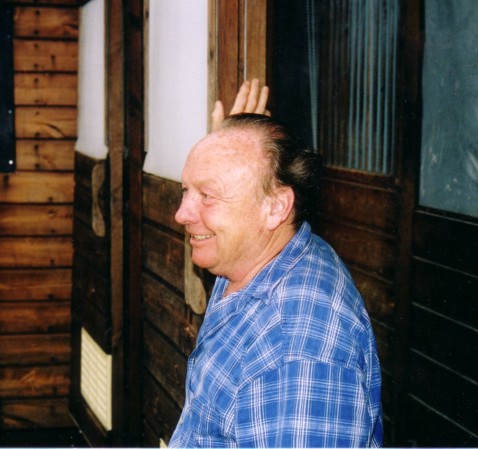
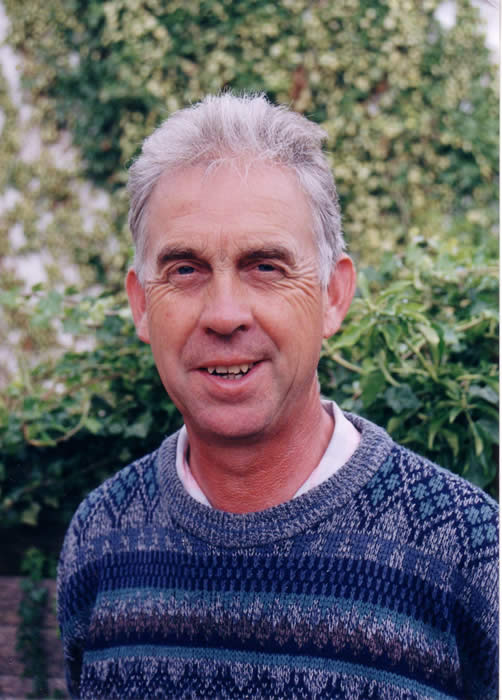
Tommy
The 2004 season could have seen them struggling because over the preceding winter they had decided to retire the bulk of their best racers to stock, which left them starting the season with a team made up mostly of yearlings, 36 in fact, and just eight older birds. With the future very much in mind, they gave these yearlings three Channel races each and 26 of them came through the test. These birds will be set up for specific races with confidence in 2005.
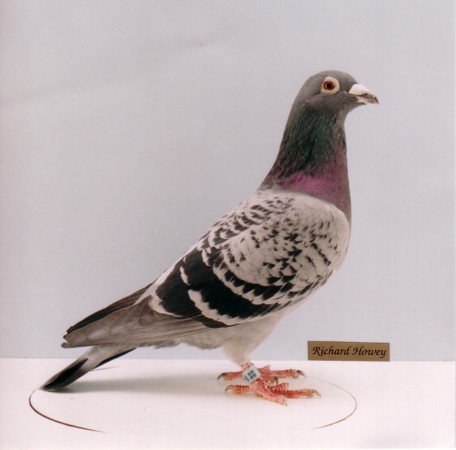
In 2004 they raced roundabout for the first time. Prior to that they had raced around about 20 - 24 widowhood cocks and half a dozen hens. They noted that pro rata the hens were taking just as many prizes even though they weren't being given the same attention, so they have upped their hen quota. They believe the key factors are health, condition and motivation, and stress that you won't win if you don't know how to motivate pigeons. The Chester 2B winner is a classic example. As a youngster she had five inland races and then won the Gobowen 2B from Picauville by 146ypm...sitting nine-day eggs at basketing. Though on roundabout as a yearling, she was re-paired for the Chester 2B and sent sitting nine-day eggs and again she had had five inland races. How many fanciers would simply have left her on roundabout? Incidentally, when re-paired she was the only hen in the section with her mate and all the other spare cocks. She is a Huybregts, a gift from Darren Roberts of Wrexham. Just before basketing for the Chester 2B the partners took three birds training. They let their winning hen go first and she promptly landed in a tree, where she sat until they let the other two birds out. Tommy says that had they taken only the one hen, they would have been so concerned by her behaviour, they would not have sent her to the 2B. They surmise that she must have been scared by a peregrine on a previous flight. By the way, the hen who topped the Section from Nantes on the same day was still on roundabout.
They are always trying fresh pigeons but they never buy unseen - they have made that mistake. They prefer small-to-medium birds, apple bodied with plenty of front - like a wedge - and above all, birds with constitution, but they say they have won with different types of pigeon. They note that the pectorals on the Van Reets in particular are pronounced.
They think they have about eight birds they could call top breeders at present in the stock loft, plus children off them. Two of their main breeders are a nest pair of Mardon Van Reets; the hen has bred multiple 1st prizewinners and the cock 18 x 1st prizewinners. Tommy asserts that the mainstay of any loft are good hens and if you haven't got them you are in deep trouble.
Tommy says rest is sometimes better than training but knowing when to do what is down to being a good fancier. He says if you sent to the first four or five races and they did well, but from the next race they returned looking tired, then if trained again they wouldn't win the following Saturday. It's common sense, in other words. They very rarely train old birds after the first race and they very rarely train beyond 20 miles, old or young. As he says, if racing was all about training, the man with the most time and plenty of petrol would do all the winning. The partners say their birds fly fantastically well at home and that this is down to being in condition, not through habit. They also think that widowhood cocks are best in spring and early summer, then they can go off the boil. To counteract this they have three sections and they stagger the work these have so that they remain competitive all season. The second section gets going a month after the first section; the third section is for the Channel birds and these go perhaps every other week and might have no tosses whatsoever.
They say that pigeons which make the transition from winning in the Club and Fed to winning in the Nationals are about 5%. They are always looking for that pigeon which comes straight and on its own, not flock pigeons. Rich said that on winning the Gobowen 2B in 2003 he felt more excited than when winning 10 x 1sts Club added together.
Rich's ambition is to do well from Nantes, Saintes, Niort and Pau; Tommy just likes on-the-day racing, whatever the distance. They say the pigeons they have at present are capable of winning up to 520 miles on the day but beyond that they don't know because they haven't sent them. Tommy says a good fancier is one who wins inland and Channel. They think pigeons are now faster because of feed and health, not because pigeons themselves are faster, and they say it is harder to win today than ever. Incidentally, when I asked Tommy whether he still got the same buzz out of racing as ever, he replied that he even gets excited when he sees a batch of trainers going over!
In 2004 the birds were paired on January 28th and reared a pair of youngsters. The cocks finished off the young birds then after a fortnight they put the hens back with the cocks. When the oldest egg was eight days old, they then removed all hens whether they had laid or not. This brought them to 10 - 14 days before the first race, during which time they were trained every day, weather permitting, from eight miles. They didn't go further because at that time of the year it was too cold.
They say the most important time to observe pigeons is in that first hour after they return from a race; this is when they pick their poolers for the following week, going for the ones that look tightest and freshest, what they call 'no-trouble pigeons'. They are generally intolerant of sick pigeons and if they think it necessary they will remove the sick pigeon and the whole line related to it. Tommy says he can go to anyone's loft and tell within seconds if the birds are not quite right.
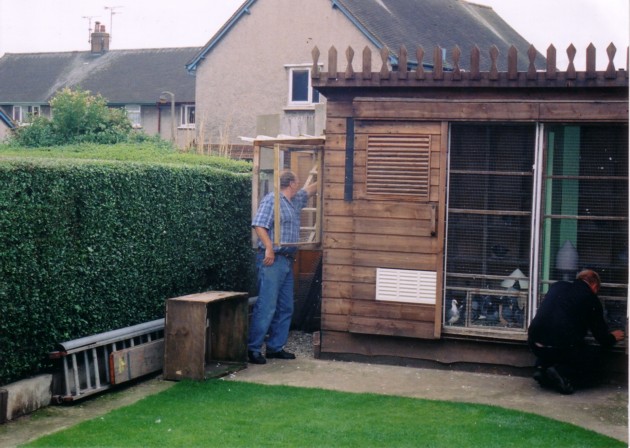
The young bird section
The partners basically believe in pairing good to good and they say when you lose your winning size you've had it so if you cross a good big pigeon and the offspring go smaller you are on the wrong track and likewise, if you cross a good small pigeon and the outcome is bigger pigeons, you are in trouble again. When crossing, therefore, try to make sure the offsrping are to the size of the winning parents.
Youngsters go to every race down to the coast and a few go across the water, with the second Channel race with the WSRNFC being where they expect to do well. Incidentally, in 2003 they started with 52 youngsters and 50 flew the inland programme. All youngsters are treated exactly the same, regardless of parentage. They enter young birds in every race but although they always set out to win, they say they would rather have pigeons come to win and not trap but be well fed than win with pigeons that had been kept short. Their eyes are always on the future. They have been flying darkness since 1996.
The birds have only grit and minerals when rearing. On the corn they use cod-liver oil - just enough oil to glaze the corn - and Provit once a week and Tommy is a big believer in lettuce.
The birds are fed HP Economy as a base feed. Tommy queries why fanciers have a thing about not giving maize to youngsters when, by the same token, they feed maize to their widowers to make them go faster - he says it doesn't make sense! They like big maize because the bigger the maize the bigger the kernel and it's only the kernel that's any good. Popcorn maize, they believe, pleases the fancier, not the pigeon, and they steer clear.
Once the old birds have finished racing, Rich & Tommy don't clean out, preferring to leave the birds well alone. The birds don't go out much in early winter and in December would fly perhaps 20 minutes if let out but by January they will be flying for an hour. During the season, after they have done their hour plus, they leave the doors open for 10 minutes. Cocks and hens on roundabout exercise only once a day.
To describe form in a hen, Tommy said: 'Picture a hen sitting. Her eye seems to go massive and though her head doesn't turn and her eye doesn't move, she follows you round the kit.' Also they want to see their birds eating fast to show they are well - 'fast beaks' they call it - and they liken it to the sound of a pneumatic drill.
Tommy firmly believes that good pigeons are born. He says you can give a good pigeon just barley and another pigeon the best of everything, and the good pigeon will still beat it. He and his wife and son would like to thank Tony & Ann Mardon and Curtis, Wall, Lunt & Green for the good birds and wish to say that the people they admire most are their hard-working fellow club members who keep at it week in, week out.
Finally, Tommy has a motto: 'If you want to keep 'em, try to lose 'em. If you want to lose 'em, try to keep 'em!'