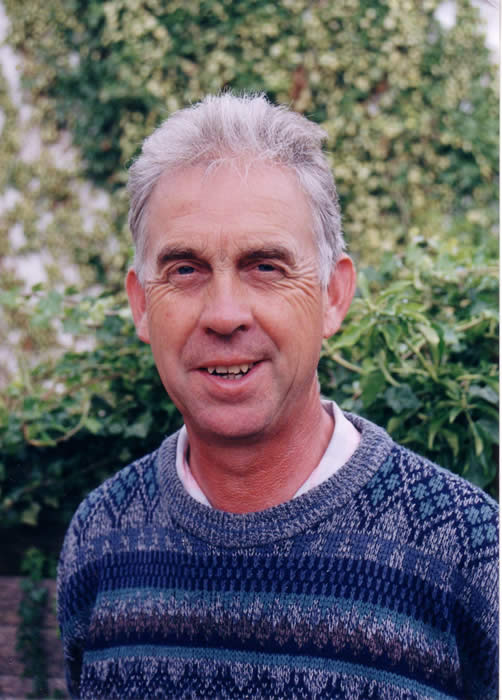
STAN DANGERFIELD
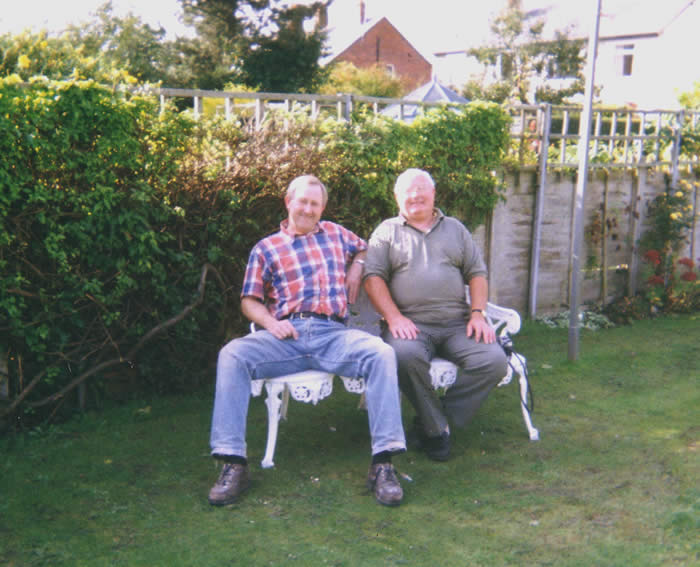
talking to Cameron Stansfield
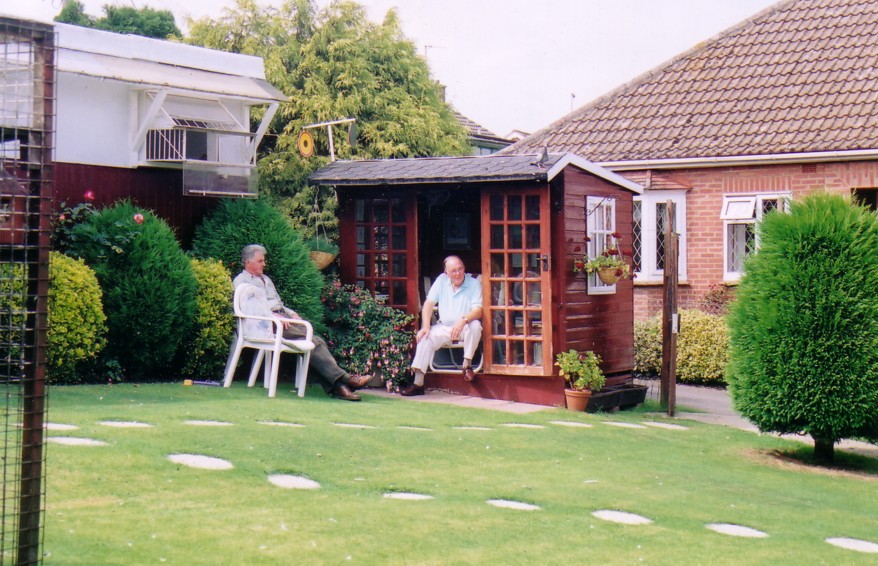
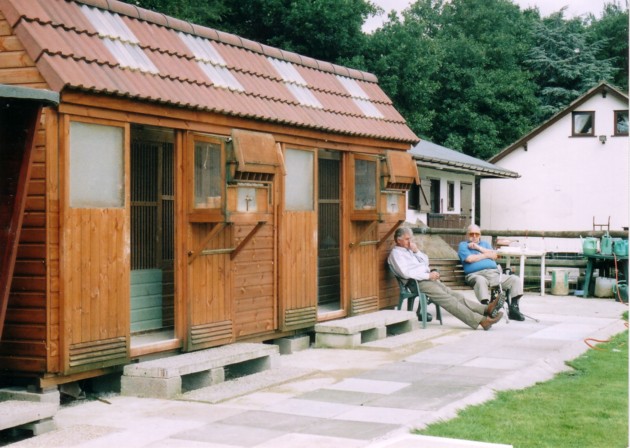
Stan inside his summerhouse, chatting with Brian Stansfield
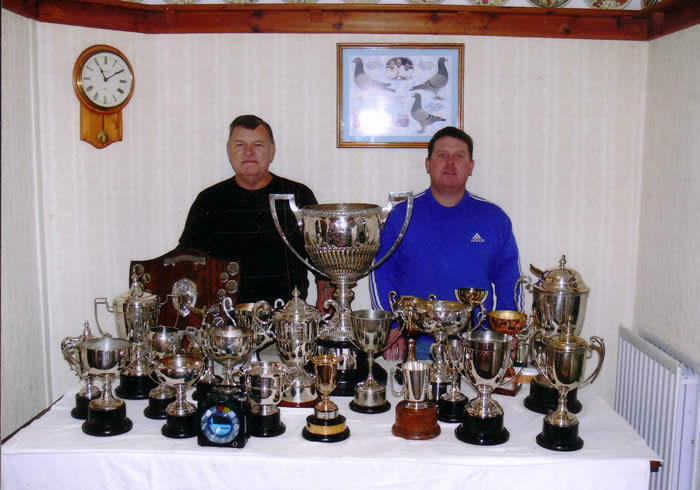
There are few more popular fanciers than Stan Dangerfield, and few more successful. Stan has been winning at club level through to national level for donkey's years and, in June 2002, he enjoyed a fantastic weekend, winning both 4 th Open BBC Palamos and 1st Open CSCFC San Sebastian. When asked to pen an article, he replied that he isn't much of a writer but would be happy to sit down and talk about his methods and observations. Here then is what he had to say.
'My present day methods have just evolved really. About 10 or so years ago, though I was doing really well racing natural (I'd been, for example, twice 3rd Section Pau with hens), I thought I'd give widowhood a go. I tried it for a couple of years, at first keeping my widowhood hens in separate boxes. My late wife, who helped me a lot with the birds, was not happy about it and told me that if I was going to keep pigeons in boxes she was not going to contribute, so I went back to natural for a couple of years. My performances were still fine but I decided to give widowhood another try. This time I put all the hens in an aviary away from the main racing loft, and the results came immediately. At about the same time I did away with feeding a heavy bean-based mix and introduced a high carbohydrate mixture. At that time I used Dufky Elite, but in this locality it can be difficult to get, so I eventually moved on to Versele Laga Super Widowhood, and during the 2002 season I fed their Widowhood Plus mixture. To compensate for the lack of protein in the mix I fed peanuts, though not too liberally as a pigeon will carry on eating them until there's no room in its crop. I feed perhaps 6 to 8 peanuts per pigeon each evening. I wean youngsters on a high protein diet but once they've got a frame on them, after about 6 to 8 weeks, they too are fed a high carbohydrate mix. One of the things I like about the mix is its dari and safflower content as I believe it helps the feathers and it means I don't have to think about adding oil to the corn. My stock pigeons also receive a high percentage of safflower and dari. My birds do not seem to become more advanced in the moult through feeding like this; in fact my 4 th Open Palamos pigeon had not thrown a flight when he homed. On this diet my pigeons fly more freely than when I fed, what you might call, just a normal racing mix. In the past I'd fed beans in every way, shape and form, and I still have Tom Clarke's old kibbling machine to this day. (Tom used to kibble his beans and give them as a titbit to get even more protein into them.)
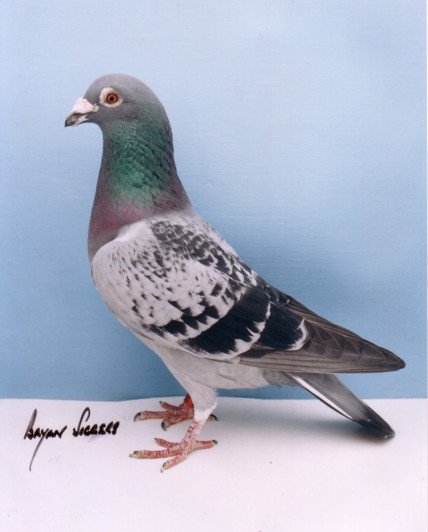
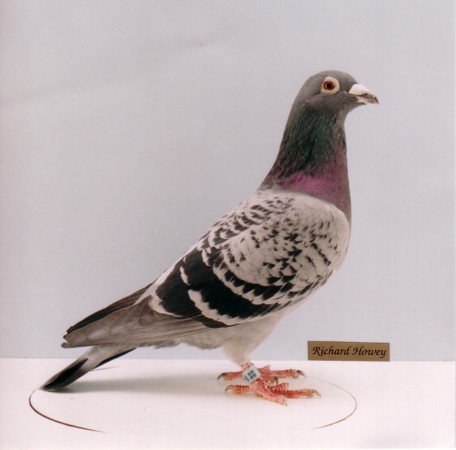
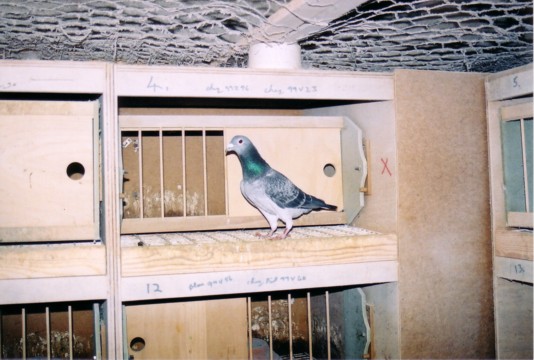
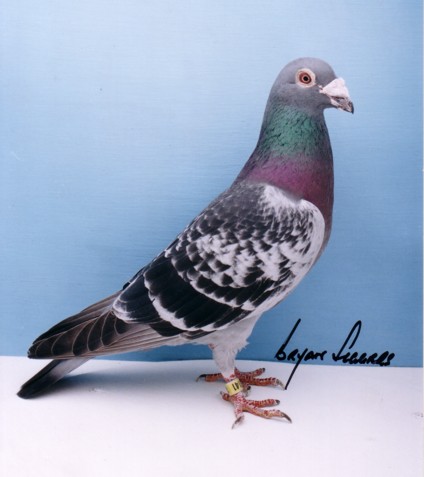
4th Open BBC Palamos
'I flag my widowers for 1 hour am and 1 hour pm and then they have half an hour to do just what they like - picking around the garden and clapping off. This half hour is important for both the pigeons and for me. They get used to their home environment and I can watch their behaviour and learn a lot from them. After both exercise periods they get a Horlick's spoon each of their main mix, which amounts to three-quarters of an ounce am and three-quarters of an ounce pm. I feed exactly the same throughout the season.
'During the last 4 or 5 years we've had a lot of north-east winds in the early weeks of the season and I will neither flag nor train pigeons in such winds. My widowhood cocks have 2 tosses at the beginning of the season and, providing they are fit and healthy, will be raced every week, or fortnight, through to the coast, approximately 60-80 miles. Thereafter they go to selected races every other week, but before a long race they may have 3, 4 or even 5 weeks off. The pigeon I clocked on the day from San Sebastian in 2001 was having his first race for 5 weeks. Mention of which, brings me to something that I've learnt from experience and that is that a pigeon which has flown that kind of distance on the day, wants more than 12 months' rest. I lost that San Sebastian pigeon this year, and I lost a pigeon which flew Pau for me on the day, the year following. I know San Sebastian 2001 was not the hardest of races but I still think it took a lot of mental effort on the pigeon's part. It is a different matter if a pigeon is up at midday and flies half the race one day, and half the next; those I will continue to race the year after.
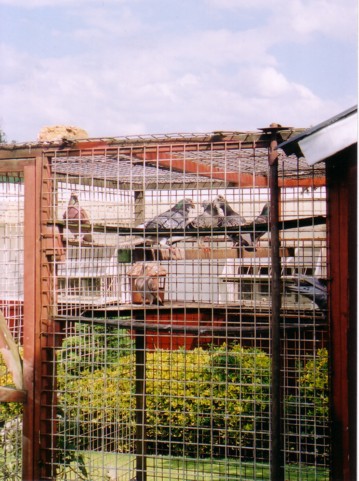
Stan's stock bird aviary
'I think widowhood pigeons fly more freely and easily than natural pigeons and I put it down to them only having one thing on their mind - their box. A natural pigeon has to think about its mate, its nest, its box, its eggs or its young. I could race a hen brilliantly on natural but you have to make a fuss of them and you have to keep a lot to find a few which are on form at the right time. Incidentally, the 2 hens which both won 3rd Section Pau for me would go out of the loft on their own accord at about 8.20pm and fly on their own - when they were in peak condition. I used to think I had natural pigeons fit but I realise now they were only half fit compared to my present day widowhood cocks. The thing about widowhood is you've got to get the widowhood cocks to come to you. I would not go back to natural flying, though I do miss racing hens and have toyed with the idea of racing a few, keeping them with the youngsters. I get just as much enjoyment out of keeping widowers as I did natural pigeons, but then, once my cocks are locked up from exercise, my youngsters are out picking around all day. I get great pleasure from watching the cocks exercise, particularly in the evening. They fly in every direction and on their own. They work the contours of the land around me and when one goes out of sight, suddenly another will appear from nowhere. Flying is just enjoyment for them. I have found, however, that when they are allowed half an hour after exercise to do as they please, it's not always those which are continually clapping off which are the fittest. When really fit, some cocks will just sit quietly in their boxes. I'll be thinking, that's funny, such and such a cock isn't around, only to go into the loft and see it sitting there contentedly.
'I think a widowhood pigeon will go on for 6 or 7 years, but then I'm quite gentle on them in their early life. I'm not too keen, for example, on sending them past Nantes, 311 miles, as yearlings. As Tom Clarke used to say to me: "Never ask a boy to do a man's job." Or as Freddy Edgworth used to say: "You can always give away a tile, but you can never give a way a foundation stone because the house will fall down on you." So true.
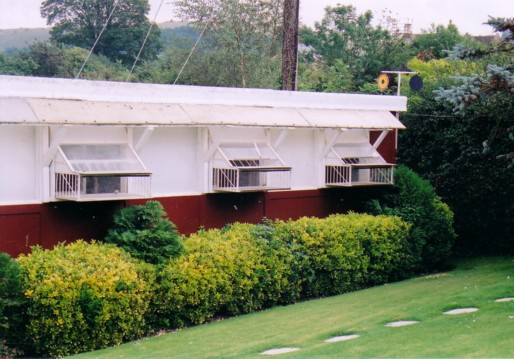
One of Stan's racing lofts
'At the beginning of the season I only flag for 15 to 20 minutes but I always make sure they have a regular routine. There's nothing difficult at all in widowhood, except that, as the season progresses, it's difficult to keep their hens motivated, which is very important. No matter what I've tried, which have been many things, short of putting a rabbit in the bottom of the aviary, I get eggs. I show the hen once or twice in training pre-season then thereafter only when the cocks tell me they need geeing up - and then perhaps only the once and just for 20 minutes. I do not follow a set pattern. I've found no difference between old English and continental pigeons when it comes to adapting them easily to the widowhood system.
'The ideal racing weight for a pigeon obviously depends to a degree on its size, but I reckon about 15 and a half ounces is about right. A pigeon sent fit to, say, Pau, which returns doing, say, 900ypm will probably only lose an ounce, whereas a pigeon sent carrying more weight but less fit will return having lost a lot more and I think it's because the heavier pigeon has to expend more energy right from the start of the race and that takes its toll. Sent fit like this, my widowhood cocks recover more quickly than my naturals used to. When Alan Gibb came to verify my San Sebastian winner, he let him go and he went off flying. Likewise, after I clocked my Palamos pigeon he went round the skies clapping! Pigeons must have the correct ratio of work and rest. I've handled many that had no buoyancy. If I'd taken my hand away, they have hit the floor and gone wallop! I never send pigeons to a race heavy.'
At this point I asked Stan which were the last 3 things he had put in the drinking water?
'Crikey. You'll have to wait a minute while I think. Number 1. Electrolytes last Saturday when my youngsters came home from the race. 2. A one-day treatment for worms, which I give to the young birds only, every 1 to 2 weeks. 3. A treatment for cocci, which I also give once a week or once a fortnight. I believe it is very important to keep cocci at an even level. You don't want to reduce it too much, but on the other hand once your count begins to rise it has an adverse effect on the form of the birds. I test all my widowers at the beginning of each season, if needs be two or three times, until I've got them as I want them. I don't, however, take much notice of cocci outside of the racing season, nor do I believe that treating pigeons has any adverse effect on them. For the record I use Harker's liquid for cocci and a Harker's tablet for canker. As for respiratory, I keep some Tylan just in case of problems but have not used it for 2 years.
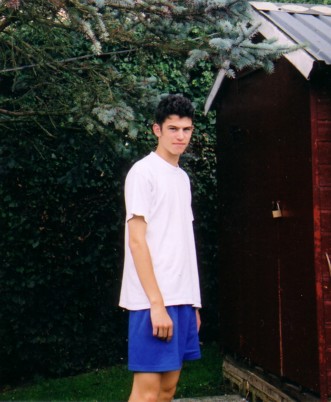
Stan's grandson, Scott
'Quite frankly, I think pigeons are getting faster and a lot of it is due to the way they are attended to these days and the advantages we have in feeding and transport. I've got to race against the likes of Geoff Cooper, Patrick Brothers and Paul Kendal every week and I have to go some to keep up with those boys. After the Saintes National, to put it bluntly, I was knackered. I was contemplating sending one or two with something to prove to Bordeaux with the BBC at the end of July. I was sat watching the pigeons and thought to myself, "the sparks gone out of them and out of you, too, Stan'. They'd had enough and so had I.
'I'm a big believer in Hormoform. Each widowhood box has two pots in it, and one of them has Hormoform in at all times. My youngsters also have it as the evening feed, two or three times a week. Pigeons know better than I what they want and will only take what they require. I have one cock who, the minute he starts taking his Hormoform, will win the following week, no doubt about it. He's 5 years old now and has never let me down yet when in this condition.
'I'm very particular about a pigeon's droppings. A widowhood cock's droppings should be round and firm and, from the time they are locked up after their morning exercise until they are let out for evening exercise, a cock in good condition will pass between 8 and 10 droppings. A fall of down feathers is also a must and indicates your pigeons are beginning to come into condition. You have to have a steady and continual fall throughout the season, not just now and again. I would be very concerned if the down feathers weren't falling and to hasten it I would use garlic or Gemthepax. After a hard race the fall of down will cease until the pigeon has started to recover, then you'll get a large fall all at once, indicating the pigeon is getting itself right again.
'I've found that it's more important for my widowhood loft to have sunshine and warmth than it was for my naturals. My racing loft faces due east and becomes warm from very early in the morning. It used to get unbearable (for me, anyway, as I'd sweat buckets) by midday, but I made some alterations and have flown better since. I think an ideal temperature is about 70-75 degrees. In my loft now, air comes in the front at 4ft high and goes out over the top of the boxes. I use nothing on the floor because I believe dust causes a lot of harm. I'm a great believer in using a vacuum cleaner (I've 3 lying about here somewhere) and vacuum the lofts every day. I also used Vapona bars until they were discontinued but only spray the loft infrequently (and then with Duramitex). The interior of my loft is painted with white emulsion.'
At this juncture I asked Stan to nominate 3 fanciers to have around for dinner, if he could choose his favoured company from all the many fanciers he has met over the years.
'There are too many amongst my present day friends to choose from but if I was going back in time I would perhaps invite Tom Clarke of Frampton on Severn, Billy Steele of Uttoxeter and Ron Mitchieson of Winchester. I used to take Tom and Billy to visit Ron once or twice a year and just to sit and listen to them was an experience which I value right to this day. I've never met anyone more fastidious than Ron was. We were good friends, though we could argue like hell. I remember once when I told him the reason he couldn't get his Pau pigeons from Palamos was because they weren't good enough: He didn't like it! I said they were 500 milers not 600 milers and he reared up in the air. We remained good friends right up until his death and I've never known anyone like him for living and breathing pigeons. Every perch in his loft was painted a different colour, and every week he would scrub the whole of his loft out. I was once there when he had reared some pheasant chick under his pigeons and I watched as they followed him, all in a line, into his house!
'Blood is more important to me than type when bringing in fresh pigeons to try at stock. Providing they carry the winning genes, I think within two generations I can get the type I want from them - medium to slightly over, buoyant with good feather. I used to study the eye a lot years ago but I'm not a great believer in its significance. I recall, I handed one of my dominant breeding hens to a friend and he said he wouldn't take her home even if I gave her to him. I said to him: "I'm not blooming giving her to you anyway, she staying here!"
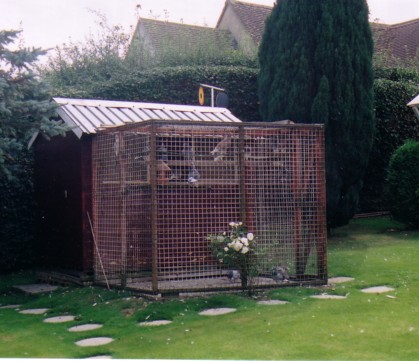
The stock loft
'It is not easy to produce good long distance pigeons. I have about 40 young cocks this year and I would be chuffed to bits if as many as 5 or 6 of them went on to fly Pau as 3 year olds. Every year I like to write down the ring numbers of those youngsters I fancy most - and I'm right only about 25 per cent of the time. That means I'm wrong most of the time so the basket has to be the final judge. I recall when I first had the Peter Titmuss pigeons (which still run through my loft today), being told by Ken Hine to take no notice of them, forget they were there, keep sending them and that they would keep coming. and those turned out to be very wise words. I went a good few years without bringing in any fresh pigeons but I knew I was going backwards because I had no room for movement in my pairings. Nowadays I'm on the lookout for a fresh introduction, or two, every year. Recently I've brought in more pigeons from Ken Hine and Peter Titmuss, and fresh blood from Geoff Cooper, Paul Kendal and R & B Smith. The bloodlines of a pigeon don't bother me too much, it's whether I can trust the people I'm bringing them in from, and thereafter all my pigeons must fly either Pau or San Sebastian at 3 years of age. I've tried 2 year olds at Pau, and have even had them on the day, but none of them went on to make a consistent 600 miler.
'I'm as keen now, if not keener, than ever. I have my grandson, who is a great help, to share my pigeons with, and have no other interests. Am I a better fancier than I was 20 years ago? That's difficult to answer. I sometimes wish I had some of the pigeons I had 20 years ago, now that I use better methods. The biggest mistake I've made has been keeping too many pigeons for too long in the expectation that they would perform, only for them to fail, and the one thing I've most learnt is that you've got to get to know your pigeons as individuals.