Mr & Mrs PAUL KENDAL
1st, 2nd & 2nd Open NFC Pau Grand National
Talking to Cameron Stansfield
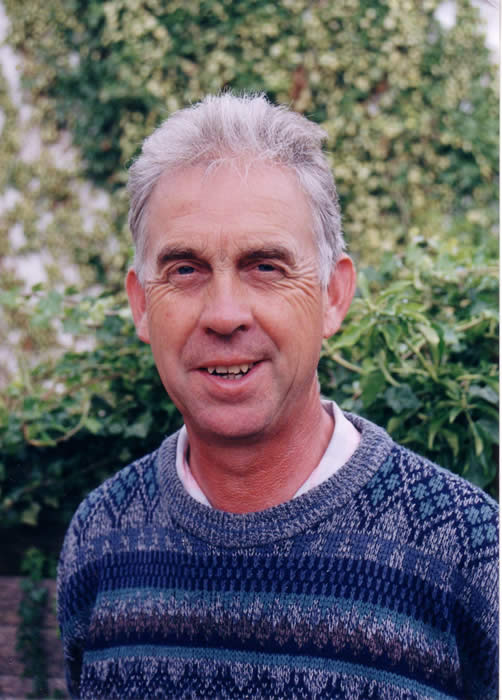
Paul.
I would put Paul Kendal in the Elite category when it comes to an analysis of the UK’s best National fliers. Indeed, if you could place a bet on the pigeon Grand National like you can for the horse one, I would put my money on him - whatever the prevailing conditions. Racing a relatively small team on widowhood, he has won 1st Open with Holloway Boy and been twice runner up with Holloway Boy’s grandson Morning Glory. That is a fantastic achievement but here’s the thing – he reckons he’s not yet cracked the art of pigeon racing. Modesty aside, he obviously knows how to peak a pigeon on a given day so I have made that the central theme of this interview. Here’s what Paul had to say.
Evolution
‘When I first flew with my Dad it was tic beans, tic beans and more tic beans bought from the local farmers and we would always buy a general mix with maize, which we fed gradually at the end of the week. We were really successful – up to a point. We just could not clock pigeons on the day from our longest race, Bergerac, though we would always get them back the following morning no problem at all. One day, around the late 1970s, we decided to alter their feed and at the same time we changed to a roundabout system. We were totally confident in our pigeons so the reason we couldn’t clock on the day had to be the system or the feed. The beans were taken out by as much as 50% so that we were feeding 50% maize and 50% beans and that year we sent two hens to Bergerac and clocked both on the day! However, I can’t honestly say I thought they were any fitter beforehand because we were in a bit of a rut. Really we didn’t have a system. Dad looked after the hens and I let the cocks out and went to work, so the hens might be out all day but if the weather was bad they might not go out at all.
‘We flew roundabout for 9 years up to when Dad died, though towards the end of that period we also had a section on total widowhood. The pigeons were flying OK and we were getting them on the night from the longer races but we still couldn’t get a real edge on them so the point came when I said to Dad, “We’d better change again and go onto a widowhood mix.” Why did it take us so long to change? I think it was just habit. It was an era when everyone was feeding cheap corn, a lot of it straight from the farm and it was easy to do the same.
‘I had a look around at the different mixes and I liked the look of Natural corn. I discussed it with Dad and we decided to go for Natural Sport Racing mix. We stuck with this for a few years but though the birds were perhaps exercising better there was no obvious impact on results. However, out of habit we were still hopper feeding so it might have been that we didn’t have the quantities quite right. In 1989 we went over to hopper feeding Natural Concorde mix and won the section in the Central Southern Classic from Bergerac, timing on the day. (Two years later this hen was 2nd Section, 3rd Open Classic Pau.)
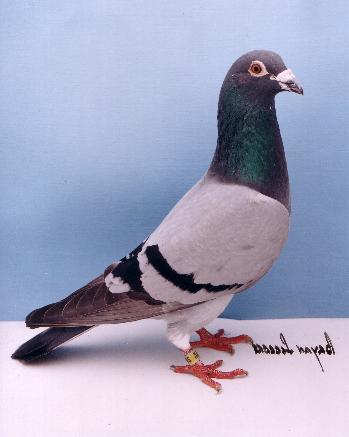
Morning Glory. 1st section, 2nd open NFC Pau, 3,941 birds; 1st section, 2nd open NFC Pau, 4,085 birds; 10th section, 82nd open NFC San Sebastian 5,564 birds; 2nd section, 188th open NFC Sennen Cove, 5,642 birds; 21st section, 491st open NFC Nantes, 10,150 birds; 5th section, 128th open BBC Nantes, 2,618 birds; 15th section, 122nd open BBC Nantes, 2,995 birds. Winner of the NFC Certificate of Merit and the F. G. Wilson Challenge Trophy 2002.
‘Widowhood racing was now beginning to evolve in our area and the sport was changing as a consequence. Dad always took our National entries to Reading where he would chat with Albert Babbington and it was Albert who turned us onto widowhood feeding. In 1990 we changed from hopper feeding to giving a measured amount morning and night and the pigeons improved quite a bit.
‘This was the time when we had Holloway Boy. He flew Pau well on roundabout in 1990 but the following year he came back injured. I knew in my heart that he was good enough to fly it on the day but we couldn’t get him fit enough or motivated enough. By this time we were flying as Mr & Mrs P. Kendal and I said to Helen that I wouldn’t mind trying widowhood in one section to give Holloway Boy every chance. This was 1992 and, as it turned out, that year everything was perfect - the feed, the health, everything. As we know, Holloway Boy won the Pau National.
‘Through the rest of the 90s we never had another pigeon which was good enough to build up like we had done with Holloway Boy. They were always consistent, but not quite good enough, in fact they had perhaps declined a little.
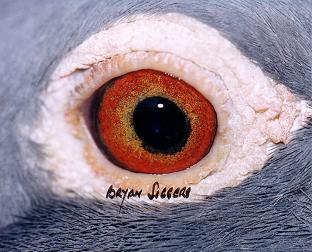
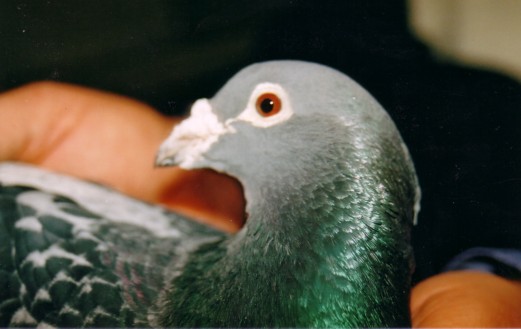
The eye of Morning Glory.
‘In the mid-nineties Geoff Cooper was mixing his own feed and he asked me why I didn’t try doing the same. I’ve still got the piece of paper he gave me detailing his standard feed, his widowhood feed and his build up feed. However, I didn’t copy them. I kept analysing the food tables in the back of Squills, looking at the fats, the carbohydrates and the protein contents. I looked at the Concorde mix and Geoff’s mixes and thought about how I might improve on them. I concluded that the carbohydrate content could be made much higher still by reducing the peas and beans, in fact by this stage I’d started to think beans were only fit for horses. I thought 30% should be maize as they could also get their carbohydrates out of the wheat and the barley. Then I added a conditioner mix similar to Red Band, which also gave me the fats. I should also say that I’d begun feeding peanuts at the beginning of the 90s.
‘The pigeons started to perform better on my own mix so I thought if this was so, why didn’t I increase the maize percentage even more. So I upped it to 50%, sacrificing more peas. There was therefore not much protein in the mix so I introduced a lot more peanuts. For example, from the beginning of May each pigeon would have around 10 peanuts each evening, fed in its box after it had eaten its normal feed.
‘This system worked alright and then in 1998 I went up to 60% maize with more peas coming out. (By then I was feedng white peas not maples because they contain more lactine, which I’d read was a benefit). I gave it a season but I thought the pigeons were still not quite there.
‘The more I read about distance athletes the more apparent it became that they cram the carbohydrates into their bodies so in 1999 I went up to 80% maize. It was difficult to get them to eat it all at first but I persevered. Four weeks before the Pau National they were on 8 parts maize, 1 part white peas and 1 part conditioner, then as many peanuts as I could get into them. Around home they were flying better and because of this they ate the maize more readily. In the Pau race I clocked my good cock Double to take 26th Open and once again I thought, “I’m onto something here. I’m away.”
‘I kept to 80% maize through to the end of 2004. By this stage Morning Glory had been twice 2nd Open but I still felt I had somehow let him down and not done my bit to get him on the night. On both occasions he’d arrived early next morning and it was very annoying. I analysed why I wasn’t getting birds on the day and started to think perhaps they were slightly overweight so, at the end of 2004, having done a lot of reading, I went completely over to another brand of corn. I began with a moulting mix then used their basic feed for the winter and for breeding. Once they had finished breeding I went straight onto their lighter racing mix, thinking it would be a benefit to get the pigeons exercising well earlier than ever so that they would therefore be fitter earlier than ever. I kept asking myself if there was enough guts in the mix for what I wanted then just before St Nazaire with the BBC I switched to their widowhood mix. I was 3rd Section but even so I wasn’t happy with the pigeons as I felt they weren’t quite there. The idea that year was to go to the Pau International with my 5 best cocks then Dax but I picked the wrong Pau International as it was one of the hardest ever. I didn’t get a pigeon for nearly a week (this pigeon went on to win the Section from NFC Sennen Cove in 2006) and lost one of my best cocks who had been four times in the first 100 of the National. The four that came back did, however, recover very quickly but that was their season finished. Meanwhile I kept racing the 2 year olds but for whatever reason they didn’t improve. The season was a waste of time. In 2006 I went back to Natural Concorde and in 2007 I shall race on their Trend mixes. I bought a bag and it was what I had always been looking for, as when I opened it up all I could see was maize. I’m sure I will stick with it.
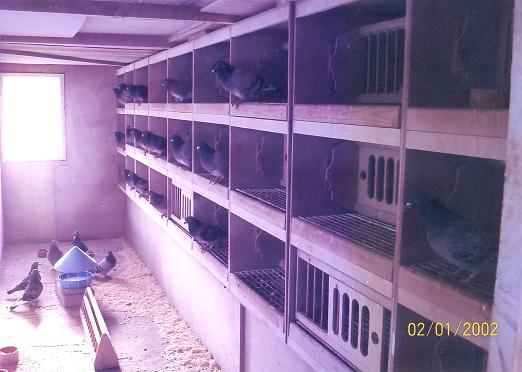
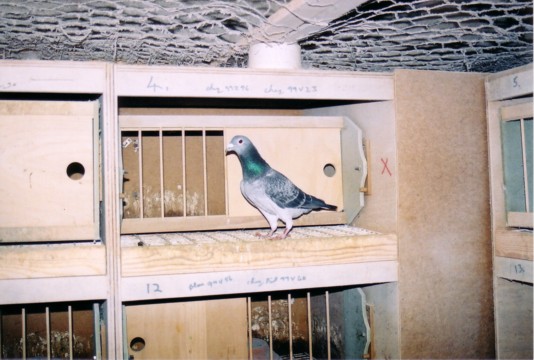
Inside the racing loft.
Timed condition
‘Apart from an odd good weather day, they are not let out from October to February because I can se no point in it. You don’t need pigeons fit if they are doing nothing. A racehorse would be put out to grass in the close season. There would be no galloping – it would just wander around the field. I have no facilities to bath them in the loft so they might go weeks and weeks without one but it makes no difference to them. Once paired, they go out every weekend. After rearing a round, which takes us to the end of March, the hens are taken away after sitting 3 or 4 days and the cocks are let out gradually over the next two or three weeks to get them flying.
‘Getting them to peak when you want them is a matter of feeding and exercise. I use a general mix when rearing and change this to a widowhood mix once they are on widowhood. When they have started to fly for 20 minutes of their own free will, I start to put the flag out and this is built up over the next four or five days so they are doing 45 minutes to an hour once a day, then they are down and in. When the clocks change this exercise is twice a day. I watch them and if they want to come down after 45 minutes I let them but they are shut out of the loft to ensure they keep going up and down, otherwise mine would just go back in their boxes and stay there. If I didn’t use a flag I can guarantee they wouldn’t fly.
‘As we get to the end of April, they stay out longer. At this stage they mainly exercise in a group. I now give them two or three 15-mile tosses but they always beat me home so I ask myself why I bother. Usually our first race is in the first or second week of May from about 150 miles and this could be from across the channel. I send them so that I can see if they are fresh when they come back. If they are I don’t worry about changing anything but if not fresh or if they are reluctant to exercise the following day, I take it that their fitness is not up to the level I want, in which case I shut them up for two or three days. This rest seems to bring about a change.
‘After two weeks they have another race, which is from across the channel, and they normally don’t show signs of fatigue, in fact they come home fresh and ready to take on anything. I have only one section so every bird has to tag along, unless the weather looks questionable in which case I might keep the yearlings at home. I should point out that their feed is changed drastically one week before their first channel race.
‘The following week they may have another short channel race of 150-200 miles. These two channel events are usually BBC and NFC Nantes. After the latter, which brings us to three or four weeks before the Grand National, they should be coming into something near the condition I want. Ideally I prefer a three-week gap between NFC Nantes and the Grand National because the cocks can become a bit on edge if they haven’t seen their hen for four weeks.
‘After NFC Nantes, they are let out for 2 hours morning and evening but I now don’t use a flag. When you add it all up, typically they will fly for around an hour and a half at each end of the day. They are out at 4.30-5.00am and again in the evening when I get home from work and there is no difference in how they exercise at either end of the day. As soon as I let them out I won’t see them for half an hour – they could be absolutely anywhere – and they come back one at a time. If they were not acting like this I would be very worried. If they began acting like this earlier in the season it would not concern me either, as from experience I know that once they come into this kind of form it’s good for 6-8 weeks. They have no more tosses before the Grand National, everything is kept just the same, except for a coastal toss or two just to keep the sharpness there if I think they need it. If it’s wet they don’t go out. They won’t fly so what’s the point?
‘By this stage they handle not too heavy and not too light, if you get what I mean. They are all built differently and handle differently but if you know them individually you know when they are at their best weight, and you also know when they are at their best just by observing their general manner. I think everybody has got a type they like but to me it makes no difference if they are built like a sparrow or a turkey as long as they race. It’s down to the fancier to know and understand his pigeons. A big pigeon carrying excess weight may, for example, need four single ups from the coast. Once you’ve done all you can for the pigeon and it doesn’t perform it’s either not strong enough, off colour or there’s something which needs unlocking.
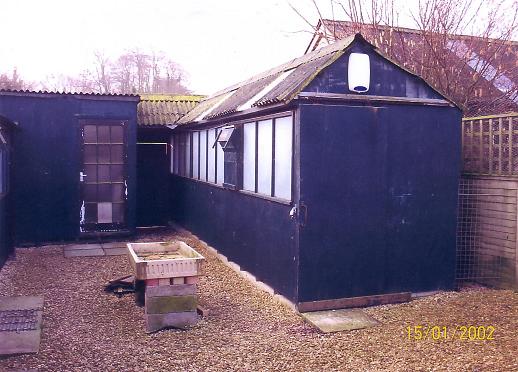
The new racing loft.
The final build up
‘In the fortnight before the Grand National I never clean out. They get let out and whilst exercising I top up their water (which has garlic in it) then they are fed in. I get them completely and utterly settled and nobody is allowed near the loft. I made an exception one day when Geoff Cooper was here and he will confirm that during those two weeks there is muck everywhere, food everywhere and down feathers everywhere. It is as it is. I don’t worry. I think when left quietly alone they become keener and squabble a lot more. And by keeping out of the way they are not squabbling with me but with each other.
‘Three days before basketing for Pau they may well be let out with their hens, always with the loft door closed, my philosophy being if they are out, they are out. I have done it other ways too. When Holloway Boy won the Pau National his hen was let out with all the other cocks first, then he was let out afterwards and he was going beserk. But this is something I’ve found you can only do once a season. He hadn’t seen his hen for 5 weeks, which is why I showed her. I’ve tried letting the cocks out with their hens closer to marking day but the pigeons were nutcases when they came home. They were too motivated if you like. Morning Glory needed to be let out with his hen on his own or he’d get too worked up and become dangerous. Put it this way, I could not put him on the bull system. You have to try and find the happy medium that suits each pigeon.
‘I believe very few fanciers can condition a pigeon but it’s hard to put into words what a pigeon in tip-top order is like. It’s a feel you get, whether it’s the feather quality, the colour of the wattles or the bloom in your hands. They should be corky and not overweight, nor should they handle like a rock.
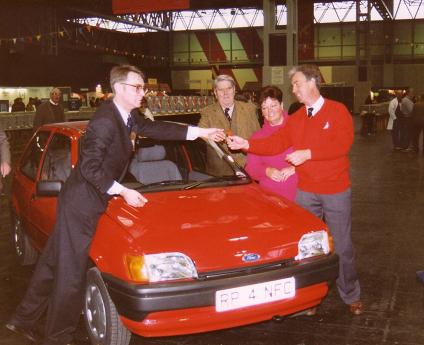
Paul & Helen receiving the keys to the Racing Pigeon-sponsored car from the then Editor Rick Osman.
The little extras
‘I’m a big fan of garlic having first read about it in the BHW through Bernie Bennett in the early 1980s. I thought I’d give it a whirl and bought some Natural Garlic Oil. I then got a bit more into it when I bought a herbal book. I decided it would be better to use a bulb and it sort of all stemmed from then. Initially I tried different ways of giving it. For instance, I chopped the garlic into small cubes and tried to get them to eat it. One or two did but that’s all. Then I tried pushing it down their throats but some would spew it back up so that was no good. I settled on peeling the cloves, piercing them and adding four or five cloves to a 2-litre drinker. It stays in for a few days until it starts to go soft and mushy, so the water does not get changed but is just topped up. I don’t use much garlic in the winter because I like them to build up some degree of immunity but garlic is always in the water at other times. This year I have tried something different. I have put the cloves in a food processor then added this to the drinker, one bulb to 2 litres, then topped the drinkers up for a week so that the concentration gradually dilutes. By doing this I’ve found that they drink the water more readily. They also have glucose, usually for 2 days, a week before basketing.
‘Initially I didn’t understand what all the benefits of garlic might be, then shortly after Holloway Boy won the Pau National Geoff Cooper telephoned and said, “Bring some droppings down and I’ll test them.” When he looked under the microscope he asked, “When was the last time you treated for cocci or worms?” So I said, “At the end of the 70s. Why?” He replied, “There’s not a sausage - no cocci, no worms, nothing. I don’t believe you haven’t treated!” Presumably therefore the garlic either kills the cocci and the worms or it helps the pigeon build up its immunity.
'Over the last 3 years, however, I have been treating for canker, either through the water or in tablet form. I just had a feeling that the garlic might not remove canker from the stomach and the bowel. Up to now I have not tried giving a tablet pre-race though that could change, but who knows, if I get the balance of garlic and water consumption right I might not have to treat for canker at all.
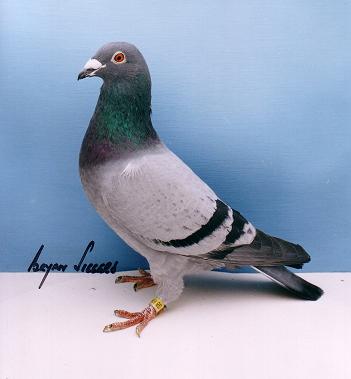
Peasdown. 28th section, 238th open NFC Saintes 3,887 birds; 7th section, 67th open NFC Nantes, 8,664 birds; 4th section, 93rd open BBC Nantes, 3,158 birds; 3rd section, 41st open NFC Saintes, 4,526 birds; 1st section, 88th open BBC Nantes 3,198 birds; 5th section, 86th open NFC Nantes 8,112 birds; 7th section, 67th open NFC Pau, 3,463 birds.
‘I am definitely a big fan of B12, which is something they can’t get from their food. I buy it from the chemist and have been putting it in the water since the early 1980s. The dosage is a matter of trial and error but you will know you have overdone it if the skin turns an eggshell blue colour. The colour of the flesh is a good indicator of condition. I want it either pink or red - though not a brilliant red. I also like the skin to be clean but, having said that, I’ve sent them to Pau with flaky skin and they have performed brilliantly. I give the B12 once a month when breeding and once a week when racing, usually two days before basketing. B12 brings a pigeon into form like nobody’s business, and I would even go as far as to say I would struggle to get them into form without it.
‘I’ve also been using more and more hemp over the last four years for its high fat content. I know fanciers say don’t give it, it will heat the blood up but I’ve found they fly better with having it. I also use a lot of wheat germ oil. When they come back from a race they have wheat germ oil, brewer’s yeast and lemon on the corn and they carry on having this am and pm through to Monday evening or even Tuesday. Both the yeast and the wheat germ are high in vitamin E and I started using both years ago after I read about Australian swimmers who had been given vitamin E and their performance levels had changed overnight. It said it was unbelievable the difference in what they could do after just a few weeks. I don’t believe I could compete if I didn’t provide it. In fact, I don’t think I could compete to the same level if I had to give up any of the things I use, though perhaps if I didn’t use garlic I could get round it by treating for things.
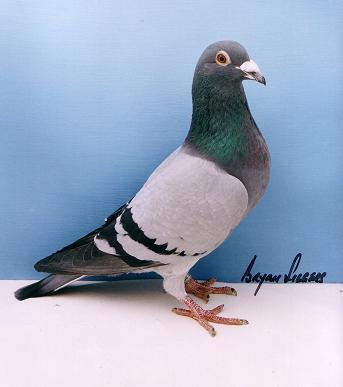
Ashdown. 5th section, 51st open NFC Nantes 8,664 birds; 8th section, 169th open BBC Nantes, 3,158 birds; 2nd section, 236th open BBC Nantes, 3,198 birds; 20th section, 423rd open NFC Nantes 8,112 birds; 5th section, 33rd open NFC Pau, 3,463 birds; 1st section, 42nd open NFC Saintes, 4,225 birds; 3rd section, 295th open NFC St Nazaire; 20th section, 181st open NFC Bordeaux.
‘I do not think, however, that I have yet got to the bottom of how best to prepare pigeons. I believe we in this country are light years behind the Belgians, the Dutch and the Germans, so much so that if I moved over there I think I would struggle against them. From what I read, I believe they condition pigeons better. I think their feed is better than ours, though I must say, as a consequence of UK fanciers going over there to lofts and shows and asking questions, the feed in this country is now improving greatly. They are also more switched on to diseases. For example, they don’t think twice about vaccinating for Paratyphoid. I’d never given it a thought until I had a problem.
‘Back in 2000 I had paratyphoid and it decimated the loft. I have never seen pigeons fall apart in such a short space of time. It started in the young birds. They were perfect when they came home from the race but on the Monday morning there was one on the floor with not an ounce of flesh on it. Two days later there was another one the same, and then the droppings became an absolute mess. It went from the young birds into the hens. I couldn’t believe the change – not within weeks or days, but hours! I had them tested and was told it was paratyphoid. The procedure was to treat them for 14 days, after which I had to sterilise everything, even the pigeons. It took Helen and I two full days working from 8am to 8pm. On the loft we used Virkon S at double the normal dose and when we came in the house our clothes went straight in the washing machine. We had clothes for outside and clothes for inside. We dipped the pigeons, even putting their heads under – the whole works. It solved the problem but afterwards I lived on a knife’s edge all the time. To try and improve things with my pigeons I took the Poultry World to see what they were doing for paratyphoid. I read that they had something you could put in the water which was 99% guaranteed to keep salmonella away from the eggs, so I spoke to a scientist at the company that made the product. He couldn’t give me a dilution rate for pigeons but he did hint at vaccination. Then one day I was talking to Brian Sheppard and the subject got onto paratyphoid. Brian said he vaccinated against it. I now vaccinate the old birds every two years and each year’s youngsters.
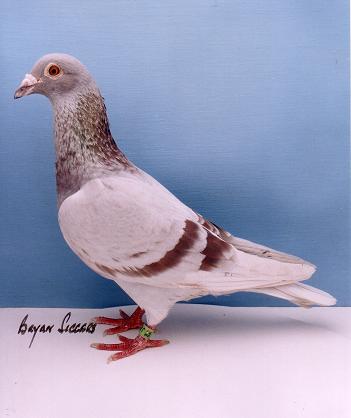
The Mealy. 11th section, 94th open NFC Pau, 3941 birds; 8th section, 82nd open NFC Pau, 4,085 birds; 7th section, 62nd open NFC Saintes; 14th section, 109th open BBC Nantes 2,995 birds; 4th section, 6th open Anglo-Welsh National San Sebastian, 538 birds; 5th section, 108th open BBC Nantes, 3,158 birds; 22nd section, 283rd open NFC Saintes; 6th section, 90th open NFC Pau/Saintes.
The loft
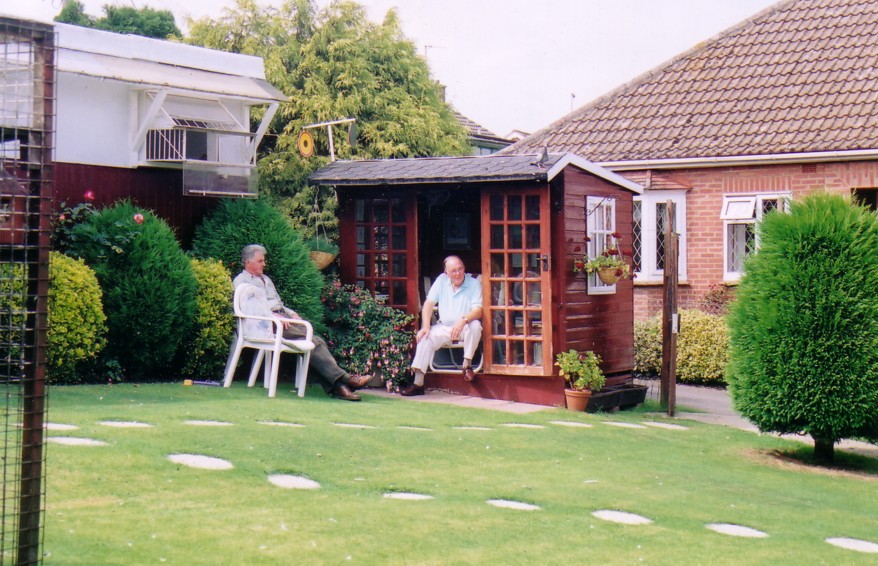
‘My main racing loft up to 2006 (when I changed it) is divided into three sections, with the front of each section being made up of three pains of obscured glass and a stall trap. There are also two 9 by 9 vents two foot off the ground per section but these are always closed. The roof is flat and falls to the front. The only air that enters is through the odd crack here and there and when the stall traps are open on race days.
‘The loft was different again when Holloway Boy was racing. It had a window in one end and I could take a board out and let the sun in. However, there were only two sections for the cocks, which meant I had nest boxes facing each other, and therefore cocks looking at each other, which I thought was no good. I stripped the loft right out and then put glass in the front to keep the loft warmer. My present loft can now get to 100 degrees but that doesn’t worry me, unless the air is humid which makes the pigeons pant, in which case I may drop part of the trap down to let air in.
‘The reason I have changed my loft again is that back in 2000 I put up a brand new loft, fully insulated except for the front. This was always used for stock birds and boxed hens but in 2005 I put some boxes in to race young cocks on the darkness. I have never seen pigeons with condition on them like it. These young cocks were absolutely perfect. I decided then that I would race my widowers to this loft.
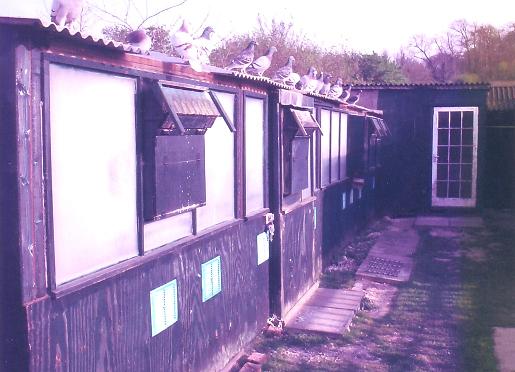
The old racing loft.
‘My old loft has 24 boxes but I usually start a season with 16 cocks, and I like it this way because the loft is completely shut in. In the main racing loft where Morning Glory was there were two sections and all my really good cocks raced to one section in particular. In fact I only had two good pigeons race to the other section – and the losses to that section were greater – so on reflection I think I’ve squandered a lot of good pigeons. One of the two cocks occupied a high top left-hand box and the other the bottom right-hand corner box, which got a lot more sun. But then again, where Morning Glory was never had any sun as the boxes did not run along the back wall. The loft itself faces due west so it gets no sun till one or two o’clock. I am not a believer in low-level ventilation because on dewy mornings this sucks moisture into the loft. I’m not a believer in air whistling through either. I’ve found form comes better when the loft is warmer. If I could keep my loft at a constant 70 degrees I would but as it is, with having an asbestos roof, my loft gets very warm during the day and cools down quite rapidly at night.
‘When I said I was going to change my loft again, Geoff Cooper came down and we had a long discussion. I’m going to put in extractor fans - not to reduce heat but to remove dust. I’m also now going to have air coming in through the front by means of a flap, which I can control at high level. I have nothing on the floor and scrape out and hoover once a week. The wood is bare as I have never got round to painting it. I wonder if bear would draws in more moisture than painted wood. I spray once a year with a bleach/Jeyes’ Fluid mix. I’ve never used smoke bombs but am contemplating doing so.
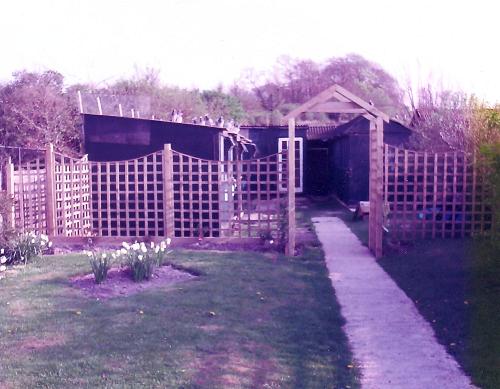
The loft set-up.
From Holloway Boy to Morning Glory
‘I think the Clerebauts are best up to 450 to 500 miles – that’s their limit, so Holloway Boy was an exception to the rule. He was perhaps a throwback. After he won the Pau National it took a while for me to conclude that I needed some more stamina but when I did I thought, “Right, what do I need?” I was friendly with Geoff Cooper so I went to see him. He leant me a sister to top pigeon John, who was of Andre Vermotte lines, and she clicked straight away with Holloway Boy. Then one day shortly after Harding Brothers won the Pau National, Geoff suggested we go and see them. Gordon Harding and I hit it off straight away and he asked me if I would like a sister to his Pau winner, Ashgrove King, his suggestion being that we could split the offspring between the three of us. I said I’d love one so he gave me a yearling hen. Anyway I paired her to Holloway Boy the following year and they produced the sire of Morning Glory. He was so absolutely huge you wouldn’t think he could be any good but funnily enough, every now and again I’ll breed something massive out of Morning Glory too. In fact I gave a sister to a friend and he has had to cut its ring off!
‘As to the dam of Morning Glory, in 1996 Geoff bred me four late-breds. He told me to race them, not stock them, so through that winter they were let out every day. I didn’t see them before I went to work or when I got home until I went to shut them up each evening. Then one night there was nothing there. The days passed and still nothing, then on the fifth day a blue pied hen turned up with one eye hanging out and her side all smashed up. I was so taken by her determination to get home that I thought, “Right, I’m going to get you healthy and give you a chance.” I paired her to the same cock for two years and they bred nothing of note and then Morning Glory appeared! In the meantime I had a son of Ashgrove King which I called Ash 2 and he and Gordon’s original hen are in nearly all my pedigrees now.
‘Holloway Boy and Morning Glory were chalk and cheese, which is why I don’t believe you should go on type. Holloway Boy had more body, was a reasonable length and was slightly bigger and stronger. Morning Glory is short with a longer length of keel.
‘My mother-in-law worked for the racehorse trainer Fred Winter for 25 years and I got to know Fred very well. We talked horses and he told me never to go for type but to always look at an animal as an athlete and appreciate that all horses are different. He said if a horse was any good, one day it would show you, but you had to know how to get the best out of it and that came down to observation. Pigeons are the same. If you believe in a pigeon it’s down to you to know what to do to get it to perform and once you do, it will perform again and again. The trigger could be absolutely anything.
‘Fred would say you could have a horse who pulled up and you’d examine it and there would be nothing wrong, but the next time it ran it would suddenly get it together. This is what you are looking for all the time – the things that wake them up. If I believe in a pigeon I will sometimes give it to three years of age to show something, but generally two years is the limit. At that age, unless they have had a knock, they will have flown 500 miles. On reflection I’ve probably made some mistakes by being too ruthless with pigeons that haven’t shaped by the end of the two-year-old stage.
‘It’s difficult to say what it is about some pigeons which make you think they are going to be good one day. I can’t put it down to any one thing. It might just be something I see when it comes home that tells me it’s been really racing. It might be behind but it drops on ten hours looking fresh. It obviously got something wrong somewhere so you have to try and think how you can get it to not make that mistake again. All it might require is a single 30-mile toss to get it back on the right line.
‘A mistake is often the thing that triggers a pigeon. In 2000 I sent Morning Glory to the bad NFC Nantes race and he turned up at 2pm on the Sunday absolutely flown into the ground, but after a couple of days he was totally different in his behaviour inside the loft. It was as if he was saying, “I’m still here. I’ve done it.” The change was dramatic. He was never still, in fact after a while he was hanging on the trap to get out just so he could have a fly. And he flew and flew and flew. If I hadn’t shut him up after exercise he would have been back out again. The loft was coming into form at this time anyway and the others were trying to keep up with him. Three days before Pau he just couldn’t stay still and I thought, “Right mate, you’re buzzing.”
‘There were no birds on the day and he arrived at 7.20 on the second morning. He was absolutely soaking wet and came through thick fog, but he was so keen to get in I said to Helen, “He’s going to be close to winning it.” In the end the pigeon of Ernie Deacon’s did him by ten minutes! I have no doubt that the mistake at Nantes was the making of Morning Glory because the change in him was phenomenal. If a pigeon makes a mistake, the key is whether it gets over it quickly. I read in your piece on John Puddephatt that John doesn’t mind if it takes a pigeon a fortnight to come home from Pau and I am the same.
‘The second time Morning Glory was 2nd Open was when John Ayling, on the coast, clocked the only bird on the day of liberation. Morning Glory was, I believe, the first pigeon to be timed on the second day being timed at 7.31am but this time he was tired. He came from slightly out of the south-west – which is where all my best performers come from, and when I caught sight of him he was just a little dot in the sky. I thought to myself, “That’s him”. He never moved off a true line as he spiralled down but it took him forever to land. I’ve only ever had pigeons come like this four or five times in my life. He was keen but when he landed his wings were down. We believe it was due to the north-west wind.
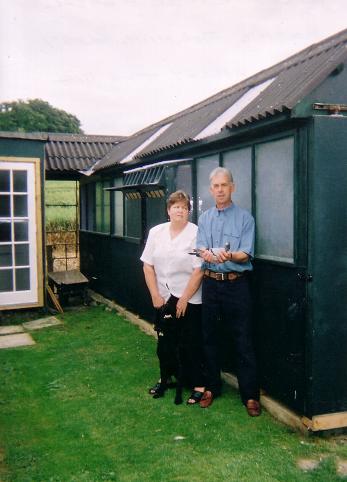
Helen and Paul Kendal outside what will be the new racing loft.
Percentages
‘I keep 18 pairs of stock as I’m always looking for better pigeons. In the last five years I’ve brought in birds from several sources: Van Bruane/Fear Bros from David Bacon, Jan Aardens from nowhere in particular, Patrick Bros’ Somerset Lad x Supercrack lines and Mark Gilbert Deweerdts. I don’t have to like a pigeon. What it looks like doesn’t come into it with me, only how it is bred. I was looking at the pedigrees of a well-known Belgian fancier and the four grandparents of one of his best pigeons all came from different lofts. That is the difference with us. They will try anything if they think it will improve their loft but British fanciers want ‘pure’ pigeons!
‘I buy between 50 and 80 rings because I lose too many young birds, many of them off the loft. I don’t know why but it is maybe only every 3 or 4 years that I manage to retain a nice team of young cocks. By the time I get to training I’ll be down to 35-40 youngsters. It seems to be the earlier you breed the more youngsters you lose. You need to start training them at 12 weeks of age. In 2006, I wintered 14 young cocks, which is more than normal, but that’s because they only had two races. I would like to race a competitive youngster just to give me something to play around with because my old bird season is short, but I would have to bring in a different type of pigeon, something perhaps Janssen based which develops more quickly.
‘As yearlings I find I can lose them in the early National races because it takes them until later in the season to learn what widowhood is really all about – not every one of them but most of them. A very small percentage of what I breed goes onto become a good pigeon, one that I can get to do what I want it to do. Nowadays I am leaning more and more towards International racing and I think I might have to carry a bigger team to find those that can cope with it.

The pedigree of Morning Glory.
Going International
‘The buzz of the Internationals is now more than I get competing with the NFC. Of the Internationals I fancy Pau and Dax and possibly Perpignan but Barcelona is probably out because the birds would have to dog-leg round the Pyrenees and that’s enough for us not to have a chance. I might not necessarily have to adapt my methods but I might have to give my pigeons more individual treatment earlier in their life, giving them more single ups than they have now. To get a day bird from the Pau International would be marvellous and to get into the top 50 of the International, even if clocked next morning, would suit me down to the ground. I think Pau International is definitely harder than Pau with the NFC.
‘I would like to see the NFC go down the route of flying the Pau International as its Grand National, with the rest of the programme made up of Cholet/Tours, Dax International and Saintes. I would also like to see the big clubs getting together more. Last year the BICC and the NFC were at the same racepoint on the same day. You’ve got to have competition. Every week in Belgium and Holland they have a national race but you can still fly at your local and regional level in the same event. We could do the same.
Table showing the ultra-consistency of Paul Kendal at National level. Once again my thanks to Paul O’Leary for providing such excellent information.
|
Member Name |
Year |
RacePoint |
Sent |
Section Pos |
Section Entries |
Section Sector % |
Open Pos |
Open Entries |
Open Sector % |
|
Mr & Mrs P Kendal |
2006 |
St Nazaire |
4 |
3 |
203 |
1.48% |
294 |
4483 |
6.56% |
|
Mr & Mrs P Kendal |
2006 |
Sennen Cove |
10 |
1 |
280 |
0.36% |
27 |
5350 |
0.50% |
|
Mr & Mrs P Kendal |
2004 |
Saintes |
6 |
1 |
264 |
0.38% |
42 |
4225 |
0.99% |
|
Mr & Mrs P Kendal |
2004 |
Nantes |
7 |
5 |
399 |
1.25% |
86 |
8112 |
1.06% |
|
Mr & Mrs P Kendal |
2003 |
Saintes 1 |
9 |
3 |
367 |
0.82% |
41 |
4526 |
0.91% |
|
Mr & Mrs P Kendal |
2003 |
Nantes |
12 |
5 |
638 |
0.78% |
51 |
8638 |
0.59% |
|
Mr & Mrs P Kendal |
2002 |
Pau |
3 |
1 |
282 |
0.35% |
2 |
4085 |
0.05% |
|
Mr & Mrs P Kendal |
2001 |
Sennen Cove |
2 |
2 |
339 |
0.59% |
188 |
5642 |
3.33% |
|
Mr & Mrs P Kendal |
2000 |
Saintes |
1 |
3 |
227 |
1.32% |
80 |
3606 |
2.22% |
|
Mr & Mrs P Kendal |
2000 |
Pau |
6 |
1 |
207 |
0.48% |
2 |
3941 |
0.05% |
|
Mr & Mrs P Kendal |
1999 |
Pau |
4 |
2 |
237 |
0.84% |
20 |
4526 |
0.44% |
|
Mr & Mrs P Kendal |
1998 |
Saintes |
4 |
3 |
290 |
1.03% |
48 |
4572 |
1.05% |
Paul O'Learysays: Just take a look at Paul's results since 1997 ... where we can see that his first timed pigeon appears in the top 2% segment of Section F a highly creditable 12 times including FOUR outright section wins. Outside of his Section performances his first timer achieved a Top 2% Open position NINE times which is pretty remarkable in itself. Paul is perhaps best remembered for Morning Glory whose two 2nd Open Pau performances feature in this list. However Paul is far from a one-trick-pony having had two other pigeons win a 1st Open Pau (Holloway Boy) and Certificate of Merit respectively! Note also that Paul sends a pretty small team so couldn't ever be accused of achieving his results through volume of entries.
The future
‘I’m still looking for the right type of feed because I do believe that the right feed and the right supplements are absolutely vital. I think I’ve had it about 90-95% right from time to time but I’ve not got that last bit right. As you can see from what I said earlier, I am always looking to improve. I have, for example, tried 50% peanuts and 50% maize and it brought the pigeons up so high it was amazing but in fact I think it was a bit too much. I’ve been a really big peanut feeder in the past but have slightly let it go now because the mixes contain more oil plus I use plenty of wheat germ. One thing I do know is I couldn’t have done what I’ve done flying natural because for a start the food would not suit natural pigeons as they won’t exercise enough.
‘You’ve always got to think that if you stand still others will catch you up so you have to keep looking to improve again. The top fanciers are always looking for an edge, and although there may be fewer fanciers today, those that are left are a lot more competitive than fanciers used to be. They are staying in the sport because they are successful and so many of the forty-five plus age bracket are now professional fanciers who spend loads of time with their pigeons. Mind you, that’s not always a good thing as you can disturb your pigeons too much. You have to find that happy medium. When I could nip back from work at lunchtime I used to like to walk up the garden and not hear a sound from the widowhood cocks. Just recently, however, I became concerned that the grass growing up to the loft was a source of damp so I replaced it with shingles. Now I daren’t walk up to the loft or they will hear me!
‘I was not quite so keen last year with all the uncertainty surrounding Channel racing but with things looking more promising I’d have to say I’m as motivated now as I’ve ever been. But if I never win another thing, I’ve achieved far more than I could ever have imagined.’
9/5/07