JOHN BARNETT & DTR
of Telford
by Cameron Stansfield
5 OUT OF 6 AIN'T BAD
The last weekend of July 2003 was truly a weekend to remember for John & Julie Barnett of Telford. At the start of the campaign they had earmarked what they thought were their best pigeons for a three-pronged attack on some of the country's major races, all of which were scheduled to take place that same weekend.
The races they had pinpointed were National Flying Club Pau, Midlands National Flying Club Bergerac and British Barcelona Club Bordeaux. By setting their birds up to be in condition all at the same time (and at the right time) they knew they were putting a lot of pressure on themselves, but they also had confidence in their birds and their methods.
Let's now look at the events of that late July weekend in closer detail. The Barnetts prepared just six pigeons for the three races mentioned, entering two for Pau (liberated at Saintes instead), two for Bergerac and two for Bordeaux. All were cocks - but this is no widowhood set up. Each of these cocks was raced on natural, their cycles not having been broken since being paired in March.
With bad weather preventing a liberation at Pau on Friday, July 25th, and poor weather forcing all three UK organisations to hold over on the Saturday, the attention of fanciers across the length and breadth of the country turned to Sunday. Would any birds be up? For the Barnetts, who had geared their whole season to this weekend, it was a frustrating time, and it was to become even more so when they heard that the National Flying Club had brought their birds back to Saintes and effected a 5pm liberation, reducing the 653-mile trip to one of 488 miles. They could only hope that the MNFC and the BBC would be able to conjure early liberations next day, and that Monday morning, as they waited, they learned that the BBC had let go in Bordeaux at 6.15am and the Bergerac birds were airborne at 7am. There was nothing to do now but wait.
With the oddness of the NFC liberation time, John and Julie didn't know what to expect in terms of an arrival time but it would be fair to say they didn't expect to clock before noon. In the event their dial read 11.59.44. This pigeon, a 4y chequer cock, really set the ball rolling for he was to win 1st Section J, 53rd Open, 2,770 birds. As a youngster he was the only bird on the day into Telford from the Young Bird National and he can be traced back to 67F1389, who scored from Pau on the day in 1970 for the legendary C. Ball & Sons of Telford. Then at 12.41.19 their second entry arrived, a 2y chequer cock who had scored 5th at Messac in his final prep race. This cock was to take 5th Section J, 156th Open and the fact that the Barnetts were to win 1st and 5th Section with 42 minutes between their two arrivals just goes to show the different nature of National-type racing compared to racing into restricted areas.
The first part of the job done, John and Julie could wait with increased confidence for the arrival of their Bergerac and Bordeaux birds. After all, they now knew the 'loft' was in form. With a helping wind they were confident of day birds out of Bergerac, 559 miles, and at 6.17pm, on 11 hours 17 minutes, their 2y chequer cock swung into view and was promptly clocked. A natural pigeon from an 'old-fashioned' lineage, conditioned to the minute to take on the widowhood men on a helpful flying day, this pigeon showed the versatility of the Barnett pigeons. He ended up 8th South-West Section, 30th Open from 2,016 birds. In his previous race he had been 4th Section J, 26th Open NFC Saintes on June 21st from 4,526 birds. He is the nestmate of the cock mentioned earlier who took 5th Section Pau/Saintes. The dam of this pair was the only bird on the day in the Telford area from the 2000 YB National and their sire is a full brother to the sire of 1st Section J Pau/Saintes 2003. Three down, three to go.
Fast forward now to 6.24pm and the arrival of their second Bergerac entry, another 2y chequer white flight cock. This one was to win 10th South-West Section, 35th Open to add to his 51st Section, 435th Open NFC Saintes five weeks earlier. He is a full brother to the dam of 5th Section Saintes/Pau and 30th Open Bergerac 2003, being bred from John's and Julie's No. 1 stock pair, dark chequer cock Peanut and a blue white flight stock hen, parents also of 27th and 38th Open NFC Saintes. That made it four out of four.
This just left the BBC Bordeaux race. Remember, these birds were liberated at 6.15am, 45 minutes earlier than the Bergerac birds, racing a similar distance but on a different line. Also the composition of the convoy was different with most of the 1,574 birds heading into a wide front along the south of England. Although their hopes were high of recording day birds, this was not to be, but they didn't have to wait long the next morning to welcome their 3y chequer cock to record 7th Section E, 356th Open. This cock had taken 15th Section, 89th Open NFC Saintes on June 21st so, like his loftmates, had held his form for a long while. He is a grandson of Bella Donna, 2nd Section J, 6th Open NFC San Sebastian, 648 miles on the day in 2001. His sire is the brother to the sire of 1st Section Saintes, 5th Section Saintes, 30th Open Saintes and 30th Open Bergerac, and he is a brother to the dam of Bella Donna.
What of their sixth and final entry that weekend? Unfortunately, John and Julie had to wait another three days for him to arrive. However, he had hit the wires so it was not surprising he came late. All in all then, the Barnetts put up a wonderful team performance which any loft in the country would have been proud of. This loft has always knocked on the door and in recent seasons has been on the 'up', but 2003 cemented its reputation for being one of the better National-minded lofts in the country.
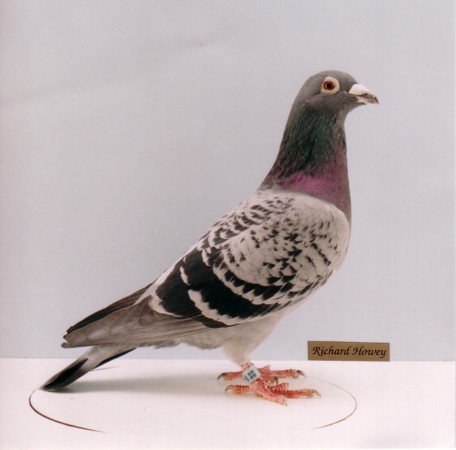
The Section Cock
1st Section NFC Pau; 1st Section NFC Pau/Saintes; sire of 1st Section BBC Lamballe.
Background
The older generation will be familiar with the name C. Ball & Sons of Ketley, but for younger readers a bit of background on the Ball pigeons will not go amiss. In 1970 the Balls clocked from Pau, 650 miles, the longest flying bird on the day of liberation, to win 3rd Section, 31st Open NFC, this being reported at the time as 'a ruddy good pigeon in Shropshire'. That was an understatement for this hen, '1389', was on the wing for 16 hours and 24 minutes to record 1163ypm. To show it was no fluke, this chequer hen was sent back to Pau in 1971 to win 6th Section, 18th Open - a great pigeon and one which was to leave its mark on the Ball loft and, by extension, the Barnett loft. Indeed, the hen who won 6th Open NFC San Sebastian on the day for the Barnetts in 2001, 'Bella Donna', can be traced back to the Ball hen. And by the way, this Ball hen was also 2nd Fed Angoulême and 126th Open NFC Nantes. A report compiled on the Balls for the Gazette in April 1971 noted a few things of interest. Quote: '19 birds were entered in the over 500 mile races in 1970 and all are in the lofts today, clocked in race time.' Quote: 'They are truly a well-knit family, originating from the most famous of all Midland lofts, those of the late F. W. Marriott. Crosses have been tried and tested and most of them have failed. The progeny of a dark chequer cock stood out both in performance and build, being slightly longer cast than the majority. The remainder are of the medium-to-small build, extremely shallow of keel and all in wonderfully silky condition.' The Pau Hen was described thus: 'She is medium sized, compact and nothing particularly outstanding in appearance to attract the attention from the rest of the family, yet she is a true champion.' Quote: 'Feeding proved to be the surprise package of the visit as I found that nearly every grain sold by the corn merchants is used.' For the record, the 'Pau Hen' '1389' was bred out of '16752', 1st Club, 3rd Poitiers, a son of 2nd Section, 45th Open NFC Nantes. The dam of the 'Pau Hen' was a daughter of 7th Section, 17th Open NFC Pau and 'NU58N7961'.
Firm Foundations
John kindly supplied me with a copy of an article written by Keith Gaut back in 1990 which gave the background to the main Ball pigeons John started out with. The article read: 'Amongst the original Ball pigeons which found their way to John's loft were:
74Z8507: a nice big hen, winner of 1st Section, 17th Open NFC Nantes, 2nd Section, 15th Open Pau, 1st Saintes and three RPRA Awards. This hen had broken her wing but John has filled his loft with her offspring.
In the stock loft are two dark cocks, '01' and '39'. These were bred from 70A87863, winner of 1st Fed Rennes, 2nd Section, 9th Open NFC Pau, 650 miles.
This cock is a direct son of 67F1389, The Pau Hen, 650 miles on the day. The dam of '39' and '01', who, incidentally, was clocked three times from Pau herself, is 77Z11671, winner of 5th Section, 19th Open NFC Pau, 2nd Section, 16th Open NFC Pau herself, being a daughter of 74Z8507, 1st Saintes, 1st Section, 17th Open NFC Nantes and 2nd Section, 15th Open NFC Pau (three RPRA Awards).
The '77' Hen: Bred by C. Ball & Sons, she is a sister to 16th Open and 19th Open NFC Pau, 650 miles, and is from 73N70782 x 74Z8507, 17th NFC Nantes and 15th NFC Pau, 650 miles.
73N70782 is from 66S49373, 1st Section, 84th Open Angoulême, 1st Section, 5th Open Angoulême, x 62N5346, winner of 5 x 1sts plus 3rd Journal Cup Nantes, 5th Fed Dorchester, 4th Fed Nantes, 9th Fed Weymouth and 4th Salop 500-Mile Club Angoulême.
The '900' Hen, 85N85900: From 79N08001, '01' x 74Z8507, 17th Open NFC Nantes and 15th Open NFC Pau.
79N08001, flown Pau three times, is from 70A87863, 9th Open NFC Pau, 650 miles, x 77Z11671, 16th Open and 19th Open NFC Pau.
The Lamballe Cock, 81N26226: Bred and raced by C. Ball & Sons, 7th Section, 14th Open NFC Lamballe, 8,976 birds. This cock is a grandson of 74Z8507, 15th Open NFC Pau and 17th Open NFC Nantes.
'The '91' Cock, 86T69891: Bred by J. Barnett from The Unrung Blue, a half-brother to '01' and '39', being a son of 70A87863, 2nd Section, 9th Open NFC Pau, who is a direct son of 67F1389, The Pau Hen.
Dam of The '91' Cock is 83N06933, a daughter of 81N26227, The Lamballe Cock, 14th Open NFC Lamballe, x 77Z11671, 2nd Section, 16th Open NFC Pau, 5th Section, 19th Open NFC Pau.'
The Present stars
So then how do the present-day winners in the Barnett loft trace back to these original Ball pigeons? Let's start with Bella Donna, 6th Open San Sebastian on the day in 2001. She is from '06353', the 'Grey Cock', 47th Section Saintes/Pau 1996 and 63rd Section Saintes 1996, clocked from Pau, clocked from Saintes NFC 1997, 14hrs 34 mins on wing, only 2 birds on the day in Telford x '80911', clocked twice on the winning day from Pau, winning 291st Open in 2000, also clocked on the day from Bergerac. '06353' is from bronze cheq cock '87921', a winner from Nantes and Angoulême plus 10th Section, 38th Open Pau 1987, velocity 1017. Flew Pau three times in all. Dam of '06353' is '85900', 'The 900 Hen' - see list of foundation pigeons.
Next we'll look at GB98A01804, 81st and 101st Palamos, the hen who, all being well, will be going for a Spanish Diploma in 2004. She is out of 'Peanut, 58232', who was off a son of 'The 900 Hen' and '45007', the 'Broken Toed Cock', when paired to the '77 Hen', and '01804's' dam is '18880'.
Now for the five birds which John clocked on that memorable weekend in 2003.
First up is '41461', 1st Section, 53rd Open NFC Pau/Saintes. He is bred from a son of '02865, son of the '91 Cock', and a daughter of '06353', the 'Grey Cock' x '04488', sister to the '91 Cock', herself a winner of 4th Combine Nantes, 48th and 49th Section NFC Saintes and clocked twice from Pau. '04488' is a daughter of the 'No Ring Blue Cock', a son of 9th Open Pau x '06933', a daughter of '26227', the 'Lamballe Cock', 14th Open NFC Lamballe x '11671', 16th and 19th Open Pau for the Balls, dam of the sister to the '77 Hen' - see reference list. '11671' is the dam of '08001', the sire of the '900 Hen' - see foundation list.
Next up is '01465', 5th Section, 156th Open NFC Pau/Saintes. He is from '02867' x Daisy Duke. '02867' is from 'The 91 Cock' - see list of foundation birds x '18880', the dam of the hen who is going for a Spanish Diploma. 'Daisy Duke' is a daughter of 'Peanut' x the Joe Shore hen.
Now for the two Bergerac pigeons. Winning 30th Open was '06382'. He is out of '02867', a son of the '91 Cock' and '18880 x 'Daisy Duke', a daughter of 'Peanut and the Joe Shore hen. '06383', the winner of 35th Open Bergerac, is a son of 'Peanut' x the Joe Shore hen, who was the dam of Daisy Duke.
Lastly, '53926', the 7th Section BBC Bordeaux cock. He is from a son of the '91 Cock' (see foundation birds) x the dam of the hen who is going for a Spanish Diploma when paired with a daughter of 'Bella Donna'.
John is a 58-year-old car mechanic, self-employed and very much his own man. Daughter Julie is a 36-year-old car sales person and just as committed to birds. They are ably supported by John's wife, Tania. The Barnetts have cultivated a team of pigeons based upon birds from Cyril Ball & Sons from Telford, crack National flyers in the 1960s and 1970s and, as the preceding performances outlined suggest, this is a family of pigeons which is getting better.
In recent years John has spent some time each winter in Dubai as loft manager to Sheikh Ahmed. Racing there takes place in more hostile conditions - it's hotter and there's less water about - and for the pigeons to deal with the conditions 'heavy' food is undesirable. John has been very successful in Dubai and he has taken some of what he has learnt there about feeding, weight (buoyancy) and condition and applied it to racing back in England. Here are some of John's views on feeding and other aspects of the sport.
The Ball Connection
I went self-employed in 1967. Ted Heath's three-day week forced my hand. Tania and I were married and Julie had just come along. We couldn't manage and I was having to work somewhere for three days, somewhere else for two days and then another place on a Saturday. I would do whatever was necessary to make ends meet and I think it was this which gained me the respect of the Ball family, father Jack and sons Cliff and Lenny. Lenny in particular had had a hard working life and damaged his chest. Because of his chest problem Lenny had been told not to smoke but nevertheless he would hide his cigarettes and a lighter at my garage and sneak round from time to time for a crafty puff. It was through this that a closer friendship developed.
When old man Ball and son Lenny had died and the time came for Cliff to sell all the birds, he told me that no one would give him a hand with the paperwork. I told him to give me the breeding books and I'd do it for him. There were 10 or so birds which were either unrung or too old to sell and these he gifted to me. Included amongst these was the last daughter of their famous Pau hen. Then at the sale I bought a further six birds. I would have bought more but I didn't have the money. One of the major buyers was Dave McNeilly, the Delbar man from Ireland. I wanted the lines of all the best Ball pigeons and Dave had bought lines I couldn't afford so I contacted him with the result that in due course we swapped a round of youngsters off our respective Ball pigeons and I later had the original pigeons he purchased at the Balls' clearance sale. At the time I also had my own Barker lines and over the next few years I ran the two families side by the side with the result that eventually, as the distance increased, the Ball pigeons came to the fore. Back then, it was a question of the birds being able to mould themselves around the time I was able to give them.
'Big, big, big'
In the past I used to feed 'big, big, big' but I got to asking myself what's the point? In my opinion, our trouble is that we are stuck in a European way of doing things based on misinformed ideas. Traditionally we've fed distance pigeons in such a way that it takes them 200 miles to burn off the excess weight and then they 'go'. What a shame more pigeons aren't fed in such a way that they can 'go' from the outset. Nowadays, for racing if you feed the old way of beans, peas, tares and maize, you'll invariably be beaten before you start.
My basic mix has plenty of variety. From mid-September through to the second week in March I feed 1 part peas, 1 safflower, 1 Super Diet, 1 white dari, 1 mung bean, 1 tares, 1 popcorn maize, 1 peanuts and 1 black rape (which I regard as black gold). When the youngsters hatch I mix extra peas and tares to this. Once the youngsters are away, I remove the peanuts, peas and tares (the three heaviest grains) so they are back on a light feed to get them ready for racing. At that time of the year I can't have the birds out as much as I would like because of work commitments but fed this way they keep in good trim. When I do let them out they go smack, bang all over the sky, getting up with a good swing. I don't believe they'd do this if fed on the old-fashioned methods. This general mix is wonderful for their feather quality. Once we are into the races that matter we feed Versele-Laga Super Diet, Versele-Laga depurative and Red Band, then 7 days before a targeted race they get krib maize, red maize, peas and tares and, just before they go, extra peanuts. I'm a firm believer in popcorn maize because you can tell at a glance if it's sound, and I also like krib maize, but I keep away from plate maize because sometimes it can be mouldy.
Lessons from Dubai
I think the biggest single thing I've learnt from my time racing pigeons in Dubai (six weeks each winter from 2000 to 2002) is that the greatest hindrance to pigeons is the loss of body salts through exposure to the sun. I've proven that up to 500km I can get them home in blistering heat over desert - if I administer electrolytes before the race. In Dubai they race on Thursdays, and so I give electrolytes on the Tuesday and Wednesday before they are basketed at 4pm and driven to the racepoint before liberation next day. In the UK I think if we gave the birds electrolytes whilst on the transporters it would be a first-class idea. You must remember that when pigeons get hot, they get stressed, then get thirsty so drink more. If you keep their salts at the correct level they won't drink as much and in turn they will be much less likely to pick something up through the drinkers. I do also give electrolytes in England on their return from a race and to the youngsters when it is very hot.
'Terms and Conditions'
The art of being a fancier is in knowing how far to push particular birds, knowing their limitations if you like. If a pigeon makes a mistake one year, work out for yourself why it might have made the mistake and for your own part don't repeat the same mistake the following year. In other words don't push certain pigeons that extra yard. For example, my Number 5 Cock's distance is Saintes - a day race. He's a cock who loves his box and he will have your hand off if you go near him. That is where he wants to be and that is where he will strain to get back to. But my Number 6 Cock is different. To him the box is not so important because he's not in any way territorial; he's happy to be here, there and everywhere. To me this says he's not so focused as the Number 5 Cock, that he won't fret if he can't make it back on the day and consequently he's unlikely to try as hard. But the advantage he therefore has is that he's more likely to get further.
Where people keep hundreds of birds they can't hope to observe things as well as the man who keeps fewer and has a family. When I'm working as loft manager in Dubai I basket at 4am for training and at that time it's dark. To get a better idea of the condition of the pigeons I hand basket all of them rather than drive them into the basket. This way the pigeon can tell me what it's like and whether it's worth sending. I like to think I know my pigeons' 'terms and conditions'.
Hawk-faced
I was given a budget to buy pigeons in Belgium to take back to Dubai and the Belgians laughed at the way I went about selecting birds. Before thinking of picking a bird up, I put my left hand up and watch for the bird's reaction. If the way it behaves doesn't then grab me I don't bother to catch it. If I like the look of a pigeon and then pick it up, it's not often I'm disappointed with what I have in my hand. Pigeons tell you what they are if you watch them and I like them to have a good, intelligent head and to be hawk-faced - with a determined look. Pretty pigeons can be like pretty women - deceptive.
In the feeding
Is there a difference in sprint pigeons and distance birds? For day racing I think a lot of it is in the feeding more than the family. Fed properly, a good, determined pigeon will give its all for as long as it's on the wing - which could be all day. But it won't do this into the second day when it's well past 500 miles. Then it comes down to bloodlines.
Spanish Diploma
One of the things I've always wanted to win is a Spanish Diploma with the British Barcelona Club, for a bird three times on the result from Palamos. (According to the BBC's Jim Hooper, one of these has not been won by a Section E member in his time as Secretary.) My dark cheq hen finished 101st Open in 2002 and 2nd Section, 81st Open in 2003. Previously she had flown the very hard Anglo-Welsh San Sebastian in 2001. This year she will be given a race of no more than 300 miles 3 weeks before Palamos, no more work thereafter and be sent sitting 10-12 days. I also aim to send a dark cheq hen, a 2y who was unraced and untrained as a youngster then as a yearling flew Wincanton, West Bay and Messac. She hasn't the experience of the other hen but I believe that ability is innate - a pigeon either has it or it doesn't - and beyond that love of home is the greatest motivation for it to want to return at speed - or at all. For me, Palamos is more of an endurance test than a race and I send for that reason - to prove my family is good enough for the extra distance - in other words to prove the soundness of the breed. I could send a bigger team to Palamos but with limited time I think I probably wouldn't notice the little things that count. I firmly believe that the only way to reproduce birds which have the necessary homing ability is to keep going back in your breeding to pigeons which have demonstrated it before.
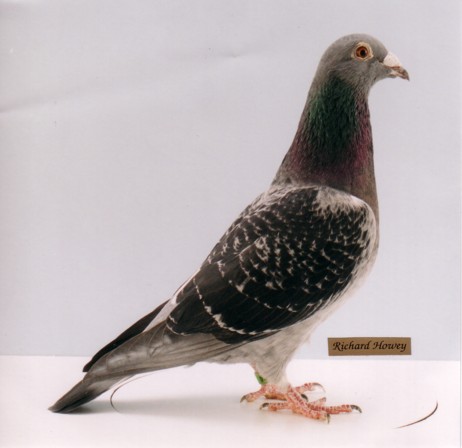
The Palamos Hen
Corkiness
The pigeon has to be like picking up a 6-inch block of cork, firm but not fat, and light framed with decent muscle, as a light-framed pigeon will burn less energy. I would say that my returning birds from Saintes and Bergerac last year were the same weight as when I sent them and the Bordeaux cock, though not in the same condition as the others because he had nighted out, nevertheless had lost no weight.
With the way I feed and the weight I send them with, I still believe my pigeons would be to the fore even if they were to hit a north-east wind at somewhere north of Bergerac. A north-east wind is hard on every pigeon so those with more weight would have to work even harder and so burn more energy earlier on.
Breeding the goods
If you asked me if my loft was on the up at the moment, I'd say yes, definitely, and that's because I have followed a very strict and selective breeding programme and because I've not been frightened to inbreed. You listen to a lot of older fanciers and they say don't go too close, but I'll happily pair mother to son and so on - providing the pairing throws my style of pigeon - and after that the proof is the basket. And to use a shipping analogy, by style I mean I want a destroyer not a battleship, something than can cut through the water not something that chugs along. I have two distinct lines, both of which go back to the same base, '1389', and to prove both lines are equally strong in their own right I put one into the other and expect the same result as if I just keep the lines separate. I think there is a place for intuition on the part of the fancier and I believe in my gut feelings about pigeons but, that said, the most important criterion is race performance when it comes down to a pigeon's likely ability to breed winners.
Percentages
Of all the youngsters I breed I would hazard a guess that about 30% go on to score somewhere and, with having a family, if I just threw the doors open and allowed the birds to choose their own mates I'd still be up around the 30% mark. You like to think you're clever by choosing their mates but, to be honest, I've had these birds that long it probably wouldn't make much difference how they were paired.
'You only go for one style of pigeon, Johnny'
The late Nobby Hughes used to say I always went for the same style of pigeon, which is hawk-faced with good vents, though vents not as tight on the cocks as the hens; a pigeon that is good in the hand, apple bodied and not deep; a streamlined pigeon with length. I try and steer clear of of those which are a bit more up front. If I suddenly won with a pigeon which was alien to my type I'd keep an open mind, breed off it and then expect it to conform back to my type in the next generation. For example, when I bought the dam of 'Daisy Duke' (see earlier details on John's best birds) at Joe Shore's entire clearance sale she was a bigger type than mine but nevertheless she was exactly what I was looking for because I felt I could breed out of her without going downhill.
Walk Away
It is very difficult to know where to go to for fresh pigeons. The late Nobby Hughes, my mentor, always said to me, 'Johnny, if you go somewhere and can't have what you want, walk away.' Nobby would let me borrow what I wanted and I suppose I was spoiled. One of the very few pigeons to have clicked with the Ball birds was the Gary Inkley hen - and I was fortunate to come across her. She was in Keith Gaut's loft and I remarked, 'She's a tidy pigeon, how much would you want for her?' She cost me £35 although, funnily enough, for the next two years I never tried her. Then by chance I was due to split my '96 Cock', one of my best pigeons, and pair him to another hen, but the new hen's cycle was out and she wasn't ready. Meanwhile the '96 Cock' was chasing everything in sight so I thought, beggar it, I'll put you with the Inkley hen. I only took a pair off them, and one of the pair, 94T80911, was to become the dam of Bella Donna. The only pigeon apart from the Inkley hen (which is Jan Aarden based) to have had much impact on the family is the hen I bought at Joe Shore's final clearance sale. She was the dam of Daisy Duke, a hen who scored in the YB National and which has since bred the cock who was 5th Section Saintes and his nestmate who was 26th Open Saintes and 30th Open Bergerac. For the record the Shore hen was out of a hen which had been timed out of Pau and a Van Hee Stichelbaut cock which had won 8 x 1st including 1st Sartilly, also 2nd Cheshire 2B Rennes and 4th Champion of Cheshire Sartilly.
Bella Donna
Clocking from San Sebastian on the day in 2001 was the hardest thing I've ever done - and in pigeon terms it was also the most thrilling. You've got to have a goal at the end of the day. In the early '70s flying in the Shropshire Fed I won the young bird averages three years running with my team of Barkers but having done it I looked around I thought what next, there must be bigger targets. I always wanted to do what the Balls had done in 1970 - clock on the day - and they held the record into this area for 31 years before me but I don't think it will take as long again for it to be broken. Fanciers have got better, food has got better and pigeons are faster. I think in 20 years' time 700 mile-on-the-day performances will be more frequent. My ambition now is to do it again.
Old heads on young shoulders
I've always found that my best pigeons have been over the Channel as young birds in National-type races where they have to think right from the outset, which is different to Fed-type Channel racing where they probably cover the first 100 miles together. In National races - and even more so with the BBC - they learn to break from day one. In 2003 I sent 28 youngsters over the Channel with either the BBC, the NFC or the MNFC and I still have 26 in the pen.
On Line
I don't agree with most fanciers' views on the training of pigeons because I think you can't give a pigeon a line. It will make its own line determined by the wind and its willingness to maintain as straight a line between A and B as possible. Last year my Bergerac pigeons went to Junction 13 of the M4 and then swung across to Warwick.
Trial and error
There has been a lot of trial and error on the way to having the birds I have today but now when I send I feel 90% sure that something will come. I don't carry the size of team to be able to send a team of say 10 or more to places like Pau or Bordeaux. Nothing would be nicer than having 20 2ys, 20 3ys and a dozen 4ys to pick from but with the number I breed and by the time they have been through the course, there aren't that many left!
They find their own weight
With feeding as I do, individually with food always in front of the pigeons, I believe they eat what they want from the mix to find their own weight and consequently they are fitter. And because they are fitter they won't gorge themselves on their favourite grains. How often have you heard fanciers saying their birds are as fit as fiddles but they have no appetite? That's because they have found their ideal weight. These fanciers then make the mistake of trying to find ways of putting more into their birds because they don't think they'll have the resources to fly the distance, but what they should do is send their pigeons and see - they'd be surprised. I give a lot of variety because I believe some pigeons will get fitter faster on grains of their own choice. If I have one who likes rape it can have as much rape as it wants and I'm not bothered if they waste food, it just falls under the grilles on the floor. My little Section Cock won't eat rape or barley and my Number 2 Cock won't touch dari but will readily eat mung beans.
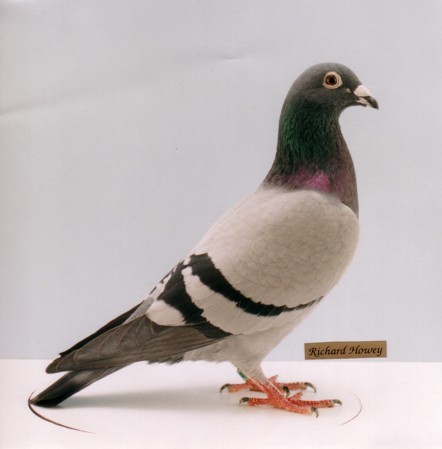
Lamballe Cock
1st Section BBC Lamballe.
Feeding
What brought about the change to my feeding methods was a trip to Luc van Hoeke's in Belgium in 1999. He showed me his methods and I could see he fed lighter grains than most were doing in England. Then in 2000 I went to Dubai for the first time to race pigeons and I saw they were feeding the typical English system of depurative and super widowhood. I thought this was too heavy for the conditions over there so I adopted the Belgian method and the performances improved dramatically.
Back in England, for the 2001 season there was no water racing early on because of the DEFRA restrictions so I adopted the methods from Dubai for the land programme and, flying natural, we won 8 x 1sts and 9 x 2nds in the Market Drayton Club. One of these 2nds was won by Bella Donna from West Bay and when she dropped she looked as fit as a fiddle. It was just 10 days before basketing for the NFC's San Sebastian race and I thought that if Bella Donna, a distance pigeon who had scored the previous year at Bergerac, could be that close up from West Bay, if all went well she would fare well from San Sebastian without me having to make any radical changes. The only thing I did in those 10 days was add krib maize and red maize to her feed - and the result was she finished 6th Open on the day - my greatest thrill in pigeon racing. I only wish I'd been feeding like this 20 years ago but there wasn't the choice for fanciers then.
The Road to Damascus
It took me a lot of years to pluck up the courage to change my feeding methods and what made me make the switch was, as I said, going to the Middle-East. I knew I was going to have to prove myself out there if I wanted to be invited back and in a way I had nothing to lose. After all they weren't my pigeons and I wasn't paying for the corn! The pigeons I inherited were a real mixture - there were plenty of ducks - but I felt some would take to the methods I'd seen in Belgium - and that's exactly what happened. Within a fortnight of arriving in Dubai for the first time and changing the feeding system, I entered a race and took the first 8 positions.
Beans
I don't think the reason why bean feeders have done so well historically at the distance is because beans provide a better diet for the distance than lighter feeds, only that the old-fashioned bean-feeding fancier often sets his pigeons up better. A lot of sprint and middle-distance fanciers hammer their birds before they get to the distance rather than set them up for the job, whereas the bean feeders go for a gentle approach and so have fresher pigeons. Now what's happening is that more and more good fanciers have cottoned on to feeding a lighter diet for the distance whilst at the same time setting their pigeons up properly and they are reaping the rewards.
A team effort
My daughter Julie is a very important factor in our loft's success. I think a woman is always quieter around the pigeons and because Julie never catches them, they know to trust her. In the summer she will be around at the house to see the pigeons every night and she knows exactly what they need with regards to feeding and training - which is very important because sometimes it can be 8 o'clock before I get in from work. Julie has been in the loft since she was three so she knows her birds. Our other daughter, Nikki, a nursery nurse, helps to train the pigeons in the school holidays, and my wife Tania helps on the paperwork side of things. When I'm in the Middle-East for six-week stints in the winter Julie and Tania do all the looking after of the birds. I'd struggle without them, that's for sure.
AUTHOR'S CONCLUSIONS
The earlier look at seven of the current stars of the Barnett loft took you back to the foundation Ball pigeons which John inherited and in turn took you back to the key Ball pigeons of the late 1960s, early 1970s which, in turn, through the original Ball pedigrees in John's possession, can be traced back to winning distance pigeons of the early 1950s. In other words, through the efforts of John Barnett we can track, over a period of 50 years, the evolution of one of the best lines of distance pigeons in the UK today. And as the events of that late July weekend of 2003 showed, it is a line which is still going strong. No wonder John is so proud of his pigeons.