MICK McGREVY
of Rotherham
Talking to Cameron Stansfield
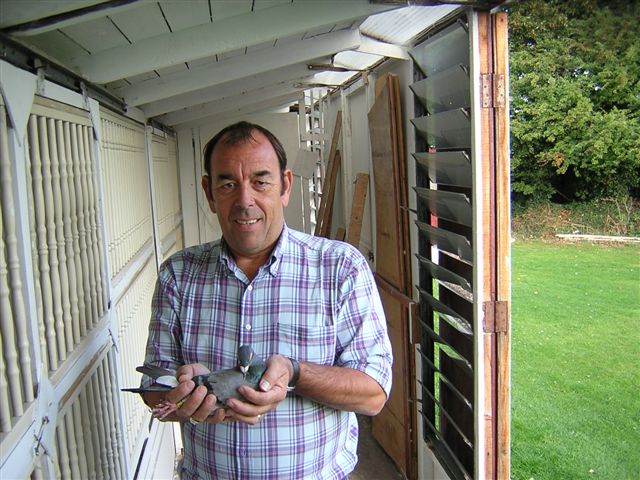
I was mulling around in my head how to introduce Mick to those of you who don’t know him and I came up with ‘Fully joined up member of the Yorkshire Society –straight talking, blunt, tells it how it is!’ You know what I’m getting that. That was that sorted and then five minutes into this interview he lets slip that he was once an eyesign fanatic. Mmmh!!!
Half an hour later and I could tell that must only have been a temporary blip and that my first impression was the correct one. How about this for starters? ‘There’s no such chuffing thing as strain. Good pigeons mated together produce good pigeons.’ This is said from the perspective of someone who struck lucky when acquiring his foundation stock. Mick had two youngsters from Ernest Kinsey out of the last daughter of Champion Marquis of Queensbury (you can find a picture and details of this fantastic hen in the Squills year books of the early 1980s), the sire of the youngsters being a Krauth called Young Dutchman. He lost the hen and was left with a cock and this he paired to a hen from Fred Keeton of Sheffield. These formed his foundation pair and their offspring have since clicked with, amongst others, Busschaerts and Herbots.
The Kinsey x Keeton pair, which were first paired together in 1986, had an impact straight away when their children were put into Midland National competition in 1989. A son was sent to Angouleme 547 miles, and Mick said to his lad: ‘We’re flying with the big boys today so if we get a day bird we’ll have to be happy.’ Mick recalls: ‘It was a hot day with a steady north-east wind and there were 5 or 6 of us watching. At about 9.20pm our Jamie shouts, “There’s one here Dad, right high up with the swallows.” I couldn’t see it though. Then my mate shouts, “It’s coming”. It was 10 or 12 seconds before I could see it and when I did I thought it was a young ‘un I had missing. Then when it was about 50 foot above the loft it whipped round and I said, “Bloody hell, it’s the blue cock”. My mate says, “No, it can’t be, they don’t finish like that from 500 miles!” It turned out he won 1st 700 Mile Club, 84th Open, and he was flying 20 miles further than any other day bird. I was trembling. ‘We were off so we joined the big National in 1990.
We had a 1986 hen off the Kinsey x Keeton pair who had been coming well from Rennes and we joined the National so that we could send her to Nantes. We filled out the race sheet and there wasn’t an empty square on it! As it happened I had been invited to a 21st birthday party in Doncaster but I said I wasn’t going until I had clocked her in. It was raining like hell but I timed her at 9pm to be the only bird on the day in the 700 Mile Club and 4th Section K, winning £800.
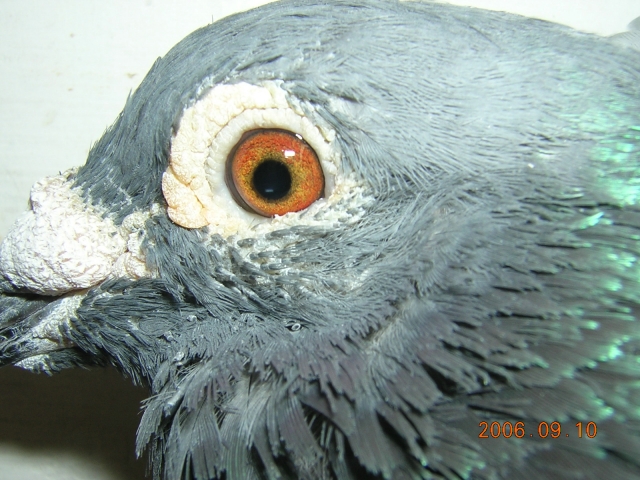
Stock cock off 17th Open NFC Pau x 2nd Open Midland National Nantes.
I now wanted to start to treat National racing like club racing, sending greater numbers. It always makes me laugh when people moan about someone who sends 40 in a National when they don’t knock those who send 40 in the local club, yet in a National it’s 40 against 7,000 and in a club it’s 40 against 200!‘ I then paired a Herbot hen of Roger White of Salisbury lines to an unraced brother of the Angouleme Cock to breed 2nd Open MNFC Nantes. I already had some John Crowder Busschaerts and I paired one of these to a son of the Angouleme Cock to breed 17th Open NFC Pau. Other odd pigeons that have proved influential are a Delbar hen whose daughter has had four good positions at Saintes, and Vandenabeeles of Dave Holderness of Preston lines. These have been winning over the Channel, one cock having won 5th Section at both Pau and Tarbes.
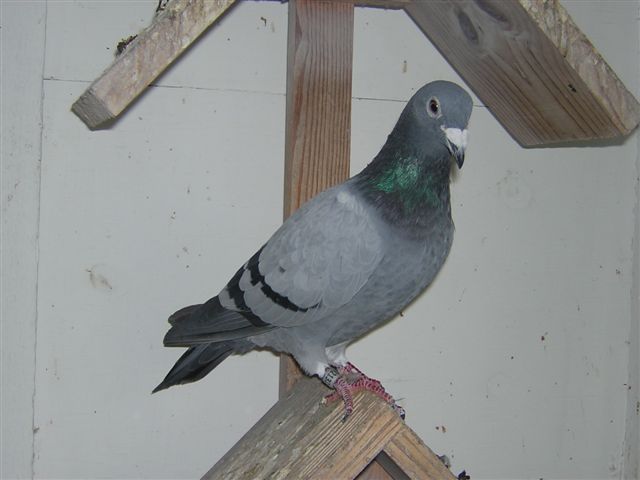
2nd Section Nantes and then 1st Open Northern Classic Nantes 2 weeks later.
To an extent there’s a difference between pigeons bred for sprint and pigeons bred to get further but I think it’s exaggerated and people get a wrong impression of what a bird is capable of. For example, they see Van Reets as sprinters and I had the same apprehension until I got a grandson of Toey for my lad to race in the sprints. It bred one that always came late inland, so he sent it every week except for one drop back between the last 2 Channel races and it won 2nd Fougeres 350 miles and 2nd Saintes, 538 miles on the day!’ This is in fact Mick’s second stint with pigeons. He was involved with them in his early teens and after a couple of years he went into partnership with Fubby Brice, a local character who had helped other lofts out in his time and all of them had been successful. The Co part of the McGrevy & Co partnership name was added so that Fubby could attend meetings. Together they enjoyed reasonable success at club level before Mick lost interest and packed the birds in, aged around twenty. Fast forward now to 1983 when one day a fancier by the name of Cyril Hoyle said “Bring some rings down”.
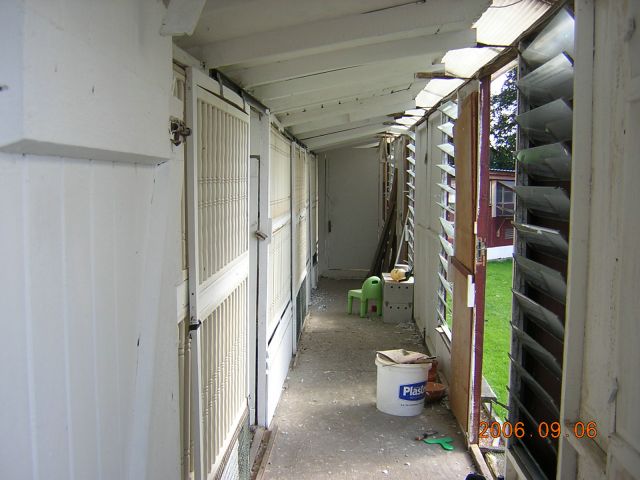
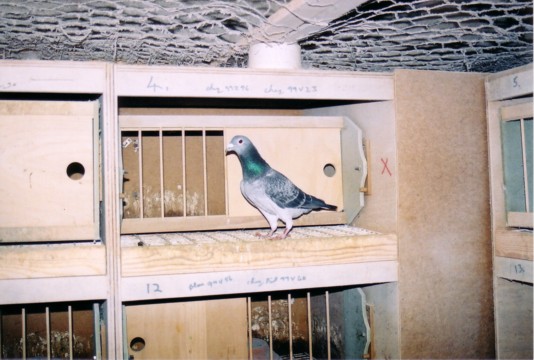
Inside the corridor.
First time round Mick, like most fanciers at the time, had been content to feed a beans, peas and maize mix but on his second start he changed tack. He had read an article in the International Pigeon World magazine penned by Armand Scheers who recommended a Heavy PLX mix. Mick decided to mix this himself and give it a go and his pigeons took off as regards results, though that said, in his local club, the Highgate PC, a really strong club at the time, he still wasn’t managing to be highest prize-winner. He then began going around with Brian Cooper, who scribed for the RP as Blue Cock – this, by the way, was Mick’s Eye-sign Period! It was on a trip one day to see Horace Lidster of Sheffield, that Horace suggested Mick try a pair each off Ernest Kinsey and Fred Keeton. Around the same time Mick used to visit Billy Simons of Woodhouse West End in Sheffield and when talking to his loft manager, Mick said he was thinking of joining the Midland National. He remembers the reply: “You can’t give 50 miles away to them in Birmingham.” Undaunted, Mick joined, and it was not long before he was enjoying success, as has been outlined. Others followed suit and before long the success of the North East Section snowballed. It has led Mick to believe that the wind factor is exaggerated. Back then the SW Section dominated regardless of wind because they were sending the most pigeons. He remembers one day talking to Alwyn Paddy when the MNFC birds were up in a strong west wind, with Alwyn saying it would be won in the east, but Mick said it would make no difference, it would still be won in the SW Section and it was. Because he now reckons drag is more of a factor than the wind, he believes the NFC provides fairer racing than the MNFC. That said he also believes that ultimately it’s down to the pigeon. He has concluded: ‘People think they are smart but it is the pigeon that is the most important factor.’
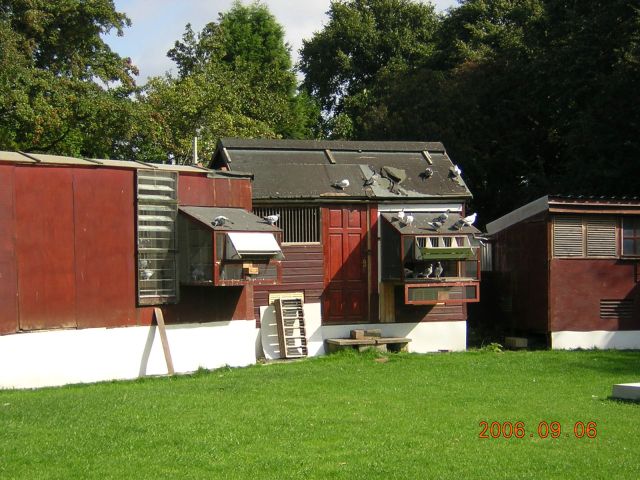
Mick’s smart set up.
Mick adds the following observations: ‘With National pigeons it’s a different ball game to sprint racing where you can get a cock so psyched up that if you point the basket the wrong way it will go and lose itself for a couple of hours! For my sort of racing you don’t want psyched up pigeons, you want ruddy good honest homing pigeons with a bit of incentive. I need one that can make up its mind about where it wants to go as soon as it’s liberated. There’s no point it changing its mind after half an hour or even after ten minutes. The problem is that pigeons are gregarious. I think you can try and help to make them think, however, which is why, when I have the time, I single and double them up. I don’t wait for perfect weather. Some days I can’t see more than 400 yards but they still strike for home just the same. I train from whatever direction. If I fancy a day out in Bridlington then they go with me. Three years ago I trained them 65 miles south and 55 miles north and that year in the Northern Classic I won the first race, was 1st & 2nd in the second race, and 4th out of Saintes. I don’t train them to get them fit – that’s done around home through feeding and exercise – I train them to make them think, and the best way to do that is to take them in different directions. As the old saying goes, “If you don’t want to lose it, use it.”
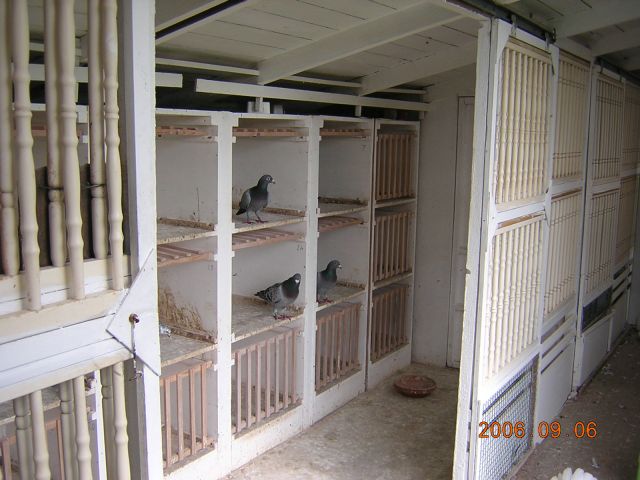
One of the racing sections.
‘My losses in the Nationals are fewer now, but having said that, last year for some reason I lost a lot of pigeons. It was strange racing. The pigeons were in good nick so it wasn’t a health thing. My percentage returns in National races are now as good as they used to be club racing. My youngsters race the programme in the club, and as yearlings they go in the big ones, with some doing Nantes three times and some doing Saintes. I think I would do worse if I kept them to club racing as yearlings – it would spoil them because I think they get into the idea of following. Two year olds and above I try to send to Pau but they are probably better at three because they have more experience. But thinking about it, I should employ my yearlings-to-Saintes mentality and get all my two-year-olds to Pau.
‘A PLX mix is my basic feed, though when I restarted I was on a straightforward widowhood mix with the idea being to break the birds down with depurative, but now I don’t even add extra barley. During April they are still on the stock loft feed but when training starts at the end of the month they are on PLX. They have one 140-mile race on the basic mix. In the last three or four days prior to the first National they have a mix made of up 10 tins of basic, 3 tins of peas and 7 tins of maize to put extra carbohydrates into them and you notice quite a bit of difference. You can feel them blow up and they are basketed big but light. I don’t want them solid, nor do I think you want extra weight on for the distance. I’m always learning though. About five years ago I put someone’s pigeons through and I thought they handled no good. Imagine half a pound of liver in a plastic bag and squeezing it – that’s what they felt like on the breast, but they won so who am I to say what’s right and wrong? If they come back tired, they weren’t right when you sent them. If you have done your job, within half an hour of their arrival you shouldn’t be able to tell they have been out of the shed. I’ve had people here who have seen some of my channel pigeons shortly after they have arrived home and they can’t believe they have been. I suppose if the shoe were on the other foot I wouldn’t believe it either.
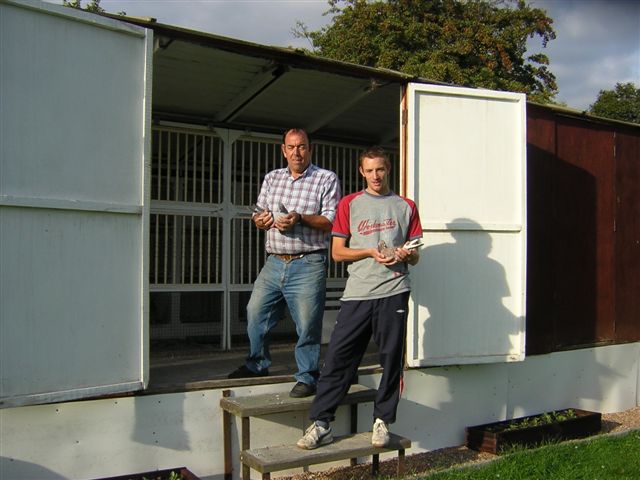
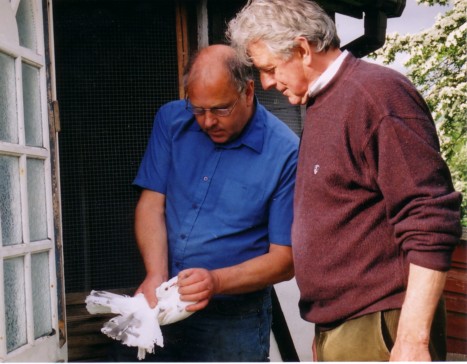
Mick with Robert.
Once they come home they are back on the basic mix. I have experimented with other ways of feeding. Last year, for example, I used peanuts and sunflower seed for the first time but I shan’t be doing so again. ‘I race roundabout and don’t re-pair for the longer ones. I have done in the past but now prefer not to as it’s an extra nuisance, though I don’t think it makes a difference to the pigeon and how it performs. From rearing through to the middle of April they don’t go out for a month because they would field, then towards the end of April they go training every day to 15 miles. I don’t send my National performers in the first few races, preferring to wait till we get to the 140-mile stage, which means they usually only have one race before the first NFC event. They used to have 4 or 5 but it was doing them no favours sending them in the local club. My Pau pigeons go to the Nantes National and thereafter I train them 2 or 3 times a week. I really enjoy making up a flask of tea and going off training.‘I love watching the roundabouts fly; the hens sometimes get up and go like youngsters and the cocks exercise like widowhood cocks. The cocks are better to watch than the hens. They do 20 to 45 minutes but never 2 hours - I wouldn’t want them to anyway - and if they are keen to drop I let them. On the days I’m taking them training I don’t let them out for exercise. The only time they doss around the garden is for a bath. I don’t let them pick around on the grass.
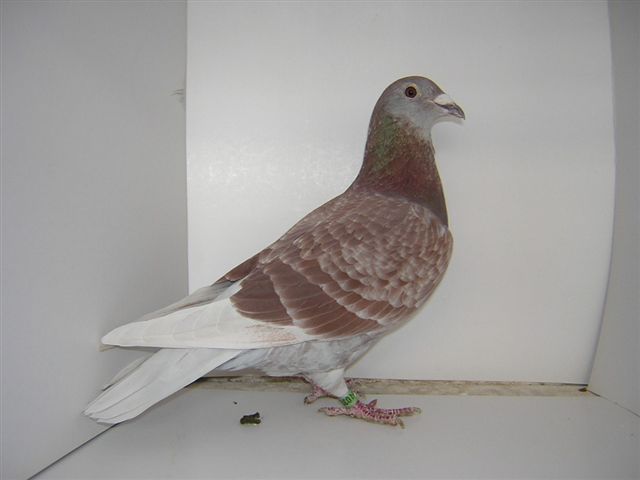
Red hen, bred in 1998 who scored well at the distance every year from the yearling stage – flying Pau and also Saintes on the day more than once. She was out all winter as a young bird, as was her sister who went on to fly Palamos.
From left to right, looking at my loft from the front, I have a 16ft section with 24 nest boxes and a small section with V-perches for the hens. They can’t see each other but I don’t think it would matter if they could. Sometimes for a change I house the hens in the boxed section and the cocks in the section with the V-perches.‘I race young birds natural. I’ve tried darkness but I couldn’t wait to take them off it. This year they have had access to an aviary and the elements. I don’t think the system makes a lot of difference. Darkness may give them en edge with feather but in National racing you want the brain factor more than anything else. It is a fad to say darkness youngsters are no good as yearlings as I was on full darkness for 4 or 5 years and they went on to make good old birds. I like to send half a dozen to the YB national but I tend to lose quite a few. Oddly, although I haven’t a clue how to fly the Channel with youngsters I expect yearlings to fly the Nantes National without much bother. ‘I learnt from Armand Scheers that years ago everyone was racing “badly” pigeons so it was a level playing field but that’s no longer the case. Nowadays a week after weaning I give every youngster half a Spartrix tablet and you can see them lift. In my opinion a little bit of cocci won’t hurt a pigeon but a small amount of canker will so every 3-4 weeks during racing the old birds are cankered either in the water or by tablet using Flagyl or Ronidazole. I worm the youngsters but the old birds only if their droppings are poor. I don’t treat for respiratory unless I think there’s a problem. I have in the past used Baytril for 10 days and after 2 or 3 days their wattles were glowing. There were no side effects that I noticed and I did this for 3 years. I also give multivits once a week.‘

One of the main stock hens off the original Kinsey x Keeton foundation pair.
A few years ago I was wanting to move away from treating and I’d read about Raymond Ingram of Workington so I gave him a call and took a stock hen up to him. She looked a picture and would have won in a show. He swabbed her and projected the findings onto a monitor and it was like watching something out of Star Wars – so it just goes to show you can’t tell if a pigeon has a problem just by watching it around the loft. You might say she looked a picture so what does it matter, but imagine if she had been a race bird that was going to come under pressure. After that I went down the path of mixing my own herbs for a few years but you know how it is, it got to the point where I couldn’t be bothered to do it any longer so now I use conventional treatments. ‘My team’s a lot stronger now than it was in the early years after I re-started. I breed best to best and keep my fingers crossed, but I know this, National pigeons and federation pigeons are different animals. Whether it’s because of breeding or training I don’t know but many a fed topper has been lost in National racing. Racing in the Northern Classic I would say is halfway between fed and National racing. Ideally you could do with them being more motivated for the Classic. On a scale of 1 to 10, 10 being great, I’d say I’m about 3 in terms of favourable loft position – for either the fed, the Classic or the Nationals but at the end of the day if the pigeon is on the job it will do it. The pigeon is number one and you can only get out of a pigeon what’s already in it; the fact is 80% of pigeons are not capable. If I breed 60 youngsters I may have 10 left by the time they reach three – if I’m lucky. And the figure’s probably only one if we’re talking about Pau. If I get a good pigeon I keep racing it - I’ve only ever retired three! Sending pigeons when they weren’t right has been my biggest mistake. You kid yourself because you get greedy. If they come back from a race and look nearly as good as when you sent them they can go again but if, for example, one comes from Nantes next morning it’s telling you something’s not quite right with it.’
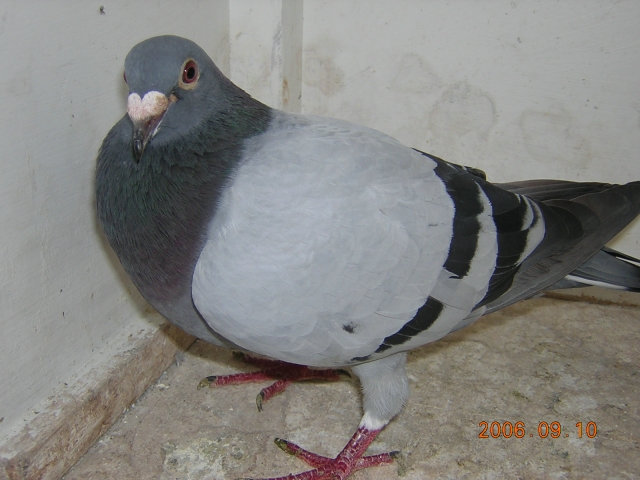
The Vandenabeele Pau cock mentioned in the text.
Mick’s enthusiasm for National racing is such that a few years back he thought he’d do his bit by putting himself up for election as a Section K representative on the National committee. Now you’ll usually find him manning the NFC stand at the Blackpool Show, trying to recruit new members, and he is one of those who has bent over backwards to make the Dax race viable by reducing costs.
‘Ken Hanby cajoled me onto the committee. I’ve got as big a gob as most and I believe that whether right or wrong you have to say your piece to make people think, so here goes… If you are talking early libs Pau is the wrong racepoint but when you start talking about moving it all hell breaks loose. I would like to see fewer Sections, perhaps seven, with Devon and Cornwall combining to make one. Prize-money for all Sections should be equal irrespective of the send. I thought Sid Barkel’s idea of a North Sea race was a great one and I would have had a go. I’m not bothered about the choice of racepoints: north, south, east or west, good pigeons will come.’
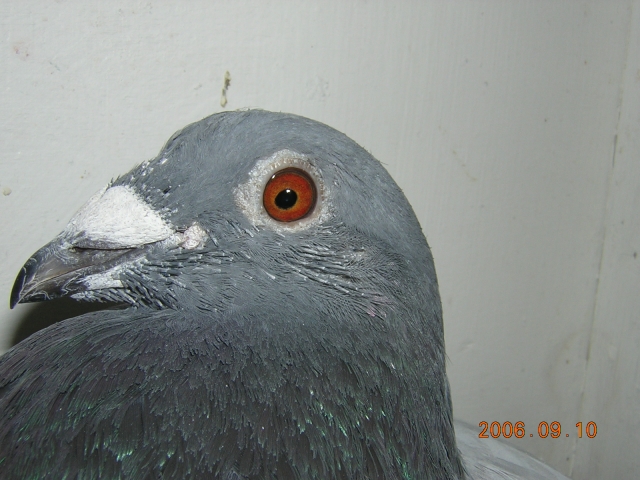
Flown Dax twice, winning 5th Section K.
I finished off our chat by asking Mick two questions: who has influenced him and what is his ambition?
‘I’m not one for going looking at other lofts of pigeons so my influences have come from what I’ve read. For example, I was influenced into sending yearlings to Saintes by what Brian Denney does. Who do I rate? I’ve no interest in foreign fanciers. At Pau Brian Denney and Chris Gordon, in the Northern Classic Hardaker & Sykes, and nationally Geoff Kirkland is the kiddy for me.’
And his ambition?
‘To win the National from Pau…or Nantes… or Saintes… or Dax.’
10/11/06