DARREN ROBERTS
of Wrexham
by Cameron Stansfield
Winner of 7 out of 7 Channel races in 2003
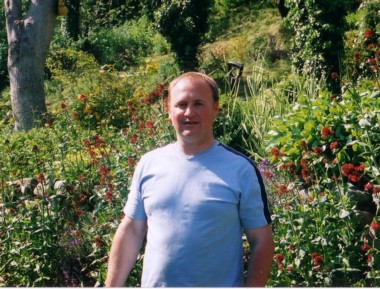
As the heading to this article says, Darren Roberts enjoyed a fabulous 2003 season, winning 7 out of 7 Channel races. This extended his record to 10 wins out of the last 12 Channel races he has entered. Obviously he has a system that works and the right pigeons to take advantage of it... but is it a system that the average fancier could adopt to his advantage? Well, read on and I'm sure you'll agree that it is.
SIMPLICITY
The birds are paired at Christmas and allowed to hatch either one or two youngsters, with the hens being taken away before laying again and placed in the young bird section, the cocks being left to finish off the youngsters. Note that Darren allows his racers to choose their own mates so has no need for nest box fronts. The birds are re-paired three weeks to a month before the first race, being allowed an open loft, and then all hens are split again as soon as the first hen has been sitting four days. The birds are left alone for two or three days and then let out to fly for 10 minutes or so before Darren opens the traps, whereupon they shoot back inside the loft. On the Thursday before the first race of the season all birds are given a 10-mile toss, the hens in the morning and the cocks in the afternoon, on both occasions the birds returning to their mates. This is all the work they have before the first race, as Darren chooses not to work them harder so early on because 'There's no glory to be had from Hereford.' All birds are basketed on the Friday for the first race and when they return on the Saturday they are hopper fed a young bird mix, staying together until Darren returns from the Club. As soon as it is light on Sunday, Darren is up and outside to give a bath to the hens, followed by the cocks. Again, the birds are hopper fed a young bird mix. On the Monday after the first race of the season both cocks and hens are made to fly for 20 minutes at a time twice a day. They trap to a full trough of young bird mix on both occasions. On the Tuesday, Wednesday and Thursday they are forced to fly for 45 minutes twice a day, Darren standing in front of the loft and throwing a hula hoop in the air if needs be! By the Thursday they are into a real swing, then on Friday they are allowed together for two hours before basketing. This continues for the land programme and under this method Darren is regularly in the prizes, but the point to make is that these prizes are a bonus in the lead-up to the Channel races as Darren is not wanting his birds to be in peak form too early.
AIMING FOR TOP FORM
At this point Darren moves up a gear. For the last two seasons all birds have been given a tablet one week prior to the first Channel race to ensure their respiratory tracts are A1. He has not found it necessary to give this tablet more than once. After the final land race before the Channel programme commences, Darren changes tack. On return from the last land race the birds are hopper fed a PLX-type mix (the actual mix coming from Court Farm Feeds). They are fed this am and pm on Monday, then for the last three days before marking for the Channel they are fed what Darren terms 'a special mix'. This isn't a mix, it is just a combination of two grains, but though he was forthright in outlining all other aspects of his system, he asked that he be allowed to keep this bit of information to himself. That tells you how much of his success he puts down to this aspect of his management. Anyway, this 'special mix' is hopper fed to the birds twice a day and they have access to no other food. After each Channel race the birds return to the PLX-type mix and then in the final three days before basketing for the second Channel race they have the 'special mix'... and so on through to the longest two Channel races, when the 'special mix' is supplemented with peanuts. With the novelty of the 'special mix' perhaps having worn off by this stage of the season, Darren notes that the birds eat nearly all peanuts - and as many as they want. To this 'special mix' he adds a product called Herba Bee Gold plus multivitamins (from Cadburys).
WINDING BACK DOWN
The passing of the final Channel race effectively brings Darren's season to a close because he does not race youngsters (although to be totally accurate he did send half his 2003 young bird team to one race). He used to be a young bird enthusiast but now with having a young family he would rather dedicate his time to days out without being tied to the birds. The old birds remain together until mid-November, the eggs being dummied, and are then re-paired at Chistmas time... and so the process starts all over again. Note that not only does Darren not race youngsters, he hardly trains them either. They have maybe three or four tosses to 15 miles - yet they fly the programme and perhaps three or four Channel races as yearlings without much difficulty. In fact one yearling hen in 2003 flew six Channel races and won prizes in each of them.
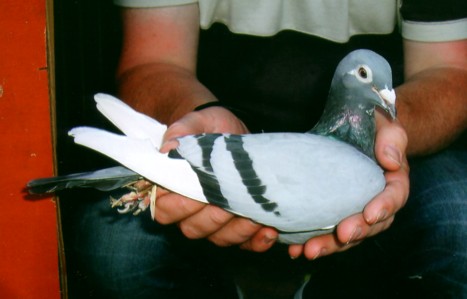
1st Falaise & 1st Nantes in 2003
OBSERVATIONS
Before taking you through Darren's 2003 Channel campaign to illustrate the effectiveness of the system just outlined, a few observations wouldn't go amiss. He says he knocked the traditional method of feeding depurative on return from a race then a widowhood mix on the head because of a chance happening. Two years ago he was feeding this way on the land programme but happened to run out of depurative and widowhood mix so the birds returned and were fed a young bird mix. He kept this up through the ensuing week and the following Saturday had five birds drop together to take 1st, 2nd and 4th Club!
Darren does not keep a big race team, just 16 pairs at the beginning of the season, and this is reduced early on because, not racing youngsters, his yearlings are totally untested so some go down. He notes that if he is going to lose any, then it will be in the first few races and after that he doesn't drop many at all. He does not train old birds. They are raced every week inland and go to every short Channel race, with most also going on to Nantes and then a few to Saintes. He only moved to his present address in 2000 so is still getting to know his birds and their capabilities, and one thing he has concluded is that the Marcelis lines are 'stretched' when it gets as far as Nantes, so they won't be asked to do it again in future. As a rule, the birds do not get weekends off. They are expected to race an inland race the week after a Channel race if that is how the programme falls. He would prefer not to send his hens every week but does so to dissuade them from pairing. He does not re-pair any of his racers for the longer events. He tried this three years ago and says it was a disaster. He is adamant he won't be doing it again. He says he can see if the birds are still retaining their enthusiasm by the manner in which they hit the trap after home exercise. In 2003 his whole team was still 'hitting the trap' well into July, even after having been on roundabout from mid-April.
When exercising, the birds are unable to see any birds inside the loft because Darren wants them to fly without distraction. When right he says his hens knit together in a ball and work the skies. The hens are either in the sky or in the loft, whereas the cocks are given their liberty for two or three hours at a time with the loft doors being left open. Apart from on Sundays, he has fed no grit or minerals to his racers for the the past two seasons! As his hens are either in the sky or the loft they can't pick any extra from around the garden.
EXTRAS
During racing, the birds are given a combination of Johnson's Tonic and Epsom Salts each Saturday and Sunday. In addition to the one-off tablet for respiratory, the racers also receive a quarter of a canker tablet (metranidazole) every fortnight, this being given on the day of basketing for a Channel race. Every two weeks each bird receives two drops of Nystan down the throat.
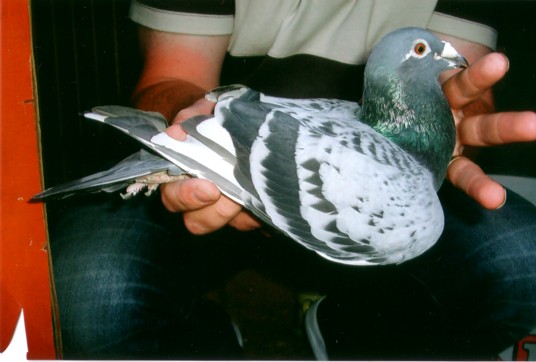
1st Nantes & 1st Saintes
A SEASON TO REMEMBER
Darren's 2003 Channel campaign began on May 25th, but before getting into it we'll start a week earlier on May 18th when he sent his entire team of 24 (this was what was left after early losses) to Littlehampton with the Welsh South Road National. With this being a 190 miler he thought it would be a better tightener for the Channel than a local Club inland race. He was to win 27th Open, and the following week from Picauville, 263 miles, with the Wrexham & District Fed when 1,027 birds were up in a west-north-west wind, this same pigeon topped the Fed. She is a Jimmy Weeder Marcelis x a Paul Szalwski Janssen hen bred in 2001 which has won loads of prizes. (She hit a wire a week later and was promptly retired.) Overall in this Picauville race Darren was 1st, 3rd and 5th Club and 1st and 22nd Fed.
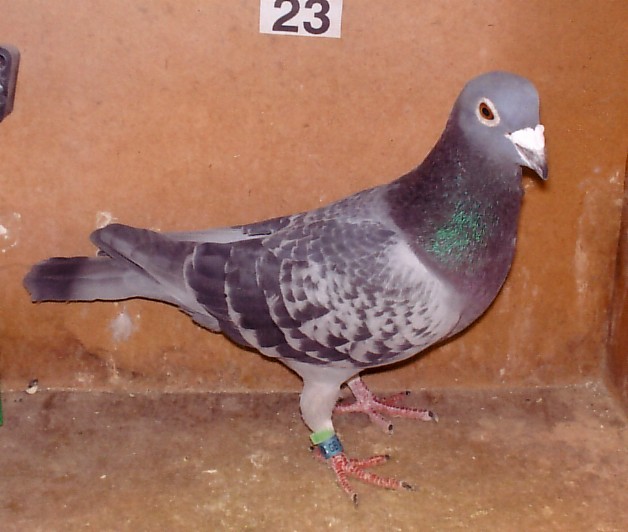
A fortnight later on June 8th he was racing from Falaise, 312 miles, in the Wrexham & District Fed when 945 birds were up in a light south-west wind. He took 1st, 2nd, 4th and 5th Club, 1st, 3rd, 15th and 22nd Fed. His winning hen (a Trevor Benton Marcelis x Long & Cox Wildy of Jim Dutton's No 1 stock pair lines) had won 2nd Club West Bay a week earlier. The pigeon which was 3rd Fed, he'd travelled down to South Wales five days previously to pick up as it had gone astray from the Falaise National. The pigeon which was 15th Fed (bred from a pair of Jimmy Weeder Huybrechts), a week earlier had been 2nd Section, 45th Open Welsh South Road National Falaise.
Now we move on to June 15th and the Falaise race with the Deeside Fed when 120 members sent 818 birds up in a light north wind. Darren entered seven hens and had three drop together to take the first three in the Club (60 yards a minute clear of the 4th bird) and 6th, 7th and 14th Fed. There is a very interesting story surrounding the hen which won this race. She was a 4y and prior to 2003 had been a stock pigeon; not only that but she had spent the previous year on loan in Scotland, and not only that, she had never flown out in her life! The year 2003 was the first time she had enjoyed any liberty and, following one 10-mile toss, she flew every inland race prior to winning the above race from Falaise. Her story doesn't stop there, as you will see shortly.
Next up for Darren was Messac, 365 miles, on June 21st with the Wrexham & District Fed, when 752 birds were loosed into a south-east wind. A yearling hen who had been 2nd the previous week from Falaise this time went one better as he took 1st, 3rd and 5th Club, plus 12th Fed.
The following weekend, June 28th, there were no Channel races available to him and, rather than send inland, Darren decided to give his birds a rest in preparation for Nantes, 406 miles, on Saturday, July 5th. He engaged 12 birds in the Wrexham & District Fed and just the one in the Deeside Fed. Both organisations liberated together into a west-north-west wind and it turned out to be the hardest race of the year; indeed there were only four day birds in the Wrexham Fed and three in the Deeside. Racing with the former, he won 1st, 3rd, 4th and 5th Club having the only bird on the day in the Club and 3rd, 22nd, 23rd and 32nd Fed against 525 birds. In the Deeside Fed his only entry won 1st Club, 3rd Fed against 340 birds and also 3rd Amal, 1st North Wales Championship Club, this being the same 4y hen who won Falaise who had, remember, been a prisoner prior to 2003. She was pooled through! His only bird on the day, 3rd Wrexham Fed was a 2y late-bred Huybrecht. Remarkably, the six birds clocked from Nantes were bred from just two pairs of Huybrechts from Jimmy Weeder of Liverpool! Incidentally, most of the birds Darren races are bred down from Huybrecht obtained from J & P Weeder in 1997, the year they won the North West Combine Channel averages, and Darren would like to thank them for the pigeons and the advice given to him over the last few years.
The following week Darren sent a few to an inland race and then came the long one, Saintes, 516 miles on July 19th. In his local Club he was the only member to send and he recorded two of his four entries to secure 1st and 2nd (naturally) plus 5th and 15th Fed, his first bird being the same 2y cock which won Nantes. And so ended a splendid Channel campaign.
BROADER HORIZONS
With the lack of birdage at local level when the distance increases, Darren now feels it is time for him to have a real go at National racing and with that in mind he has joined the National Flying Club and the British Barcelona Club for 2004. Indeed he doesn't anticipate competing at Club level over the Channel this year.
THE PROOF OF THE PUDDING
There you have in a nutshell the very straightforward, easy-to-follow system of a working fancier. Under this system there is no hammering down the road training pigeons (young or old) and most birds can be raced week after week, so consequently you are always able to play your strongest hand. Seven wins from seven Channel races (10 wins from 12 Channel races in the past two seasons) shows that the system works. Darren has very kindly offered it up on a plate and it is there for anyone to follow... but as to which two grains comprise his 'special mix', well, you'll just have to work that bit out for yourselves!
COPYRIGHT C. STANSFIELD