JIMMY ROY
talks to Cameron Stansfield
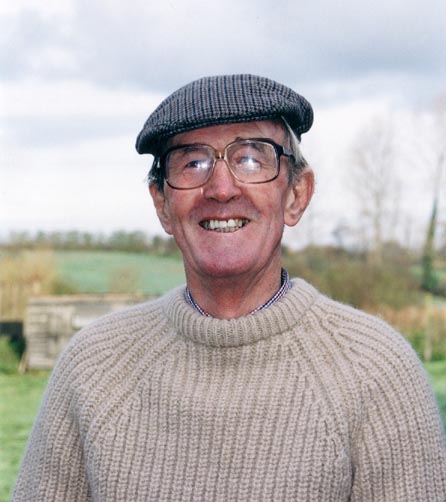
I've only met Jimmy Roy twice and it was something I heard him say on each of those occasions that got me thinking, 'I might learn a bit of something from this man'. The first occasion was at the British Barcelona Club's Annual Dinner a couple of seasons back when he said to me, 'I wish I knew thirty years ago, what I know about pigeons now', the obvious inference being that he'd cottoned onto something that makes pigeons tick. Had he somehow discovered the 'Holy Grail' of pigeon racing, or more specifically, the key to unlock the mystery of how to win?
The next occasion was at last November's BBC Dinner when he approached the top table, leaned over to the Club's Secretary Jim Hooper and said, 'Jim, I'm telling you now, give me a north-west wind and I'll win Palamos next year. And I've two pigeons that could do it!' Neither comment was said with boastfulness, these were simply the words of someone confident in both himself and his pigeons.
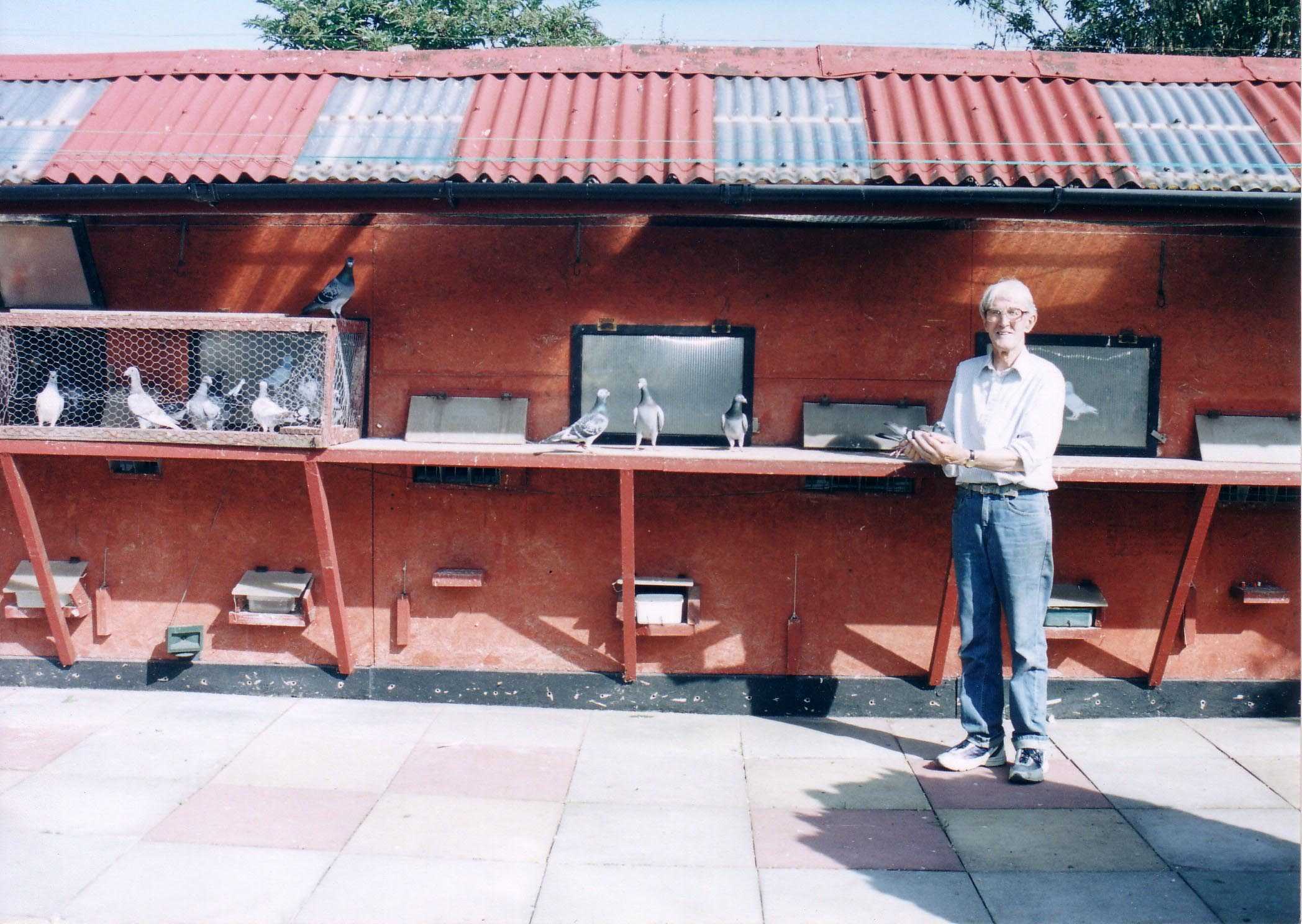
Here's a quick resume on Jimmy for those who may not be too familiar with the name. He is 77 years old and lives in Margate in Kent after having followed a path through life which has seen him race pigeons successfully in his native Ireland, then on to Loudwater and Windsor, followed by a spell in Australia and then back to England. The last time he had a really serious go at local Club racing was in 1996 when he won 29 x 1st. Since then he has concentrated on the major races - to tremendous effect. Last season he won 3rd Open BBC Palamos, 4th Open BICC Perpignan and 1st Section, 5th Open NFC Pau. These performances followed hot on the heels of 1st Open BBC Nantes, 2nd Open BBC Nantes, 1st and 2nd BICC Pau and 2nd & 3rd Open BICC Marseilles, to highlight but a few of his best results. Here are some of Jimmy's thoughts.
Type
I have 53 racers now and only one that I don't like; I've bred the razor keels, the wobbly vents and other faults out of them. I've raced pigeons since 1943 and back then pigeons seemed to have long legs and necks and were more streamlined than today. I had the Putman Van Cutsems and they were like this. Pigeons nowadays seem to be shorter cast. In Australia, where I raced from 1979 to 1983, all the birds were short cast, apple bodied, not much bigger than a thrush and with lovely feather; there were no big pigeons. At that time, 90% of the pigeons traced back to birds introduced into Australia in 1928 by a millionaire who bought them from a Mr Harrison of Stoke. I go by tight vents because I've never had a good one with loose vents. They shouldn't move about, they should be welded together. When Mary Anne came from NFC Pau last year to win 1st Section, 5th Open, her vents were tighter than when she was sent. And all the best ones have a bit of depth to them to allow for their heart, lungs and air sacs so I don't like really shallow pigeons. In the hand, I like them to feel like a block of wood - hard not spongy. Windsor Lady, one of my best pigeons of the late 1960s, had a hump on her back like a big shell and when you tapped it was just like knocking on a piece of wood. She was never tired, not even when she flew Pau on the day into a north-east wind! Nor do I like long spindly legs; the pigeon has to hold them up during a long flight so they want to be strong and short. I like a one-tailed pigeon with a tail that slopes downwards and not what I call a 'scooped' tail. I also look for plenty of room between the last 3 or 4 primaries as a pigeon flies mainly on its secondaries and it's the top edge of the secondaries that do the work. I want them to be shaped like Venetian blinds with the top edge of the secondaries turning over. I like a nice round keel that curves upwards towards the neck. I always feel that if the keel is 'flat' and doesn't curve upwards it is liable to catch the wind. I would go so far as to say that if the keel runs flat (handle the bird on an empty crop) the bird won't be any good. Likewise, I've never had a good pigeon that handled badly in general terms. For me, a hen has to be made like a cock, a little bit deep with a nice thick keel that wants to be a rusty colour.
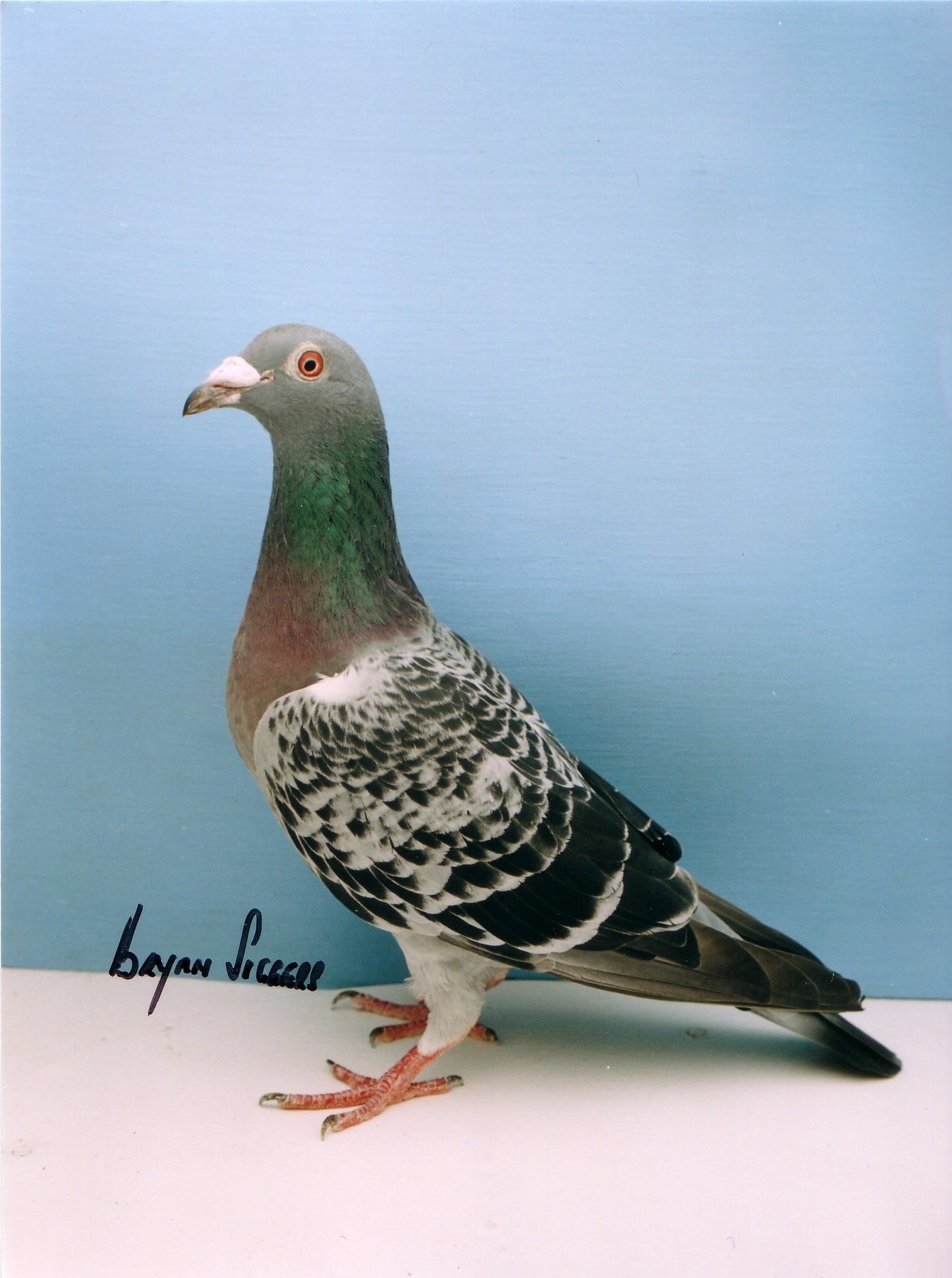
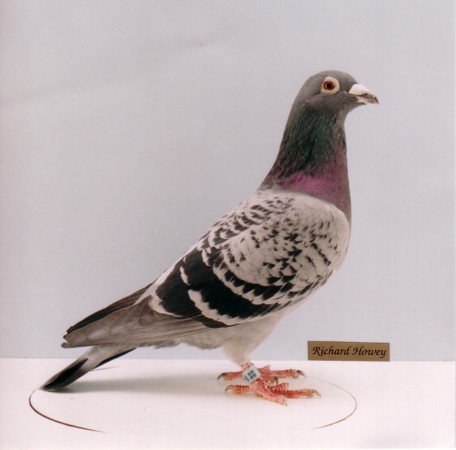
1st BICC Pau
Percentages
I have 29 pigeons flown 569 miles in my racing team. From experience I've found that about 80% of those that fly Bergerac, 461 miles, are capable of coming out of Pau, 561 miles, but I would estimate that only 20% of those would then be able to cope with Palamos, 659 miles.
Form Signs
When some of my pigeons get really fit their cere goes dark red. It becomes more noticeable as the season progress and by the 3rd or 4th week of July I get quite a few like this. When I lived in Windsor I had one cock, which I called The King, who would come into form at the same time (between the 9th and 12th of July) each year. When the eye ceres change it is because they are full of blood, so if they don't change I don't think they are 100 per cent fit. I look for it to change in the last 10 days before basketing.
The Birdman
I'm convinced the reason a lot of pigeons don't win is they don't like their owners! Tameness is a big factor and I'm sure that if my birds didn't love me as they do I would only be half as successful. I think they race home to me. I don't know what it is - and I know people will think I'm daft for saying it - but I seem to be psychic or, put it another way, I have an aura around me. For example, I have a 24ft landing board that runs the length of my loft and from time to time a stray will land on it. I saw a programme on Monty Roberts, who calls himself the Horse Whisperer, and thought I'd try the same approach on pigeons. Anyway, I can get strays to go into my loft through a stall trap in no more than 7 or 8 minutes using just my eyes and my shoulders! When I let my birds out for exercise they fly straight out onto the board not into the sky - because they want to come to me. I have to hide when they are exercising for the same reason and when they drop they don't want to go in so I give them broken peanuts and usher them into the loft. Sometimes I give them seed on the landing board. I brush my hands through them and this helps create trust. Likewise I can walk right through the middle of them when they are bathing on the lawn and they won't bat an eyelid. My best 4 hens and my best breeding hen, the Belgian Hen, all start 'singing' when I get them in my hand. Having said that, the Belgian Hen was a real cow when she came back from a race because she used to stick her neck out and fly past me - showing off! Mary Anne sings to me all the time. To be successful at the distance I believe it's down to 50% origin and 50% the man. That said, I've seen the way some people keep them and they've still won, particularly in holdovers when their birds enjoy more food and come into form. In Australia I bought 17 pigeons for a dollar each, broke them and won the old bird averages so it must have something to do with the man.
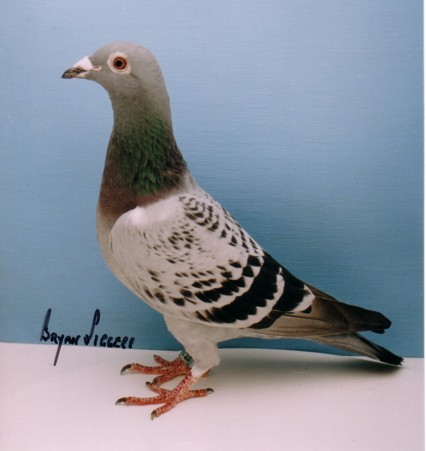
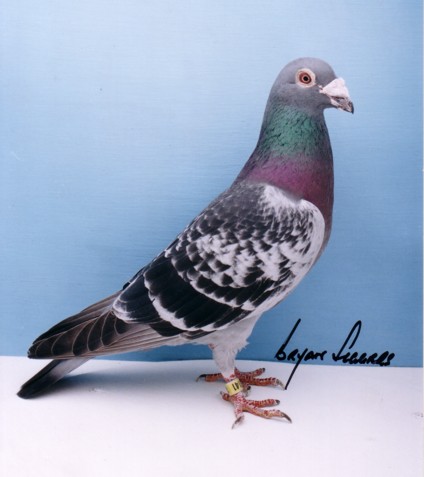
Mary Anne. 5th Open NFC Pau in 2004
Seagull Days
You must send really fit pigeons if you want them to cope with those still days we get, those days when the seagulls are the size of sparrows and there are no other birds about. You know then that you are in for trouble. Your pigeons must be well trained, and ideally before a long race I like them to have 8 or 9 hours on the wing in a prep race; I would say mine need that sort of workout. One pigeon I can recall made a mistake from a hard San Sebastian, returned on the following Thursday, then on the Tuesday was sent to Montauban 509 miles and won it by over an hour. It had probably been under worked and too heavy in the first place. You want their muscles to feel spongy, not tight. If you can, imagine pressing your finger into the muscle. You want the dimple to fill back up slowly.
Preparation & Motivation
I honestly think I will win Palamos this year if we get a north-west wind - and I've two pigeons which I think can win it, two that did so well for me last year. I will send the hen celibate and the chequer w/f cock will be just looking at his hen. He was 4th Open Perpignan in 2004 when he flew 2,700 miles in total, including Dax. I sent him to Blandford 156 miles a week before Perpignan then gave him his hen and a bowl of straw at 4pm the day before basketing. Next morning he was low down in the bowl and the hen was standing on his back! I let them down onto the floor together to make sure he wasn't over-excited and starting to chase her, having once made a mistake with my good cock Rob Roy by giving him his hen too soon before basketing for his third tilt at Marseille. He had won a 2nd and a 3rd at Marseille when sent 'looking' so I put him in 4 hours earlier thinking it would make him just that little bit keener - but just those four hours overdid it. I let him out of his box and down onto the floor and he banged his hen off the side of the loft. I sent him to the race - and didn't see him for a week! The hen I'm sending is Maria who was 3rd Open Palamos in 2004 when she was also sent celibate. She was paired on February 14th, reared 1 youngster, laid again then was parted having sat 4 days. She is only three so, with luck, she could go on to win a Spanish Diploma in the next two or three years - but then again I could take her up the road for a toss and never see her again. That's what makes pigeon racing so hard. I once lost a pigeon in a prep race from Beauvais that I was going for a Spanish Diploma. My typical preparation for a race like Palamos is 10 tosses, 3 inland races and 3 short Channel races.

The eye of Emmet, 1st BBC Nantes
Basic Routine
I let the cocks out at 5am then go back to bed and they fly, on and off, for around three hours. They are back in the loft again by around 8 o'clock and then I let the hens out. They won't fly if they see me so I put up a 17ft pole with a Tesco bag on the end of it and then hide! I only have to shake it 3 or 4 times and they go off running like youngsters, away over Margate and along the seashore. They come back maybe 3 or 4 times during exercise, which only lasts 35 minutes or so, then are down and in. If mine do 40 minutes I'm very happy. I can tell when they are getting fit because when they fly overhead they make a 'sssh' sound. Once they land on the let board I throw some peanuts into the loft to get them in straight away otherwise they will start treading each other, and if they are allowed to do that day after day, then before you know it there will be eggs about. I then go into the loft myself and usher them straight into their boxes. Invariably they will go into their own box but if they don't it doesn't matter, I just lock them in whichever box they find themselves inside. They are then fed and watered in their boxes and all the while I make a fuss of them. They go out again at 6pm and are again flagged. They perhaps fly that little better in the evening but even so, they are all back in the loft and in their boxes within the hour.
The Weaker Sex?
My advice to anyone just starting would be to make themselves 60 boxes to race 60 hens and keep just 8 or 10 cocks to show them occasionally. I think you will win twice as much with hens. All my hens play up to me, 6 or 7 more than the others, and the best ones are the tamest, those that come down into the house to find me. The celibate hens seem to be fitter than the widowers. On year I did an experiment. My wife took my cocks and my hens on twenty 34-mile tosses. Each time she let the hens out 15 minutes before the cocks. When there was no wind the hens flew it in 90 seconds to 2 minutes less time, and in headwind the cocks were between 4 and 7 minutes slower. The cocks never beat them. But you've got to have the hen to start with, you can't just shove any hen in a box and expect to win. You'd be wasting your time.
The Box System
I pair up around about the 14th of February, let them rear one youngster and then remove the hen when she has been sat for 4 days on the second round of eggs. To leave the pair sitting even a day or two longer carries the risk of them dropping their first flight. Under this method I scored from Perpignan in early August last year with a pigeon that was only on its second flight. Once the hens are removed they are housed in individual boxes, meanwhile 12 of the cocks retain nestboxes and the remaining 30 cocks are housed on V-perches. I bond with the V-perch cocks on the landing board and they are just as close to me as the hens and cocks that have boxes. From the hens being parted and boxed it takes them about a week to come round and then I can tell by the noise they make when I enter the loft that they are in good nick. You don't want to go up there in the middle of the day - they would play around too much and not rest properly. I have 29 hen boxes. They can't see each other and they don't lay. They go on all season on this system, year after year - my 1st Section Pau hen is a 1999 pigeon. When boxed my hens rest on 4 by 4 blocks of wood and are very relaxed. This must be better for them than if they were natural pigeons sat sweating on the nest and being hassled by other cocks. This is the same reason why widowhood cocks are so fit.
Widowhood Cocks and Celibate Hens
Last year my widowers didn't see a hen at all. The hens race to me anyway. Once celibate, they stay celibate; I haven't sent any on eggs for years. There are two conclusions I have come to: anyone can fly widowhood and good pigeons will handle any system.
Final Touches
Before a big race they have perhaps 3 x 35 mile tosses then are left for 4 days but on the last 2 of these days I don't let them out of their box. At one time I kept greyhounds and I found they were always fresher and stronger after a period of confinement. Similarly, I once had a black Herman cock which I took out of the stock loft (he didn't fly out) and sent to races - and time and again he would go and beat my 'racers'! I find I can get better condition on pigeons that are locked up; they handle better and their feathers are like silk. You only have to look at how tired out strays blow up after a couple of days of confinement and rest. As an example of how I adopt this system, my NFC Pau birds that are race-marked on a Tuesday, have a bath on the Sunday morning and are then confined to their boxes before being basketed for Pau.
The Right Racing Weight
I send them about an ounce 'overweight', but really it's not their weight I go by, more the size they are - they look big but are corky. Prior to their final build up they are much less corky so it must be the maize and peanuts in the last few days which does it. With feeding the hens individually they have the proper amount, whereas cocks are fed communally and may over eat. Having said that, I tend to overfeed all my birds with titbits anyway. I use an awful lot of peanuts, 3 or 4 per pigeon per day up to a fortnight before basketing then 40% maize and maybe 6 peanuts a day in the final few days. Last year none of my leading birds came back more than a quarter of an ounce lighter than when sent. They always seem to be in great condition when they drop, tight feathered and not at all ruffled up. They used to come back with their wings down and sit huddled up for 2 or 3 days but not any longer. I send them as fit as I can get them though sometimes I think they are too heavy, but you have to do that little bit of something to alter their state of mind to try and make them want to come home that bit quicker. I make a fuss of all my pigeons, early arrivals or latecomers, when they come home.
Topping Up
I did an AAA course in the 1960s with Tom Nab, the then National coach, and I went on to coach runners including an English 1500 metres champion, and I ran myself. I condition pigeons in a similar manner to how marathon runners prepare with a protein base then carbohydrates and fats. I don't think I could fly the distance races without peanuts. In the last 3 or 4 days before basketing, they are approaching 100% fitness and consequently they lose some of their appetite. With peanuts, I find I can keep them eating. And one thing I have learnt is that a build up with seed is no good.
My Greatest Race
Clocking from Pau last year at 8.43pm on the day was a great thrill. However, Perpignan in 2004 was my greatest race. As you know yourself, pigeon racing is all to do with the wind. It was north-east all day Saturday and a strong, hot east wind on the Sunday and there were very few pigeons in the eastern counties. I didn't think I would ever see him again. When he landed he ran up and down the landing board and his feathers were still tight! His nestmate, Maria, won 3rd Open Palamos last year. They are both out of my Belgian Hen (a 1993 late-bred which came in as a stray). I transferred her and sent her to 17 races as a yearling with her winning the last one, from Bergerac, by 47 minutes. She has subsequently bred 16 different winners. Their sire was Sad Eyes who was off my old pigeon 'Gift From Heaven', who came from Reg Fulfour. Reg went up to see Joe E Shore of Comberbatch and wanted to buy 6 youngsters. He was given the pick of Joe's whole team and one of the 6 turned out to be 'Gift From Heaven'. I still have 3 of his sons, all born in 1993, in my stock loft. The dam of Sad Eyes was a Huskeyns Van Riel from Mick Price of Marlow that won the Combine in a hard race from Bergerac as a yearling. My 1st Section Pau hen of 2004 is off The Irish Hen, a 1996 hen who was 2nd Open BBC Nantes and 9th Open BBC Bordeaux. To breed Mary Anne she was paired to a cock which came from my brother which was related to Noel Wiles of Skerries, 4th Open King's Cup winner. The Irish Hen was so named because that year my brother sent me 14 rings to breed him some youngsters but in the event he never had the pigeons over to him. I've read about pinkies and don't know whether to believe in them or not but what I will say is, Mary Anne was a pinky, the only one I bred that year. Her flesh was dark red with dark red veins, in fact she was more like a plum colour than pink. Prior to her Pau performance Mary Anne had been 227th Open Young Bird National but although steady thereafter, had never been spectacular. These lines and 14 latebreds which I had from Malibu Stud in 1991, these being Sid Montgomery Krauths, form the backbone of my loft.
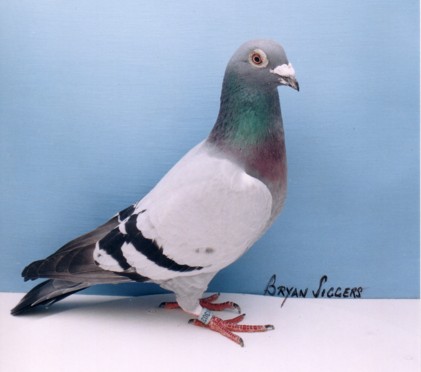
2nd BICC Marseille & 28th BICC Pau
Food
Last year I reared my youngsters on 75% two-year-old beans and 25% Hormoform and they were the greatest set of young birds I've ever produced. These days, however, there are no beans in my racing mix. I mostly use 50% Bucktons VIP, 25% Bucktons YB High Protein and 25% Irish mix. To this I supplement peanuts and maize that I buy separately. I prefer American maize if I can get it as it has more of an ear, which is where the goodness is. I don't feed hemp or linseed (the latter drives them mad and makes them moult), canary seed (too sharp) or barley (I don't like the edges on it). I made a mistake last year of giving seeds and they moulted too quickly. For Palamos, which comes early in the season, this doesn't matter, in fact I like them to have cast one or two by then, but it does matter if you want to be competitive into late July/early August. I fed barley and beans for racing years ago but they used to become too heavy. Having said that, in Ireland in the 1940s, barley was the only grain we could get our hands on and they flew the Irish Sea on it - which just shows how pigeons adapt to anything. I think the way I feed today enables my birds to knock perhaps a couple of hours off their flying time from somewhere like Pau, compared to how I used to feed.
There are fanciers... and there are fanciers!
I've come to the conclusion that you can try and be helpful and give people advice on how to race pigeons but they will never learn because they are just not born fanciers. You can tell immediately on going into someone's loft whether their pigeons are happy or not, and whether they are going to win or not. Some pigeons just aren't relaxed in their lofts. Then there are the other people who have great reputations but are just pigeon politicians. I cringe when I go to some of these supposed good fanciers' lofts when I see how they handle their birds. Even a wild pigeon shouldn't struggle in your hands if you handle it properly. The people who impress me the most are not the big senders but the smaller team flyers who have a greater bond with their birds. Having said that, I don't really go looking at pigeons. That's because some lofts look so posh that when I come home and see mine it puts me in bad humour!
Positive Thinking
I always try to be positive and I'm always making excuses for my pigeons. You see, I like to think they love me and their loft so much that unless they are dead they will come home. It can be very, very hard to send your best to places such as Palamos, and others have said to me, 'Don't send your best there, you'll lose them'. Some send plodders but how can you win if you don't send your best? I would be very sad if I lost my 3rd Open Palamos hen but she is only three years old this year so I can see no reason why she can't get into the first 10 three years running, providing the wind is not dead east.
Difficulty
To this area, excluding Palamos, I think the Pau and Nantes Nationals are the two hardest races. In fact I still can't work out how, under the conditions, I managed to win the Section at Pau last year. In the races with the BICC you can be lucky and get your birds 'carried' a lot of the way home. Palamos is the hardest race of the lot. Hardly anyone from around here sends so the birds have to fly single up a long way. Really for Palamos you want to be in the West Country or Wales. How important is experience in these long races? If they are good enough, I think they will come back from anywhere regardless of experience.
Advice
1. Always wear a mask; 2. Always move very slowly around the loft; 3. Always talk to your birds in a soft, gentle voice.
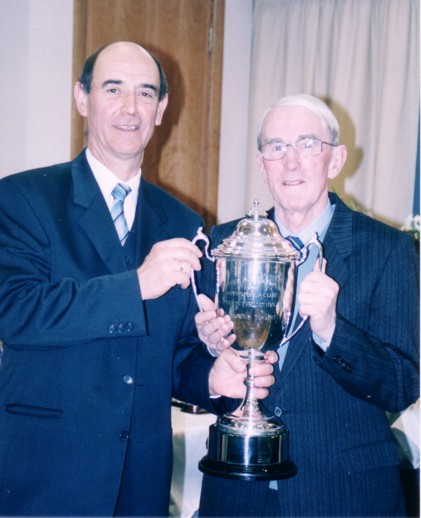
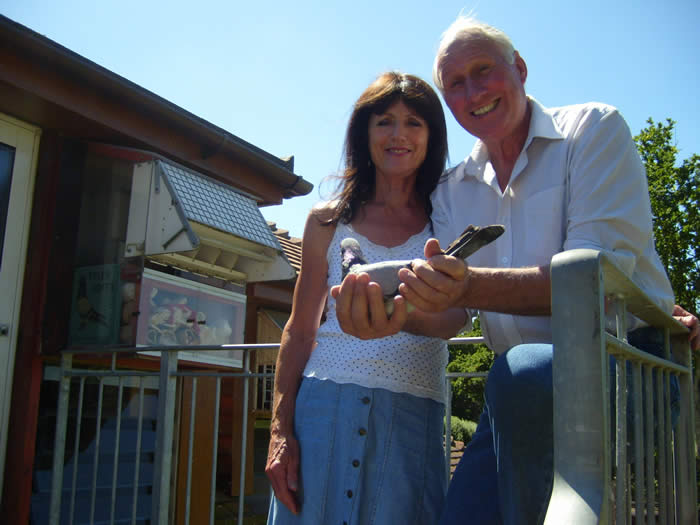
Paul Stone presenting the BICC Pau Cup to Jimmy Roy
Young Bird Education
Young birds have their first toss at 24 miles, then 2 more at the same place, then onto 34 miles and 50 miles. I can't educate them to go from A to B as quickly as possible because I live on my own and can't get home in time to see them in.
Peak Years
Sprinters are best at the yearling stage through to two years old. I have a pigeon called Rocket Man who won 9 races at two. Distance birds, hens anyway, are at their best at 4, 5 and 6. My British Barcelona Club Nantes winner, Emmett, flew 2,800 last year as a 7y and won over £150 in every cross-Channel national race I sent him to. At the end of last season I retired him to the stock loft but I went to pick him up for the first time in three months and had quite a shock because he'd lost his body. I put him straight back into his old box in the racing loft and he came round lovely, in fact he keeps looking at me as if to say 'carry on sending me'. I've had this happen to me before which makes me think the worst thing you can do to some pigeons is retire them away from their old box.
Extras
I do the conventional treatments for worms (Panacur) and canker (Spartrix) in January, but don't treat for cocci or respiratory. I then treat for canker again about 4 weeks into the season. I also add vitamin B12 to the water.
Breeding Winners
Most of my best pigeons will breed something good eventually but even if you put your two best pigeons together you'll still only get 2 good ones out of 10. Most of my best pigeons are off yearlings and 2y racers, so it doesn't bother me if they are unproven so long as they are perfectly made and of good parentage. One thing I do think is that all this chopping and changing of pigeons is no good. You have to wait till new arrivals become attuned to their surroundings and by my reckoning this takes about two and a half years. If you buy some new stock you are better not racing them. Breed off them and race their youngsters instead. Having said, these days I can't find a pigeon I want to bring into my loft - my standards are too high.
Pigeons And Life
Pigeons have been very important to me and two things stand out. Firstly, when my mother died, I was able to go into the loft and the rest of the world didn't exist - which was a big help. Then there was the time when, through circumstances, I had to sell all my pigeons by auction in Windsor. I went home afterwards and into the loft and, looking around, it hit me that all my pigeons had gone. I collapsed, crying, in the corner of the loft.
Parting Shot
I wish to God I was only 20 not 77; I can hardly get into the loft nowadays!
Copyright© Cameron Stansfield 2005.
No part of this site may be re-produced without the permission of
Elimar Pigeon Services