ALWAYS REACHING FOR THE TOP IN MALTA
CHARLES & BERTRAM DEBONO
by Tony Harte
Bertram Debono, as a nine year old boy, was given an injured pigeon and from that time his passion in pigeons was ignited. With great support and help from his father, Carmel (Charles), they started in partnership to race pigeons when Bertram was aged eleven. Now it seems impossible to think of life without pigeons and the whole family are involved. All their first pigeons were given to them and some turned out to be real supers, which are still present in their bloodlines today. An example of this is the pigeon “Julia the Jewel”, which is a fourth generation of winners.
In their first year of racing they were quite successful in managing to win a couple of races amongst some other positions. In Malta there are 24 clubs with about 1300 fanciers and Charles & Bertram race in the Mosta club, which is centrally located and has around 55 members, sending on average around 400 pigeons each week. As per Federation rules, members are only allowed to send a maximum of ten birds per week, so the competition is extremely high. In Malta there is no velocity system and it is the first bird in the clock which wins.

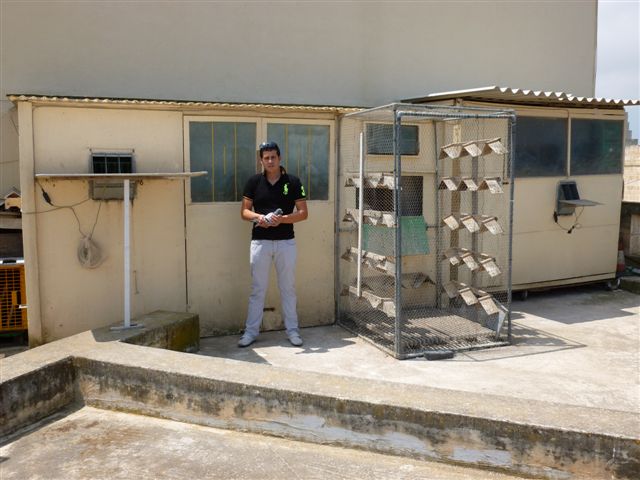
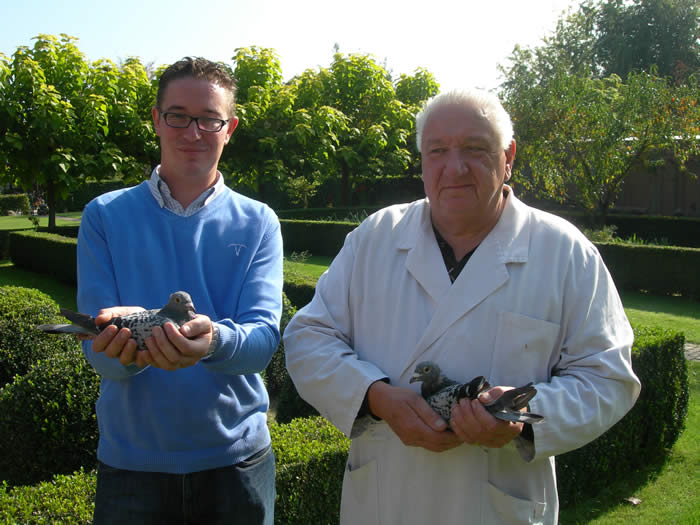
Charlie & Bertram Debono outside their racing loft
In the second season of racing the partnership managed to achieve 2nd Overall Best Fancier in the club, which at that time had 70 members sending on average 500-600 birds per week. Then in the third season there was fantastic success, in achieving to win Best Fancier of the Year Long Distance, Best Fancier of the Year Overall Distance, not only in the club but also for the whole of the Malta Federation, which had some 1300 members covering the whole of Malta & Gozo. That year the partnership also won two Nationals including 1st National Manfredonia (660 km) against 2800 pigeons with eleven hours on the wing. This is one of the most prestigious races in Malta, as it is a very difficult race, known as “a pigeon graveyard”, with most pigeons never to see their lofts again. The first National win was during the second year of racing and once again both the parents were donated by friends. The bloodlines of that pigeon are still present in the current stock, even after 20 years of active racing.
Charles & Bertram Debono have won a National from every race point in which they compete, including Belvedere (155 km) to Manfredonia (660 km). Bertram considers that they have developed an allrounder type of pigeon which can compete in short, middle and long distance races. A good example of this is “Julia the Jewel”, which is the Best Bird Long Distance and Best Bird Overall Distance in the Central Racing Pigeon Club, Mosta, season 2009 – 2010. This pigeon won a prize in every race in which she competed, including Belvedere (short distance), Catanzaro (middle distance) and then excelled in the long distance races at Taranto, Bari and Manfadonia. The partnership also won the Best Bird Overall Distance in the club last season with a pigeon named “Matthias”, which was also very successful at every stage of the season.

Bertram Debono outside his stock loft
The partnership keep around 45 pairs of stock birds and have recently added some Belgian sprint pigeons and some pigeons from Lemmes – Hild, in Antwerp, for middle/long distance racing. Normally the partnership breed around 140 young birds but this year they have bred some 220 young birds. In the race team there will be about 30 old birds but the vast majority are young birds. The pigeons are normally stopped from racing as soon as they feel that the bird has given everything to the pigeon's potential. For example, “Julia the Jewel” was only a yearling but Bertram decided to put her in the stock loft because she had already given everything and there is a good possibility that she will pass on her good genes as a racer to the next generation. In Malta the losses are extremely high and you will not find many older pigeons. (All pigeons compete against each other, no young bird races, so some fanciers ring their young birds using old rings). The pigeon “Matthias”, Best Bird Overall Distance, Mosta club, was also retired as a yearling.
The stock are normally paired up in January, with the young birds starting racing from the beginning of the season, November until the end of the season, the following May. The birds are raced natural, although this year some pigeons will be raced on roundabout. No darkness systems are practiced. Charles has a fishing boat and the pigeons are sometimes trained out on the boat to about 10 kilometres. The pigeons are fed by Bertram mixing his own feed, which is a mixture of 3 brands of breeding mix and to make up 1/3 breeding mix, 1/3 maize and 1/3 barley. This way Bertram feels that the pigeons receive as much variety as possible, as well as making sure that they get the best nourishment from the food. Brewers yeast is also added to the feed at least twice a week, mixed with some garlic or lemon juice. Medicines are rarely used, especially in the summer. Bertram being a pharmacist, also uses a microscope. Bertram considers it best that there is a natural selection, i.e. survival of the fittest, without the use of medicines. During the racing season, it is a different story, pigeons start mixing together in the baskets and the problem of canker and respiratory problems start to emerge, so the pigeons have to be treated accordingly. Bertram feels that no product or medicine is going to turn a donkey into a horse.
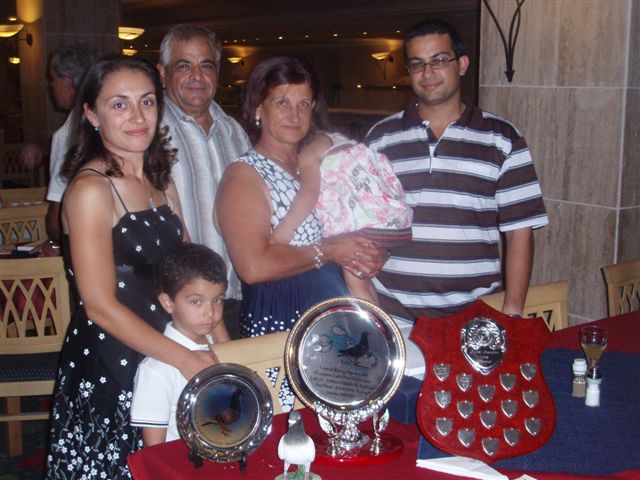
Charlie & Bertram Debonno & family, together with the many trophies won in season 2010-2011 in the Mosta Racing Pigeon Club, Malta
In Malta there is very high humidity and Charles & Bertram live close to the sea and although the pigeons seem to cope with this in the summer, it is more of a problem in the winter. At this time, the humidity is extremely high and the temperatures low, especially from December until February. To help counter this, they have two heaters installed in each loft, not just keeping a constant temperature at night, but especially for reducing the humidity levels.
The partnership believe that motivation is very important, as pigeons only need that extra push to make them go harder. Every pigeon is an individual and as such has its own character, so the motivation has to be adapted to each and every pigeon. An example being when the partnership won 1st National Manfredonia, the hen was sitting on a newly hatched youngster. With “Julia the Jewel”, her best performance always came when she just laid her first egg, usually on basketing day. When sent sitting on 10 day old eggs, she had the worst performance of her racing career.
The pairings are normally made with the best hen going to the best cock, although the partnership admitted that most of the best pigeons were bred by luck. The partnership do not believe in any theories other than the basket. It is only the basket that decides which are the winners or losers. Bertram is amazed at seeing fanciers staring at a pigeon's eyes. Over the years they have had winners with all sorts of eyes and all sorts of body. As long as they are winners, then it does not matter. They prefer to crossbreed but will inbreed, especially for stock. However, at the moment they have a lot of pigeons closely related, but only because of selection of the best. The main families kept are from original gift birds, for which the partnership still feel great gratitude since they know that they were given from the fanciers' best pigeons. It does not matter if they are Janssens, Koopmans or whatever, the most important thing is that they perform well and also pass on their good genes to their offspring. Basically they look for a good round body, nice feathers and colourful eyes when selecting a pigeon.
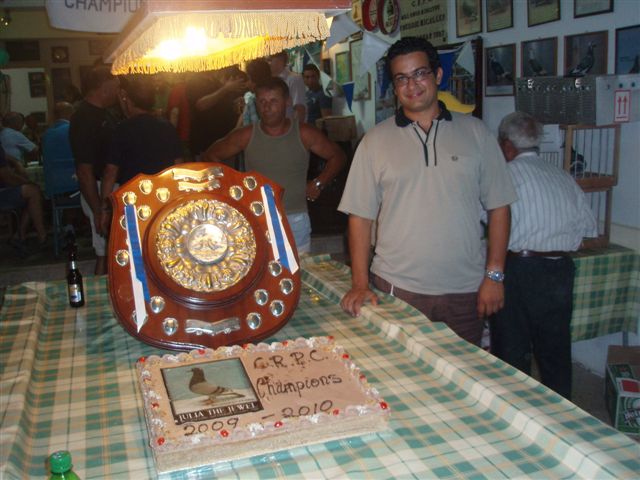
Bertram Debono together with a cake celebrating "Julia the Jewel", Best Bird Long Distance, Best Bird Overall distance, 2010
When asked if Bertram considered that the Maltese pigeons were any different from others, he replied that although some good Continental pigeons had been brought to Malta, not all performed well and maybe that's because the pigeons have to handle the 60 mile of water for each race. In Malta, every race is a channel race, so pigeons have to cross a minimum of 60 miles of sea. Pigeons do not like to fly over water and so a lot of pigeons are lost in the process. Another difference is that in other countries, young pigeons can be trained over land, maybe up to the first race point, as many times as you like. This is not possible in Malta and even if someone was to be living at one end of Malta, then the maximum training toss would be around 20 miles, so this is very difficult for the pigeons and on return they are in the middle of the ocean, perhaps with poor visibility, looking for Malta, just 17 miles by 12 miles! Not for the faint hearted.
The partnership of Charles & Bertram Debono is successful, as each partner has a separate role, in which each excels. Charles concentrates on the breeding, whilst Bertram deals with the day to day race birds. The partnership's most memorable moments were of winning the National races and also particularly winning Best Fancier of the Year, Malta Federation for both Long Distance & Overall Distance. So now they have bought some sprint pigeons, to add to the team, always reaching for the top in Malta!
Tony Harte
Gozo, Malta