SCHREURS-HAUBEN
All Roads Lead To Barcelona
by Mike Lakin
May I start this piece by asking you two questions? First one - are you a long distance enthusiast? If your answer is yes that is great but the second question is a little more testing which is, are you aware of the partnership of Schreurs-Hauben? I expect the majority of you will answer Schreurs who? This is no real surprise to me because let me admit here and now that prior to being taken to visit them by my close friend Ronny Kesselaers I, like many of you, was totally unaware of Marc Schreurs and his family that form the team Schreurs-Hauben.
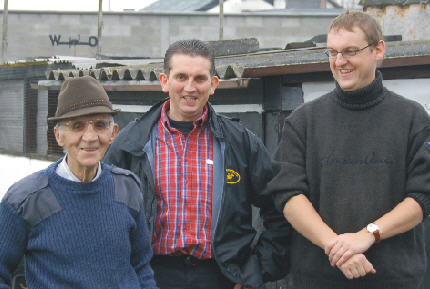
Schreurs brothers with their friend Guillaume Petri
When I asked Ronny how he knew about the partnership and why I didn’t, he laughed and replied: “Mike, I am afraid that you must spend too much time on the commercial websites to get your information. I find the best place to find the best flyers is to go to where it all counts the result sheets!’’ As we carried on our way to Neil-Bij-As where the loft is situated it gave me the time to quietly reflect on what my ‘eyes and ears’ in Belgium had said and he as usual was 100% correct because Ronny is a wise man. In truth anyone including me can extol the virtues of a fancier and his pigeons but in reality the only real answer to how good a loft is are results pure and simple.
There is one area that our Belgian counterparts do far better than we do and this is the way they compile their results. They list the first 30% and how many birds each competitor has entered and the percentage they get in the top 30%. This gives a true reflection of how well each fancier has done. Much food for thought here surely?
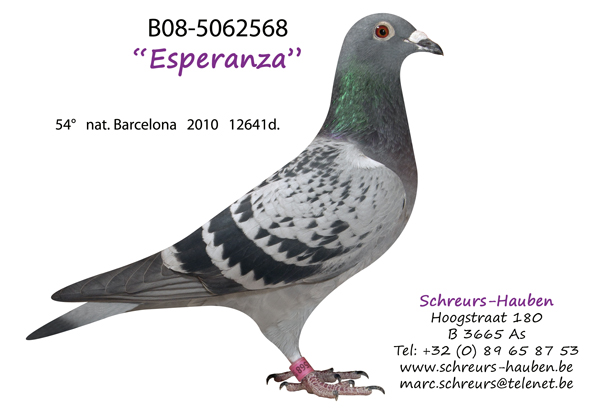
When you check the Barcelona National and International result looking for the name Schreurs-Hauben you will see that they enter a large team of birds because the only races that they specialise in are Barcelona and Perpignan but when you look at their success ‘strike’ record of approximately 50% from Barcelona for instance then you realise just how good their performances really are when you consider that the distance their birds fly is 1106 kms (687 mls). In 2013 they sent 52 birds and achieved 26 prizes (top 30%). In 2012, 32 prizes from 52 birds. 2011 it was 37 prizes from 67. For 2010 I don’t have the entry figures but I do have the actual result. At National level the partners achieved 18th, 20th, 54th, 62nd and 76th from 12,641 birds and Internationally 29th, 32nd, 104th, 122nd and 145th from an entry of 25,750 birds.
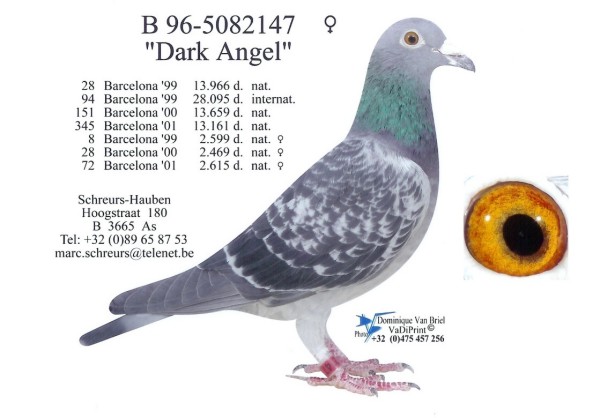
Please don’t think that the Scheurs-Hauben team have suddenly appeared because in truth they have been clocking up exceptional results for many years now. Proof is provided by in 1997 when 13th National and 25th International was won from the iconic Spanish race point from 12,731 and 24,908 birds respectively. In 1999 it was a similar story with 28th National (13,966 birds) and 94th International (28,095 birds). Nearly every year since then the partners have put up fine performances in the longest National races.
I promise that I won’t bore readers with reams of results but I feel that the above were surely needed to highlight how well the team have performed and surely the due recognition that they deserve.
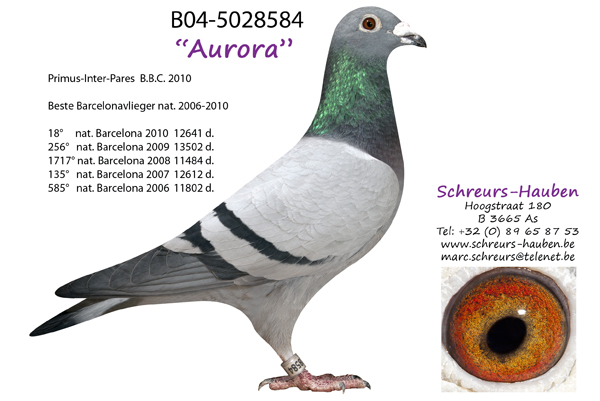
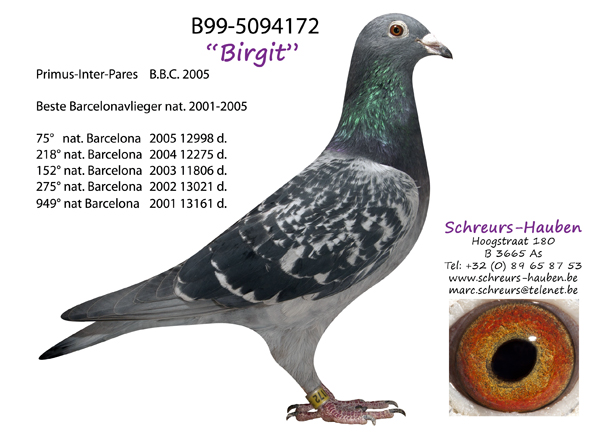
The partners race both the cocks and the hens in the shorter races which are used as training flights. They are entered on widowhood but for the two important races they are coupled and sent to Barcelona with a new hatched baby of up to 4 days of age. From Perpignan, which many of Belgium’s long distance elite consider to be the best race, they are raced sitting 10-12 day old eggs. It is the ladies that Marc favours and is it any wonder when you realise that the partners have won the ‘Primus Inter Pares’, which is a competition organised by the ‘Brugge Barcelona Club’ for the Ace pigeon over a 5 year period, on no less than two occasions since 2004. First of all with their great hen ‘Birgit’ in 2004 and in 2010 with another super hen named ‘Aurora’. Make no mistake Barcelona specialists would die to win this prestigious award so to win it on two occasions is absolutely amazing.
Even more amazing is the fact that the partners decided to sell all of their birds older than 2 years of age with the pigeon paper ‘De Duif’ in December 2013. I was amazed to hear this news but Marc says that they made the decision to make room for their younger generation as the partners have great confidence in their latest crop of birds and think that they will be able to become the latest ‘standard bearers’ without any decline in their performances. I shall watch their future results with a keen interest.
Let’s take a look now at base of the loft and I’m sure that you will be impressed as the origins of their family are steeped in long distance blood. Back in 1970 when Marc’s father Jan was part of the original Schreurs Vandueren partnership they got their base pigeons from Guillaume Petrie, a former coalminer who was only a small but a very well respected fancier who had an exceptionally good stock loft with birds directly off ace fanciers like Cattrysse Brothers and Charles Vander Espt and his nephews the Vander Espt brothers who had their pigeons from their world renowned uncle. Over the years Petrie, who was considered as a pigeon ‘connoisseur’, only ever wintered a maximum of 36 pigeons so it is clear that his selection was very severe. He brought in crossings from many excellent fanciers who he got to know. These included Vanbruane, Gust Ducheyne, Emiel Cobbaut and Jos Van den Bosch. Marc’s father Jan and his brother in law Lambert Vandueren got them from their friend Guillaume off his very best.
Over the years, crosses were added to the Petrie birds which the partners called their ‘Blue line’ (Cobbaut x Ducheyne x Cattrysse) and ‘Rood Fox line’ (Vander Espt x Desmet of Zemmerzeke x Cattrysse) so additions from their friend Hub Peeters, who in fact was racing Schruers Vandueren Cattrysse based birds, were really just a transfusion of their own blood. A bird was also introduced of Bricoux-Tournier lines via Vale Beunen. This bird was in fact a full brother to ‘Vaaltje of Beunen’. Since Marc and his brother Patrick joined and then took over the ‘reins’ of the lofts further blood has been acquired from the likes of Borgers (Kuypers x Matterne), Brinkman and Bommerez (both Van der Wegen). To strengthen the ‘Blue Line’ the blood from Wijnands Kuypers has also been introduced. It must be pointed out here that only the very best of these fanciers’ birds were introduced. This basic rule has helped Schreurs-Hauben to both compete and often beat the very best marathon fanciers. What can be gleaned from this information? Well first of all that the partnership owned superb Barcelona birds and secondly on a historic front the best birds descend from the finest lofts of yesteryear. The fact is that today’s winners have to have parents and at the end of the day like (with good selection) begets their like!
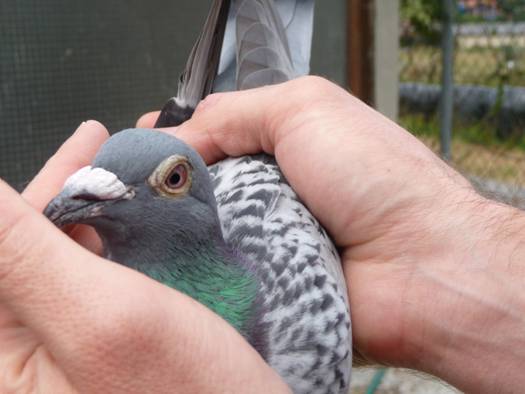
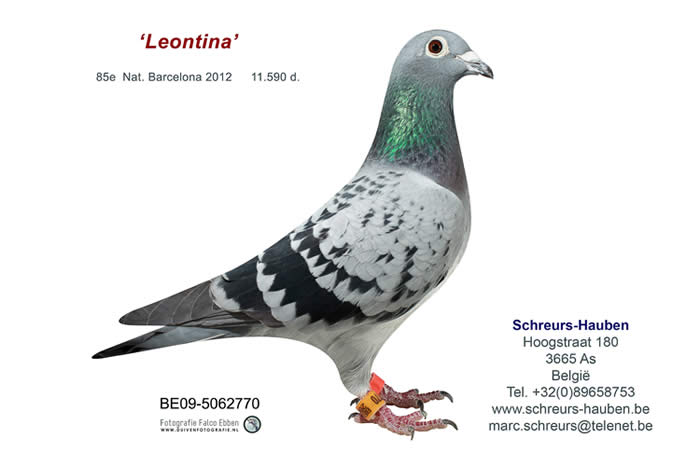
On my visit I was able to handle many of these fantastic long distance pigeons and they were just as I expected. typical of birds capable of flying until late at night and then getting up and finishing the job off. My own particular favourite was ‘Leontina’ a chequer hen which has won 21st and 85th National from the most famous long distance race point in the world. I still struggle to believe that Marc and his family were prepared to part with such a ‘super’ but without a doubt their loss will have been to someone else’s gain a few weeks after my visit.
I would like if I may to summarise as best I can the breeding philosophy of the Schruers family started in the beginning by the father Jan and continued to the present time by his sons Marc and Patrick.
- You must choose wisely when acquiring the base of your family of birds. Preferably going to one fancier with a strong line of winning pigeons.
- Continue with these birds to prove the wisdom or otherwise of your choice of origin. This is because Marc is adamant that inbreeding is the only way to maintain a breeding loft but the selection must be severe as inbreeding highlights the faults as well as the superior qualities.
- Birds for the racing loft are best produced by loosely related members of the family. Uncle/Auntie to Niece/Nephew being as close as the partners advise.
- When you bring in the occasional ‘important and necessary’ cross to revitalise the blood one can never be too selective. Remember as Marc told me “You can never be too demanding because only the very, very best is good enough!’’ On reflection it is difficult enough to win in strong, keen competition with excellent bloodlines, so don’t handicap yourself even further with stock of mediocre quality. Always remember the saying ‘The biggest and best apple always falls closest to the tree!’ I have found this to be very accurate.
- Pair any new introduction to one of your best breeders. Test the offspring and only if you are happy with their performances pair these children back into the base family. In this way you will get the benefit of the injection of ‘new blood’ without compromising the basis of the loft.
- I smiled when Marc told me his final comment on the subject as he said “breeding is an art, you must have a ‘feeling’ for it ‘’. Then after a short pause he added “and a little luck!’’.
Let’s now take a closer look at the racing methods of Schruers-Hauben.
From the middle of September until the birds are coupled in mid- March the birds are confined to the loft due to the all so common hawk problem. The birds are then flown out and trained whilst the birds are sitting on eggs, which are replaced with pot eggs as the race birds are not allowed to rear young prior to racing. When the birds desert the pot eggs the hens are removed and ‘widowed’ being put in an aviary whilst the cocks are now on widowhood and exercised daily. I was more than a little surprised to hear that the hens were not exercised on a daily basis but were raced every week building up from 100 miles then gradually increased as follows: 130 miles, 200 miles, 250 miles and 375 miles then brought back to twice at 130 miles. Most of these flights are completed with, to repeat, NO HOME EXERCISE before they are re-paired in June in preparation for the Barcelona International in July. I was rather shocked to be told that the hens generally outperformed their male counterparts from this race. This fact provides much ‘food for thought’ in my opinion. It does ask the question is daily exercise really necessary to perform in the marathon races? Clearly Marc and his brother Patrick believe not and they have the results to back up their belief.
In 2014-15 I shall be looking closely at the Barcelona result to see if the partners were indeed wise to part with their mature and proven Barcelona race team. I suppose it can be argued that though they have sold their ripest fruit they have still got the trees in their breeding loft!
---
Elimar - July 2014