From The Chair
By Chris Williams
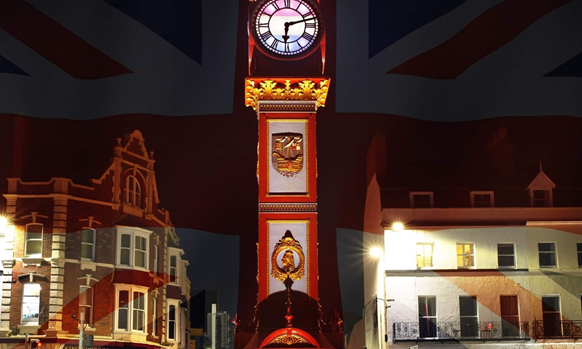
Weymouth town clock lit in remembrance of Captain Sir Tom Moore. Weymouth's Jubilee Clock Tower was built to commemorate Queen Victoria's 50 years of reign in 1887.
For the past few weeks, I have been looking at video clips on YouTube of various winning lofts, not only has this helped ease the boredom of isolation but also inspire me for the season to come. I have always believed that it is important to have a goal to focus on, and at a time when the world is upside down this is more important than ever before. Its amazing how even short snippets can provide you with tips and information which can be applied to your own system because the sport of pigeon racing is a perpetual process of learning and even the great champions must learn and they did not come much greater than Gerard Vanhee who always maintained that no fancier could know everything about pigeons, although with the dynasty of winners that he created you would be forgiven for thinking otherwise! Born in 1910 Gerrard Vanhee entered the pigeon world in 1925 when he was aged 15 from the outset, he established an empirical scientific approach to the art of racing a team of pigeons. By all accounts this future grand master was an avid reader of anything and everything concerning our sport, something which we still need to be in the 21st century after all as the saying goes “knowledge is power “and in the world of competitive pigeon sport the fancier with a little extra knowledge together with good healthy pigeons will hold his or her own in any competition. This was a lesson which Gerrard Vanhee learned very well paying close attention to the different racing systems and methods of the champion fanciers of the era, along with how to feed and take care of the pigeons, to prevent or cure diseases, etc. This modern attitude in the days of “grain and water gave him a distinct competitive advantage and illustrates perfectly how vital it is for a serious fancier to do their “homework”.
Tragically this learning process was cut short due to the outbreak of the second world war and subsequent German occupation which resulted in the destruction of the loft! After the war Gerrard set his mind to studying countless result sheets to ascertain who were the best fanciers before and after the war armed with this information Gerrard Vanhee set off across Belgium in search of champion birds and in doing so would come into contact the creme de la crème of Belgium’s pre and post war champions such as the famous Huyskens van Riel partnership which was formed in 1945 and immediately illuminated Belgian racing scene within the world renowned union of Antwerp with an impressive array of record breaking results such as the Libourne race in which this infamous partnership entered 14 birds (certainly not mob flying when compared with some teams entered in today’s races ) against a field of 2,000 pigeons in province the Huyskens van Riel achieved 1, 2, 3, 5, 6, 9 all 14 entrance made the result with their 7th bird scoring 25th National such an outstanding result caught the attention of pigeon press including a certain Piet De Weerd who called it” the most startling results ever achieved.” With such high praise from “The flying Dutchman”, a man responsible for the formation of so many iconic strains it is little wonder to this author at least that the discerning Vanhee had the name of Huyskens van Riel high on his “most wanted list”. Among the many notable fanciers Vanhee obtained birds to form his own family we find two brothers who were giants of the game and I am sure they could more than hold their own against many of today’s champions.
In the pantheon of pigeon racing gods, the names of Oscar and Gerard Cattrysse will be revered for eternity and their performances both with the race basket and in the breeding loft, established the small west Flanders village of Moere as one of the jewels in the crown of Belgian pigeon racing. Oscar and Gerard commenced pigeon racing prior to the Great War of 1914-18. We all have to learn, and fate was more than kind to Oscar and Gerard in this department, for their mentor was non other than the formidable Charles Vanderespt, who was known as “the King of Flanders”, not surprising considering that he won an astonishing 4,635 prizes between 1923 and 1935. He won 492 titles in 1934 and 518 titles in 1935, which makes a total of 1,010 prizes. In these two years he won no less than 53 first prizes and a whole lot of other top prizes. He could race wherever he wanted, including Bordeaux and Arras. The crowning achievement was probably his first (and eleventh) international prize from Bordeaux Belgium-Holland in 1935, which took place in dreadful weather conditions, so it’s clear that Charles Vanderespt, was a dyed in the wool fancier of extraordinary talent!
“Racing is silver but breeding is gold “and in 1922 Oscar and Gerard would find themselves at the centre of a gold strike , for in that year Cattrysse brothers purchased a pair of youngsters from Jules Vanderespt, the nephew of Charles, the sire of these birds was a pigeon called “Blauwe ' that as a youngster won eight races for the loft of Jules Vanderespt . This line when crossed with birds from a fancier by the name of Ernest Casteley produced 'Grote Blauwe' a pigeon responsible for producing both racers and breeders of outstanding quality of such a high magnitude that the name Cattrysse brothers became a byword for excellence which has echoed down the ages.
With such a solid foundation as the aforementioned pigeons it is no wonder that Gerard Vanhee and subsequent generations of his family have justly attained worldwide acclaim thanks to performances such as:
1949: 1st National Chateauroux
1958: 1st National Vannes
1959: 1st National Argenton with "Kleine", 3048071/55 1962: 1st National Limoges with "Atoom", 3002042/59 and 1st
National Libourne with "Monsieur", 3300065/58. Both pigeons came out of the super breeding hen "Blauwe Bliksem Duivin".
1969: 1st National Montauban with "Argenton", 3100252/65
1971: 1st National Barcelona with "Jonge Monsieur", 3100081/67 (5th International)
1972: 1st National Limoges with "Dromer", 3101142/71 out of the "Patrick" line.
1974: 1st National Barcelona with "Teentje", 3110138/70 (the second time in only three years!) and 1st National Bordeaux (hens) with "Bordeautje", 3102179/72
1975: 1st National Bordeaux (again) with "Zwarte Ijzeren", 3101772/71, and 1st National Montauban (hens) with "Ginetje", 3103019/73.
1976: 1st National Bordeaux (again!!!, this time yearlings) with "Apache", 3105249/75
1977: 1st National Cahors (hens) with "Lucresetje", 3105313/74 (4th National overall) 1978: 1st International Narbonne with "Napoleon", 3104180/74 a grandson of "Motta"
1982: 1st National St. Vincent with "Workman-Libourne", 3109281/79
1983: 1st International Lourdes with "Lourdes", 3110165/80
1988: 1st National La Souterraine with "Domingo", 3108151/88
1995: 1st National Limoges with "Pure Patrick Gimondi", 3105035/95
PLUS, many more outstanding accolades which could fill volumes of books and magazines.
Readers may wonder why I am mentioning these performances of old fanciers and their pigeons, well my answer is simply this, they serve as a prominent reminder to present day fanciers as to what can be done if one is willing to work hard enough !
At our own lofts the majority of the breeders are now on eggs and so it’s just a case of ensuring they have everything they need, talking of that I’m off for a cup of tea , until next time keep positive and enjoy your pigeons!
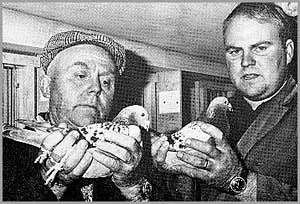
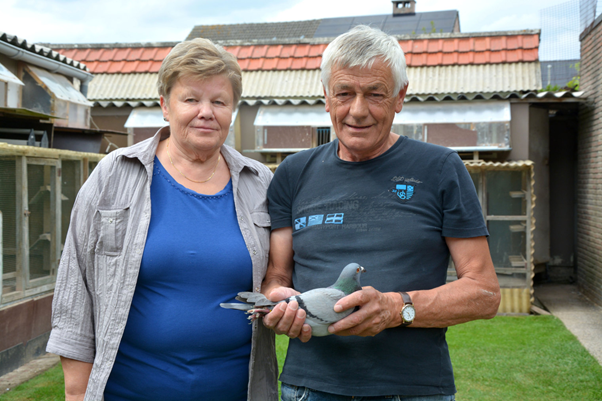
The legendry Gerard Vanhee with his son Michel has left an indelible mark on global pigeon sport.
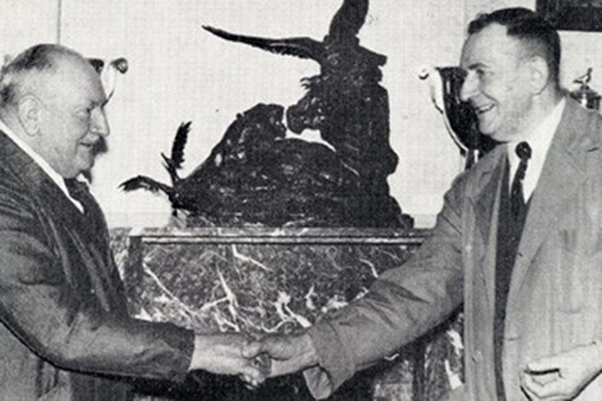
One of pigeon racing greatest of all time partnerships the iconic Oscar and Gerard Cattrysse