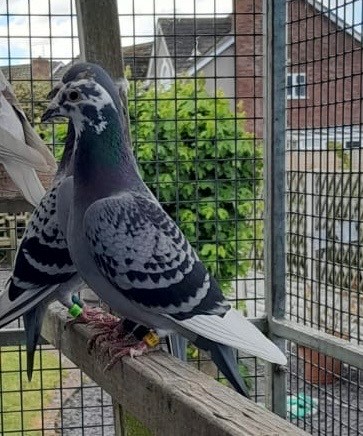
From The Chair Flying through time
By Chris Williams
In our house pigeon racing is a 24 hour topic of conversation, why wouldn’t it be? Dads been a fancier since the age of 7, me 12 and my Mum was secretary of a club when she was aged 18 and although she is not as obsessed as her husband and son, will lend a hand when needed. A few nights ago we were talking pigeons and my Mum said, “what happened to the old strains from years ago”. This got me thinking of great names like Stickelbaut and Grooters, Spangles and the countless others that raced homeward along the skyways of yesteryear and have now, it seems, faded into anonymity and antiquity. Why has this happened ? I suppose the fickle answer is fashion because all things change, you only have to listen as to what passes for music these days!
“The fact that certain pigeons or pigeon families are trendy is as old as pigeon sport.” According to Ad Schaerlaeckens and who can argue with this world renowned fancier and journalist, certainly not me because I have nothing but admiration and respect for the man forever known as “ The Mayor of Orleans.” It would however be an outrage against the rich racing history of our hobby if the impact of these noble bloodlines were forgotten by future generations of fanciers for if we do not know our past then how can we improve?
From my research, it appears that the Grooters of Brussels made a name for themselves as far back 1868, it is perhaps hard for us fanciers in modern times to comprehend that even at the height of British Empire the principality of Belgium was, as it is today, the epicentre of pigeon racing and the Grooters were among the standard bearers of Belgian pigeon sport. Behind every strain is a fancier and it appears that “The Mr Grooters” was a fancier of some intelligence and skill owing to victors from 700 kilometres, racing from Agen and at 800 kilometres. In 1870 from Bazas in France, a region that is famous for its many Clementine Castles, built by Pope Clement V . His Victory from Narbonne flying a distance of 950 kilometres to capture the first prize, was as they say “the talk of the town!”
The aforementioned results are a mere drop in the ocean in what has been described by many writers and fanciers as a glittering career. What this author finds most impressive about these performances is they were all achieved while the sport was in its formative years and demonstrates perfectly the skill our forebears possessed for pigeons and pigeon racing. This family of winning pigeons descend from two lines Vossen” of “De Roden” and “De Witkelen” (white throat) given this name because their ancestors showed this characteristic in their plumage. According to the great pigeon author and historian Jules Gallez uncovered an interview with one of the oldest flyers of Belgium, circa 1910, indicating that Grooters' birds are but one step removed from the Ulens, having originated out of that strain but also showing the influence of an early example (cross) of a bird from Brussels and subsequently the Antwerp pigeons. And, by the early 20th century, it was on the Grooters and these early influences that most strains of the modern racing pigeon were based.
Dr Ulens can be considered as the Grandfather of all pigeon fanciers because it is thanks to this “Pigeon Pioneer” and his mastery of the art both of racing and breeding, that the species of the racing pigeon as we know it is in existence today!
While studying the Grooters pigeons for this article it was interesting to learn of their impact abroad particularly in the USA. The American Stud Book” by Ronald B Dennis, published in 1950, describes Grooters as, the Grand old family. It appears that many of the strain which found its way to the “New World“ came from the English loft of W.E Lowe thanks to a group of fanciers in Chicago and Milwaukee who imported a 1902 cock bird from W.E Lowe with the ring number 6800. This blue cheq cock bird with the classic hallmarks of his ancestry i.e. pied throat and wings was not by any means a superstar in the race basket but a diamond in the breeding loft, producing birds in England which combined crossed the Channel 41 times, also 12 times 468 miles and 12 times 634 miles, if this isn’t an outstanding advert for the capabilities of the English fancier and our birds then I don’t know what is!
Now we come to Alois Stichelbaut, the flax dealer who created one of the greatest breeds of all time in world pigeon racing!. He started with pigeons in 1922 following the death of his friend Alfons Derumeaux who had been a fancier. Now was it fate, Christian charity or curiosity? We do not know but at the Derumeaux dispersal sale Alois purchased two pigeons which would become the foundation of his loft! Although the Stichelbaut name is now known throughout the world, during his lifetime this master fancier was largely unknown, the reason for this staggering lack of publicity is likely due to the fact that he competed mainly in races within the locality. Initially, the birds were raced on the Natural system but later the widowhood method became the order of the day.
These pigeons are predominantly dark in colour and excel at the distance races one of the best racers being “Opgeblazen” or “blown up” A pigeon that earned his name because he returned from Tours with his air-sacs over inflated. I recently saw a post on social media asking why certain birds are given names, nine times out of ten these names simply refer to a birds appearance or character and “Opgeblazen” is a perfect example of this trend, and what a pigeon he was taking prizes in some of the most prestigious races of the day being: 1st, 2nd, 3rd, 4th, 6th, 10th, 20th and 25th and in the period of 1938-1939 won 25,000 Belgian Francs in prize money! Yes, sir just like his master “Opgeblazen” was a superstar!

Jules Gallez, the man with an encyclopaedic knowledge of The Great strains
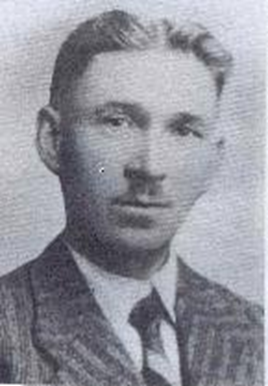
Alois Stichelbaut
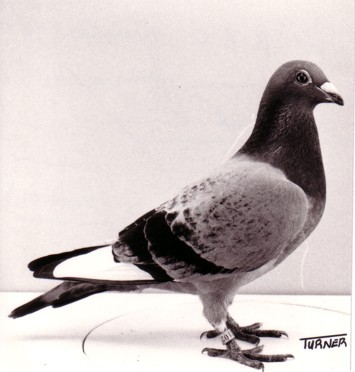
Moving a little closer to home we find ourselves in the West Country, Somerset to be exact and its here we find a true example of a classic English long distance pigeon known as the Spangles. A strain that was formed in 1895 by one Oliver Dix. When the latter procured a blue chequer cock bird of Hansenne and Logan blood from the Welsh fancier J. D. Phillips, the offspring of which a mosaic or Spangled in colour and as such they would be forever known as “The Spangles”. These birds caught the attention of J.W Logan MP and inaugural president of The National Flying Club of Great Britain this man can be considered the father of British long distance pigeon racing. Logan was so impressed that he crossed the Spangles into his own strain, as did other notable fanciers, such as J. W. Toft. This strain has more than left its mark on pigeon racing as prime examples of true long distance athletes with results at the highest level at distances up to 900 miles.
It is an impossible task for me to write about all the old strains that have impacted the sport of pigeon racing, but I hope you have found it as interesting to read as I have to research and write.
Until next time enjoy your pigeons
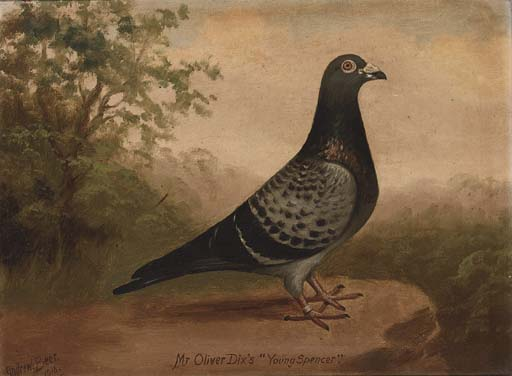
Mr Oliver Dix's Young Spencer
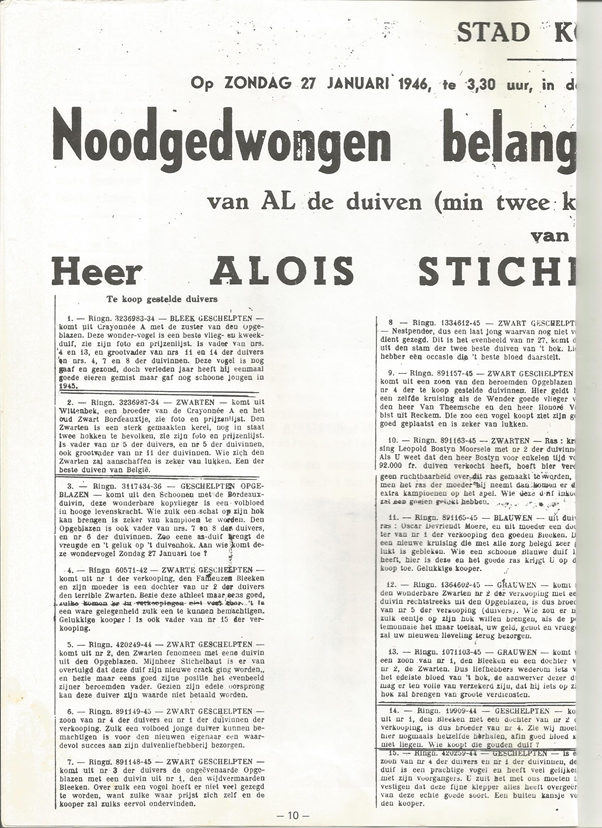
An advert from the sale of the original Alois Stichelbaut birds in the winter of 1946
|
The information contained within these written articles, posted on our website, represents the views and opinions of the original creators of such content and does not necessarily represent the views or opinions of Elimar Pigeon Services Limited. The appearance of such contact on our website does not constitute, endorse, or affiliate these views or opinions. |