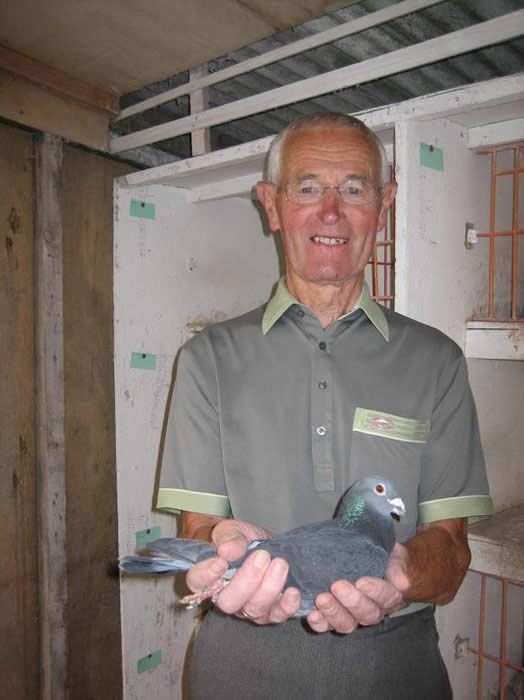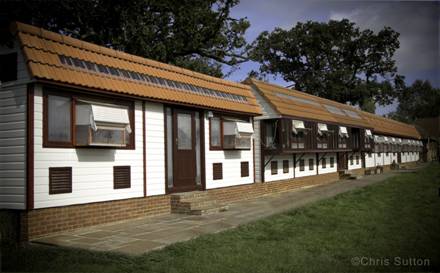
GRAHAM WARREN of Treherbert
Rhondda Valley Federation Champion 2007
Report by Martin Dunn
It was my pleasure to travel the 5 miles up to the top of the Rhondda Valley to the village of Treherbert, to visit what I believe is one of Wales', never mind the federation's, finest fanciers. Graham Warren has been at the top of this game for as long as I can remember, an example of which can be seen over the last seven seasons, where Graham has been the top flyer in Rhondda Valley fed for 6 of those 7 seasons, and runner – up the year he didn’t win it, a remarkable record when he has been competing against 250 members and around the 5000 pigeons per week for the inland Federation races and flying with the Welsh South East Combine across the water there can be up to 12000 pigeons in the channel races.
His record speaks for itself. For example for last season, 2006, he topped the fed at least 3 times with young birds alone, including from Newbury taking the first 4 position – 4545 pigeons, 6 of the first 7 in the fed from Ramsgate 212 miles and the following week getting 20 birds together to take the first 6 in the fed from Hullavington 62 miles.
This isn’t a one off season and not only confined to young bird racing, an example of which can be Graham’s good Staf Van Reet cock ‘48’ who has won 5 x 1st club across the channel, including 2nd fed Huy 390 miles 2007, 10th fed Bonn – 470 miles and 4th Fed Giessen 540 miles, when he followed the street lights home to Treherbert on the night but couldn’t get to the lofts until first light because he couldn’t see where he was going up to Graham's loft on the Mountain and landed on the house roof in front of the lofts. He was timed at 04:20 in the morning. This cock is a truly outstanding pigeon and Graham said that he’s never tired on return and always looks as if he could fly as far again.
Anyway, a little bit on the back ground of Graham. He started back in 1960 when joining the Tynewydd club. Success was never far away and he was on the winner's rostrum in his very first season. He has flown in partnership for 2 seasons but prefers to fly on his own these days. He’s retired and the pigeons are an interest to pass the day away for Graham. The birds are kept on the mountain away from Graham's home and he travels daily on his Quad up to his allotment. Tongue in cheek, he says he only see’s his wife on a Saturday when she brings up their Fish and Chip dinner after the birds are home or when waiting for the longer races.
Graham keeps 12 pairs of stock birds and what beauties they are, with the likes of the ‘Rhino’, 12 x 1st club and throwing winners galore. This superb racer is worth his weight in gold. Graham has based his team on Louella lofts Braspennings and from John Evans of Maesteg, and to these he’s added the cream of Bert Hession Van Reets. Graham is good friends with Bert and only the best are sent down to South Wales.
Graham felt that he needed a cross into these families and he brought in the Van Melderts and Linderlaufs from Foxwood Lofts and Keith Goodenough of Penywaun, with one cock from here proving to be an outstanding breeder. With the class to be found in the stock shed, it’s not surprising to see the strength in depth of the race team.
On to the race birds and the current team are superb in quality, you just have to look at the race team. Graham winters around 30 widowhood cocks. He doesn’t race his hens - there’ no need to the way the cocks perform. Looking at the team, there are at least 9 federation winners there and a number of multiple winning cocks, including yearlings cocks with 4 x 1st and 5 x 1st clubs and which have topped the fed already.
They are paired the 3rd week in January and rear and are parted from the hens. They are then exercised prior to racing and given the maximum of 4 training tosses and into the first race. They are not trained after the first race of the season, just exercised around the lofts.
After the race on Saturday they are kept in on Sunday and left out Monday morning only. From Tuesday to Thursday they are let out twice a day, locked out for an hour in the morning and given a free loft for an hour in the evening. Graham says that he doesn’t have any trouble with the team flying, they will go no problem.
Feeding wise they are given Versele Laga Super Diat in their boxes A.M. and then in the evening they are given Versele Laga Super Widowhood in a tray on the floor communally, always as much as they can eat, they never go short. Only help they have in the water is with Cytacon and nothing else.
Graham treats the birds for the normal infections, Respitory, Canker etc and the birds are vaccinated against Paramyxo as required. There are no great fads, the biggest thing that stands out with the old birds is that they have plenty of room. The sections are around 16 foot with 15 cocks in each section, and added to this there is a communal aviary that is open during the day for the cocks to sit out in. They are contented in their environment.
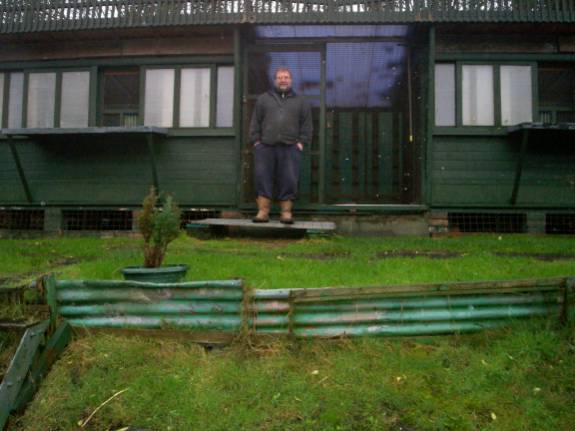
Graham’s old bird loft
Moving onto the young birds, these are kept next door to the widowhood cocks. Graham tries to get 50 trained up, depending on the Hawks. Like most of the valley fanciers he’s troubled with the Sparrowhawk when the babies are taking off and loses a number at this stage. To try to overcome this the young birds are given open hole all day to teach themselves the dangers locally and are let out after the cocks are locked up. One unusual thing is that Graham feeds them before he lets them out, but doesn’t have any trouble getting them back in the evening. He’s got his stick and they are used to this and he can shepherd them back into the young bird loft without problems.
The young birds are flown on the darkness and he tries to encourage them to go to nest when racing for extra motivation. Graham is a big believer in motivation with young birds and will sit and watch looking for situations he can use to try and get the most out of his young bird team. The young birds are well schooled before training and will train them from May onwards if they are going well at home. Once racing starts they are exercised and trained twice per week, Tuesday and Thursdays weather permitting.
The young birds are fed the same as the old birds and are again given what they need, added to this they are given the Cytacon and nothing else. I asked Graham if he gets any trouble with his yearlings after being on the dark. He confirmed that he has no problems and this is shown by the number of wins he gets with his yearling cocks each year.
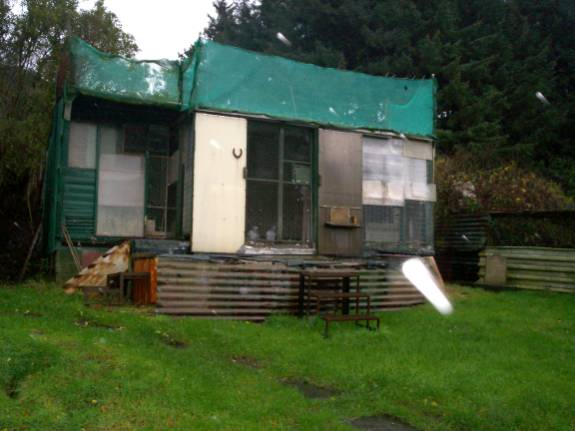
Graham's Young Bird loft
Although Graham is at the top of his game currently, this may be short lived. The land the birds are kept on is up for development, along with 2 other members of the Treherbert club, and Graham has no other place to keep the birds, although they are not giving up without a fight. The members have already raised a 3500 signature petition to overcome the development plans, and hopefully they will win this case. The sport can ill afford to lose 3 members because of the reason above.
Some examples of his performances in 2006 and 2007 can be seen in his club results:-
2006 2007
20 x 1st club 17 x 1st
16 x 2nd club 16 x 2nd
12 x 3rd club 12 x 3rd
14 x 4th club 10 x 4th
Plus at least 4 x 1st fed and numerous fed positions. Graham's results are not just kept at Fed level. In 2003 he was 1st Welsh South East National and 1st Welsh South East Combine from Ramsgate young birds – 5500 pigeons.
Graham has a real bond with his pigeons. When he goes into the stock shed the hens are fighting to land on him, and the stock cocks are equally as tame and quiet. He says they have given so much enjoyment over the years that he would be gutted if he had to give them up due to the issue of development on the allotments. He would also like to thank his wife Kitty for her continued support and help over the years and for putting up with the birds.
It was real pleasure to go and take a look at this loft, one of the best teams of pigeons I have come across in a long, long time. Best of luck with the fight and hopefully you will be going for number 7 in 2008.
18/12/07