Four British Master Pigeoners (3)
By Liam O'Comain
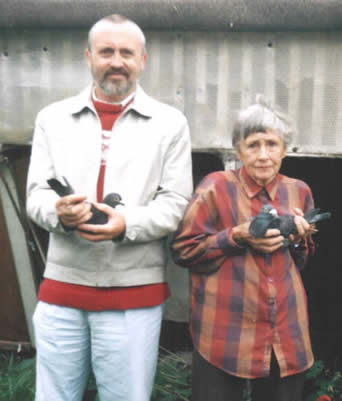
A. R. Hill
Cornwall lies at the foot of the island of Britain. It has national and cultural roots which confirms it as being more than an English county. Like Ireland its people are a river of different streams but there is something distinct about them. As of part Celtic origins I detect something in the psyche of the natives of Cornwall akin to my own. Perhaps the sharing of a similar imperialistic history makes us overcome historical subjection and reach for the stars. Being not content with minor tasks and seeking in our pigeons the same characteristic disposition. A determination to send beyond the normal and conquer what has to be conquered. A characteristic aided by and partly influenced by the geographical reality of the western isles of Europe. Now the contents of my thought arises from the unique results of the Hill family of racing thoroughbreds. Results emanating from a top managerial system and blue blooded stock.
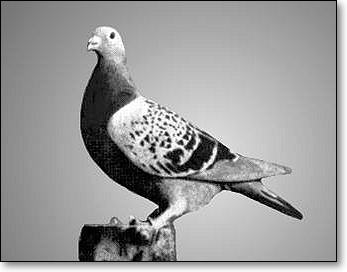
The Hill family were based upon Hill's old grizzle family and the Kirkpatrick's at the Atlantic Lofts in the north of Penzance in Cornwall, where they won prizes galore for their master and from where many left to conquer the long and marathon distances throughout the rest of the world. Pigeons like Silver Lady who won from every race point up until Luxembourg at 530 miles. Then there was Lionheart who was never a night out in his life and who was clocked from Antwerp being 15 hours and 25 minutes on the wing. To be followed by being 7th Open Luxembourg and again scoring from the same race point flying fifteen and a quarter hours on the day. Not forgetting the Leggy Cock who scored from many short races but who flew over 1000 miles in his last three races in a two week period as a yearling, always amongst the leaders. Then amongst others there was the great Grizzle cock bird Cornish Supreme who was 1st Open from Luxembourg, beating the 2nd bird by 200 yards per minute as well as flying over 100 miles further. Cornish Supreme had other successes during his working life.
A. R. Hill placed much emphasis on the principle of observation which he insisted must be in play at all times in and around the loft. Insisting that all fanciers should not have a willy-nilly attitude to the sport nor to management. He believed in feeding well and with the best produce and ensuring clean water at all times, at least twice daily during winter. To overcrowding he was totally opposed and looked upon it as anathema. At breeding time he patiently faced the anxious character of its reality and knew if the past moult was good then all could be met with patience as an armour. Although acknowledging that there were no hard or fast rules with pigeon racing he trained knowing that many roads led to Rome. In fact if a bird was in condition Hill was never afraid to jump it into its chosen event.
What Bob McDonnell is to the north of the island of Britain Arthur Hill was to the south of the island and there is no doubt that they shared a commitment to the sport with a managerial ability that is not the gift of many. The younger fancier today could do worse than take both as genuine role models.
Johnny Kirkpatrick
The famous strain of the late Johnny Kirkpatrick was a sure bet to appear in this series for not to refer to this great family from Scotland would be to commit a sacrilege. As a young boy our subject from West Cumberland was brought to and reared up in Annan by his parents where he was to be blooded early in the sport. Although strongly committed to the game of soccer our subject had pigeons early in his life via a gift of birds from a Wilf Pearson. However the real initial base of the budding strain were Logan, Barker, Osman and some bloodlines from a Dr White.
Success came early to this family for it registered in the Scottish N.F.C Nationals from Rennes and Nantes two 3rds, a 4th, two 5ths, a 7th and an 11th amongst other positions. The first big win was 1st Open S.N.F.C. Rennes in 1937. By this time it appears that the Kirkpatricks included the bloodlines of Sion, Marriottt and Bricoux. The family records also contained traces of the Gits and the Barker amongst others. The Bricoux bloodlines came via a pair purchased from a Mr Richardson i.e.a Mealy Cock and a Red Cheq Hen. In due course the pair produced the immortal 'Galabank Supreme' who won 13 firsts and approximately 40 other good positions in racing. He was also a fabulous stock bird. In truth this was the real Kirkpatrick foundation bird for all subsequent champions of the strain contained his blood.
During the 2nd World War (1939/1945) there were no races from the European mainland into the island of Britain but by about 1948 Kirkpatrick had scored 2nd Open S.N.F.C. Guernsey and by 1951 2nd Open S.N.F.C. Rennes. The latter success gained by 'Galabank King'. Another of the clan namely 'Galabank Prince' was 1st Open S.N.F.C. Nantes in 1952 as well as being 40th Open Rennes that same season. The lofts also were 2nd Open with 'Galabank Duke' in the same race. The honours continued to arrive in 1953 with 3rd Open Rennes with 'Johnny'- the nest mate of 'Galabank Duke'. Here I have only referred to national wins but the lofts won numerous club and other prizes during its reign in the land of the thistle.
Alas our mortality via sickness saw the departure of Johnny Kirkpatrick in the Spring of 1954. Then pigeondom mourned one of its greatest distance racers and a master of the sport. A strain destined to be forever mentioned amongst the greatest. Which is reckoned to have produced 500 important race winners world wide. In fact it is estimated that the strain flows in the blood of the majority of Scottish 500 mile winners alone. An interesting factor of the Kirkpatrick's is the Grizzle colouring which abounds and although the records show the important contribution of a Grizzle hen '6498' from A. R. Hill of St. Just, in Cornwall, the historians note that this colour was a factor in the strain of Dr. Bricoux. Finally, it is great to win when one is alive but Johnny Kirkpatrick won a few months after his death for his wife raced that year and was 3rd Open Rennes. A loving gesture!
The Spangles
The creator of the Spangles was Oliver Dix of the county of Somerset in England. Originating from an old family of pigeons from that part of Britain. However in about 1895 Dix brought a blue chequer cock bird of Hansenne and Logan bloodlines from J. D. Phillips of Pontypridd which turned out to be a fabulous breeder which produced mosaic or spangle coloured young. Thus the origin of the name.
J. W. Logan and J. W. Toft introduced the Spangles into their strains which contributed to the development of English long distance and marathon racers. From the start they were accomplished long and marathon flying athletes, for example Hawley's Crafty flew from San Sebastian twice at 700 miles while Jack Hay of Freemantle was 1st and 2nd National at 900 miles. Yes for their founder and many others they flew well, winning much. In their evolution however they were taken over by Mr and Mrs Bert Bryant in 1944. Doing extra well for their new owners who acted as the source of the strain's permeation of British distance bloodstock. In truth the Spangles made the names of other fanciers well known such as Taffy Bowen, Vic Robinson, John Kirkpatrick to name but a few from the nations which reside on the island of Great Britain.
One of the great exponents of the strain was the late Mike Young of Timsbury in England. The Mike Young Spangle family set up some remarkable achievements in the distance races. One of the most outstanding was 17th Open in the British Barcelona Club's National from Rome at the distance of 914 miles. Also with the British International Championship Club Young's Spangles were to the fore in the marathons flown under the auspices of that Club at distances between 558 and 721 miles. Any member of the BICC will confirm the quality of his family of Spangles. Indeed Mike Young may have brought the Spangles unto a new and higher level arising from his committed management regime.
One of G.M.Young's best pigeons was the famous Channel Queen. This chequer hen in 1984 was 1st Dax (530 miles), 1986 1st Perpignan (648 miles),1987 1st Pau (558 miles), 1987 2nd Perpignan (648 miles), and in 1988 3rd Perpignan and 3rd Pau. Excellent performances! Another great bird was Young's Spangle Prince - 2nd Marseille 1991, 4th Marseille 1992 (665 miles), winner of the International Long Distance Benelux Award.
Admittedly this was one family or strain which until recently remained somewhat of a mystery to me until I researched it. Now however in understanding its origins and successes I appreciate and acknowledge one of the greatest European marathon families in the history of the sport. And I dedicate this brief insight to the memory of Oliver Dix and Mike Young who ensured that a strain which had its origins in 1895 or thereabouts was brought successfully into the 21st Century. The Bryants are also included in the dedication because of the part played by them in the process of the strain's evolution.
Jock Reid
Jock Reid of Stenhousemuir, Scotland, is an immortal of the sport of pigeon racing. In his time he was one of the most consistent fanciers in Britain. From as early 1912 at the age of 8 he kept pigeons and in due course it became a passion that could not be extinguished. He began racing in 1923 and his achievements over the years were second to none.
The base of his family were stock from J. Cope of Congleton, McIntyre Brothers of Greengairs, and Berry of Maccesfield. However Reid was a person who was always seeking to improve on improvement and over the years many crosses were introduced to the loft at Stenhousemuir. This was not a willy-nilly process for our subject was careful about his introductions, knowing that the base was sound and being careful not to wreck it. The intros included Osmans after the founder's dispersal sale which fitted well into his original families. Some of the former originally contained Osman bloodlines. Another introduction was pigeons from W. Steele and these helped to produce Reid's Big Hen - one of the greatest racers that Scotland ever produced. Other crosses contained bloodlines from one of Germany's best flyers. Implying as opined that Reid was constantly trying to improve.
It was this mentality which led to the birth of some great performers at the distance. To name but a few at random: Tryst Supreme who was 78th Rennes, Tryst Beauty who was 6th at 518 miles, Tryst Queen who was 1st from Dol at 525 miles, Tryst Superb who scored 16th and 34th at a distance of 525 miles. Bearing in mind that those thoroughbreds were flying one of the toughest routes in the world, from France across the English channel into Scotland. Incidentally the preface 'Tryst' was the name of the golf course beside which Jock Reid had his loft.
In management Jock Reid was a practitioner of the open loft system and he was a great advocate of bean feeding. In fact all of his many successes were based upon beans and maize. The system of management was simplicity in itself. One wonders how Reid and others were so successful in a period of time when the complexity of modern feeding methods were absent. Perhaps it lies with each individual pigeon and not the tendency of man to complicate matters for one of the best racers of my earlier years was fed with 'Brock', that is, skins of potatoes and other meal throw aways. Its owner as I have written in the past went around the streets of a small Irish town collecting brock for a couple of pigs and his pigeons shared in their meals.
As an example of the consistency of Jock Reid we noted that he began racing in 1923, well approximately 50 years later our subject in 1972 was still the person to beat as he won the Federation old bird average right through to 518 miles. The latter is but an example, plucked at random, of the racing achievements of one of Britain's greatest pigeoners. His nation, Scotland, should remember him with pride.
15/11/06 15/11/06