FOUR BRITISH MASTER PIGEONERS
By Liam O Comain
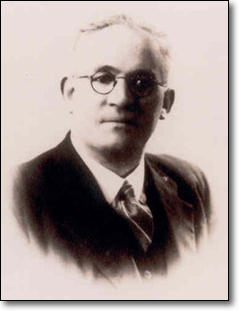
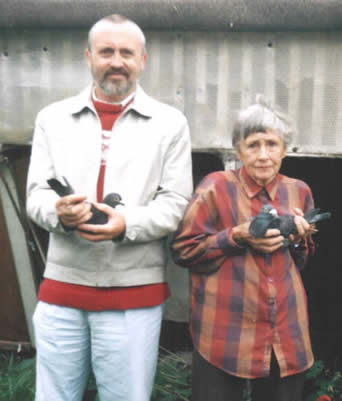
Eric Cannon
The present strain under consideration is that forged by the late Eric Cannon with the support of his wife Pat from Goldalming, Surrey, England. A strain which like some others are not given the honour which is due to them. The Cannons from what I can gather from my research loved our feathered friends and Eric was an outstanding manager of the thoroughbreds of the air. In all of his years of engagement in the sport the moulder of this great long distance strain was totally committed to forming a family capable of breeding and racing at a high level in modern pigeon racing. And he did it in his own quiet way for according to sources Eric Cannon was the epitome of modesty. An attribute or virtue which his great admirer and friend the pigeon scribe Keith Mott wrote of as 'One of the most common attributes I come across in truly BRILLIANT FANCIERS...'
Eric Cannon served in the 2nd World War with the 8th Army and the American 5th Army where he received a foot wound which ensured his return to England where during his convalescence he was nursed by his future wife to be, Pat. It was a life long loving relationship and Pat became with Eric the moulder of the strain under consideration. And what a strain. At its base lay a Blue Chequer Hen (50/1753) which Eric Cannon purchased along with five or six other birds from a fancier called Wiggins from Ipswich. '1753' had experience flying on the north as well as the south routes but from the former route the chequer hen showed her worth when she scored 3rd Section from Lerwick on the day of liberation at a distance of 620 miles. Some flying but in truth her value was at stud for it is reckoned that 1753 was the dam and the grandam of between 30 to 40 scoring pigeons at the distance. The bloodlines of 1753 are still to be found in the present Cannon strain and are treasured by those who possess them today. This reminds me of the advice of the late pigeon racing scribe 'Old Hand' who emphasised again and again of the importance of finding in ones loft or for ones loft the 'goldmine hen'. For as illustrated here 1753 was a goldmine for the Cannons.
Over the years there were other crosses brought into the Cannon strain but they had to be the best and by performance. Crosses are inevitable in strain building but many a cross has destroyed a good family of pigeons therefore it is not an action to be taken willy-nilly for thought is required if a lifetimes work or planning is not to be destroyed. That thought was available behind the reserved demeanour of Eric Cannon and through it he produced pigeons to score 1st, 2nd, 4th, 5th, 5th, 6th, 6th, 8th in National Open races in England. As well as winning his Section almost 20 times and the Three Bird Averages from Pau at a distance of 540 miles approximately on half a dozen occassions. There are many other successes by the Cannon strain too many to mention in this brief tribute. Successes by other fanciers as well as the moulders of the family. Successes which imply that in England there does exist the best of long distance bloodlines. Thus the English pigeon fraternity should not overlook their own strains when it comes to face the obstacles of long distance pigeon racing.
Albert Bennett
This is an insight into one of the best pigeon fanciers that England ever produced and I hope that I pay him due credit. Albert Bennett upon his entrance into the sport of pigeon racing had his original stock from Den Healey of Wem and it is believed that the bloodlines initially came from Heber Fearnall. Apparently the latter named family was flown successfully by a number of fanciers in Britain at the time.
In due course Bennett won the NFC Nantes Open (1969) and at this time he was living in Church Stretton in South Shropshire. He had other successes since his beginning in the sport but he was always on the look out for a reliable family for the longer distances. His prayers or hope was answered so to speak when upon a number of trips to the European mainland he concluded that the type which could perhaps end his quest was the strain of Andre Vanbruaene. The latter was one of the best strains in the history of the sport and in due course Albert Bennett's decision was confirmed over and over again. He and Vanbruaene became good friends and even changed stock with each other which proved profitable to both including national prizes for the great Belgian fancier. One of Bennetts best flyers who recorded twenty 1sts in his racing career was named Andre after his friendship with Vanbruaene. The Bennett bloodlines have also won for others in Britain and beyond including the Far East. He was a man who gave total commitment to the sport at all levels inspite of holding a day job. As well as the national successes there were countless club and federation successes.
Albert Bennett reached the pinnacle of the sport in England when in 1982 he won the NFC Open National from Pau in France at a distance of 644 miles, flying at a speed of 972 yards per minute. What a magnificent accomplishment! Confirming Bennett as a master of the art and science of marathon pigeon racing. An interesting aspect of his management was that he never raced his young birds and never trained his old birds.Yes, against the norm but as a racer Albert Bennett was most successful with his pigeons. The latter being of medium size, mainly blues and blue cheques, always well fed and exercised only around their home
environment. A truly great distance family.
Jed Jackson
I will begin with the following statement '...there are few of God's gifts I enjoy better than the seductive warmth of the early morning sun when the vegetation and the hand- rail to my loft are wet with early morning dew.' That my dear readers has come from the mind and the heart of a poet and his name is Jed Jackson. But not only a poet he was one of the best pigeon racers that the island of Britain has produced. In truth based upon what I have read and heard the man is an example to us all!
An interest in our feathered friends began in the blossoming time of his school days. Jed once recalled that one of his birds was the means by which the half time score of a soccer match was conveyed. Here our subject was lost in the wonder of the orientation ability of his blue pigeon which he had sent initially in a paper bag with the local team to be the courier of good or bad news from miles away. Of course the wonder increased when this pigeon returned from 100 miles. For distance to a child is impregnated with the imaginable and the magical.
The love of our thoroughbreds, therefore, was planted early in the life journey of Jed Jackson and with them he was in paradise. So deep was this love that it was inevitable that he would be forever a pigeon fancier and inspite of the twists and the turns, and even the tragedy of life, Jed Jackson has been a life long pigeoner. A person who has won many prizes from a modest loft at Worthing with approximately 30 pigeons. One of those prizes was the 1980 Pau National into England. His two year old hen 'Genista' beat 5,884 pigeons to win the most sought after prize in English pigeon racing. This blue chequer's dam was of Langstone bloodlines and the sire was of Jackson's own family. Well, others have won the National but what adds to the uniqueness in this achievement is the fact that Jed Jackson is a blind person. Yes, we all know what it takes to manage a loft of pigeons but to do it with such a disadvantage is amazing! Of course, Jed Jackson is a born fancier, that is acknowledged by those who know him, but to overcome such an impediment and achieve what he has reflects the very best of the human spirit.
Now inspite of his condition in one sense our subject has been endowed with many blessings, one being a loving wife, Joan, who played her part in his many successes. In a sense, like the touch of his fingers, Joan is his sight for without her by his side his managerial duties would have been much more difficult.
Sadly with the joys of life lies the sorrows for 'Genista' died from what her friend and breeder thought was the result of her efforts in winning the National. A terrible blow for any fancier but Jed Jackson got on with his productive life and even witnessed a grand-daughter of 'Genista' winning a 550 mile race from Thurso. Upon her arrival the Thurso winner landed upon Jed's shoulder from where he clocked her in. A wonderful image of the bond between a man and a bird, a poetic image of the genius of Jed Jackson.
To conclude, sadly this inspired human being passed away in 2006 but he shall be remembered by the world of pigeondom.
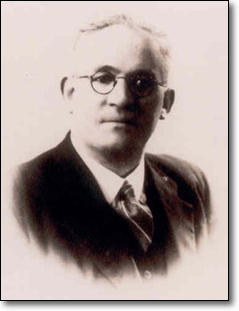
Robert 'Rabbie' Stoddart
This brief article is not only about a strain of racing pigeons it is also about the extradordinary courage of a working class Scottish lad, namely Robert 'Rabbie' Stoddart, who formed the strain and in doing so overcame a crippling skin disease which bound him to his bedroom wrapped in bandages from head to foot.Yes, Rabbie Stoddart formed his strain and raced his pigeons based upon his instructions from his bed in a darkened room because he was not allowed to enter into daylight arising from an incurable skin disease.
Our story begins in West Carron in Scotland at the beginning of the 20th Century were Rabbie Stoddart, one of a family of seven brothers and one sister, entered the sport of pigeon racing. Initially he kept his birds in an old coal shed and in West Carron one had to have permission to keep pigeons and this was often refused but perhaps because of the would be fancier's disability the authorities granted permission. Eventually permission was given to build a loft in the corner of a neighbours garden and this was to be the environmental base from which members of the Stoddart family brought birds to Rabbies bedside so that he could make mangerial decisions about his stock and other matters which we take for granted. However a loving family ensured that its pigeon fancier would receive as much support and encouragement as possible. Even the neighbours played their part for, aside from one providing loft space, on racing days if a local soccer match was in progress, nearby, once pigeons arrived the play stopped and silence reigned until the birds were clocked. I wonder if the late Walt Disney could have imagined such a script.
At the base of the Stoddart strain was a blue cheq Stanhope cock which came via a Mr Tom Scott of Camelon. Stoddart had in his mind what he considered to be the type of bird that he desired for breeding and racing and the Scott cock was of this type. Then upon handling a pied hen bred by a Mr Radcliffe of Stalybridge known as '307' (of Gits C bloodlines) Stoddart knew that he had the base pair. He was proven to be right for the pair in turn bred 'Alfonso' an important pigeon of the Stoddarts. During 1925 more blood was added to the loft, one being a blue Logan cock of the Stanton Bros of Plumstead and two hens from S. Vine of Rosyth.One of the hens when paired with the Stanton cock bred '1704' who became a very consistent racer.'1704' when paired to a daughter of 'Alfonso' bred one of the lofts best racers 'Dauntless'. At about 1929 Rabbie Stoddart knew that things had gone well for his channel ambitions but he was still determined to improve his stock and he purchased some noted birds of the Osman strain amongst others including the blood of J.B.Clarke of Bothwell - the latter blood giving birth to the base of another great Scottish strain the '1210' strain of Mason. Emanating from the latter purchases there were good offspring, in particular a blue hen 'Little Lady' who was to become a pivotal factor in the evolution of the family. The latter hen when mated to one of the direct Osman birds 'Old Squills' produced two outstanding stock birds and an excellent racer 'Leading Lady' who won a race from Nevers, France (almost 700 miles) held in conjunction with the English based Up North Combine in 1929, by 50 yards per minute. In 1930 'Leading Lady' was also 3rd Open Rennes S.N.F.C. In due course Rabbie Stoddard won 3rd, 4th,16th and 19th Open in the Scottish Nationals as well as 2nd, 3rd, 6th,16th and 23rd in long distance races held under the auspices of the Scottish Midland Combine.Yes, 1st was elusive but what other pigeon racer could achieve what Rabbie Stoddard achieved under such terrifying disability? Surely he was one of the greatest.
It should be noted that the great English fancier, Vic Robinson, had obtained directly some of the Stoddard strain and the latter bloodlines are in the pedigree of some of Robinsons best birds including the great 'Mademoiselle' who was 1st and 2nd Open from Pau in the National Flying Club.Thus in a way Rabbie Stoddard achieved his 1st National four years after his death at the age of 49 in 1951. Many other national positions in the islands of Gt.Britain and Ireland and elsewhere were obtained by the bloodlines of the Stoddards.The fancy in Scotland must surely be proud of them.
14/11/0614/11/06