By Liam O'Comain
George Stubbs
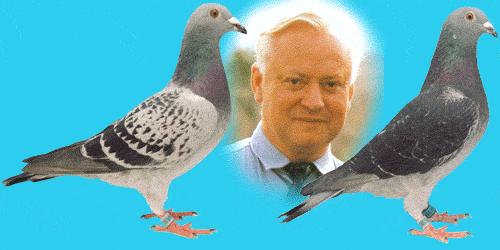
The subject of this piece is one person who should not be forgotten in the realm of pigeondom for he was a master of long distance and marathon pigeon racing, in fact, George Stubbs of England, was one of the greatest exponents of a difficult discipline. A pigeoner who can take his place in the pantheon of the world's best preparers and conditioners for the ultimate tests of flying endurance.An honourable place amongst the greatest since the origins of the sport.Also may I add that our subject bred and raced perhaps the greatest Barcelona pigeon ever.
George Stubbs apparently raced well into his 80s and held some of the records for distance flying into the island of Britain.A very patient and kindly person by all accounts, our subject built his family upon four pigeons bought in 1901 of the N .Barker family. Eventually a cross was brought in to consolidate his intentions and they were two grizzle Bovyns to be followed by examples of the Thoroughgood and the Tressider families. The latter being two of the best of British origin.
Some of the achievements of George Stubbs and his flying athletes includes 9th Open North Road Championship Club, Faroe Islands, in 1932. This was 802 miles and the longest distance then flown of north to south. And for 6 years the Stubbs small and humble loft was in the first 19 of the Open from San Sesbastian.Also the loft held the record for the greatest distance flown north and south from Faroe 802 miles and Barcelona 672 miles.The list of many honours won includes the following: 3 Gold Medals; English National Flying Club Section A Cup; the Dewar Trophy for the Best Two Bird Average for nominated birds from San Sebastian; the London Centre Trophy; the Hants Federation Bordeaux Cup; the Barcelona Trophy and the Medal of the International Organisation in Belgium etc.
George Stubbs accomplishments from the marathon of all marathons i.e. Barcelona must rank as some of the greatest in the history of the race, in fact, this success in the opinion of many counts as the greatest or at least one of the top three superb feats of racing from the Spanish race point in it history, when George Stubbs clocked to win 1st British Section and 4th International in 1931. A wonderful achievement when one considers that the one entry 'Barcelona' was in a convoy of 5,033 birds from the best of Holland, France, Luxembourg and Belgium, in a period of more primitive transport to the race point.The distance being 672 miles.And to prove that the event was not a freak the Stubbs loft was 19th Barcelona International in 1932. In that race the 'Barcelona' also scored 4th British Section. A superb thoroughbred! Perhaps the greatest Barcelona flyer ever? At least that thought raises itself often in my mind.The 'Barcelona's' 4th International however was accompanied with a 1st success from Marennes plus an 87th Open National Flying Club San Sebastian position. The 'Barcelona' also flew San Sebastian in 1930 when he arrived at 5am on the second day.Thus confirming that the 'Barcelona' was not a one race wonder.
His famous 'Trixie' however was George Stubbs favourite and after years of outstanding success flying she died at the age of 17 years. Born in 1924 from a pure white Bovyn hen and a Thoroughgood sire Trixie as a youngster was the first bird to the loft in two Nationals. Then in 1925 flew 225 miles from York.The following year 1926 this great flyer flew 475 miles from Banff and in 1927 flew over 600 miles from Lerwick. The following year as a 4 year old 'Trixie' was 1st from York and 3rd Open N.R.C.C.from Lerwick. She was then turned to the south road in 1929 and obtained good positions from Guernsey, Rennes, Nantes, and San Sebastian, 521 miles. But as stated in 1930 'Trixie' exhibited her greatness when she finished 9th in the north road Faroe Island race.Obviously under pressure for she had only three tail feathers upon her return alongside damage to one of her wings.An outstanding pigeon.
There is no doubt in my mind that George Stubbs was one of the greatest marathon racers ever in the history of the sport and on reflection upon the exploits of the 'Barcelona' surely the greatest of the greatest Barcelona flyers. And why? Because this brave pigeon had to break from the cream of the European continent and travel alone across the English channel on its way to the owner who loved and prepared it. A wonderful example of the relationship between a great pigeoner and a great pigeon.Yes, their likes are few and far between!
Jim Keynon
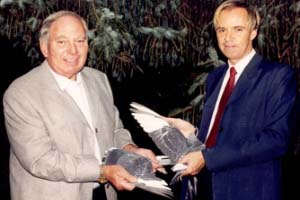
The subject of this piece is a giant amongst giants of the British racing pigeon sport. Jim Kenyon was from Skelmersdale, Lancs, England, and as years go by the legend has grown for so many winners at the distance and in tough conditions are marked as of the Kenyon blood. Not counting those claimed as 50% or 25% Kenyon, etc,. Especially in Ireland , Scotland, Wales and England at 500, 600, and 700 mile race distances.
Kenyon has acknowledged that the majority of the credit for his successes must be laid at the door of another great pigeoner Chas. Thorougood. For it was the stock of Thorougood and to a lesser extent Edwin Nicholson of Billinge, near Wigan, which was the base of his strain. A closer study however reveals as one would expect the influence of Belgian greats such as Jules Janssen, Gits, Vanderhaegan, Hansenne as well as the old white throat Grooter blood.So the best of the continental mainland bloodlines permeated through generations to build and fuel a great family of racing pigeons.
Jim Kenyon was a fancier who believed in patience and the nurturing of a loving relationship with ones birds. In fact he believed that when many of his racers defied the odds and fought through bad weather conditions that the love of their owner and their home played an extremely important part.
If there is one pigeon that epitomizes the Kenyons then it was the great What's Wanted. A dark Cheq Pied Cock (NURP 30 F 63) a winner from Nantes in conditions so bad that other local fanciers were bucketing rainwater from the confines of their lofts as it arrived in a rainfall. A wonderful example of courage and determination shown by a bird weighing less than one pound in weight. In his career What's Wanted won over 600 pounds sterling in his time. Imagine what that figure would be worth today. What's Wanted won from Nantes two years in succession and left his mark as a breeder.
It would appear however that the Kenyon's showed their class in the hands of other fanciers. Of course this is not to take away from the many achievements or the greatness of their creator but the fact is that in the hands of others numerous nationals were won. Perhaps that is a fitting tribute to the Kenyon strain in that they carried their greatness into other lofts - backyard coal sheds and palatial premises- of fanciers here and abroad.
Even today the bloodlines are keenly sought after, although I would doubt the existence of a pure representative of the family. This search however is perhaps the greatest tribute that can be made to the strain and its builder.
Fear Brothers
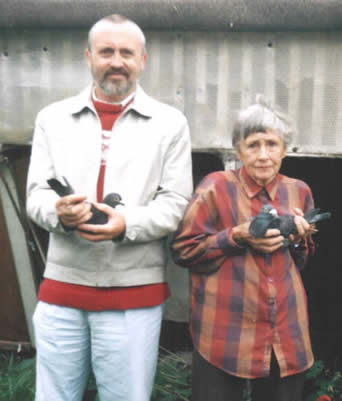
There is no doubt in the minds of knowledgeable pigeon racers that the Fear family of racing pigeons was one of the best since the coming of the sport to the shores of Britain. In fact they were participants in a sport in which it would appear that all came natural to them. Their achievements over the years are outstanding and I have no hesitation in stating that when the history of the sport of pigeon racing in Britain comes to be written
that the names of Sam and Roly Fear will be amongst the leading lights.
Although a family of long distance bloodlines the Fear Brothers raced their birds from about 50 miles to 550 miles with frequent successes. The latter fact arose from the initial decision to ensure the best of foundation stock. Their base came from another good English fancier, Bert Thatcher, who bred the brothers a half a dozen youngsters, one of which became a great stock bird after winning 4th Section, 6th Open NFC Nantes. The Thatcher bloodlines also produced a 37th Open British Barcelona Club for the Fears, thus ensuring 700 mile racing potential.
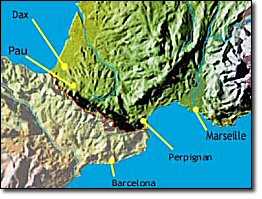
The Barcelona success was in the early 1960s but eventually the brothers got to know another English fancier by the name of Bob Legg who accommodated them by providing some of his own birds to be mated with the Thatcher bloodlines at Leggs farm. This proved a profitable arrangement for the Fears for from one of the matings there came a bird '633' who accomplished 9th Section, 27th Open; 2nd Section, 5th Open Palamos; followed by 1st Section British International Championship Club Barcelona at a distance of 718 miles. Some flying from Spain across the English channel. Of course the brothers accomplished many successes during the 1970s including winning the NFC 1st Section F, 1st Open Pau 1979 at a distance of 536 miles.
The winner being Clandown, a great mealy cock of the partnership. The important lesson of patience can be learned from the Fears management for the great 633 (above) failed to arrive from a 97 mile race from Plymouth until 4 days after race closure but the brothers rested the blue bar hen for a year (1978) and in 1979 their patience was awarded. Many others I think would have placed her in the rubbish bin, instead.
The Fears fed a diet of beans early in each year supplemented with Hormoform as well as some Homon for the youngsters. Linseed would also have been provided but beans, peas and tares would have been the diet basis for the majority of months. Although for the youngsters maize would also have been provided. They were great advocates of dry and well ventilated accommodation for racing pigeons and always strove to ensure the optimal environmental conditions. Thus with proper accommodation and diet Roly and Sam Fear would ensure an appropriate regime of training for all their racers which included 40 to 50 miles tosses for their national candidates if they thought it was required after normal stage by stage training. As for the youngsters they were trained as soon as they began to roam the countryside up to 20 miles where upon they were stopped for a period and then given a few tosses at 20-30 miles prior to the first race. Yes, a well thought out regime but a flexible one at that.
Sam and Roly Fear were fanciers of great common sense which alas many of us fail to possess which ensured the brothers confidence of detecting the pigeon in form and that or they were the the only participants in a particular race in a particular week. No mob flying here or sending for the mere sake of sending hoping for a win. They were pigeon racers of the highest calibre and of such is history made.
Westcott
I have referred to a number of strains from Britain and also of Ireland in my past articles and I have received some comeback from fanciers and a peculiar aspect of that comeback ( for whatever reason) a few tend to think that only strains of racing pigeons can come from Belgium or in latter years Holland. Now I don't want to get into the old blind racist position that Irish strains are best, or English strains are best, or Dutch strains are best, for although I'm proud of my Irish nationality I acknowledge that our racing thoroughbreds whatever configurations they encounter in any part of the planet have to accomplish upto 5, 6 and 700 plus miles to get home. And such distances are not easy in any part of the globe. Of course being proud of ones national produce is an attitude held world wide for I have received correspondence from the southern hemisphere contending that the European pigeons are not as good as those of Australia and New Zealand. However, to return to our original finding there does exist strains and very good strains in the nations of England, Scotland, Wales and Ireland as well as the rest of Europe and of course the world but there have been some strains not given the due that they deserve. One of those strains is the Westcotts of England.
The core founder of the strain according to my research was W Westcott of Ipswich and he formed his strain in approximately a decade and a half of time, a strain which produced many winners for the Westcotts and others in the last century. The founder had not long to achieve success for in 1926 with the North Road Championship Club he won from Lerwick and in the following year 1927 his brother won the same King's Cup from the same race point. The winner being bred by W Westcott for Ben Wescott. Surely a landmark in North Road flying to win the most sought after trophy two years in succession.
Apparently assuming my sources are correct the main actor W Wescott once raced with his father as Wescott and Son in the latter years of the 19th century until at the age of 16 years in 1901 he decided to race apart from his father. For a while he and his brother Ben raced as a team.Thus began the drama of strain formation and success although he did not make a conscious decision to mould a strain until according to his own testimony 1910. He began with the following base: three pigeons from A. E. Sheppard, of Woodford, of the Nantes Freeman Hen blood; three pigeons bred by A. P. Taft, of the J. L. Baker Little Wonder, Ironsides, Favourite and Orchardson's '40' blood; four pigeons from F. Houghton, of Wellingborough (two of Hustwaites Bros' 1st Lerwick NRCC and the other two from his seven times Lerwick pair); and two pigeons from Mr Lulham bred from half brothers and sisters out of Clutterbuck's No. 51, Lerwick NRCC 1914. There was also '969'- The Logan Cock raced by P. Clutterbuck and a son of Col. Osman's Hopeful as well as a pigeon from Eccles, of Darwen. In addition Westcott used a blue cock bred by Houghton, of Finden, from the Thorogood Hen '42', and a hen bred by Ure, of Polmont, Scotland, inbred to McClean's No Surrender winner of the Scottish National. This was his base and a sound one at that and in due course his expectations were fulfilled.
An interesting observation is that W Westcott was an advocate of the famous or infamous (depending upon ones experience or study) 'eye sign theory' and that he mated his pigeons according to the principles of this controversial thesis. It is an item upon which I have an open mind and its supporters would argue in support of their position that through it Westcott bred two King's Cup winners. However aside from this theory Westcott produced a type of pigeon that shone in both hard and easy conditions. For example his famous blue hen known as '589' won 1st Thurso, 488 miles, with the very high velocity of 1901 yards per minute, and then won 1st Ipswich FC, 3rd section, 12th open Lerwick, NRCC, with a velocity of 375 yards per minute. They were mainly long casted with good feathering, short legged, broad fronted chequers and blues including red chequers with occasional eye ticks.
There were many outstanding pigeons of the strain but let us look at the record of the blue cock known as '12' which flew 1920 (youngster) Durham, 220 miles; 1921 Banff, 416 miles on the day; 1922 Thurso, 12th IFC and 3rd Perth; 1923 Lerwick, 24th open NRCC, 5th section; 1924 Lerwick, 29th open, 8th section; 1925 Lerwick, 12th open, 3rd section; 1926 Lerwick, 1st Open and King's Cup NRCC; 1927 Lerwick, 33rd open, 11th section. This bird's children and grand children were also successful on the tough northern routes.
As the years advanced the Westcotts won trophy after trophy confirming that the quiet English fancier had done what he had set out to do in 1910. The fruit of a good thinking fancier ensured that the name Westcott would be forever etched in the sport of pigeon racing as he formed a strain capable of competing against any from wherever. May this brief insight into the Westcott strain add to and strengthen that etching.
15/11/06