Modern European Pigeoners - Part 3
By Liam O Comain
The Schloemers
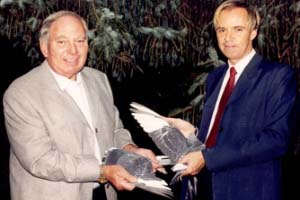
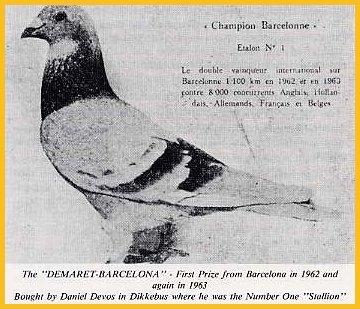
The surname of Schloemer is a name not known to the world's racing pigeon community as well as Thone or Muller yet it is one of the modern long distance families which canbe defined as a strain. For years the Schloemer's, Josef and Rolf, has won at the distance in all types of elemental conditions and long since have reached the elite status of European pigeons for conquering the long distances. Perhaps the crown and glory of their successes so far is their winning of the Barcelona International at a distance of 1130 kilometres from 18,076 of a convoy in 1986. In fact from amongst the thousands of pigeon fanciers in their native Germany they have won the national from Barcelona on two occasions.
The strain has the old Huyskens- van Reil at its foundations. Initially the father Josef Schlomer raced with a small number of pigeons.Success was not lacking however nor was it to be hindered for the stud won the 1994 national long distance championship of Germany in which the Schloemer birds ran away with twenty eight of thirty possible prizes.
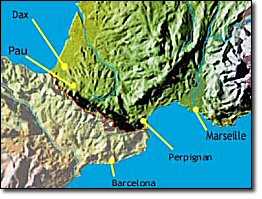
One of their undoubted champions is the hen called 'Emirates' which was the best long distance bird (hen) in Germany in 1994. Prior to this in 1988 a half sister of this great hen won three international prizes within a few weeks from Pau, Dax and Perpignan. There is also another inmate of their lofts who has won three international prizes that is the famous 08421/96/166. Also the partnership has scored in the top 50 results from Pau, Barcelona, and Bordeaux in 1988.
Of course the outstanding star is the International Barcelona winner called 'Lady Barcelona '. For aside from this success she is the source which has achieved the following fantastic breeding results in fact I doubt if any other national or international winner has been as successful as this beautiful bird. Amongst its grandchildren are: 1st national Bordeaux 1998; 1st international Pau in 1996; 1st national Pau 1996; 1st ace pigeon Germany 1994; 1st ace hen Germany 1990; 1st national Barcelona 1992; 1st prize Tours with a yearling at 588 miles with 10,068 birds competing; and 2nd prize Tours with 33,000 birds competing. Yes the latter were predominantly grand children of one of the best winners of the marathon Barcelona International.
As stated the Huyskens-van Riel was at the base of their family but there also were representatives of the Delbar strain and the Janssen brothers. It was the Delbar especially of the 'Stallion' line which projected the Schlomer's unto the European stage of long distance pigeon racers. One will also find representatives of the Van der Wegen and Brakhuis in the strain's pedigrees and apparently the Janssen lines were brought in for the latter Aarden based families because of the necessary requirement of speed. An innovative import in 1997 were representatives of the New Zealand master Roy McFadyen of Christchurch. And like earlier crossings the latter were carefully integrated into the Schloemers.
The partnership take most joy from the reality of welcoming one of their arrivals after a flight covering hundreds of miles across the tough terrain of Europe reflecting the God given gift and miracle of pigeon orientation. A miracle and a gift to a non human being which I personally hope science will never unravel. In the meantime this European strain will continue to lead the way
amongst others in conquering the distances.
The Verhellens
Two pigeons were bought at a sale of young birds in 1983 and they were mainly of Cattrysse and Van der Espt bloodlines. The buyer was an astute Belgian called Hilaire Verhellen and the goods bought proved in time to be 'good' in the true sense of the latter term for both eventually nicknamed 'The Beard' and 'The Dreamer' are the basis of good racing and breeding pigeons. The fathers of the two founders were apparently brothers whereas the mother of 'The Beard' was the sister of 1st national St.Vincent. The mother of 'The Dreamer' carried Van de Weghe and Verhaegen and son bloodlines. Thus started, based upon a regime of severe culling, the formation of one of the best strains produced in Europe in the latter end of the twentieth century.
An interesting aspect of the Verhellen set up is the owners patience for in the younger years of the pigeons existence they are not given the stick so to speak and as a result there are many 7 and 8 year old flyers in the lofts. In fact the young cocks receive up to 100km training tosses and are then stopped until they are yearlings. Then they are lightly raced until the age of two but after that they have to toe the line. In fact if during their first three years any bird showing signs of weakness say arriving fatigued from a race it is removed from the loft. The success of this type of management is endorsed when one sees a seven year old winning 1st provincial Pau and a year later winning International Super Champion Pau. The lofts have also recorded a second position in the same international championship with a similar aged pigeon.
One of the toughest competitions in Europe is the 'Europe Cup' for it entails obtaining points from four international races Pau, Barcelona, Marseille, and Perpignan across three competitions that is 1) Competition with the first nominated pigeon on the four races; 2) Competition with the first two nominated pigeons on the four races; 3) Competition most prizes with the first five nominated pigeons on the four races (for Pau only the two first nominated). The winner of the Europe Cup is the one with the best performance over these three competitions. Well Verhellen confirmed the class of his strain by winning the Europe Cup in 1992, was third in 1993, and fifth in 1994. He was the first who was ever able to classify himself three times within the history of the Europe Cup, only 10 persons are classified each year.
In time crosses were brought into the family mainly from families with Aarden bloodlines and were a success but Verhellen considers it a good day that he obtained some Robert Venus pigeons and especially the Supercrack line (Crusson) for he possesses two brothers of the latter background which are considered champions, 'Narbonneke' and 'Narbonneke 2', both won a first provincial and 'Narbonneke' won 26 prizes at the long distances. Also with the same blood 'Pauke' (6th national Pau 1986) and 'Brother Pauke' (4 prizes from Barcelona and one of the nominated who won the Europe Cup).
One of the many interesting pigeons owned by Verhellen is 'The Dax'. Apparently its owner had to force feed this bird for four weeks because it had Paramixo yet it survived and went on to record positions in three nationals within the top one hundred. I wonder how many of us would have done what Verhellen did with this bird which now occupies a valuable space in the stud
loft.
The strain of Hilaire Verhellen may not be well known in the English speaking world but their achievements at the distance warrants further publicity. For as I have written in the past the wider dissemination of the available blood stock information of the best strains is important for the development of the sport of long distance pigeon racing worldwide.
Ken Hine
Ken Hine of Hayes, Middlesex, in the land of the rose namely England is one of the most consistent racers at the long distance events and in my humble opinion one of the best distance specialists in Britain at present.Ken Hine is not the only person involved because his wife Lil is also part of a unique pigeon racing relationship or partnership.The male of the partnership was so committed to the sport prior to his marriage that he sought the property of a friend in which to erect a loft. It 1952 Ken Hine started in the sport and many successes have been obtained since then. Initially he raced the north road in which he done very well but in 1985 the decision was made to turn to the south road. This was an excellent decision for the Hine partnership won 19th Section, 69th Open NFC Pau; followed by 5th Section, 15th Open in 1986; 8th Section, 52nd Open 1987; 17th Section, 40th Open 1988.This was to be the beginning of a very fruitful period of success at the distance.
They have also won 49th & 70th Open, three times Palamos, including 8th Section, 14th Open; 7th Open, 12th Section and 76th Open; 3rd Open BICC Barcelona, 25th Open BBC Palamos; 14th Open Palamos (2002) 686 miles.Followed by1st Section, 3rd Open NFC Pau in 2002. There have also been other successes with a 2nd Open from Palamos.
Initially the base of the family derived from George Burgess and Tubby Tate, and since then other bloodlines have been intriduced, from Peter Titmuss, Jim Biss, the Fear Bros and Eric Cannon. A Natural racer initially but eventually Widowhood has been the system prevailing.
In management terms the Hine family are trained very thoroughly and the inland races are treated as an extension of that training.Training is so much a pivotal factor by the Hines that some birds may not see a race until they are a year old but they are very careful with the youngsters ensuring that they do not face the English channel before the yearling stage.Proper training is something that we can neglect but in order to get the racers into form and condition it is an important part of management.The Hines epitomises this requirement by all accounts.
Ken Hine is of the strong opinion that blood will tell according to my source and this is based upon the best of feeding coupled with pure clean water in association with the above referred to excellent training. This is the best advice that any beginner or novice should hang above their beds to remind them of their duties if they want to succeed in the sport.And that is 'consistent success' not the form of once in a blue moon success so to speak.The birds also receive their annual treatment against coccidiosis, canker and worms.
Finally, at the time of writing this article Ted and Lil Hine has just won 5th Section D, 10th Open British Barcelona Club Blue Riband National from Palamos, 2005, at a distance of approximately 685 miles. Confirming as if it was necessary my opinion relating to this modern English strain.
Kreuer Bros
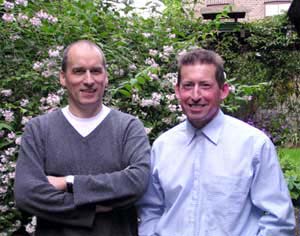
Bernd and Werner Kreuer are two German brothers from Bornheim- Hersel, they have been flying the long distance races across Europe for many years. The name frequently appears in the results at National and International level. Since 1987 they have concentrated on over night racing only. One of the brothers Werner works at Bonn University whereas Bernd is employed as a postman. The brothers initially were fascinated with the exploits of distance and marathon racing in the Netherlands and were inspired and taught by Jan Ernest of Steenbergen, and Jean Hausoul of Epen. From German fanciers Herbert Gross and Rudi Köhne the brothers procured their first successful pigeons as well as the Dutch fancier Joep van Dongen from Middlelharnis. Later, in the early nineties, further stock was purchased from Jac van der Wegen, Jan Ernest, the Frenken brothers, as well as Jean Hausoul of Holland, to be followed in latter years with the bloodlines of
Brockamp, as well as birds from the Paulet partnership and some from Dr. Henk de Weerd of Breda.
Their foundation, or base, bird is 'Joep' a son to 'Vale Barcelona' hen of Joep van Dongen, which scored 19th, 32nd, and 47th National Barcelona. Another important stock bird is 'Queen' that came from Jean Hausoul, and a daughter to 'Super 21st', winner of 9th National Dax. 'Queen' is also grand-daughter to 'Barcelona', a son of the great breeding hen 'Elza' and grandam to the 1st National Montauban; as well as dam to the winners of 3rd National Perpignan, 6th National Bordeaux, 43rd National Marseille and 45th National Bordeaux plus others. There is also in their lofts the good breeder 'De Witpen' a pigeon of Jan Ernest which is closely related to 1st National Dax in 2000. Being also dam to 35th and 37th National Barcelona, 57th National Dax, 97th National Cahors, etc.
In 2004 from Barcelona at a distance of 1,111km, the Kreuers in the German National against 2,601 pigeons were 30, 85, 201, 246, 383, 424, 469, 629; and in the International against 24, 913 of a convoy scored 223, 838, 2140, 2782, 4565, 4887, 5366. Seven out of 18 sent. Again this is mainly an Aarden based family and as well as obtaining good stock the brothers were determined to build the proper loft environment, alongside learning the technique of modern pigeon racing at the long and marathon distances.Coupled with a mutual astuteness the Kreuers have made steady progress on the road of moulding their own strain and competeing against the best the Europe can provide. As relatively young their future appears bright and they are a partnership to watch out for as they make another interesting chapter in the Aarden dynasty.
Eric Vanacker
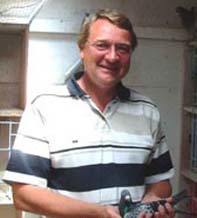
In a small French village called Pouilly-sur-Serre lives Eric Vanacker, a name perhaps unknown to many outside of his native country but one with the potential to spread beyond national boundaries. Vanacker's family background has no trace of the sport of pigeon racing but the sport is beginning to make this particular surname one to be proud of especially at the distance and at international level.
Always a lover of animals, Eric, in his early years kept various species but when a stray racer touched his life this opened the door to the world of our thoroughbreds. This being when he was approximately 14 years old. Then he lived at Halluin where in due course he was to race in the sprints and at the middle distances. In time however his forte was to be the long and marathon distances especially within the latter years of the previous century.
Coupled with his decision to go for the ultra distances in about 1994 Vanacker purchased some new bloodlines more appropriate for the type of racing he had decided upon. These were of the Eijerkamp/ Muller and the Roosens/ Cobut families, coupled with some Silvere Toye lines. This proved to be a good choice for after due patience and proper preparation Vanacker won 1st National, 9th International from Pau in 1999. This base lies at the heart of his many successes.
The 1999 accomplishment was to be outpassed by the wonderful achievement in 2003 when 'Le New Perpignan', a blue chequer cock won the Perpignan International. This great pigeon prior to this win had scored in 2001: 8th National, 177th International Marseille; 152nd National Pau, and 236th National Perpignan. 2002: 5th National Pau; 8th National, 137th International Perpignan plus 184th International Dax. Also sometime prior to the International Perpignan win 'Le New Perpignan' was 14th National and 25th International from Dax.
Other loft successes in recent years included 8th and 170th National Marseille; 125th National Dax; 5th, 8th, 17th, 214th National Pau; 12th National Perpignan as well as another International victory when Eric won the Montelimar International. In 2004 Vanacker scored 56th,103rd, 119th, 137th, 152nd, 226th National Barcelona as well as 86th and 201st National Marseille. All from a team of 24 widowhood cocks for cocks alone are seriously raced as 2 years old and beyond while the young and the yearlings are raced for education purposes only.'Gerry Plus' being their basic feed.
The Eric Vanacker family of pigeons are destined to reap further glory within the international pigeon arena in the years ahead for if one can achieve the above results in a brief period of time, as an extremely busy person, what will be the fruit of his retirement years? It will be interesting to witness.