NORTH ROAD CHAMPIONSHIP CLUB
by George Wheatman
Berwick Young Bird Section Winners 2014
One way to combat the dark, gloomy days of winter is to look back and recapture some of the highlights of summer.
For some members of the North Road Championship Club, those high spots included success in the young bird national from Berwick none more so than the section winners who are the subject of this article.
The summer of 2014 was great for much of the time, but Mother Nature is an irascible old soul and reserved several of her bad moods for the weekends.
The Berwick young bird race turned out to be a good one, but not before the old girl teased and tormented the convoyer and race adviser.
Early morning mist, east in the wind and a high K factor were all possible enemies of a good race, but patience was rewarded with the arrival of the sun to allow a 10-55am liberation.
The chairman, Brian Garnham, had been a little worried about the delayed liberation putting longer-flying fanciers in a disadvantageous position. But, as usual, they took it in their stride and again proved their calibre with excellent results, on a day when other organisations did not have returns as good as those experienced by the NRCC in a race that could never be classed as easy.
Young bird losses, compounded by the dreaded young bird sickness, hit the entry somewhat but there were still 1, 828 birds sent by 156 members.
The winning velocity, achieved by the entry of Darren Perry, of Alford, was 1314ypm, and there were eight other birds which broke the 1300ypm barrier.
Seventy of the 603 birds on the result sheet registered below 1,000ypm.
For the second successive year the race was dominated by the Old Leake, Lincolnshire, loft of Ray Knight and Sons, who took 15 of the first 20 positions but were not quite able to repeat their win of 2013.
However, they were still runners-up, a position they also took in Section Two.
So, ironically, although they were the top loft in the race, they do not feature as one of the section winners in this article. If you want to know how Ray has done so tremendously well in this race in the past two years, he has produced a DVD to tell you in precise detail.
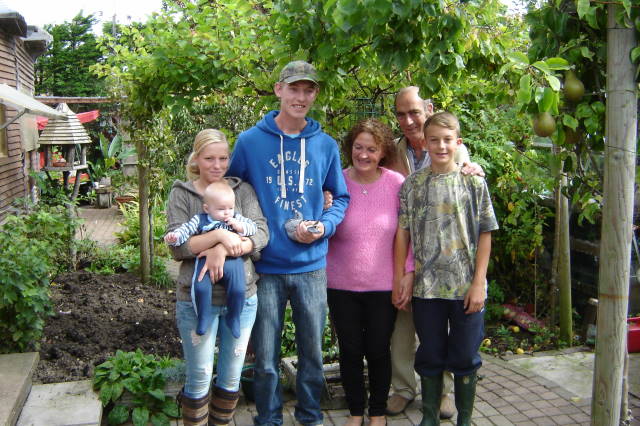
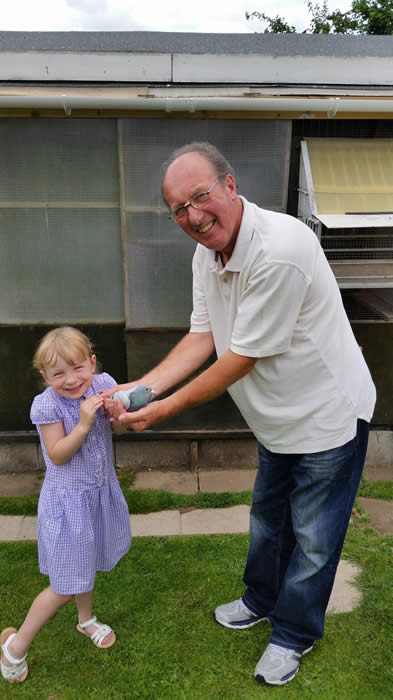
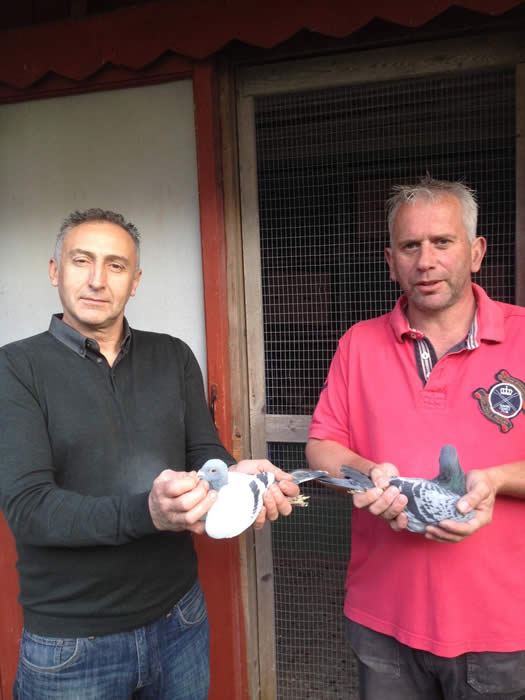
Darren Perry and family, winners of 1st Open and 1st Section Two NRCC Berwick young bird race.
Section One F and T Salt Bros and Son, Kimberley
John Salt does not like losing (his words, not mine) and a lot of soul-searching goes on when he is beaten. He scrutinises his detailed records to try to discover what might have gone wrong. “It usually turns out to be my fault,” he admits. “I write something down each day so that I can remember the little things that matter.
“The worst thing you can do is listen to people who visit your loft, especially if they advise you to ‘send that one’ when you know that it is not really right. Never do that.”
Fortunately for his own well-being he has not had to indulge in too much self-analysis in 2014, especially in young bird racing. Out of seven young bird races, he won six of them. “The lad who beat me had to win the Federation to do it,” said John. Take a bow, Mick Wilson; the one from Brinsley, that is.
John’s pigeons took their good form into the NRCC young birds classic where he was first and third in Section One, also taking 6th and 18th open positions.
Take a look at the overall result and you will see that it is dominated by members down the eastern side, so that puts into perspective those highly commendable open positions, and illustrates why John is rated one of the best fanciers on the NRCC scene.
Don’t forget that, as recently as 2011, he won the old bird race from Thurso (that pigeon is now in the stock loft and producing the goods) and, way back in 1975, was winner of the young bird national, results which emphasise his longevity at the winning game.
His first two birds in the section from this year’s Berwick young bird race were blue Soontjen hens, and the second one went on to win the Federation from Perth a week or so later.
The birds had been on darkness from the beginning of March until June 21st and, for the first occasion in a long time, John did not have young bird sickness in his loft.
John is a keen student of the sport and is never afraid to try systems which he sees being used by respected fanciers.
This year he vaccinated his birds as squeakers for paramyxo and typhoid, and vaccinated them again for paramyxo before the start of young bid racing. He was planning to repeat the paramyxo vaccination before Christmas, so his birds will have been vaccinated three times in one calendar year.
“I do all the young birds at the same time,” he said. “They will be six to eight weeks old. I always sterilise the syringe after every single time. It takes me about five hours to do it.”
John has a heated floor in his young bird loft and does not clean out, so the birds have a deep-litter of dried droppings to help the immunity. “It means the youngsters can spread out and do not huddle together for warmth,” he said.
John read an article about a Belgian fancier adopting this system, and spoke to that fancier before adopting it himself.
He starts training his young birds about a fortnight after taking them off darkness, the first toss being about five miles. Then he trains often, but rarely further than about 18 miles.
His Soontjens are descendants of birds bought directly from Jos Soontjen.
He bought six on that first visit back in 1989, and sold one to cover his outlay.
Since then he has brought in various pigeons, but found nothing to match the offspring of those original Soontjens.
Now aged 66, John has been a pigeon fancier for 60 years and has gathered a wealth of experience during that time, as well as a fund of stories to tell. He competes at club level against a number of top-class fanciers in the Eastwood club.
One of the things he has discovered is that he does not like south road racing. “I did try flying from the south, but did not like it,” he said.
But he has fond memories of his schoolboy days when he used to accompany the convoyer on the train trips to racepoints. “That was a big adventure,” he recalls.
His widowhood hens team took a bit of a hit in the old bird Berwick race in 2014, but he bounced back to win Section One from Perth, and also to be second open, as well as being 8th section.
From Arbroath he was 8th open and 5th section, did not compete from Lerwick, and was then 33rd and 37th section from Thurso, where he said he had a bad race, before his big finale in the young bird Berwick race.
John’s champions, such as Golden Fleece (who topped the Fed six times) and Fair Cop are legends in pigeon racing circles, and now their bloodlines are keeping the loft at the top of club, Federation and NRCC results.
He does not let his pigeons out all winter, but many of them spend each and ever day in an aviary from 9am to 3-30pm.
Once over the moult they receive one feed a day, of beans and barley, and they are not fed heavily. “I like to keep them a little bit hungry,” he says.
He feeds predominantly beans in the breeding season, and a widowhood mix for racing, fed via spoon into the boxes.
He breeds off both racers and stock birds, but sells the youngsters off his racers.
Alas, as usual, there is not photograph of John. He flatly refuses to have one taken of himself, although he will talk all day about his pigeons.
First 20 in Section One were: 1 (6th open) F and T Salt Bros and Son, Kimberley 1304; 2 (17) A Hind, Nottingham 1281; 3 (18) F and T Salt Bros and Son 1279; 4 (21) M Wilson, Brinsley 1278; 5 (42) Rouse and Webster, Kimberley 1265); 6 and 7 (44 and 45) PA Crooks, West Bridgford 1264.8105 and 1264.5063; 8 (50) Mr and Mrs A Waudby, Mansfield 1260; 9 (67) Mr and Mrs J Kirkpatrick, Nottingham 1244; 10 (79) PA Crooks 1236; 11 (81) Rouse and Webster 1235; 12 F and T Salt Bros and Son 1230; 13 (117) Mr and Mrs A Waudby 1218; 14 (121) Rouse and Webster 1217; 15 (123) A Hind, Nottingham 1215.9623; 16 (124) Mr and Mrs J Kirkpatrick 1215.7954; 17 (133) F and T Salt Bros and Son 1213; 18 (183) PA Crooks 1192; 19 (191) Rick and Spiers, Nottingham 1190; 20 (229) P Hogan, Nottingham 1176.
Section Two D Perry, Alford
Winner of the race overall was Darren Perry, of Alford, who, at the age of 27, is one of the younger members of the NRCC, and one who is already proving to be among the most accomplished.
After twice suffering the agony of being runner-up in previous young bird nationals, he clinched the top prize with a blue white flight hen.
Darren has also been 1st section, second open old hens in the past, and his is a name always sought out by competitors in the NRCC, Peterborough and District Federation, as well as his Alford (Lincolnshire) club.
His 2014 NRCC results, for instance, include: Berwick 10th open; Perth 1st Section, 118th open; Arbroath 2nd section, 4th open; Lerwick 4th section, 18th open; Thurso 3rd section, 6th open.
That is pretty good flying in his first season on his own after previously being in partnership with his grandfather.
The bird which took top honours was a March hatched youngster off a Gaby Vandenabeele hen and a Janssen cock bird.
The mother was given to Darren by Colin McRae, a member of the Alford club for the short time he lived at Sloothby before returning to his native Fraserburgh, and the father was a blend of Warren Foster and PJ Lofts pigeons.
She was sent sitting four eggs. That is a motivational ruse Darren likes to use, sometimes adding a bantam’s egg as well. She had competed in the whole young bird programme.
Darren races his young pigeons on the darkness system, but did not think that was so important this year as his race team was later bred. He normally pairs up at the beginning of December. The winner had dropped two flights, and was in good body feather.
He had trained regularly, including the week before the national but, during the previous week, he had given them a rest from training.
At the start of the week he gives his birds a light mix, mainly using barley, and then brings them on via a Marimans mix on Wednesday, Thursday and Friday.
First 20 in Section Two: 1 (1st open) D Perry, Alford 1314; 2, 3, 4, 5, 6, 7, 8 and 9 (2, 3, 4, 5, 7, 8, 9 and 10) R Knight and Sons, Old Leake 1311, 1310, 1308.3925, 1308.2363, 1300.9377, 1300.3203, 1300.2432 and 1299.0842; 10 (11) Upsall and Frost, Boston 1299.0842; 11, 12, 13, 14, 15, 16, 17 and 18 (12, 13, 14, 15, 16, 19, 20 and 22) R Knight and Sons 1293, 1286.2801, 1286.0537, 1285, 1284, 1279.3731, 1279.2985 and 1278; 19 (25) Upsall and Frost 1277; 20 (26) Mr and Mrs D Evans, Alford 1274.
Section Three G Chaplin and Sons, Leicester
It was good to see a staunch supporter of the NRCC winning Section Three. George Chaplin is such a man and to take this position in Leicester, and finish a commendable 47th open, was a top-class performance.
The pigeon that did the business was a February-bred red hen, flown naturally and, as all young ladies do eventually, was beginning to look at a young male during the week before the race, something spotted by George’s wife. But she did not reveal what she had suspected until after the race.
The section winner contains the bloodlines of George’s old Savage, Barker and Kirkpatrick family names to conjure up memories from the past.
She had flown the full programme in preparation for the race.
The George Chaplin and Sons partnership is, refreshingly, very much a family affair, right down to the grandchildren.
They have enjoyed another good season during 2014, winning seven out of eight young bird races in the Nailstone club. George is high in his praise of members of this club. He says that there is always a good atmosphere and high level of sportsmanship, and he is particularly grateful for the manner in which members treat his eight-year-old grandson, the keenest on the sport of his seven grandchildren. Nailstone members always involve Finn in club activities, and treat him with the utmost kindness and respect.
“They are brilliant,” said George.
At home, George is not too fussy and protective of his pigeons, and does not get uptight when the grandchildren, and those of neighbours, are playing in the garden when birds are out, or due home. “The pigeons have to get used to the kids,” he said, “and they soon do.”
Formerly a lorry driver, and now aged 72, George has been unable to work since an accident 16 years ago.
When he was in hospital, and expecting that he would have to give up the pigeons, his son ordered a new Kidby loft, and adapted access to it so that his dad could continue in the sport.
Now members of the family are always willing to help when required.
Son Andrew has been involved since he was a baby, and daughter Joey helps with training, his daughter’s partner cleans out, and wife Marilyn is always supportive and helpful. Finn, at the age of eight, is the keenest of the grandchildren, but all show an interest. Finn, however, is very much hands-on.
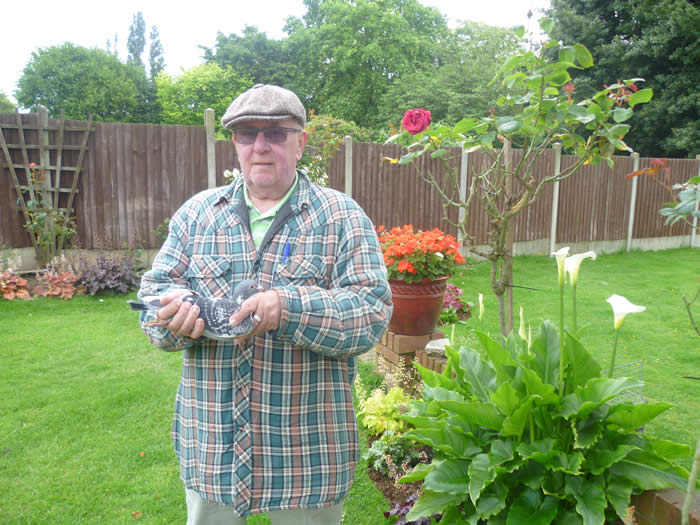
George Chaplin and family, winners of Section Three.
There is no disguising George’s pride in this family involvement.
“It is very much a family sport for us,” he said. “It is lovely to have everyone involved.”
George is a big believer in feeding beans, wheat, red maize and barley, plus the addition of seed.
He puts garlic in the drinking water, and iodine in the bath. “I still use all the old remedies,” he said. “To combat young bird sickness I make some charcoal into powder, and put it on the corn with a little olive oil. I also have a pot of charcoal in the loft. It is surprising how much they eat.
George keeps 20 pairs of racers and breeds about 30 youngsters. He does not keep any stock birds. “All my pigeons fly out. I don’t like keeping prisoners,” he said. Unfortunately, like so many other fanciers, he suffers from hawk problems on occasions.
The birds are cleaned out every day, even on Christmas Day, and the drinkers are washed out every day.
“I have not changed my routine since the day I started,” added George.
A lot of advice, and birds to start in the sport, came in the early days from a fancier called Reg Farnsworth. There were no pedigrees with the birds, but they were Savage Barkers. George was advised that the basket was the best pedigree.
It was from the survivors of these gift birds that the loft’s foundation was built.
ETS is not used, but stall traps have been installed to make timing easier.
Another thing George has done is spread the message about pigeon racing among schoolchildren. Grandson Finn did a school project on how pigeons won medals for carrying vital messages home, against all the odds, during the last war and, so impressed the teacher that his Grandad was invited into the school to talk about pigeon racing, and that invitation has been extended for four years now. “The seven and eight year olds are really interested,” said George.
Hopefully a few seeds may have been sown in the minds of these children.
First 20 in Section Three were: 1 (47th open) G Chaplin and Sons, Leicester 1262; 2 and 3 (57 and 59) R Waller, Peterborough 1250 and 1249; 4 (84) Mr and Mrs T Woolsey, Spalding 1232; 5 (97) D Parker and Son, Grantham 1227.9232; 6 (100) Mr and Mrs R Rout, Spalding 1227.3998; 7 (101) R Waller 1227.2376; 8 (104) Mr and Mrs T Woolsey 1225.5863; 9 (105) Mr and Mrs P Shaw, Ruddington 1225.5620; 10 (110) Mr and Mrs R Rout 1222.7398; 11 (112) Mr And Mrs T Woolsey 1222.4091; 12 (130) AF Parkinson, Spalding 1214; 13 (141) M Moore and Son, Leicester 1210; 14 and 15 (143 and 145) Mr and Mrs P Shaw 1208 and 1207; 16 (153) J Bellerby, Spalding 1203; 17 (161) M Moore and Son 1202; 18 (177) Mr and Mrs L Gilbert, Grantham 1194; 19 (197) Mr and Mrs T Woolsey 1187; 20 (198) W Lawrance and Son, Bourne 1186.
Section Four JW Lensen, Holbeach
If it is not one, it is the other; or sometimes it is both of them. I am talking about Holbeach fanciers, John Lensen and Terry Winterton, two top NRCC competitors who pretty well always feature prominently in the results.
They started keeping pigeons as boys, and as neighbours, sharing a clock; they played football together, and sometimes against each other, as semi-professionals; and they have watched soccer matches together over the years. The friendship and rivalry has continued in pigeon racing for more than half a century.
This time it was John’s turn to hit the jackpot in the young bird national when he took the first two places in Section Four, never an easy thing to do when the ace flyers from Norwich are among your rivals.
It was, however, on this occasion, a day for Holbeach fanciers. While Terry was not taking part on this occasion, Mr and Mrs John Dixon, easing their way back into north road racing, after a spell competing from the other direction, took third, fourth and fifth positions.
John Lensen’s two pigeons came together and it was a blue white flighted cock bird which was timed just before a chequer hen. Both were of his established Soontjen x Van Loon family.
Completing a good race, the Lensen loft also took 9th and 13th positions in the section.
John bucked the trend of what is normal for many in young bird racing. For a start, his first two timers were not early bred. They were hatched as third rounders about mid-April. They were not flown on the darkness system, but were raced natural and to the perch. And they did not race the whole programme, making a late start after the loft had suffered from young bird sickness.

John Lensen, who took the first two places in Section Four.
But here is a fancier who obviously knows a thing or two about young bird racing because he has usually done well in this race, including winning the section from the Dunbar young bird national in 2012. (Mr Winterton won the section from Berwick last year).
John got into the swing of young bird racing after treating his young birds in 2014 for the dreaded sickness with a remedy advocated by Paul Newbold and, once recovered, the illness obviously had no lasting effect on performance.
He rated himself “satisfied” with his young bird season, and he also reckoned he had a “reasonable” old bird season which included topping the Peterborough and District Federation from Berwick. So he could say he had particularly good results from Berwick in 2014.
After few losses, John found himself overstocked, and with pigeons that were too good to dispose of. His birds have done well for other people, and attracted keen attention when he advertised the surplus. The sale has brought numbers down to reasonable levels, but he could, perhaps, still be persuaded to sell one or two more hens.
The Soontjens have served John well for many years. He obtained the base pigeons from Brian Clayburn in the early 1990s, and has supplemented these with good pigeons from Ray Forbes. The Van Loons come from his good friend Dave Maddison, from Hartlepool, with whom he exchanges pigeons each year.
He has found that these cross well with the Soontjens.
He first had pigeons when he was 13 or 14, and was at school when he started racing, at the same time as Terry Winterton. “We lived on a council estate and his garden ran up to my garden, recalled John.
“Our lofts were actually about 20 yards apart, and we shared a clock for a start. Now he is a couple of miles across the fields from me. I get something like two miles overfly on him.”
John has been incredibly consistent for many years now in club, Federation, and the NRCC, and is a loyal north road competitor.
Alongside his pigeon racing, and a keen interest in sport in general (particularly football), he also occupies himself by still growing flowers for sale alongside his daughter. This was, before retirement, his full-time occupation.
First 20 in Section Four were: 1 and 2 (23rd and 24th open) JW Lensen, Holbeach 1277.7937 and 1277.6557; 3, 4 and 5 (36, 40 and 70) Mr and Mrs J Dixon, Holbeach 1269, 1266 and 1243; 6 (95) FC Skoulding and Son, March 1229; 7 (99) Mr and Mrs O King and Sons, Norwich 1227; 8 (100) Mr and Mrs R Piggin, Norwich 1225; 9 (109) JW Lensen 1223; 10 (111) FC Skoulding and Son 1222; 11 (114) D Fox, Norwich 1219; 12 (118) FC Skoulding 1218; 13 (132) JW Lensen 1214; 14 (134) Mr and Mrs R Piggin 1213; 15 (137) Mr and Mrs J Dixon 1212; 16 (155) DJA Robinson and CA Gosling, Norwich 1203; 17 (157) Mr and Mrs O King and Sons 1202.9447; 18, 19 and 20 (162, 163 and 164) Mr and Mrs J Dixon 1202.2462, 1202.1841 and 1201.
Section Five Miss M Judd, Ramsey
The only timing in Section Five was to the loft of Miss M Judd, of Ramsey, alias Garry Wilkes, and the velocity of 1097 earned 412th place in the open result.
Section Six K and D Batch, Norwich
This is what I wrote three years ago: “Kevin Batch, of Norwich, had a dream day on May 21st 2011. Perhaps a once-in-a-lifetime day, when he won three separate races, including 1st Section Six from Dunbar with the NRCC.
“The K and D Batch partnership climaxed an outstanding start to the season with these three impressive performances 1st Section Six from Dunbar with the NRCC; 1st Essex and Suffolk Border Federation from Scotch Corner; and 1st Norwich and Norfolk club from Sleaford.
Perhaps his biggest achievement was putting the rubbers in the right clock, something which had worried him a little, but liberation times and distances turned out to be helpful in this respect.” (This is not a worry nowadays because he is on ETS).
Success has been pretty constant since then, but there was another memorable day on September 13th 2014 when this father and daughter partnership (although 18-year-old daughter Demi’s contribution nowadays is support from a distance rather than hands on) took the first two places in Section Six of the NRCC young bird race from Berwick.
The two birds, both dark chequer hens, came together after a flight of 256 miles, and the loft’s entry of five all came on the day.
This was the iceing on the cake of another good season which brought 11 wins and the position of second highest prizewinner in the club.
Fifty-two-year-old plasterer. Kevin is not averse to bringing in new pigeons to add to breeds like Bert Camphuis, Van Loon Janssens and Kees Bosua which have been with him for some time.
The section winner this time is down from De Meyer pigeons obtained via Simon Snooks, the successful Grimsby fancier who is famous for his stock hen Julie, which has produced countless winners.
The second bird stems from the German Drahper strain.
A good investment at the 2014 Blackpool show, says Kevin, was an aviary which proved to be an asset for the young birds which were flown on the darkness system.
He enjoys competing with the NRCC, and says that there is excellent competition in his Norwich and Norfolk club.
He says his birds seem to have young bird sickness every year, and he lost eight young birds in the first race, but they recovered to produce good results in later races.
Hawks, with the pesky peregrines on Norwich Cathedral, are a threat to all lofts in the area.
Although the first race he ever won was from Lerwick, Kevin does not like long distance racing. He says that he is too impatient to suffer the long wait, and prefers the shorter races.
He works hard at his pigeon racing, getting up early to take the birds on 40-mile tosses to Kings Lynn in time for 6-15am liberations before a hard day’s work at plastering.
He likes to clean out every day, sometimes twice a day, and usually pairs up on Boxing Day.
One of the luckiest breaks in pigeon racing, he says, was to meet Frank Dixon, of Wallasey, not only obtaining good pigeons from him, but also endless good advice.
Kevin repeated the sentiments he expressed in that interview three years ago when he said: “He is a brilliant help. I could not fly a kite on a windy day without him. He is one of the best people in pigeon racing. I always run things past him, and he is full of sound advice.
“I bought some Bert Camphuis pigeons off him a few years ago, went to see him on The Wirral, and we have stayed friends ever since. Two heads are always better than one, and that is perhaps where partnerships have an advantage. If I have an idea, or a problem, he always has an answer. I would like to say a big thank you to Frank.”
First 20 in Section Six were: 1 and 2 (68th and 69th open) K and D Batch 1244.2698 (2); 3 (72) A Woods, Norwich 1243; 4 and 5 B Mower, Cambridge 1237 and 1230; 6 (127) G Hicks, Chatteris 1215; 7 (135) Moore and Ransome, Chatteris 1213; 8 and 9 (139 and 142) A and T Wright, Poringland 1211 and 1209; 10 (146) W and HE Attlesey, Ely 1206.8455; 11 (148) A Woods 1206.4598; 12 (151) A and T Wright 1205; 13 (165) B Mower 1201.7677; 14 (166) W and HE Attlesey 1201.7415; 15 (173) Moore and Ransome 1197; 16 and 17 (175 and 185) A and T Wright 1195 and 1192; 18 (192) Mr and Mrs D Adams, Eye 1189; 19 (185) A and T Wright 1185; 20 (207) A Woods 1184.
Section Seven F Dawkins and Son, London
There were eight timings in Section Seven and these were: 1 (196th open) F Dawkins and Son, London 1187; 2 (217) S White Bros, Walthamstow 1179; 3 and 4 (309 and 323) A Stockwell and Son, London 1147and 1142; 5 (394) S White Bros 1108; 6 (419) T Green, Dagenham 1094; 7 (468) K Surrey, Dagenham 1070; 8 (484) F Dawkins and Son 1059.
Father and son partnership, Fred and Keith Dawkins, won the section in this race for the third successive year and, among their other outstanding NRCC performances, they are famous for taking the first three section positions from Perth in 2013, when they also went on to win the section from Thurso.
Year in and year out, they are top of the tree.
The 2014 young bird section winner was a chequer pied hen of their old Alf Baker Stassart family which has served them so well over many years.
It was one of a team of six sent by the Dawkins loft (they lost one) on a day when they had to split their team because they were also competing in the London North Road Combine. Keith said he fancied two of the six but the section winner was not one of the two because she had not shown herself to be anything special up to that point.
But a win from 304 miles as a young bird now makes her a bit special and they will be interested to see how she develops as a yearling and old bird. Keith says that not all their birds show their prowess as youngsters and some develop as they get a bit older. They always like to give their young birds every opportunity to flourish and they are not condemned for a mistake.
The fact that they have to split their team on days when NRCC and London North Road Combine dates clash has led to Fred and Keith showing interest in the possibility that the two organisations may get together to transport birds for some races in 2015. They are very much in favour of the idea, and think it would be a boost to both organisations.
This latest section winner had raced the whole programme and was, in fact, bred for success, for her father is a past winner, and her grandfather won over 100 cards, racing right through until he was eight years old, and her mother is a previous winner.
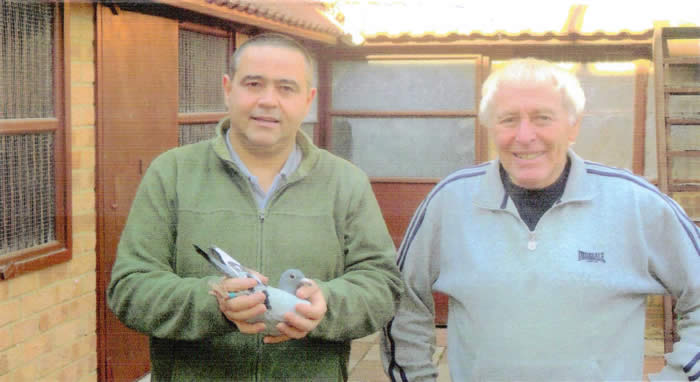
Fred and Keith Dawkins, winners of Section Seven.
This outstanding London loft competing against many other fanciers who have achieved awe-inspiring results has had another fine season, topping the East London Federation three times with the young birds, and winning the coveted Tommy Long Trophy in old bird racing for the first time.
This trophy, which every London long distance fancier dreams of winning, is for the best average over the three longest races.
The Dawkins have been close to winning it in the past, having been runners-up three or four times. In fact Keith says that they have had better results when finishing second than they had when winning it in 2014.
In club racing they topped the Plaistow club 15 times in the past season, and lost only about four birds.
Typically they fly about 30 cocks and 30 hens on roundabout but, when we spoke, Keith said they had 35 cocks and 42 hens which had survived racing.
While Keith is the spokesman for the partnership, and is well versed in all details of their birds, he says that his dad, although he will be 80 in March, still does a lot of work around he lofts, and does all the training, getting out most days in the season.
During racing they feed Versele Laga Super Star, adding maize and tic beans and seeds. They feed mainly tic beans until two weeks before pairing up.
Keith says that they seem to get young bird sickness most years when they starve the youngsters for 48 hours before treating them with De Weerdt’s Four in One, which seems to work.
“You have to work hard with your pigeons here,” said Keith. “There is a lot of good competition. They are all good flyers who compete with the NRCC, and those Cheshunt boys keep you on your toes.”
There is history in the Dawkes lofts illustrious history for they can trace the origins of many of their successful birds back to pigeons that came from the lofts of, perhaps, the greatest London maestro of them all, the long-departed, but never forgotten, Alf Baker.
He would be proud to think they were still performing at the highest level, and that is a tribute to the fanciership of Keith and Fred over many years.
“They go back to the old Alf Baker Stassarts but, of course, we have put crosses into them, said Keith.
“We do enjoy the NRCC racing very much. I enjoy all the longer races, but they seem to look after the birds in the NRCC. They always seem to come back looking well.”
Section Eight A Pountney, Romford
Section Eight is another of the long-flying sections and the 15 birds timed were: 1 (174th open) A Pountney, Romford 1197; 2 (212) CI Salmon, Woodbridge 1182; 3 (226) J and T Ivatt, Ipswich 1177; 4 (264) R Tate, Fobbing 1161; 5 (307) K Chenery, Felixstowe 1147; 6 and 7 (391 and 413) T Gunn, Romford 1111 and 1097; 8 (421) Miss R Bacon, Rochford 1093; 9 (500) R Olive, Wickford 1046; 10 (527) KR Chenery 1009; 11 (593) Mr and Mrs R and P Smith, Laindon 854; 12 and 13 J and T Ivatt 841 and 811; 14 (598) F White, Laindon 803; 15 (601) Mr and Mrs R and P Smith 801.
They could call Arthur Pountney the Comeback Kid, so often has he bounced back from disasters that have befallen his loft.
Foxes, rats, and even the terrier dogs he acquired to combat the rat problem, have wreaked murder and mayhem among his birds at various times but, just like a boomerang, he has bounced back, and winning Section Eight in the NRCC young bird race from Berwick was a just reward for his resilience.
In fact, he could have taken second section as well because another bird arrived home in time to achieve this position, but decided to sit the night out on the house perhaps a result of some of the problems Arthur has encountered. These set-backs include foxes forcing their way into his loft and killing lots of pigeons, and then rats killing another 60 birds. He acquired a couple of Jack Russell terriers to try to cure the rat problem but they, too, got into the loft and killed a whole young bird team.
The section winner was a chequer hen which had flown the young bird programme, and is of Leo Van Rijn breeding.
“This performance did please me a lot,” said Arthur. “It was a hard race, and the wind turned to the south-east, and she came on her own. It was a seven and half hours flight a good performance.
“I sent ten hens to this race and got seven out of the ten. I had another on the night, but it sat on the roof all night.”
Arthur says that he was the first London fancier of the recent era to join the NRCC and has previously been a winner in Section Seven, but his move to Romford meant that he also had to move into Section Eight, where he is the most westerly flyer.
“That makes it a hard section to win,” reflected Arthur.
Arthur is 69 and works nights as a taxi driver, something which makes it difficult to tend to the pigeons as he would ideally wish.
“I come last in my club every week because I am off the line of flight,” he said.
But he has bred Combine winners for other fanciers.
He is philosophical about the setbacks he has endured. “I don’t give in,” he said. “When you have had pigeons for so much of your life, what do you do? You have to fight on and that is just what I do.”
He believes that he has some really nice pigeons now, having invested in birds from ace fancier Ken Darlington’s on-line clearance sale.
The 2014 youngsters were the first off these that he has raced, and one of them was the Section Eight winner, and now he has 40 yearlings, all of which have been raced. Because of this, Arthur is hopeful of more success in the future.
Footnote:
It has been a great pleasure to talk to successful NRCC fanciers for the 13th successive season. This famous old club is blessed with many talented, dedicated fanciers, and I thank them for the time, courtesy, patience and good humour they have shown to enable reports to be compiled.
One of the fanciers I enjoyed talking to during 2014 was Mick Wlson, of Brinsley, winner of Section One from the Arbroath old birds race, but it transpires that I misunderstood him to say that he had missed the arrival of this bird. That, according to my wife, is one of the things I do best misunderstand people. Or is it just her? Anyway, Mick is much more gentle in pointing out my error as he writes:
“Hi George, nice to see your reports about section winners. I look forward to reading anything highlighting north road racing. If you do another report on the Arbroath race, I would like to just amend something to my story, if you don’t mind. I was here to clock him and several others in. It was then that I shot off to the supermarket to do some shopping when my mobile started going off from fanciers congratulating me. I never looked at the NRCC provisional results before I went shopping. Hey ho!!!!
“The red pied cock in question was also 4th section 44th open Perth 2011, 3754 birds in a west wind, the first bird over this side given the wind.
“My best other results in the short time I have been in the NRCC were 11th and 12th open Thurso, 8th and 9th section, 2069 birds in 2011.
“Also.... I had a decent result in the young bird Berwick race. I only sent 9 and was 4th section 21st open...with a red hen (not related to red pied cock), 4th section, 13th open old hens, and sent five to Lerwick and had all five back by the next day and was 18th section, 132 open.
“I have just purchased a nice hen, to pair to the red pied cock, from a one loft race. The sire of this hen won 1st open NRCC Dunbar and grandsire was 1st open NRCC Lerwick, and, on the dam’s side, the hen was 2nd open NRCC Lerwick.
“So, like I said to you, I like to go for good north road pigeons that are proven!!! Looking forward so much to next year.”
---