Lerwick sections 2019
By George Wheatman
Sometimes it is easy to put into words what pigeon racing and performances mean to a fancier; and sometimes it is difficult. In the case of 72-year ex-miner Derek Nuttall it is both.
Easy because his successes at club, federation and with the North Road Championship Club tell us that he is a top man in the sport. Difficult, however, to transmit his deep connection and explain how pigeons are such a vital part of his very being. His heart and soul is in the pigeon loft. Only those who share his passion for the sport will know why he could not sleep the night after the North Road Championship Club’s 2019 Blue Riband race from Lerwick when the partnership’s birds were first and second Section A and third and fourth open.
Just as it has been with many former miners who spent their working hours in the dark, dangerous, dust-filled bowels of the earth, pigeon racing was an escape into the sunlight. It was in their DNA.
An extra delight for Derek is that his son Ryan now shares the enjoyment, although it took him a long time to realise the sport’s fascination.
“Ryan is a massive part of the partnership,” says his dad, obviously delighted by the fact. “He does all the feeding and the training.”
The Nuttalls have earned many admiring glances for their performances into the Nottinghamshire colliery village of Newstead over the years, and they have been so close to the big breakthrough on a number of occasions, and are always a name to look for on the results. They have been second open three times in two years.
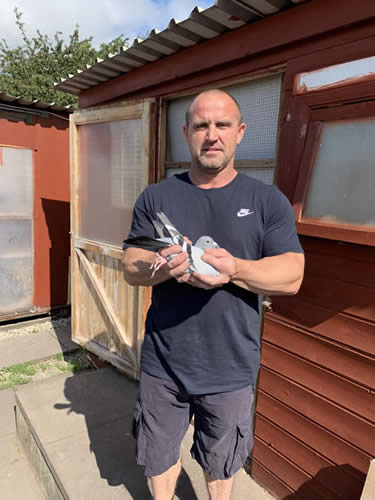
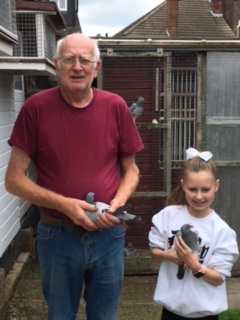
Ryan Nuttall of the Nutall and Son partnership, winners of Section A.
This year alone, before the Lerwick race, they had been second section Dunbar, behind fellow club member and open winner Roger Hallsworth, fourth section Perth, and second section, second open Fraserburgh.
They sent five birds to Lerwick, in a race sponsored by Unikon, and had them all home on the day, the first two dropping together after 496 miles. First across the line was a three-year-old blue white-flight hen bred from a cock bought from the Rick Hermans sale at Blackpool, and a hen from Dean Skues’ Delbars.
Second timer was of Wayne Doonan lines.
All five Lerwick entries had flown the early part of the season on roundabout, but were paired in preparation for the big race and sent sitting 12 to 14 days.
They have had a good season in club racing and, with an eye on the future, Derek is particularly pleased with the form of their yearlings.
Lerwick, however, is the favourite race and the five day birds this time round are already earmarked for a return next year.
Derek has always been loyal to north road racing and, after chatting with such a dedicated fancier, one is left with the feeling that people like him is what pigeon racing is all about and the NRCC, in particular, is made for him and he for the NRCC.
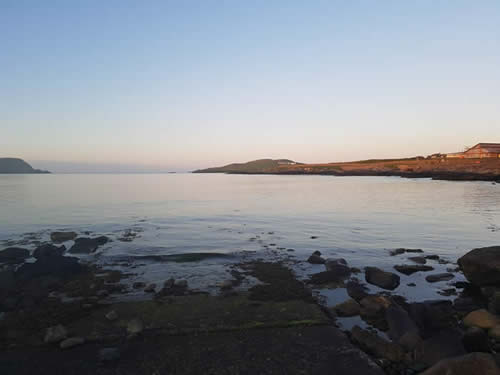
What the convoyer saw . . . view of Lerwick before the liberation.
SECTION B
Section B winner, and open runner-up, John Norris is an ardent football fan (Tottenham Hotspur is the team he follows) and he made his substitutions before the big match, Lerwick in this case.
Like any good soccer manager, he consulted an expert on the opposition before making wholesale changes to his selected team. The problem, as John saw it, was the weather and he wanted the best forecast he could source.
Luckily the advice he needed was on hand from club member, meteorologist John Scott who works for the Met Office at a Lincolnshire air base and has all the detailed information at hand.
John (Norris, that is) whose only race with the NRCC these days is from Lerwick, had set up nine hens and six cocks for the anticipated, usual tough 500 miler, only to be informed that the likelihood was a wind-assisted fast race.

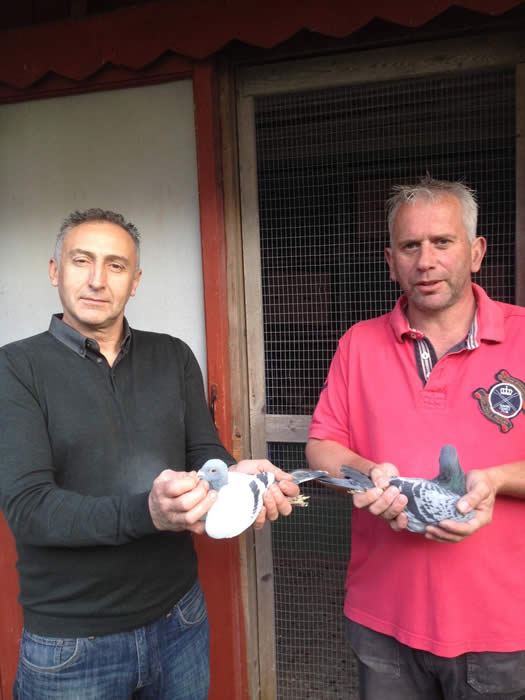
John Norris Section B winner.
In the face of this advice, he dropped six of the hens and replaced them with cock birds, making his team 12 cocks and three hens. There have been no reports of petulant transfer requests after these late changes!
It was not going to be the day, John decided, for the Jan Aarden-Van Loon crosses prepared for the race.
He obviously made the right choice when a two-year-old blue cock bird came scorching home to his Grantham loft to take advantage of the predicted north-north-west wind to win the section and take second open.
It is a Hermans Ceuster, one of 12 bred by former Lincolnshire ace fancier John Dixon which have proved to be a good investment, and was sent sitting 15 days. “It was screaming at
me, telling me it was right to send,” said John, who was delighted to have his complete team home on the day. “It was a case of horses for courses, and it was his day.”
It is a previous winner, and highly rated. Even more so now.
John has accumulated a team of Premier League pigeons, never afraid to enter the transfer market, and, before the Lerwick race, had won 10 of 12 club races, being second in the other two.
Having won the King’s Cup back in 1995, sixty-six-year-old John has a burning desire to experience that feeling again, and he is regularly knocking at the door.
SECTION C
This year’s Lerwick race was won in the sixth fastest time in the North Road Championship Club’s 118-year history, and the coveted King’s Cup will be in the possession of Louth fanciers Richard Mamwell and grandson Tom for the next 12 months, the Section C winners.
It is their second open win with the NRCC this season, having finished top of the result from Perth earlier in the year, and it makes a total of four open wins, plus many section successes, for 67-year-old Richard, a good worker for the sport and one of the most likeable members.
Richard had always claimed that he was not a distance fancier, maintaining that their birds competed better over the short to middle distances, and says that both he and Tom were amazed to win, but absolutely delighted.
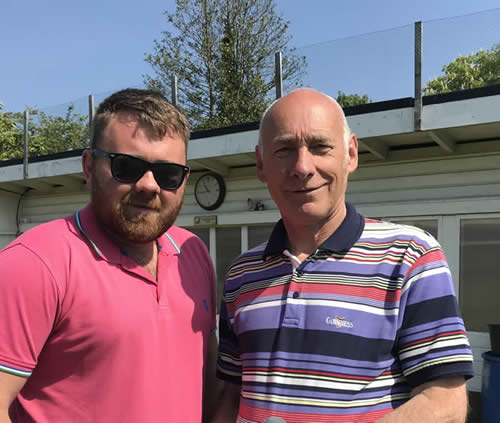
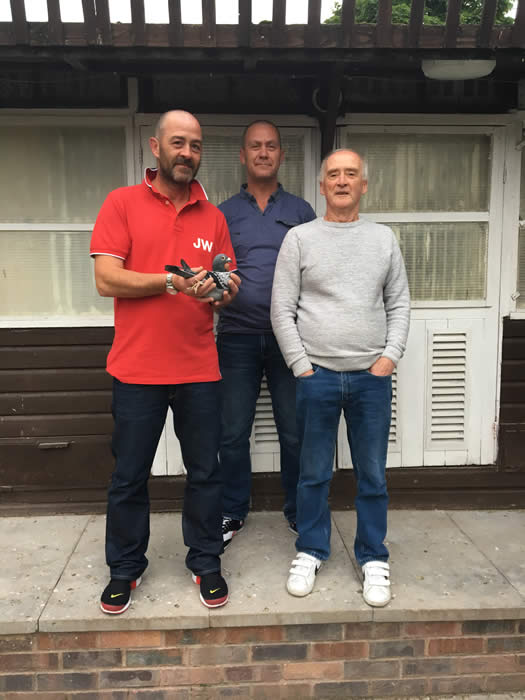
Open winners and winners of Section C, Richard and Tom Mamwell.
“I know that we are short flyers, but this was a very good pigeon because none of the other short flyers in Lincolnshire were near him, and other leading pigeons were in a variety of sections. He must have come on his own down the coast a cracking pigeon.”
The winner is a three-year-old blue chequer celibate cock bird, which has always been a consistent performer and was the one of their entry of six which Richard most fancied.
SECTION E
Is it a record? It must be, surely, 35 birds clocked on the day from Lerwick.
That was the feat of father and son partnership, Graham and Michael Britton, from Newborough, Peterborough, and winners of Section E to add to many previous excellent results with the NRCC.
Here Michael describes their extraordinary day of fantasy flying from the iconic race point:
“It proved to be a fast race and one that many thought was going to be faster even than it turned out to be. However, shorter races that were being flown on the day indicated that it could be slower than earlier predicted 70mph.....however at 60 mph and spot on our predicted ETA, a pigeon hit the loft roof!
“The pigeon that is this year’s 1st Section E winner and 6th open NRCC Lerwick is a two-year-old blue chequer hen bred by NRCC winning fancier Terry Winterton off his 2nd Open NRCC Lerwick Lady Margaret lines. It hadn't done anything of note (as is often the case) before this!
“The second pigeon home and 2nd Section E, 16th Open is a three-year-old dark chequer hen which was also our fourth bird home in last year’s hard King's Cup race recording a velocity of 1073 ypm and being 7th Section E, 30th open.
“She is also a full sister to our 2017 1st Section E, 5th open NRCC Thurso 431 miles, 1149p. Thus it is bred off a son of the late Ray Farrington's Kings Cup winner that Ray very kindly gifted to me on the condition we made a donation to his favourite charity. I have to say that Ray was a true gentleman and a real credit to the sport and we are indebted to his and his wife's generosity.
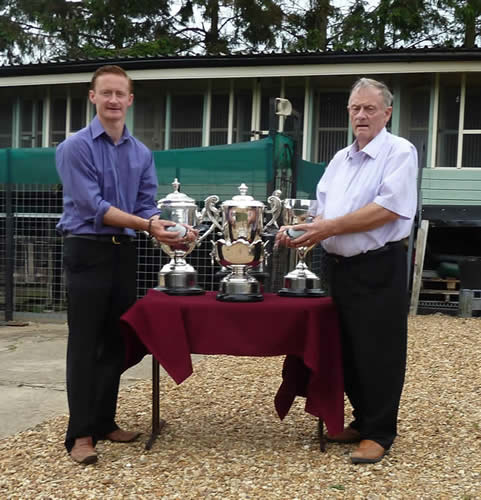
Section E winners, Graham and Michael Britton with a haul of trophies won last year.
“Its mother came from the MNFC Bordeaux winning fancier Barry Thirtle when he packed up racing on his own and, in turn, is down from the NRCC winning Perry Brothers pigeons that were so successful for him and many others.
“We had a good race overall, clocking in 35 pigeons in total (fingers crossed for a couple more of the coveted Lerwick Diplomas of Merit and the lovely Peter Bennett Diploma Plates!) and, on Sunday afternoon after the race, we were just the one missing out of our team of 40.
“Our congratulations to Richard Mamwell and Grandson Tom on winning this years King's Cup. They have certainly flown a very good pigeon this year!
“Also our thanks must go to ex- fancier David Shirley (who had the distinction of being 2nd Section E, 19th Open NRCC Lerwick when PG Wright was famously 1st Section E and runner up for the King's Cup in 1980) for helping me to get our birds to the marking station as, unfortunately, my mother has been unwell so Dad was unable to travel and take this year's birds.
“We may yet send to Thurso depending on personal circumstances over the next two weeks. However if it is not to be, then we wish all fanciers well for the last NRCC old bird race of the year.”
*Another big supporter of the NRCC, and past winner of the King’s Cup from Lerwick, Ivan Rich had 30 birds on the results, competing in Section F. More incredible flying.
SECTION F
Steve, better known as Spud, Rudledge, of Norwich, waved goodbye to Lerwick and, indeed, pigeon racing in general, by winning Section F. He plans to retire from the sport at the end of the season.
“Lerwick is the only race I had never won in the club, so to have two birds on the day, win the section and my two clubs, it was a very satisfactory day,” he said. “I started in 2009, am now 70 and have arthritis which makes it difficult to look after the pigeons so I have decided to call it a day. I have thoroughly enjoyed it but I have bought a cruiser and will spend some time on the Broads.
“I have had boats all my life and done sea fishing off Lowestoft, but now I can spend my leisure time on the Broads.”
Spud’s section winner was also seventh open.
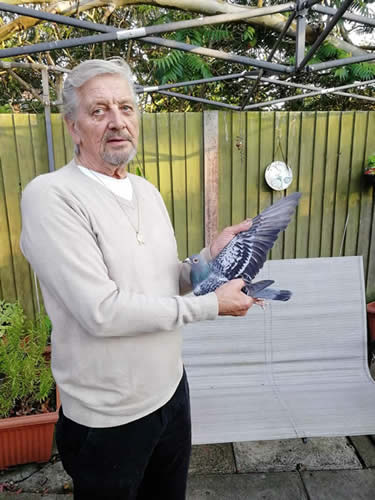
Steve (Spud) Rudledge winner of Section F in his final Lerwick race.
It is a two-year-old chequer hen flying on the natural system and sent about to hatch. Its parents are from Mr and Mrs Russ Skinner of Boston, Van de Rhee x Napper. Spud bought one of their pigeons at a breeder-buyer sale and asked to buy another to make up a pair, but Russ, with typical generosity, made a gift of a second bird. A happy outcome for all concerned.
He sent 12 to the Lerwick race, had two on the day, six more before 7am on the second day, the best of these being at 5-40am. Eventually he had 10 out of 12.
The Rudledge name has featured regularly and prominently in NRCC results over the years, and he has been a competitive member of the Mile Cross and Norwich and Norfolk clubs.
His departure from the sport will leave a vacancy to fill at the Mile Cross club where he has been secretary.
Spud, a retired asbestos stripper, says he will probably have a sale at the end of the young bird season. “I think I have a few decent birds,” he said.
SECTION H
There is always close scrutiny of the result to see who has the first bird into the London area. This year the honour has gone, not for the first time, to John Hore, of Hoddesden, who wins Section H with a three-year-old dark chequer hen bred down, on one side of the pedigree, from pigeons John acquired from the legendary Ken Hine when he started in the sport ten years ago.
The other major influence in the breeding were pigeons from a famous name in the sport, Peter Hagland, whose many successes in national racing on the south road include seeing two hen birds arrive together at his Doncaster loft from a 530-mile National Flying Club race from Saintes, taking 1st and 2nd Section K and 2nd and 3rd open. That is just a sample of this man’s ability.
John met him for the very first time at the Blackpool show in 2012 and, on that very first meeting, amazingly Peter offered to breed him two grizzles from his star-studded loft.
It was these gift birds that also played a major role in producing the Lerwick section winner. This, of course, says a great deal for the sportsmanship and generosity of Mr Hagland, for which John is immensely grateful, but also emphasises that often you do not have to pay big money for good pigeons.
It had not been raced heavily, and the furthest it had been previously was to Berwick. It was sent sitting 11 days.
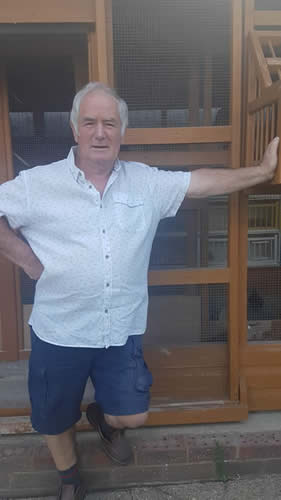
John Hore, best of the London area timers as winner of Section H.
Flying 581 miles, John had five on the night, two early next morning, plus one more from his entry of 12.
“I have not had a fantastic season,” he said. “I have always got the birds but usually a bit behind, so I was well pleased with this performance.”
John has tried widowhood and roundabout racing but did not find it as easy as some people claimed, so he reverted to the natural system this year and found that both he and the pigeons enjoyed it more.
He did step up the training in the build-up to Lerwick, and felt the birds were in good condition, both when they departed and when they returned home.
A member of the Cheshunt club, John has won the NRCC section from both Lerwick and Fraserburgh in the past, and distance racing is where he has excelled.
Born in Wexford, in south-east Ireland, he had pigeons as a teenager, but then had a long break when he moved to London in 1968. Working as an accountant, much of his spare time was taken up by his involvement with the Scout movement for 50 years, being a Leader for most of that time.
It was only when retirement loomed that his thoughts turned again to pigeon racing. In 2009 he bought himself a loft “off the peg”, and went to see that master of the sport, Ken Hine.
It was also at Blackpool, when he had that fortuitous meeting with Peter Hagland, that he picked up a Versele-Laga booklet, and he has used this ever since as a guide to treatment and feeding.
SECTION I
Section I, in the land of the longest flyers, was won by a young man whose reputation as an astute distance fancier, seems to get better every year Ross Olive, of Wickford, in Essex.
His section winner was a two-year-old which recorded a velocity of 1563ypm over a distance of 593 miles. There was a total of six of Ross’s pigeons on the final result, another fine team performance.
Unfortunately I have been unable to speak to him about this excellent achievement
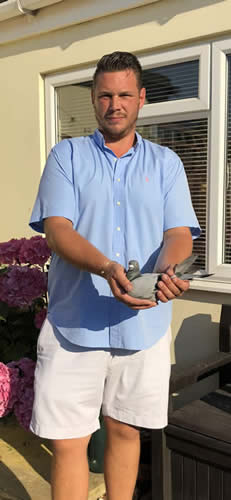
Longest flying section winner, Ross Olive, of Section I.
This, however, is not his first section win from Lerwick. He followed his father into pigeon racing and still uses his father’s old loft, and many of his pigeons are descended from those he inherited from his dad.
Bloodlines include those of Venner of Street, Mitchelson and Eric Cannon.
Ross has revealed in the past that he is patient with his birds and, following the pattern of many long distance aces, allows them time to develop. This is shown by the treatment of the young birds who are trained well but given only one or two races.
Ross Olive’s wait for his Section I winner from Lerwick was a little longer than that for Ray Luffman, but it was more leisurely. He was on a family holiday in Spain!
Like many of the young family men who are fanciers, he has to juggle the needs of family with his desire to perform at the highest level in pigeon racing, and he reasoned that his work was finished when the birds were despatched to Lerwick after the best preparation he could give them.
Luckily, and this is something he very much appreciates, he was able to rely on his brother Neil, a non-fancier, to endure the long wait that is inevitably part of distance racing and look after the birds. Modern day communications ensured that they were able to keep in close contact.
Ross’s home in Wickford, Essex, is 30 miles east of London, and 593 miles from Lerwick according to official measurement. So here we have another 600-mile pigeon being timed at shortly after 5am on the second day to record a velocity of 1034ypm and finish 46th open as well as win a section occupied by some of the best distance flyers in the NRCC. Another great performance.
The section win is not the end of it, for Ross had seven birds on the result, finishing 1, 2, 3, 5, 8, 9 and 13 section; 46, 70, 84, 92, 111, 114 and 216 open.
No doubt the good news helped Ross enjoy the rest of the holiday with his young children.
Explained Ross: “I reasoned that the important time for me to be working with the pigeons was in the build-up to the Lerwick race. Once the birds were in the basket I could do no more to help them but, thanks to Neil, I could enjoy a holiday with the family and it is important to keep them happy. So I had a good race and a good holiday.”
The section winner was a five-year-old blue hen, small to medium, sent sitting 12 days. She had never won anything before but was always consistent, and certainly a tryer, said Ross.
His brother witnessed the arrival of other second day pigeons to give the loft a very satisfying 2018 Lerwick.
An out and out distance man, just like his dad, Ross would love to test his birds even beyond Lerwick, and would be a keen supporter of a race from Saxa Vord should the NRCC ever decide to venture there again.
In preparation for the latest Shetland Isles test, the Section I winner had races from Wetherby, Ripon and Dunbar, and a lot of 25 to 30-mile training tosses, in addition to morning and evening exercise around the loft. But, with the weather being so hot, she did not do much at all during the week before basketing.
The birds were fed a high fat mixture, supplemented by peanuts and small seeds.
When re-united with the section winner after his holiday, he said that she looked a picture, which was testimony to the way the birds had been looked after by the convoying team.
Ross sent 10 birds to Lerwick, and had seven of them in race time.
Now 32, he is a plasterer by trade but works as a general tradesman on property maintenance. He is the only one of a large family who followed his father into pigeon racing.
He still uses his father’s old loft, which he reckons is about 50 years old and which is still situated at his mum’s house, and many of his pigeons are descended from those he inherited from his dad.
Bloodlines include those of Venner of Street, Mitchelson and Eric Cannon.
Ross is patient with his birds and, following the pattern of many long distance aces, allows them time to develop. This is shown by the treatment of the young birds who are trained well but given only one or two races.
Now and again he introduces new pigeons, mainly through exchanges, and currently has a couple from Ipswich and NRCC legend Peter Crawford which he hopes will enhance his team.