NORTH ROAD CHAMPIONSHIP CLUB
by George Wheatman
NRCC Sections 2016
By George Wheatman
Eddie Seabourne, of Norwich, and his bird Dark Diamond, will take pride of place at the North Road Championship Club’s Day of Champions on Saturday December 3rd at Springfields Exhibition Centre, Spalding. And rightly so after the impressive performance that won the club’s historic 100th race from Lerwick.
There will, however, be plaudits for a series of other outstanding performances in this race, namely the section winners.
Hardened Lerwick flyers described this Unikon-sponsored centenary King’s Cup race from the Shetland Islands as being “a typical Lerwick race.”
This means a handful of birds home on the day, early risers making it soon after dawn on the second day, and a steady flow of timings at all distances until the close of the race. It also means empty perches and highly-rated pigeons failing to return.
Here we take a look at the stars of the sections.
SECTION A
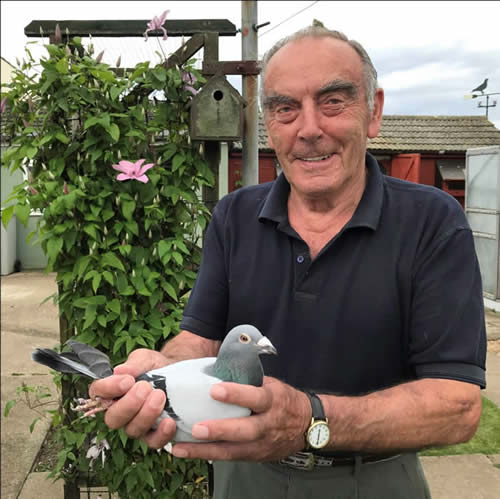
One particularly outstanding performance, especially as it was against the prevailing conditions, was to the Carlton loft of Bill Cutts. In fact, some admiring rivals have called this the performance of the race, finishing a highly praiseworthy fourth open as well as winning the section.
Bill, from a send of three, had the only bird on the day in his section, recording a velocity of 1094ypm, compared to the second section bird’s 887.
“It came right out of the east, so, in effect, was racing against the wind,” said Bill.
The bird in question is a two-year-old blue chequer hen which was second Section A in the NRCC race from Fraserburgh last year, when she was also a second day bird from Lerwick, as a yearling, returning with a damaged wing.
In her build-up to Lerwick, she had had quite a number of club races but most of these were in tail winds. Flown on roundabout, she spent the night with her cock bird before basketing.
Bill loves the distance races, and has every reason to be proud of this performance, but it is not a new experience as he did something similar last year with a bird on the day which took 2nd Section A and 4th open with another hen.
Bill (71), retired area manager for a brewery, says that he likes to keep pigeon racing as a hobby - but that does not mean, with the support of wife Lyn, he does not put a lot of effort into the sport.
Two day birds from Lerwick in successive years have rewarded that effort. It is especially praiseworthy as it is only last year that he joined the NRCC
The bird that achieved last year’s outstanding result was a two-year-old blue Soontjen hen flown on roundabout. She is a descendant of Frank Sheader’s top Soontjen lines and, according to Bill, has been a steady pigeon which has not set the world alight.
Bill is a member of the Calverton club, and has really hit the ground running in his short time with the NRCC.
Bill Cutts, winner of Section A
SECTION B
John Norris, of Grantham, a generous supporter of this year’s centenary Lerwick race, has been building a distance team that would be the envy of many fanciers. In fact, his re-building has kept pace with that of his favourite football team, Tottenham Hotspurs. I would not dare to conjecture who has been the more successful, but . . . John did take 1-2-3 Section B in this year’s Lerwick race, as well as taking 26, 27, 35, 62 and 65 open. And in 2014 he was 1st section 5th open.
Like any true Lerwick flyer, he would have loved to have won this 100th race, and he prepared a team of 15 to launch his assault on the north road’s toughest, and most unpredictable, race, but his heart sank when he discovered that it was to be flown in a west wind.
Preparations had gone well, and the birds, having flown on widowhood early in the season, were paired up for the big race, and all the hens in the team were on John’s favoured condition of chipping eggs on the day of basketing.
They had been hopper fed with Verselaga super widowhood mix before them all the time, and each had received their six peanuts a day, while drinking water laced with equine garlic.
Ominous for the opposition, but highly encouraging for John, is the fact that his first three in the section were two-year-olds, one hen and two cocks.
He clocked two at 8am on the second day, and had six in the clock by lunch time. Two of his early arrivals came within 20 seconds of each other.
Sadly, at the time we spoke (which was some time ago as I have been somewhat tardy in the face of various distractions in producing this report) his section winner of two years ago was missing, although he had been “bouncing” when despatched. This pigeon was, however, father of the brother and sister which were his first two birds this year.
John returned to membership of the NRCC only three years ago after what he described as “self-imposed exile” but had continued to enjoy himself in club racing, highly successfully too, until the lure of Lerwick proved too strong to resist.
He had, after all, tasted the heady heights of winning the King’s Cup back in 1995.
John, through his experience as a fancier, convoyer and past chairman of the NRCC, knows only too well the demands that flying Lerwick puts on a pigeon, and he knows that only the best will conquer the challenge.
During his break from NRCC racing he helped develop the Grantham North Road Club into one of which he is very proud, and where they have a £40 a week payout, and made a £600 profit on a Sunday lunch time prize distribution. “There is a wonderful atmosphere in the club,” he said.
But, with a particularly good bird in his loft telling him that he was fit and ready for the job, John could no longer resist the challenge of Lerwick in 2014, and the urge to compete well from the Shetland Islands is still very much alive.
For 45 years of his life, John, now 64, had been involved with the NRCC in one form or another, and now he is back as a strong contender for more honours.
He is not afraid to spend big money on quality pigeons, as he has often done, but getting a bargain gives him more pleasure than anything.
It has been written before that the 2014 section winner had the breeding of an aristocrat, being a grandson of the late Eddie Wright’s (of Fountainhead Stud fame) famous North Star, John buying a daughter at Eddie’s clearance sale for the bargain price of £40 because other fanciers at the sale did not appear to appreciate the value of the birds on offer.
This Janssen hen was paired to a John Gerrard Hartog to produce the 2014 section winner.
Now he has first and second section winners in 2016 which are grandchildren of that bargain buy.
John has had a difficult battle with bowel cancer in recent years but, luckily, had good friends who helped to look after his pigeons while he was fighting this dreaded disease.
Nowadays he starts the season with 19 pairs of old birds, and says his pigeons have to do as they are told. “They have got to have discipline and motivation,” he said. Their day starts with 80 minutes exercise around the loft “Forty minutes for me, and 40 for them,” he said.
After years of opposition to ETS, he was finally persuaded to accept it and now thinks it is a great forward step for the sport.
Now retired after running a successful business as a funeral director, having previously been a crematorium operator, other big loves in his life are his family (he particularly enjoys being a doting grandfather) and football, where his big passion is Tottenham Hotspur.
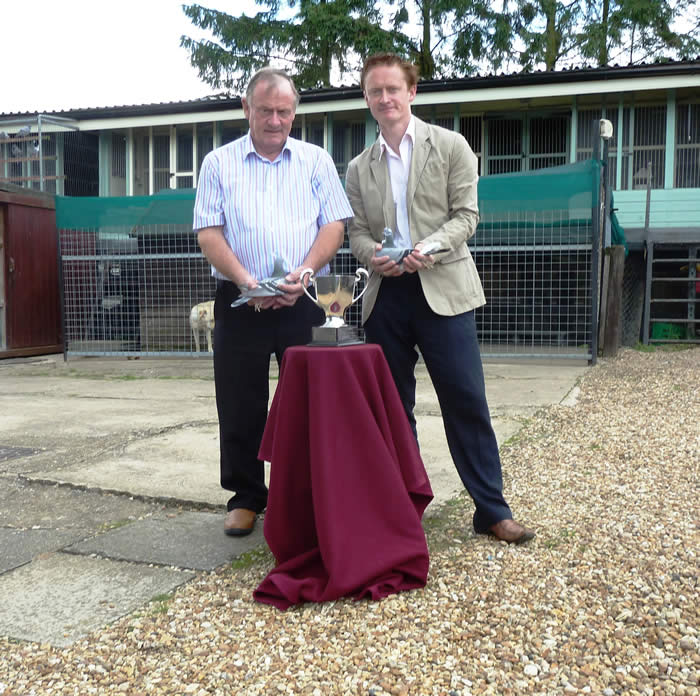
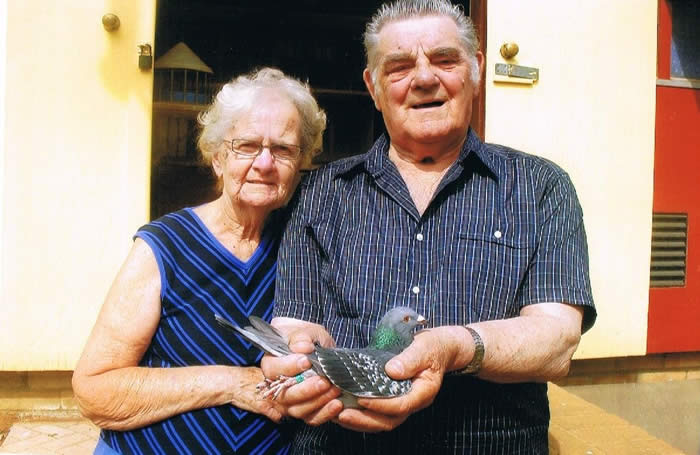
Graham and Michael Britton with their Section E winners from this year and 2015
SECTION C
One of the most respected members of the NRCC, and, indeed, the Peterborough and District Federation, is the ever-consistent Terry Winterton, of Holbeach.
His name is to be seen highly placed in most of his club’s and Federation’s weekly results, and it is always one sought out on NRCC days, particularly in the long races.
So it was from Lerwick when he won Section C and was second open this year with a hen bird that must rate as one of the best Lerwick flyers ever.
She is now named Lady Margaret, as an acknowledgement to all the support Terry receives from his wife.
A five-year-old chequer hen, this is her record from Lerwick, 512 miles:
2013 1st Section, 117th open from 877 birds.
2014 5th Section, 6th open, 1064 birds.
2015 5th Section, 27th open, 913 birds.
2016 - 1st Section, 2nd open, 802 birds.
Lerwick is her speciality. She has never won from any other race point. Her mother and grandmother were also excellent Lerwick racers, and all are confirmation of Terry’s firm belief that “Lerwick birds breed Lerwick birds.”
Starting the season on roundabout, she had about six races before being paired up and prepared for the big Shetland Islands challenge, sitting 10-12 days at basketting.
Unfortunately, Terry missed the arrival of this super pigeon as he was in hospital, having undergone an operation to relieve the agony of a blocked bowel. His wife timed the bird and she, and friends, kept Terry informed of the state of the race.
Obviously, he would have liked to have crowned an outstanding career in the sport by winning the centenary race, but he was delighted that his ace pigeon had done so well again.
Now Lady Margaret has been retired to stud in the hope that she will keep the production line of Lerwick pigeons running.
Terry sent three to the race; the second arrived on the third day, and the other is missing.
“I don’t normally send many to Lerwick,” he said, “because if you have a bad race you can decimate your team and have nothing for the following year.”
Neither does he concentrate quite so single-mindedly on Lerwick as he once did because, as he points out, if the conditions are against you and, for instance, there is a blow-home when you have prepared your birds for a hard race, your chance has gone. Now he likes to be competitive all through the season.
While on roundabout early in the season, the section winner was fed on a light mix, this was strengthened in the build-up to Lerwick, with the addition of fats through peanuts and hempseed.
The Lerwick success has rounded off another good season for Terry, who says performances have improved since retirement gave him the chance not to rush things around the loft.
This is the second time in 50-plus years of racing he has finished as runner-up in the King’s Cup, the previous occasion being in the 1970s.
Although he has enjoyed many wins since starting in the sport as a schoolboy, and has had many excellent birds in his loft, Terry has said in the past that he attributes much of his recent success to a pigeon he calls Pure Pleasure for the obvious reason that it is a pigeon that has given him a great deal of pleasure with its numerous wins (adding up to something like 26) and, now, its ability to turn out winners from the stock loft. . . the type of pigeon that many of us can only dream about.
Now Pure Pleasure has a rival in Lady Margaret, a supreme champion if ever there was one. But, while Pure Pleasure never ventured beyond Perth, Lady Margaret was in her element at the distance.
In a previous article, Terry revealed how he got into the sport of pigeon racing: “I started with pigeons when I was still at school. My loft and John Lensen’s (John is another successful NRCC member) used to be about 30 yards apart. We grew up in Gedney. We have always been good friends. When we first started we purchased a clock between us, one of the old Toulets, and we used to place it in the middle of the garden and the one who got the pigeon first used to run to it. I was about 14 then and have never been without pigeons since.
“John and I played semi-professional football, sometimes for the same team, but not always, because we moved about a bit.
“My old bird loft is 18ft x 8ft, and my young bird loft is 16ft x 8ft, which is split into two sections, and I have a stock loft which is 12ft x 8ft, and then I have a roundabout loft where I keep my hens and that is 12ft x 8ft.
“I suppose my team of pigeons now is as good as any I have had, because I have more time now. I like to try to bring a hen in every couple of years, but it is hard to bring in a bird that can help me. I have brought some in during recent years and they have not measured up.
“You have to keep trying, otherwise your loft can get too inbred. On one side my family is Soontjen and Janssen based, but on the other side I have some Jan Aarden and Van Bruane which I have had for 30-odd years and they are the real distance pigeons.
“I bought a Jan Aarden from Massarellas, about 30 years ago, and I had some good pigeons from that, and then I had a hen from a chap who had the Van Bruanes for years, AH Bennett, of Church Stretton. I did buy a granddaughter of his King’s Cup winner, and that bred me no end of winners. Consequently I have kept the basis from there.
“After a few years of flying odds and sods you realise that you need something different. I bought some Kirkpatricks from Rob Wright when he lived at Swineshead (Rob won the NRCC Kings Cup from Lerwick in 1974 after he had moved to Bourne). I had a motor bike then, and I went there because he had advertised some birds for sale. He had four left to sell but I could only afford two, and he gave me the other two. He was a lovely man, a real gentleman. In 1970 I had a pigeon that was second open in the King’s Cup and that came, on one side, from one of the pigeons I had from him. That was one of my best results you can only go one better, can’t you?
“Of course, that is something I would love to win. When you have been flying for more than 50 years and have not won it, it seems a bit of a bitter pill. You set your goals . . .
“I use widowhood mix mainly, Versele Laga mixes. If I need to support them with anything else, a few more peanuts or a few maples, I do that. It depends on how the season is going.
“Treatment is the normal for cocci, canker and worms, and the paramyxo jab, and that is about it, really. I feed a lot less strong mix in the winter and mix it up myself. Quite a bit of protein when they are moulting but, as soon as they are through the moult, I introduce wheat and barley then, just to take them down really.
“I only let them out on good days in the winter, and I do like to be there because there are a few sparrow hawks about. They are always about and some years I lose several, and other years I don’t lose any. The young birds suffer the most in my opinion. Once they get upset you can’t expect anything good from them.
“I did fly south for a year or two in the 70s, I flew with Kings Lynn, but it got as though I could not do the two, with work and everything else I could not manage the two. I only raced one young bird season. I started with eight and finished with seven. They did have a lot of training and I used to single them up. They would probably be all day coming but, when it got to racing, you could not lose them.
“I would rather lose them training, than lose them racing. I do think that if you educate them early, they do pick it up and if they come on their own they have a bit more confidence.
“I normally have nine stock pairs, 20 widowhood cocks, and nine hens which I race on my roundabout system, and then I have the partners for these which I don’t race because I like to make sure that the racers have something to come home to. You do have to keep a few more birds but I do feel that it is well worth it. Before the season starts they have a few training tosses back to their partners, but as soon as racing starts there is no more training, only leading up to Lerwick. I show the hens to yearlings for a week or two at the start of the season, but once they get going I don’t show them before basketing, but they are always there when they come back.
“I think that, after they have had a few short training tosses, if they have not cottoned on then, they are not going to be any good. There are definitely some pigeons that don’t take to widowhood. You usually find them in the first year. I have to be fairly ruthless with selection as I usually have more young birds ready to take only a few vacancies in the race team. Some have to go that never ought to go, really. It is all down to numbers. It is a good place to be in but a horrible choice to make.
“I sit on an acre and a half of land here, and I used to grow a lot of vegetables on it and we used to sell at the door, but once the supermarkets got hold of everybody they all used to ride by. So I packed it up then and put it down to grass. It is all down to grass and small trees and shrubs. I can always find a job.
“I have always lived in the country and like it that way.”
SECTION E
It is almost expected these days that the Newborough, Peterborough, father and son partnership of Graham and Michael Britton will feature on the Lerwick result, and they didn’t disappoint as they topped Section E.
This is how Michael describes their race: “Feels a bit like deja vu really......a few pigeons on the day....but alas none for us, then an early one next morning.....although we did get one a bit earlier than last year and we are getting closer to that elusive 1st Open ....and this year the pigeon had all it's tail feathers!
“Yes, the winner must be delighted as everyone surely is.....you have got to feel for Terry though.....the way he has been flying he must wonder what he has got to do to win an NRCC race......(as long as the wind isn't a strong south) he's got to be favourite for Thurso hasn't he......?
“This year’s Section E winner and 7th Open pigeon is a 3- year- old small to medium size blue chequer hen. Both its Sire and Dam came from the late Ray Farrington. The sire is a grandson of Mr Fergie, Ray’s 2010 NRCC Lerwick winner, and the dam is a pigeon that was raced by Ray, being his first pigeon out of Thurso recording 171st Open NRCC, 2639birds, but was actually bred for him by Keith Raynor.
“It hadn't done anything of note (as is often the case) before this......apart from being our third pigeon home from Thurso last year.....but again it would have been nice to have seen her on the night!
“We had a good race overall, clocking in 16 pigeons in total.....and we look likely to be 1st, 2nd & 3rd Section E.
“Please find attached a photo of the Section E Lerwick Trophy presented to the club by Lord Dewar, with Dad holding this year's Section winner and me holding last year’s Section winner and 12th open hen, who hopefully will be in line (along with a couple of other birds) for a Diploma of Merit....and the lovely Peter Bennett Lerwick Diploma Plates!”
The Brittons have an impressive collection of Diploma wins for pigeons that have done well from Lerwick on three occasions, proving the depth in quality of distance pigeons they house in their lofts.
In the open result this year, in addition to that seventh position, they were also 17, 22, 36, 46, 69, 70 and 72. Not a bad day’s work!
SECTION F
Outright winner of the race, Eddie Seabourne (aka Hall and Seabourne), of Norwich, is the winner of Section F, with a five-year-old chequer cock bird now named Dark Diamond.
Although the success has been reported in the pigeon racing Press, it might be appropriate to recall that eventful day in 54-year-old Eddie’s life:
The victory was not without its drama and scenes that would not have been out of place in a Carry On film were witnessed at the Seabourne household.
I’ll let Eddie tell the story himself: “I had looked on the website, which I usually don’t do, and seen that Mr and Mrs Thomas had verified. It was about twenty minutes past eight and I reckoned I needed a bird inside the hour just enough time to have a bath . . . I thought.
“I like to keep myself busy on Lerwick days and had been weeding the garden, so felt I needed to freshen up.
“I told my son (12-year-old Ritchie) to sit in the conservatory and not take his eyes off the loft, and to shout me if a pigeon arrived.
“I jumped in the bath, splashed the water about a bit and there was a shout ‘Dad, there’s two pigeons on the shed.’
“Panic set in. I grabbed a towel to try to dry myself, struggled to put my shorts on because I was so wet, struggled again to get something on my feet, but tottered off down the garden.
“I am surprised that the bird did not make off in fright at the sight of me. By the time I clocked him in, my backside was hanging out of my shorts, but I managed to give a thumbs up to Ritchie.
“The other pigeon wasn’t mine, and took off.”
By the time Eddie had calmed down, dried off and dressed decently, he reflected that 40 miles an hour over 527 miles was not bad.
The winning pigeon, a five-year-old having its first trip to Lerwick, has a lot of Busschaert in its pedigree, via Billy Napper’s Mad Max lines, is also crossed into Verehagen lines, and had enjoyed a successful racing career with wins up to Thurso.
Now named the Dark Diamond, he will race no more but, in retirement, will be given the task of trying to sire Eddie a team of distance pigeons to fly from Thurso and Lerwick, continuing the line of the winning bird’s father who produced a number of top birds.
He will be introduced to birds from brother Nick who is building a team of 650-milers based on De Weerdts obtained from Geoff and Catherine Cooper.
Eddie had 11 birds among the entry of 802 sent to Lerwick by 167 members, and had three more on the second day, and another two on Wednesday. He said that even the later arrivals were in good condition, but his open winner was looking particularly good on reaching home, and he complimented convoyer Darren Shepherd on the manner in which he had looked after the birds.
SECTION H
Paul Kellett is one of those London area members of the NRCC whose performances never cease to amaze. Flying within a whisker of 600 miles, he not only won Section H but was also an impressive 9th open.
His form earlier this season had suggested that Paul, a 66-year-old painter and decorator, might be a likely contender because he was second section, 12th open, from Perth. He completed an outstanding NRCC season by being second section from Thurso.
His Lerwick section winner is an experienced four-year-old pencil blue pied cock bird raced on the natural system, and sent sitting about seven days.
He is a medium sized pigeon of Busschaert x Hartog lines. He also went to Lerwick last year and arrived home on the third day, just outside of race time.
“He is a nice little pigeon, always there or thereabouts,” said Paul, a Dubliner who now lives within a stone’s throw of Romford dog track.
“Years ago I never thought I would get a pigeon like that from 600 miles. He went to Perth and had a lot of club racing in preparation for Lerwick. I timed him at 7-41am on the second day. He had lost a little bit of weight but was not down. He was in good condition when he came back and was soon happily settled in his box.
“I have bred two off him and shan’t race him again.”
Although he usually flies only cock birds, Paul says they are raced on natural, not widowhood. He says he is a bit lazy about training but the birds fly well around home.
He has been in the sport since 1995, thanks to the influence of Mickey Smith and Henry Miller. His father had kept pigeons but never raced them.
For the distance races, he likes birds with a bit of age on them, and he likes to send them with a bit of weight on.
“I am a carbo man and like to fill the birds,” he said. “I am a bit kinder with the feed for five or six days before basketing. Pigeons need a bit of weight to race 600 miles.”
Paul has been a member of the NRCC for five or six years and is also a member of the London North Road Combine. The two organisations give him a good choice of distance races, and he keeps a team of about 60 so that he can compete in all races. He finds that there is a high standard of opposition from distance-minded fanciers in the section.
“I rarely bring in new birds nowadays,” he says, “and this is very much my own family bred over the years.”
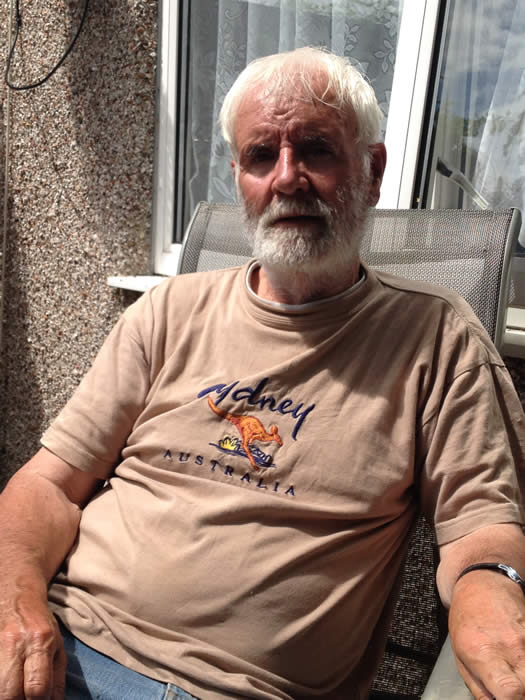
Paul Kellett, winner of Section H
SECTION I
The Ipswich legend who is Peter Crawford won Section I, and has now taken his NRCC section wins to something like a cricket score.
The section winner is a six-year-old blue chequer cock bird with a good track record, having won the section from Dunbar and featured prominently from Lerwick and Thurso in the past, plus a number of other successful races. “He is a good pigeon,” said Peter. His breeding is Peter’s old Westcott lines with a touch of Wily Thas.
He was also an impressive 10th open.
Now that his racing days are over, this pigeon will be paired to the section winner of two years ago in the hope that they produce more winners.
He sent six to Lerwick, and is missing only one.
Peter has enjoyed another good season, rarely being out of the top half dozen in the club results.
Now approaching his 87th birthday, he is recovering from a knee replacement operation, and looking forward to a similar operation on his other knee.
Goodness knows what his results will be when he is free from the pain and discomfort of arthritic knees that have troubled him for a long time.
Despite those creaking knees, and having had a pacemaker fitted, Peter is an inspiration to pigeon fanciers everywhere. Younger men are put to shame by the work he still does at his club.
He first had pigeons in 1937 that is 79 years ago and he still loves the sport as much now as he did at the start. The only difference is that he knows a lot more about it now, and has kept pace with developments over the years while still keeping in his routine the things that have served him so well over all those years.
More importantly, and quite amazingly, he has retained the winning touch at the top level.