NORTH LIVERPOOL FED
NEWS FROM DARREN SMITH
Loft Profile on Charlie McCardle & Terry Archbold
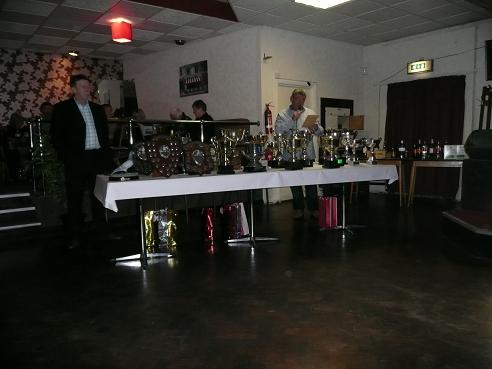
Premier Prize Winners Netherton HS 2013 with 14 x 1st + other prizes
Premier Prize Winners North Liverpool Federation 2013
1st North Liverpool Federation Wincanton OB
1st North Liverpool Federation Fougeres 1
1st North Liverpool Federation Hereford YB
Winning Billy Nesbitt Cup, the Dingle Cup and the Mersey Cup
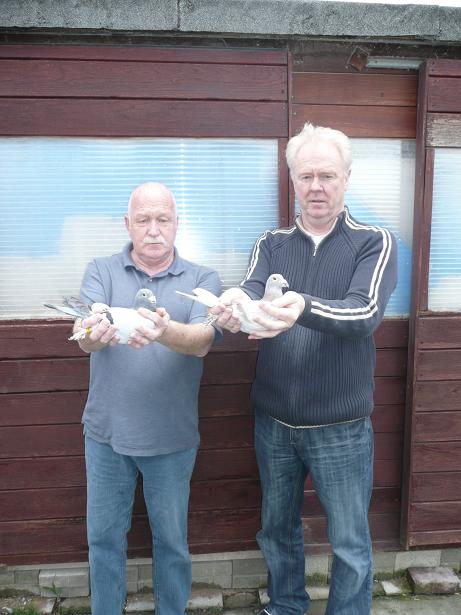
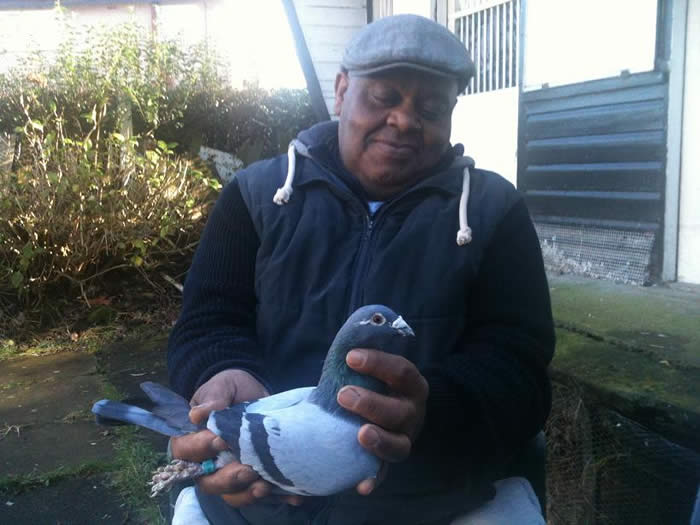
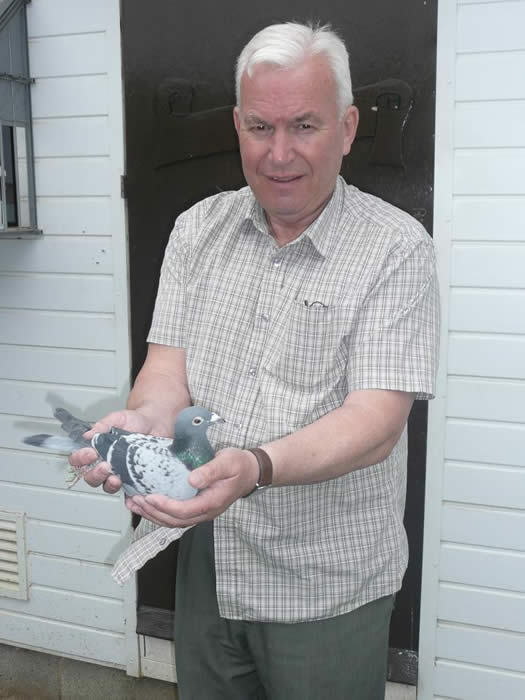
Charlie & Terry holding 1st North Liverpool Federation Hereford YB and 1st North Liverpool Federation Fougeres 1
Can you tell me a little about yourself and how you became involved in the sport?
TA: It all started for me in junior school. There was a lad I knew called Alan Ball who kept a couple of pairs of pigeons in his back garden in what I would describe as a big rabbit hutch. I went round after school one day to have a look and that was it, I was hooked. The caretaker of our school also used to fly pigeons in the Netherton, his name was Jack ‘Kipper’ Lynch and I think as a kid I was in his loft more than he was, we used to go round borrowing pigeons off him!
I remember one Sunday afternoon we got caught red handed in his loft borrowing a few more pigeons and we goes to school the next day, got called out in front of the assembly and got the cane and everything! But after that I was just pigeon mad. I didn’t get me own until I was about 15. My old man, who I later went in partnership with, bought me a 6x4 shed. I got a few pigeons and we joined the Netherton HS in 1973.
It was in 1974 we won the Netherton Open, which was a big affair back then and the prize and pool money would have been around £100. There were probably around 45-50 members in the Netherton at the time, with 400-500 pigeons going every week. I remember the pigeon we won it with was a blue cock from Dr Rigg. I then flitted in and out of the game for a few years as you do when life and other things take precedence.
It was 1992 before I next became involved. I was living in Maghull at the time and it was the Sunday after Liverpool beat Sunderland in the FA Cup final and a cheq hen walked into the garden so I caught it and it turned out it was from London. My uncle was working in Oxford at the time so I phoned and asked him to take it with him the next day and he said yeah no problem so I took it over to where he lived in Chester and when I came home from work on the Monday it was sitting there in the garden!
After that I thought I’m getting some more pigeons but the problem was me missus hated them, still does. So I approached a fella named Billy Young who lived next door to my old school mate Alan Ball and asked if he wanted to go in partnership and he said yes. We bought in 6 Fountainhead Janssens, we only had 8 pigeons in total and we topped the fed the first year with them. We did alright to be honest but eventually we went our separate ways.
I then became partners with Phil Shaw and we flew in the Tailors Arms and did really well, winning our fair share. Again my partnership with Phil ended and I joined forces with Charlie who had been a mate of mine for years and we’d actually been buying pigeons together before I split up with Phil and that brings us up to the present time.
CM: Me brother Jimmy had pigeons before I started with any real purpose and while I had been around them and helped him out with training and whatnot that was as far as it went. I first raced pigeons in my own right in 1984 and won my first race, thus losing my novice status. I then topped the federation in 1985 and also won the federation young bird averages before having a break until around 1989. My brothers in-law also kept pigeons and when my father in-law died, they asked me would I help them out so I agreed but on the condition we introduced new stock and I would source them. I got our new pigeons off my brother Jimmy and Arthur Beardsmore.
We raced well together for a couple of years before I struck out on my own but eventually I packed in. I then started up again with late-breds before joining forces with Joey Williams and again enjoyed reasonable success until Joey left the partnership. It wasn’t too long afterwards that Terry and I started together in 2003. Again my missus is not fond of pigeons and wouldn’t let me have them here until I turned up one day with the lofts from her mother’s garden!
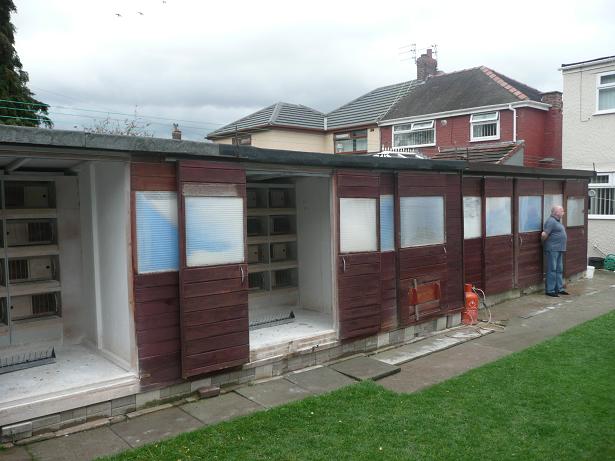
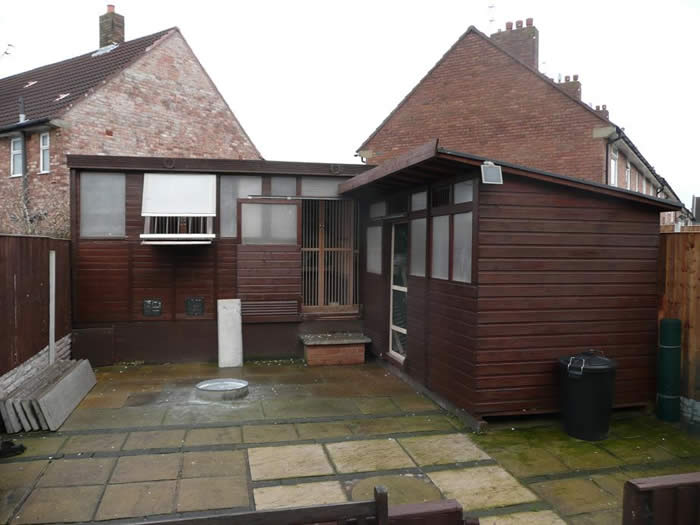
A view of the lofts
Who were your mentors in your early years in the sport?
My mentors in the early years were Arthur Beardsmore, Billy Ashcroft, me brother Jimmy and Dennis Gerrard, all good pigeon men. Even today I’d say I still learn a lot from our Jimmy and Dennis. I’m down the corn-shop most mornings to have a cup of tea and a natter with him and then of course there’s young Georgie Pendleton.
TA: I first introduced pigeons from Charlie going back to 1994 and was also given a lot of good advice so I suppose you
could say he was my mentor at the time. He drove me on to be somebody who could compete rather than just send, you know. I was just sort of in love with pigeons rather than wanting to win races. But when you come to learn that you can influence things and win a bit more, you do want to go out there and give it a good go so I’d say knowing Charlie has helped me more than anyone really.
Have they taught you anything which you still practise today?
One of the habits I have come to pick up from Charlie if you like, is the importance of cleanliness. We try not to disturb the birds too much, but we will clean out between 2 and 4 times a day. We never ever leave droppings lying around in any of the lofts and I think that is one of the key things. Health is everything with pigeons and to maintain health the pigeons have to be kept in a clean, hygienic state.
On the flip side there are fellas who fly well on a deep litter method, but it all depends on how you manage that deep litter. The basic principal is that the loft and litter must be bone dry and we don’t have that. One of the main things Charlie and me argue about almost on a daily basis is buying a new loft. The loft is by no means perfect but it does it’s job and given the success we have had racing to it we are reluctant to change it.
CM: I’d go along with what Terry has said. One of I think only two films I’ve ever watched on pigeons down the years was regarding health and if you can’t keep your pigeons in a basic state of good health through your management your wasting any other time and energy that you do devote.
With regards the loft what you have to appreciate is that there have been at least 60x1st federation victories to it so why would you want to change anything? We wouldn’t want to make wholesale changes to the way it is designed now such as adding a tiled roof or anything like that but making alterations could potentially set us back.
CM: At present we are members of Netherton HS which is affiliated to the North Liverpool Federation and the Maghull FC which is affiliated to the Liverpool Amalgamation, though we haven‘t sent in this club for a few years. We are also members of the Liverpool Classic Club and the Midlands National Flying club.
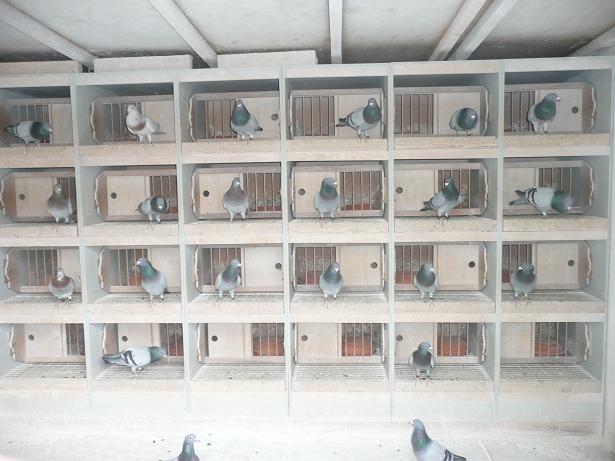
Cocks ready for the off
Can you tell me what preparation goes into your breeders prior to pairing up?
CM: when it comes to preparation for breeding I’d have to say we don’t do anything. For a couple of years we were using the services of Gary Spavin and it taught us a lot. We didn’t treat for anything unless he advised us to and if there was ever a problem arose out there in the future we would go back to Gary again. But hand on heart I’d have to say no. You’ll know when there’s a problem but the birds in the stock loft haven’t been treated for anything for years.
TM: We used to, we even used to treat them for paratyphoid but we haven’t bothered with that for a while. We’d go to see Gary Spavin every fortnight. So every other Sunday Charlie would pick me up at half past 6 and we’d be off up to Gary’s which was a 120 mile round trip. Gary would check the birds or droppings and based on that we’d either treat or not depending on what he found. The only reason we stopped was because Charlie was ill and we just got out of the habit of continually going. I think it’s been over 12 months now since we were last up there hasn’t it Charl?
CM: Yeah about that but you can bet your life if there was a problem out there we’d be straight on the phone to Gary and go up there. He’s been a great help to us and he’s a good lad.
Do you fly widowhood, roundabout, natural, celibate?
CM: We only race widowhood cocks. I hate hens and I’ve never raced one.
TA: We’ve had some smashing hens who have topped the fed and everything and we end up giving them away because they are no use to us unless they go into the stock loft but we’re not going to replace proven breeders unless the hens are getting on so we pass them on to close friends.
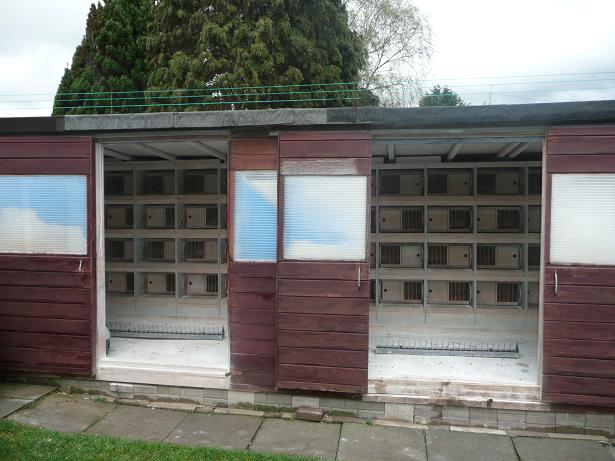
Widowhood sections
Can you outline your system from the time you pair up, to once racing commences?
TM: When it comes to pairing up we pick and choose and it’s not like set in stone in any way. If it’s too cold we’ll put the date back for example. I can’t be here all the time so it means Charlie having to be out there on his own putting hens and cocks together. I’d say the weather dictates to an extent, but also when we can put the time in to making sure everything goes smoothly. We always used to base it around Charlie’s Christmas shifts.
CM: We’ve paired at various times in December and January, it hasn’t made a blind bit of difference and it also means you haven’t got young birds sitting in the shed for 8 weeks longer not doing anything because you can’t get them out.
TA: One thing that we do is we introduce the hens to the cocks that they will be paired to for racing every week starting in November right up to pairing-up. It allows the cocks to get used to the hen and they will be driving along the front and clapping up and down to the boxes and it prevents so much trouble later on.
CM: From 40 pairs treated this way over the winter we had them all down on eggs within 8 days which is not bad. Basically they go together after their feed on a Saturday afternoon and depending on when Terry is working, they will come away Sunday morning or afternoon.
Do you believe you must stick rigidly to your management routine once your racing season kicks into swing, or do you adapt it as situations arise?
CM: If you’re working three shift patterns as I was, you can’t have a rigid system. It’s good corn and good birds but there’s no system. They don’t go out at a set time, but normally by 3pm on any given day we’re finished with old birds. I don’t think there’s ever been a routine around here though to be honest and everything is worked around the family now. I could be taking the grankids to school one morning, the next day I’ll have the cocks out if I haven’t got to do the school run. The point I’m making is they don’t go out at set times and never have done.
TA: I finish at 2pm and Charlie will ring me and if the cocks are out I’ll shoot home to get changed and by the time I get down here the cocks are normally finishing and then we’ll sort out the young birds and just make sure everything is ticking over. What we don’t do is say they have to go out every day at 7am, there’s no point putting them out at that time if it’s freezing cold, certainly not with widowhood cocks I don‘t think.
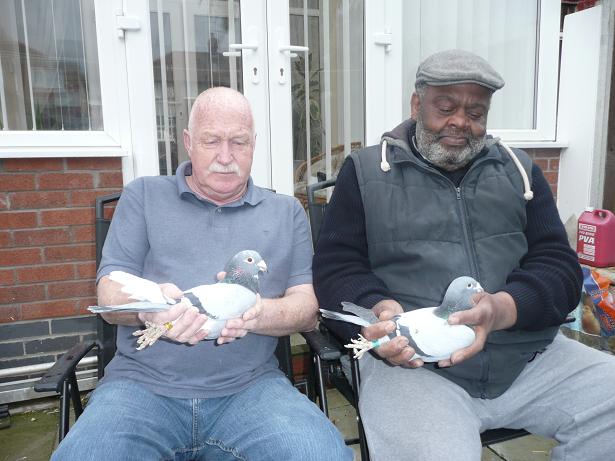
Charlie holding '43' a winner of 5x1st and breeder of 7x1st, Cliff holding the Box 8 Cock, sire of many winners including '43'.
Describe in as much detail as possible your Friday preparations, from feeding and at what time, through to basketing for the club?
TA: There are no hard and fast rules regarding the way we prepare our cocks on a Friday. We’ve done all kinds of different things down the years and a lot depends on how the birds are flying because sometimes if they’re not doing great, you might try something different the following week. Generally we let the hens into the cocks but there will definitely be times where we will just turn the bowls over. The older cocks after a couple of races know what’s coming and it doesn‘t take much longer for the yearlings to cotton on.
CM: One of the best years we ever had we paired the cocks up for ten days and trained them back to the hen every day and then pulled the hens out before any laid. But this year the weather was bad so we couldn’t do this and within 24 hours of being run together the cocks ballooned in weight which is most likely a hormonal response that has been triggered by introducing the hen.
TA: The box 1 cock in the end shed there carries no weight whatsoever. We put the hens in and as Charlie said within 24 hours he was a different pigeon. The weather was so bad we couldn’t train and they wouldn’t fly if we let them out anyway knowing the hens were in the boxes so we had to split them up again.
That is another thing we never do either, have the cocks and hens flying out at the same time, the hens have always got to be in that shed waiting. We know some fellas have them out together, clapping up and down and everything but it’s not for us. You’ve got to try and gee them up from time to time because if it becomes a little bit routine they will lose interest.
CM: With regard to feeding on a Friday, they are given a full pot of food in the morning and they can eat as much or as little as they want and then it is removed at dinnertime. When the cocks return they are fed diat only and can eat as much as they like. Some Sundays we have continued to feed diat, but normally we return to feeding a full widowhood mix which is then given all the way through to the end of the week.
TA: We’ve probably tried every widowhood mix under the sun over the last 10 years but by and large there is not much between them and as long as the corn is the best quality that is the one thing we do insist on. We always leave a pot of food out for the cocks. You’ll never find a hungry pigeon out there. Charlie will go round on a Wednesday and replenish what’s in the pots as it’s all the stuff that they don’t like which is left.
CM: I’ve had fellas saying to me the cocks are always looking for food and I always say give them more, fill the pot up, they won’t be looking for food the next day. But they can’t see it. You’ll find by using a measure the cocks will put weight on as they will eat everything you give them. But you leave corn down they will begin to regulate what they eat and will actually eat less. There’s a nationally recognised flier who came here one day, he seen the feed in the pots and admitted to calling us liars as he didn’t believe what we’d said.
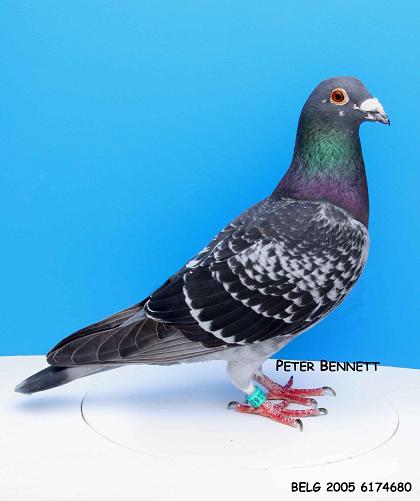
'80' brilliant racing cock, winner of 2nd, 3rd, 6th North Liverpool Fed plus many more fed cards, 6x1st club and winner of RPRA Western Region Sprint Award.
What corns / feedstuffs do you use?
We use a combination of Natural widowhood, Versele Laga super widowhood and Marimans Variamax, but we can take or leave the Variamax to be honest. We also add maize depending on the forecast. If it is going to be a harder race we add it and vice versa if it looks like it could be a quick one.
The young birds will be weaned onto Junior UK. They will be fed diat in the morning and Junior UK in the afternoon and about three weeks before racing the feed will change to a mixture of Junior UK and Gerry Plus in the afternoon. We haven’t altered that for years.
With the young birds there has to be an element of control and so we stop feeding once the first pigeon goes to the drinker. We give between a quarter and a third of an ounce in the morning depending on how they are flying and we have an ounce measure for the evening but once that first pigeon goes to drink, feeding will stop there and then no matter how much feed is remaining.
TA: Charlie is brilliant with young birds, I’ll tell you that now. Within a week of them starting to fly they will not land on the house roof again no matter what. I’ve tried watching what he does hundreds of times but I can’t get me head around it, he just has the knack.
Can you describe one motivational trick that usually brings about a good racing result?
CM: We bought a load of perches about three years ago with the intention of hanging them up in the shed on a Friday to motivate the cocks further. They’re still in the bin down the garden. Like a lot of things they seemed a good idea at the time but we don’t do anything out of the ordinary other than what we have already spoken about.
What is your criteria for getting another season at your lofts?
TA: In terms of selection criteria we like to see pigeons that arrive regularly in the early batches. They don’t necessarily have to win as long as they are in the prizes but if they’re not making the first ten in the fed with any regularity they won’t stay. We are quite tough on older birds as well. I always thing that when a cock gets to 3 or 4 years of age they start to knock off. If that happens they can’t stay here regardless of past form. End of the day they are racing pigeons and should be getting you prizes or they have no place in your shed.
CM: We like racing yearlings and two year olds, anything over that and still here has to be exceptional.
Can you describe your health schedule during the race season?
CM: We do not and have never subscribed to the practise of cankering our pigeons every three weeks. The stock haven’t seen a canker tablet in years. Going back to Gary Spavin there was one particular line of our pigeons that always showed up in screening as having trichomonads present so what would be the point in treating everything if only say one in three pigeons has it? All you are doing is destroying your pigeon’s immune system and that cannot be right.
TA: My honest opinion is that the reason some are more susceptible to canker than others is the make-up of the pigeon. That they are a highly strung type that get stressed or panicked easily and that is when it flares up. The Terror Busschaerts we had were very much like that, always living on their nerves and I definitely believe there is a link.
Do you use supplements, if so, are they specific to pigeons or do you use natural products or both?
CM: We don’t use supplements other than cider vinegar, Naturaline and garlic. We have been drug tested 4 times so we avoid using any products at all, especially after what happened to Terry & Tony Kirman. People might not believe that but it is about good pigeons nothing else.
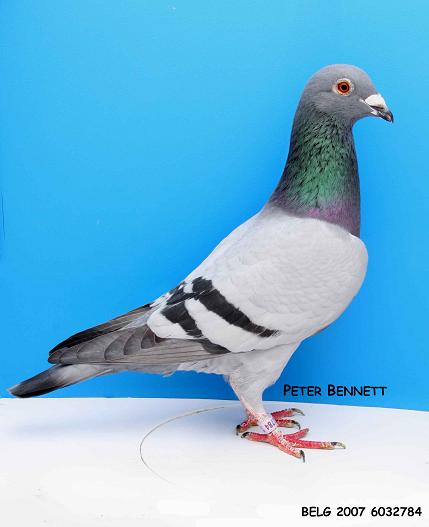
'784' - 3x1st Fed 1x2nd Fed, 5th North West Combine 10,500 pigeons, 10th North West Combine 8,500 pigeons, runner up (to loftmate) RPRA Western Region sprint award.
Do you believe spending a lot of time with your pigeons is essential and if so why?
CM: We do not believe a lot of time has to be spent with the pigeons, sitting in the loft for hours on end. In fact I spend less time with them now than when I was working. We do what we have to do and then they are left alone until the following day. It is funny in a way because the young birds are quite tame despite not spending that much time with them but we don’t set out to have tame pigeons
TA: I think a lot of it comes down to the temperament of the stock that you are breeding from. Granted we do get the odd barm-pot but it’s not the norm. One thing I will say is there is a fancier who shall rename nameless who said if a pigeon jumps out of its’ box it’s no good and it has to go. If that was the case with ours, we’d have none left!
CM: We’d end up emptying the whole loft and the Dominator would have been gone years ago!
Other than through observing your own pigeons, how do you further your knowledge?
TA: I think you’re always learning with pigeons. There isn’t a person alive who knows everything about pigeons, no danger of that. But for us I’d say we look no further than young Georgie Penno. He is very good without any doubt. George has been around pigeons since he was a small kid and loves the Midlands National. He won the west section averages the other year and he is keen to repeat and better the feat in future years.
CM: I don’t know anyone who puts more effort in than Georgie. I recall years back I’d be taking the birds training of a morning. I’d be driving down the motorway and he’d be passing me on the way back. The man eats, sleeps and breaths pigeons.
TA: I think if you’re speaking to top fellas, and picking up little bits of advice, you then incorporate it into your management if you feel it will be of any use. Brian Maguire is another fella who’s been around for years flying a top pigeon and he’s not afraid to tell you he hasn’t stopped learning.
What are your aims for the future as a partnership?
CM: I want to win the Liverpool Classic and the Midland National and I think we’ll have a go this year.
TA: We haven’t had a go at the channel for a few years as we lost some really good pigeons and it kind of affected our confidence but last year we split the team into 2 and they did okay in the couple of races they went to and it has spurred us on to have another crack at it as we know these birds can have a go. Brian Maguire’s combine bird of the year is half our bloodlines and his Niort cock was 100% our blood.
CM: One of Brian Leadbetter’s best channel pigeons, the mealy cock, was also bred here so we know the pigeons can do it. And by changing the feed slightly and taking on board sound advice, sometimes that’s what you have to do.
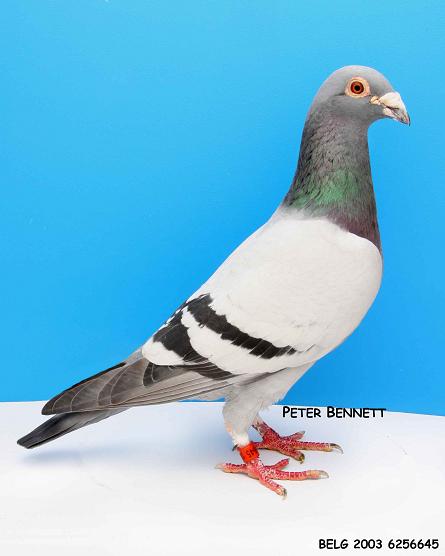
'645' - 2x1st Fed 1x2nd Fed winner of 6x1st clubs, sire and g.sire of numerous winners at all levels.
What do you look for when introducing new stock?
TA: When introducing new pigeons first and foremost they have to come from a top performing loft. Having fulfilled this criteria they then have to meet our ideals as it were in terms of their conformation. We like blues and blue white flights but we’re getting down to the finer details here. What we particularly don’t like are big pigeons that carry weight and even if we find a loft of top performers but they are on the larger side of what is our ideal, we’ll keep our money in our pockets and walk away.
CM: Myself personally if I’ve ever bought pigeons I’ve always handled the parents and if they feel right then fine. You cannot tell from handling a pigeon at 25-35 days old how it is going to turn out but if I like the parents then yeah we go from there. Small to medium is what we are after. When we pair up it is not done based on bloodlines, but how the pair look and handle together.
TA: When introducing new stock we would much rather purchase a round of young birds as we often did with Walter (Docx) than buy say 4 pair of stock birds and only take the first round from them, which often happens. It makes no sense whatsoever housing and feeding 8 stock pigeons for a year just to get 8 young birds to race. By going out and buying 20 or 30 young birds in one go, you might only end up with half a dozen but they could be half a dozen decent ones.
CM: The first year with Walter we bought 12, we raced nine, seven won and three topped the fed. The two that didn’t win won 2nd prizes and were only ever beaten by their loft mates. It was absolutely phenomenal, 3 x 1st federation winners from 9 raced.
Brian Holland bought all of our M & D Evans Vandenabeele stock pigeons and we gave him 6 Walter Docx young birds to try. 5 of them topped the South Lancashire Combine for him, including 3x1st combine from one pair. He couldn’t go wrong with them.
How many old birds / young birds do you race?
TA: We race 40 widowhood cocks and rear between 60 and 70 young birds. This is reduced to about 60 after training and then we stop all the young cocks after 2 races. This is something that we have done for the past 7 or 8 years, though we might change it in the future to be honest.
CM: We usually have 16 pairs of stock birds but we added 3 more boxes this year. The mainstay of our stock are down from two cocks, namely ‘62 which is of Van Reet x Busschaert bloodlines and the 645 which is a direct Walter Docx. These two cocks are responsible for endless top pigeons for us and others. There are still a small number of direct Walters out there but they are coming to an end now and we haven’t had any pigeons from Walter for a few years.
Do you train your old birds once racing starts if so, how much and why do you feel it improves your chances of victory as opposed to giving them home exercise only?
CM It all depends on how they are coming. If they are performing no, if it’s the other way round, then yes we will try something different. We’ve topped the fed having trained and also when we‘ve done none at all.
An example of the former was when I topped the North West Combine from Weymouth with 10,600 pigeons racing. One thing I never do, I did that day. I had 4 come together and after the first one went straight into the loft I ran in and closed the door and the other three pigeons hit the window. I ended up 1st 4th, 5th and 6th Combine.
I was racing in the Maghull at the time and hadn’t won a race all year, but I was working 12 hour shifts so I trained them all week, 40 miles of a morning and 10 miles of a night. They’d put weight on because they weren’t getting out, but on this occasion the training did the job.
How do you train your young birds and how often before and once racing starts?
CM: When it comes to young birds if they are fit and healthy, we train as much as we can and would much rather just train the young birds and not let them out. If the weather is right it can be anything up to 3 times a day.
Generally we will only keep them short. The first few trainers will be from Kirkby golf course which is about a mile and a half away and after 4 or 5 there we work our way up to the end of the motorway which takes us to about the 10-12 mile mark. On the odd occasion we have gone as far as Daresbury which is about 18 miles away.
TA: The thing you are trying to instil in them is repetition. We’ll start by liberating the four baskets each containing up to 15 pigeons separately and over a period of a few weeks we will get down to liberating in batches of three or four. Once they start going like that and clearing for home immediately, it is a joy to train them. You know they are right once they start doing this. That is the battle over and you just have to keep them ticking over from thereon in and keep them healthy really.
CM: We do all of our training ourselves and don’t send the young birds on the wagon prior to racing as some do. We would always start around the Nantes race in the past and once we start, we wouldn’t stop except for if the weather was bad and that is how we still do things today. It is a lot of hard work I have to say but the results I would say are worth it.
People don’t appreciate the effort that goes in, but if your aim is to get anything out of this game, first of all you need good pigeons and then you have to put in the graft, it’s that simple. We’ve been drug tested numerous times but it all boils down to what I’ve just said, good pigeons and a lot of hard work.
Our thing is not so much making them individuals, but getting them into flying in short numbers so they are not afraid of flying on their own because when they are breaking for home they will generally be up there in small batches of 2 or 3.
What has been your best achievement in the sport?
TA: We’ve had some great performances over the years but the Bamfords Gold Ring has got to be up there. Then there was taking the first 6 in the Liverpool Amal open from Taunton which is 172 miles, in a south west wind.. We sent ten that day, got 8 together and they just screamed in. Charlie shouted me and I threw the ditherers and the 8 of them hit the loft together.
We only had six thimbles so we’d used 4 and I had two more rubbers in me hand and Charlie said what are you doing with them? I said I’m throwing them in! and Charlie replied We’re waiting on the poolers! it was bedlam. As we come out of the shed still arguing the two we were waiting on that were carrying all the pools went bang into the loft so they both got clocked in and we took the first 6, but it could have been the first ten.
CM: It was the best thing I have ever seen in pigeon racing. Marty Garrity was here that day and they just come racing in a line so I shouts Terry as I’m always moaning that he doesn’t throw the ditheres fast enough but he got it spot on this day and it was a perfect finish. Young Georgie Penno picked the winner out the night before which was the mealy cock 48.
Can you tell me about your best pigeon/s?
TA: In terms of favourite pigeons I would have to say the 645, a winner of 2x1st and 2nd Fed and about 6 or 7 x 1st clubs, but he left a legacy behind him. He never bred anything that won himself, but his children have just bred winner after winner.
Other pigeons who have done alright for us are the Champ who topped the fed on the land and also won Cholet for us. He was a Vandenabeele and there was also the little pencil blue cock Young Champ who won about 4 or 5 firsts and a 1st and 2x2nd feds.
Then there are pigeons like 80 who won a Western Region meritorious award and was just a total joy to own. You would see him coming and the next thing he was in the shed. The best trapper we have ever had. Then there is the Dominator, a winner of 3x1st fed.
CM: I had the Laffy Daffy a winner of 17x1st and our Jimmy reckons he also won 5x1st fed, I know he definitely had 4x1st feds. The Laffy Daffy would always come with another good racer 23. I’d always put the Laffy Daffy first, but 23 was a fantastic pigeon as well.
There’s also 02 who is now in the stock loft. He won 7x1st clubs, 1st fed, 2nd North West Combine and on his last race as a three year old won 1st club, 6th fed but then damaged his wing. He came to win over 12 races that pigeon though, he was mad as a hatter but he was a fantastic racer, never had a pigeon like him.
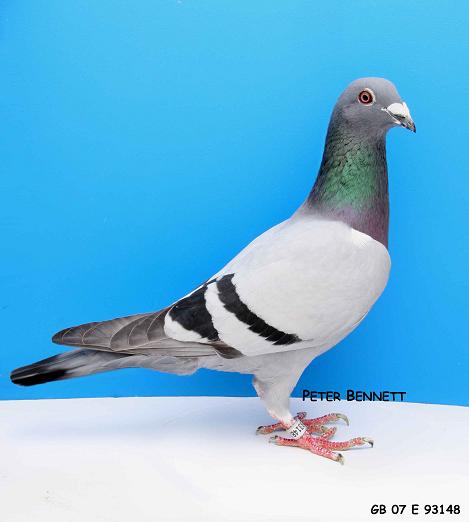
'148' Walter Docx, winner North West Combine Sprint Award 2008. Sadly died after first race as a 2 year old (probably of a heart attack).
What advice can you give that you feel would help improve the management / results of a novice / new starter?
TA: The best advice we can give a new starter is as was said earlier, get good pigeons and work hard. It’s not about drugs or cheating. The Walter Docx pigeons have been an absolute dream and have made it easy for us.
Who do you admire in the pigeon sport?
TA: I admire Brian and Simon Maguire, they’ve been in the game for donkey’s years, done a hell of a lot of winning over the years and are still absolutely keen as mustard. Then there is our mate Georgie Penno, he is gifted with pigeons and we listen to George more than anybody. Any problems or we’re unsure of anything we’ll use him as a sounding board.
Then you’ve got the likes of Tommy McIntyre a cracking lad who is a fantastic worker for his club. But he is up against it in the Vauxhall as he only has a small set up and is flying against some brilliant fliers there with Willo & Muff and the 2 Danny’s & Thomas Devine. When he won last year I think we topped the fed the same day but we were more made up for him it was great for him.
CM: I admire the likes of our Jimmy for the work he puts into the pigeons and I also admire Terry. I couldn’t do what they do, travelling miles every day either before or after work to look after pigeons. It was too much for me when I had to walk across the road when they were in the mother in-laws.
What is it you love about the pigeon sport that keeps you involved?
TA: I enjoy the daily connection with the birds, watching them fly, cleaning out and just being around them really. I could take or leave the racing as long as I had everything else, it is a by-product of the relationship we have the way I see it. Charlie always says you love cleaning out and I do because it can be therapeutic. It’s not too bad now but in my previous job I didn’t know whether I was coming or going at times and I would love just being in the shed for an hour scraping away and it would sort me right out. It’s a stress release you know what I mean.
CM: I would go along with what Terry just said but I do love the racing side of things.
What drives you mad about the pigeon sport?
CM: The back biting and the bitching and the non recognition of our efforts.
TA: One example I can give is years ago when Charlie and I had not long been partners, I was in the corn shop and I overheard a fella who shall remain nameless but who should have known better, talking about Charlie. He was claiming Charlie raced 40 widowhood cocks and 40 pairs of naturals. I didn’t know anyone at the time and wouldn’t say boo to a goose but it’s things like that where people go round bad mouthing you that do my head in.
CM: I was actually racing 15 cocks in the fed and 20 in the amal at the time as well.
What is racing in your club like?
TA: We have a good set of lads in our club. There are 13 members but if we are lucky we might get about 8 members sending. Robbie Kershaw is an absolute lunatic but to be fair he is a good lad. Sdtan Stevens has come back into the fold recently and is a good worker for the club and John Gosling has joined so the level of good competition is rising all the time. The difficulty you have got these days is attracting new members as there are none out there, although saying that we have a new member joining this year Fred Murtagh who raced years ago and he’s having another go.
Who is the one to watch out for in 2014?
CM: Alan Halsall has flown a really good pigeon the last couple of years. He’s a workaholic Alan but it hasn’t stopped him flying exceptionally well. Another is Dave Rothwell who’s starting to come to the fore. You’ve also got Roy Reid who had a fantastic channel campaign in 2013, then there’s Teddy Davin, Willo & Muff and the Danny’s and Thomas. You can’t be complacent in this fed, it is definitely getting a lot harder to win.
TA: The thing for me though is that around here fellas don’t get the credit that is due. People would rather go and buy birds from all over the country when there are top fanciers in the fed and the Liverpool Amal with excellent pigeons who would compete with anybody. But we tend to place out of towners on pedestals when there are some really good pigeons to be had in this city.
Do you have a message for your club-mates?
TA: Enjoy your racing. We are the same as everybody else and get disappointed if we have a bad day but it is all about having a go and I always say if hand on heart, you have put the best effort you can into your pigeons and they don’t perform for you, you know what you have to do.
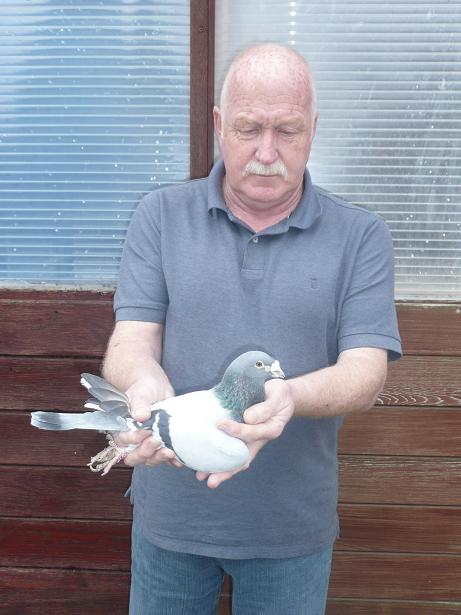
Charlie holding '62' a winner of 9x1st club, 1st & 2nd North Liverpool Fed. Sire of winners 13 years in succession including at least 6x1st federation.
FIN
There is an old saying Many Roads Lead to Rome that springs to mind whenever my thoughts turn to Charlie McCardle & Terry Archbold. In this instance, the empire is that which has been painstakingly created over the last decade by these two observantly dedicated pigeon men. There are many fanciers both local and not so, who have time and again beaten a heavy trodden path to Charlie & Terry’s door with the intention of bettering themselves and the insides of their breeding and racing lofts.
Take a look around our local results for evidence of this, see with your own eyes the rich red thread connecting numerous lofts. So many successes reported week after week throughout the spring and summer months attributed to the offspring of the small colony of multiple performers that have been honed and crafted with great care and desire by the men of the moonlit marina.
The strike-rate and pre-potency for others however is a by product of the demands set by Charlie and Terry upon themselves to unearth and create the ultimate in multiple performance racing pigeons for their own purposes. Much has fallen by the wayside, the demand and expectation placed upon their small feathered shoulders too much. But what has remained is pretty damn special by any standards.
There has been a widely varying range of responses provided by the fanciers I have profiled since taking over the job of press officer. Each reply I believe has been presented with both belief and conviction by the fancier in question. This interview however contradicts so many of those responses thus far except for 2 inescapable truths. Systems, treatments, regularity and rigidity all come a very poor second to top pigeons in the rudest of health and hard work for all involved. Lots of it.
Of course there is also the small matter of possessing an abundance of stock-sense. Which inconveniently for some, this partnership has in spades. Thank you to Charlie and Terry for having us over, it was a pleasure handling so many top performing pigeons and for your openness throughout our visit. I always know it has been a good one when I’m still recalling events days after. Two weeks and counting.
Riverside president Paddy Cousins is organising a charity sale for a local girl Kate Murphy who has been diagnosed with breast cancer at the age of 26. Kate is also mother to a 2 year old daughter which puts her situation into even sharper focus. The sale will be held at the Sefton Arms, Carr Lane, Croxteth on Sunday 27th April 2014. Auctioneer is Brian Maguire and viewing of lots will be from 12-1pm when the sale will commence. To donate a young bird which will preferably be ready for the sale, please call Paddy on 07936 516 254.
Please do your utmost to support the sale and let us try and help Kate and her young family out.
Thanks for reading,
Darren
---
Elimar - April 2014