“ON THE ROAD” WITH KEITH MOTT.
LOFT VISITS IN SCOTLAND (PART 5.)
The late, George & Gareth Rankin of Glasgow.
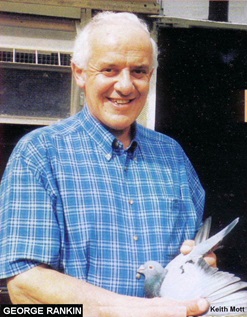
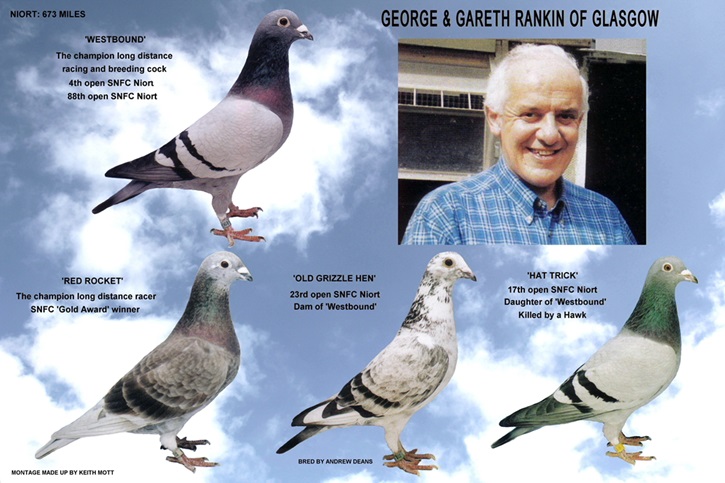
For many years the name Rankin has been at the top of the Scottish National Flying Club long distance results with outstanding consistency. The Rankin loft won 66 S.N.F.C. certificates from 1975 to 1996 and over £11, 700 in national racing. The loft was the only one in the S.N.F.C. to be in the first 25 open positions from the Niort (673 miles) races in 1989, 1990, 1991, 1995 and 1996, with the same bloodlines. The loft’s star performers from Niort in the S.N.F.C. races are: ‘The Old Grizzle Hen’: 1989 3rd West Section, 23rd open S.N.F.C. Niort: ‘Westbound’, son of ‘The Old Grizzle Hen’, 1989 20th West Section, 88th open S.N.F.C. Niort, 1990 1st. West Section, 4th open S.N.F.C. Niort: ‘Hat Trick’, daughter of ‘Westbound’, 1991 3rd West Section, 17th open S.N.F.C. Niort: ‘The Blue Hen’, granddaughter of ‘Red Rocket’, George’s S.N.F.C. Gold Award winner and ‘The Old Grizzle Hen’, 1995 5th West Section, 25th open S.N.F.C. Niort: ‘Westbound Junior’, son of ‘Westbound, 1995 7th West Section, 36th open S.N.F.C. Niort, 1996 1st West Section, 24th open S.N.F.C. Niort. What a family of pigeons!
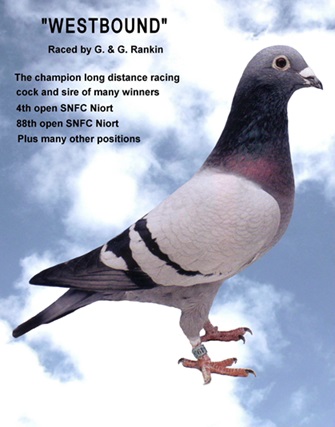
George Rankin was born in Bangor, County Down, in Northern Ireland and as a lad kept all sorts of pigeons on his father’s farm in Drumawhey. He sold his tipplers and tumblers and at the age of 11, he purchased his first racing pigeons, including a wonderful black hen from Robert Smith of Newtonnards. Her sire had won Penzance three times to three different addresses. George joined Donaghadu R.P.C. in 1956 and raced 13 young birds, lost two and won a 6th. prize from Bray. In 1954 , the 11 yearlings won the old bird average, winning the last old bird race from Penzance (310 miles), 14 hours on the wing, with a black cock from the Smith black hen. This game cock had reared seven youngsters before going to Penzance. In 1955 he won the coveted ‘Miller Gold Cup’, then valued at £32,000 from Landerneau (427 miles) in a north east wind, liberating at 07.00hrs and clocking the only bird on the day at 21.04hrs, velocity 913 y.p.m., and winning six other trophies and a Gold Medal. A wonderful performance by the young George, as there were only 17 birds clocked in the three days of the ‘Miller Gold Cup’ race. Sire of his Gold Cup winner, ‘Landermeau Express’, was a gift from the top national loft in Ireland of Sloan & Whytes and George said he learned how to race pigeons from 600 miles from Leslie Sloan, a master of racing on the long distance. From 1948 to 1970 Sloan & Whytes were on the Irish National Flying Club , Northern Ireland and Co. Down Federation results from France every year, and the system that George works today is just about the same as the Sloan & Whytes winning system. Leslie Sloan died suddenly in 1971 and George sold his pigeons for his wife in the Muckamore Clubroom in Co. Antrim. In 1968 George won 7th. Open Young Bird I.N.F.C. Penzance (310 miles), 1st. Open East Down Combine and in 1969 won 11th. Open I.N.F.C. Nantes (550 miles), 1st. East Down Combine, with only 99 birds clocked in three days.
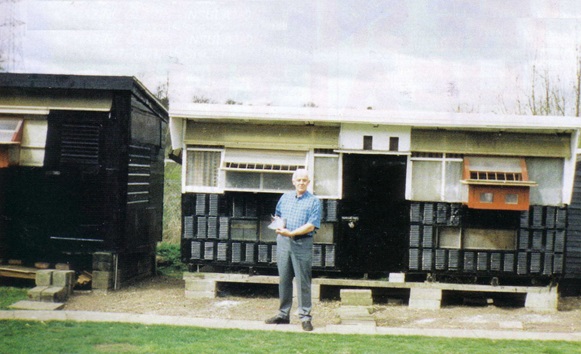
The Rankins had several old bird lofts in their Blantyre, Glasgow set up, which totalled a length of 34ft, but only housed 35 natural racing pairs. The 50 young birds were housed in their own 16ft x 7ft loft and although they had a small stock loft, they liked to pair stock birds to the best racers, so all were flying out. George’s son, Gareth, said on my visit to the loft, ‘Good ventilation is very important in a loft and a fancier must keep using a hammer and saw until it is right’. The partners breed about 76 youngsters each year, with about 20 going to charity and club sales, and the rest race through to the young bird national (260 miles). All the old birds are paired about March 10th. each year, as in Lanarkshire in Scotland where they live they have cold Easterly winds early on and they are only interested in the National races from France, in June and July. The young birds fly out to 160 miles with the Lanarkshire Federation, which is the largest in Scotland and about ten are sent to the young bird Worcester National. All two year old and other pigeons are sent to the main four Channel races, if fit, with the S.N.F.C. Sartilly (500 miles) twice, Rennes (540 miles) and Niort (673 miles).
George moved to Scotland in June 1972, with his wife, Marcia, and children, Richard, Gareth and Sharon. In 1984 the racing name was changed to, G. Rankin & son, when his son Gareth became very interested in the birds, at the age of 13, and he is a very good pigeon fancier. Gareth, a 6ft. 6in.tall 30 year old, when I visited the Rankin home, was very keen on long distance racing and had never missed a day at the lofts. The partners’ present family of pigeons has been blended together by themselves to produce pigeons that can fly 16 hours on the day and get going again the second day if needed to finish the job from the long distance. They are nearly all bred down from pigeons flying into Lanarkshire from 500 and 673 miles for the past 45 years. In 1993 they received, as a gift from Joe Murphy & son of Kirkcaldy, Fife, a son of ‘Mystical Rose’, 1st open S.N.F.C. Sartilly. In 1992 and 1994 he was paired to a daughter of ‘Red Rocket’, and result was the Rankin’s S.N.F.C. Gold Award winner and they bred, ‘Double Delight’, winner of 1st West Section, 13th open S.N.F.C. Sartilly in 1996. A young blue cock from David Mawhinney, in 1996, won 1st open Strathclyde Combine, a total of six Federations, from Stafford (220 miles), lifting £641 and a gallon of whisky. George said that it’s a thrill to clock pigeons in from France after 16 hours on the wing, but many of his good birds have been killed by Sparrowhawks and Peregrines, including some with three certificates in the S.N.F.C.
He fed high protein for racing and a super widowhood mixture with best peas for the long distance events. The old birds got lots of safe 18 mile training tosses south of the loft, then after that there are hundreds of Hawks and Peregrines for the next 33 miles to Lockerbie. The young birds got training for only one week before the first race, because of the Hawks, then, just fly out around the loft daily. Most of the birds were sent to the long distance races sitting 14 day old eggs, due to hatch the day of the race. George told me on my loft visit, ’you have to find out what each individual pigeon likes to race to’. He had been Secretary, Treasure and President of the Lanarkshire Social Circle and at that time had been Vice President for many years. They did their stint marking at the local club and Gareth was on the clock committee.
Gunn & Cherrie of Roslin.
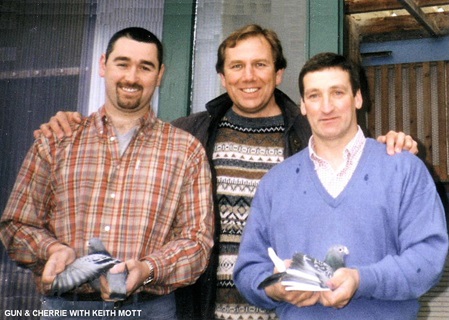
Although most of the lofts that I've visited in Scotland have raced on the natural, one that wasn't was Gunn & Cherrie of Roslin, as they race the roundabout system with outstanding success. Tom & David formed their partnership 20 years ago and although they like long distance national racing, they went round about ten seasons ago. Tom has been in the sport 45 years and first became interested when he visited a local fancier's loft as a five year old.
Gunn & Cherrie have won countless positions in their Federation and S.N.F.C, but said their best performance was winning 1st open Rennes (540 miles) S.N.F.C. Tom said it was a great day to win the National, it was a hard race being in a heat wave and a light head wind. The 1997 season saw them record 5th, 6th and 7th open Sartilly S.N.F.C. and this was another hard day for the 496 mile race. The 5th open Sartilly pigeon was a handsome blue cheq cock bred down from Preece Brothers’ of South Wales, ‘Iron Man’ bloodlines. This game cock had previously won as a young bird.
The race team is paired up early in February and their roundabout system is very basic, racing cocks and hens in the same races. They are fed widowhood mixture, being 'broken' down in the first part of the week, and are never trained after the first race. Birds rear one pair of youngsters before being split three weeks before the first race. They like to compete in all races at any distance, but maintain roundabout is an excellent system for long distance racing. The main old bird racing loft is 30ft long with three sections, one of which is a special trapping section with open doors and has grille floors for easy cleaning. The cocks stay in the nest box section and the hens live on 'V' perches. The family kept is based around the 1st. open Rennes winner and a good cross is brought in from time to time. Strains mean nothing to them, all new introductions must be from the very best winning lines. The eight pairs of stock birds are housed in a small stock loft with a wire flight, and are fed mostly on beans. They are paired up at the same time as the race team in February, so their eggs can be floated under the racers.
Their 45 young birds are raced right through to 215 miles, with half the team being stopped after four races. The young hens and cocks are housed separately in the racing season, and are put together on marking day to wind them up. They are given lots of training tosses from 15 miles before the first race. On our visit to the Rosin loft we handled most of their premier racers, including the blue hen ‘Duchess’, and she had scored in several national races. She is a granddaughter of the 1st open Rennes winner and bred down from top Welsh bloodlines.
Well that’s it for this week! I hope my readers have enjoyed this look back at these Scottish winning champions of yester year. We will be looking at some more very soon. To view some old video footage of some of these fanciers and their birds go on to my YouTube channel. I can be contacted with any pigeon matters on telephone number: 07535 484584 or email me on:
TEXT & PHOTOS BY KEITH MOTT (www.keithmott.com).