NEWS FROM DOWN UNDER
by Doug McClary
The Birds
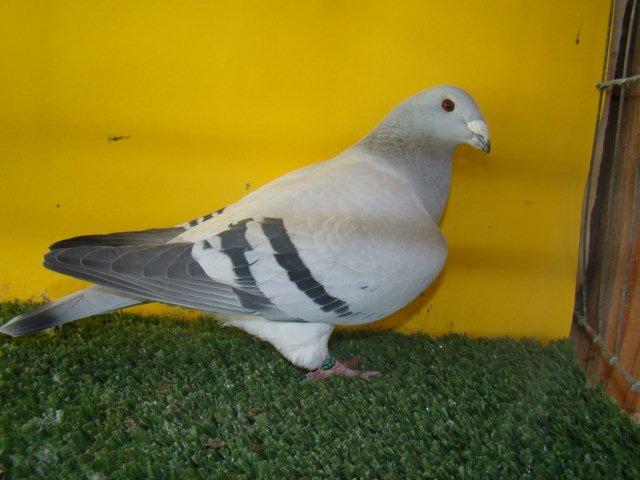
I received a few nice comments about the photos of the ‘old-timers’ I portrayed in my last article. They have come through the heatwave unfazed by it all. As for the young birds, they are now taking shape nicely and presenting some very pleasant surprises whenever I visit the loft. They seem to be changing almost overnight. Meanwhile, the feathers are falling in profusion and I am cleaning more diligently and removing as many feathers as possible almost on a daily basis. My intention to breed good powder blues seems to have worked and some of the youngsters are carrying that lovely powder colouring which never ceases to thrill me. Along the way the mealies have also appeared in numbers and seem to be remarkable in quality. The chequers are lacking so next year that will be my chosen colour, combining the quest with the blue colouring which has served my family so well for many years. Pairing of birds is very much a personal matter. As stated, for years I paired checker to powder blue as a preferred mating, but occasionally used mealy with blue to strengthen bars. I use red to mealy frequently but rarely mealy to mealy, red to red or chequer to chequer. The opal mosaics have brought a newer dimension to pairing and opal to opal seems the way forward although the opal colouring has never played an important part in the Kemyel Lofts. We all have our preferred colour pairings I am sure that all my readers will have their own preferences. I am always reminded of John Cross of the Blackpool area who kept only mealies, pairing mealy to mealy for many years with no apparent loss of quality, colour or type. It was an interesting team to visit. A lesson came for me many years ago when living at St Austell, I had a visit from Harry King and Ron McCarthy. Harry was astounded because my team in those days was at least eighty per cent powder blue. He promised me a pair of pigeons and advised me to pair them into my birds. He sent a dark chequer which had won BIS at Abertillery, and a mealy which when paired to my stock blue cock produced Bluebelle, Sparnon Queen and Kemyel Max, multi winning classic birds. I always like to think that Harry identified a weakness and applied a remedy for me. Such was the man.
A Narrow escape
At four in the morning Ann woke me having heard an explosion outside. Upon investigation I could see that the power cables which are strung down the road had touched in the high winds, causing the wooden support pole to catch alight. Driven by the fierce wind in from the bay, the fire was soon burning well and was throwing out a constant flow of burning embers which were landing in the trees, in our garden and decking area. Fortunately we had rain the day before so the trees did not catch alight, but had this happened during the previous week’s heatwave I am sure that the tale would have been a different one. This was particularly so for our next door neighbour who owns a tall eucalyptus tree, which, had it caught alight, would likely have burned his house down and ours would have been in great danger also. It took an age for the fire brigade to manage to get the fire out as they did not appear to have a hoist or ladders to get up to the necessary height. There was a constant danger of the pole collapsing and providing even more danger. Needless to say we spent hours in an uncomfortable mode, with hoses ready to douse flames. It was not a pleasant experience. It was a brush with fire and high winds which I have no desire to repeat. The heat during our ten days of 85 to 100degree heat proved to be most energy-sapping. It was too hot to do anything much outside so I used some of the time to catch up on office chores. My scrap book is up to date as are my pigeon records. Fortunately my study remains quite cool so I can work in relative comfort. We swam regularly but even the pool water was almost too warm. Just as we have sweltered I am noting the atrocious weather in the UK so my thoughts are with you all. We were reminded this morning during a Palm Sunday church service, that on Palm Sunday last year we were in Paul Church in good warm weather, as I revisited some of my Cornish roots.
Overseas visitors
I was delighted to have a visit from Len Rusche and his wife Eileen, visiting Australia for the first time from their home in California. I knew of Len through Dick Lipski. Every year Len travels up to Milwaukee to stay with John Lipski for the duration of the show season with the Lipskis caring for his show team which he takes with him. One would have to be very keen on showing to do this also to have an understanding wife to stay at home and care for the remainder of the birds. Together they then travel to the top shows enjoying the company and the quality showing based on agreeable companionship. Len and Eileen travelled out from Melbourne by train and we picked them up from the station at Frankston. It is always good to have visitors to the loft, a feature that I miss having moved from Exeter. Len was interested in the birds of course and judging by the birds he selected, he likes them with a shorter, more rounded head, a wedge-shaped body and with plenty of feather. Unfortunately the birds were in heavy moult so he did not see them at their best. However, it proved to be an enjoyable day with plenty of laughs along the way.
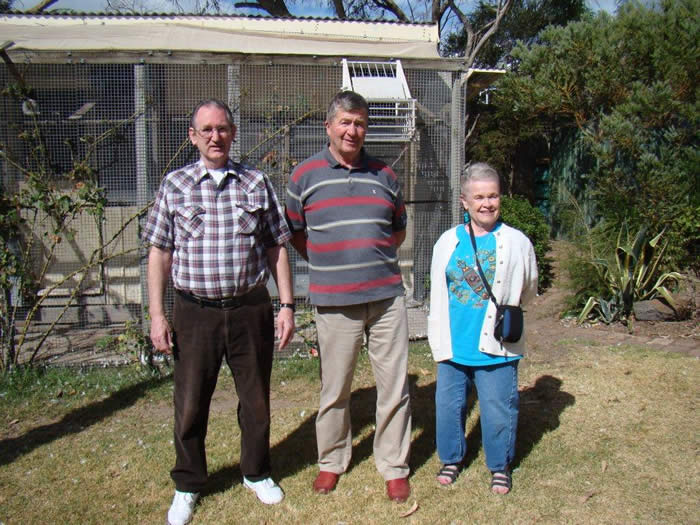
Leonard & Eileen Rusche
Rules
I was interested to see in a recent letter from Alf Jones of Northampton reference made to the rules. The letter was a long one written in the face of provocation but Alf maintained a gentlemanly demeanour and was backed up by Ian Jarrett. Using his long experience in administration, Alf observed that the rules are there to protect the membership, not to be tools of enforcement only. Believe me he is right, for having lived under the protection of the RPRA for so many years; it is difficult to endure having little or no framework in rules, to help members against those who do not want to be controlled in any way.
Welsh criminals
I noticed that Dai Roach of Treforest had his loft of show birds burnt down. What a dreadful act this is to condemn lovely pigeons to destruction by fire. David is a good fancier, one of the best and I sincerely hope that he will be able to overcome this act of wanton destruction. Dave once suffered the loss of his entire stock when a wild mink got into his loft so this latest tragedy is the latest in his programme of misfortune. What sort of idiots would o such an act? Words fail me.
Fanciers I have known
I thought that I would select a name from my past friendships and provide some information on that person and their contribution to the showing side of the sport. It is an extension of what I have written in my latest book but it enables me to make mention of friends and acquaintances who do not figure in the book. My first name is that of my good friend Francis Gamble of Penzance. In my schooldays in the Penzance area I didn’t get to know Francis but heard of him. It was later when I came back to the sport in the early 1960s that we met at the shows and I started my visits to his loft, firstly near the hospital where he worked, and later when he moved to Treneere where he enjoyed a new loft. If ever there was a man who loved his pigeons it was Francis. He did not keep large numbers, in fact his team was a compact one and he was a man who was able to control what he wanted to keep. Little things stand out for me regarding Francis. He kept storage tins which contained his titbits for the birds. These would be Bisto tins and the like and each would have a treat for his beloved birds such as Red Band seed. It is a habit that I have adopted myself and I always seem to have a selection of containers with treats and other management aids. Francis loved coloured pigeons and worked to improve the colours every year. Living down in West Cornwall and with limited funds, he was unable to travel very much to see other lofts and to be able to acquire stock which would enable him to make his task easier. How impressed he would be if he could see the array of colours now being shown at the British shows, the yellows, creams, lavenders, silver blues and especially the opal mosaics. He was one of the early pioneers of the coloured pigeon and if he had been able to obtain the crosses he wanted or needed, he would have been a force to be reckoned with. I often look at the colour pigeons of today and wish that Francis could see them. He loved his showing and he loved the company of other fanciers. He had set beliefs and expectations in fellow fanciers and liked only those who were straight dealers. He always described himself as a fancier and not a financier in that he did not like the amount of buying and selling that went on. He visited me in Exeter and we occasionally exchanged birds. He was one of the early members of the Devon and Cornwall Show Racer Society where he enjoyed success with his small team of entries. Unfortunately his health was not strong and with having to live on his pension, he had to rely on the railway for his showing or occasionally being taken to the shows by car. Whenever I visited Penzance I found my way to Treneere where we enjoyed our talks about pigeons and fanciers. On one such weekend, I drove him to the railway station because his birds had been returned from a show somewhere. We collected the basket of six from the parcels office and while still in the office, he opened the basket to see what he had won. There were no prize cards so it was a silent Francis on the return journey home. We took the birds to the loft, after which he took everything out of the basket in case there was a prize card in there somewhere, the inner of the basket, came out, then the sawdust. It was all to no avail for on that occasion he had drawn a blank. I imagine he did not sleep very well that night. That however was Francis and his attitude to his hobby. He kept a clean loft and would have cleaned the birds two or three times a day, using lime to keep it looking spic and span. He loved the breeding and as we all know, with the colours, there were always surprises in the nest. As I say, I wish that he could see how the birds, particularly the coloured birds have developed and how I wish he could see the Blackpool show. He would be thrilled and truly amazed. Francis was a class fancier who lacked the tools to be even better. He would have been as good as anyone had he been able to travel more and to see birds he wanted.
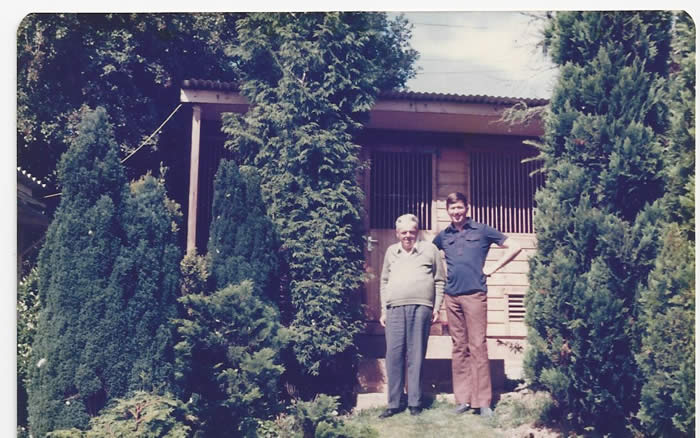
Francis Gamble
American Showman of the Year
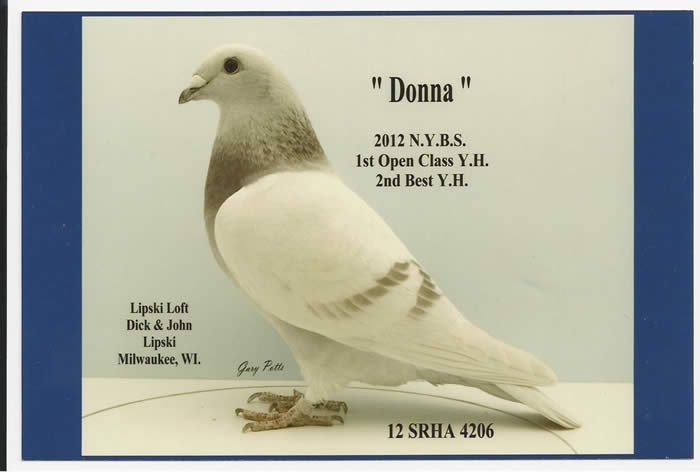
Dick Lipski kindly sends me the results of the American shows every year and this year, there was pleasure in the results for me because Dick and his son John have been awarded with the Showman of the Year trophy. They have been knocking at the door for some years but this year their birds have performed for them at just about every show. They were well ahead in the points tally with 153 more than the runner-up Howard Du Chene. The points system is based on total entries at the shows permutated in quite a complicated way based upon the top awards. Dick explained it but I cannot describe it in a few words. The individual points for Bird of the Year went to a silver old cock (mealy) owned by Stan Relinski. Dick and John commenced their winning by taking out Grand Champion at the National Young Bird show at Louisville with their blue hen, ‘June’.
The following weekend at the North East show racing pigeon show they were reserve champion with ‘Donna’ their silver hen (mealy). The following weekend this hen took Grand Champion at the Midwest National, and Dick and John also took reserve best and third best in the show. Two weeks later they were Reserve Champion at the Wisconsin show of the Show Racing Homer Assn. The two hens which I am displaying are closely related and contain the lines of Len Rusche down through Paul Anderson and Bob Kluss. Dick has always rated the Kluss birds which have the Greenshields lines through Art Rochol and some of the Kemyel blood through Kemyel Krease and Kemyel Lace. Congratulations to Dick and John for their wins and for their work for the American showmen. Incidentally, Dick always judges the Blackpool winners, like myself ‘through the wires or photos and chose Alistair Tankard’s Dark Chequer cock. The pigeon I said I could give a good home to here in Mount Eliza. Dick thinks that some of the birds are beginning to get ‘down-faced’ almost like German Beauty Homers. I don’t necessarily see this myself as much depends on how the bird stands for the photograph. It is a sincere observation and worth thinking about.
Insect life
Tony Harte of Gozo, Malta tells me that he is a believer in the Columbine spray which works on all insect life including the pigeon fly. A couple of months ago he noticed that his birds seemed troubled and spent a lot of time preening their necks in an agitated manner. He again used the Columbine and it sorted the problem for him and his birds. Thanks Tony and good to know that I am read over there in Malta.
Concluding thoughts
This article has taken me a long time to produce while trying to fit it in with other tasks and to précis a great deal of material into readable form. I am always pleased to receive news and views on anything to do with pigeons and as always can be found here at 3 Kunyung Road, Mount Eliza, Victoria 3930 and email
---