NEWS FROM DOWN UNDER
by Doug McClary
August 2012
Winter rumbles along
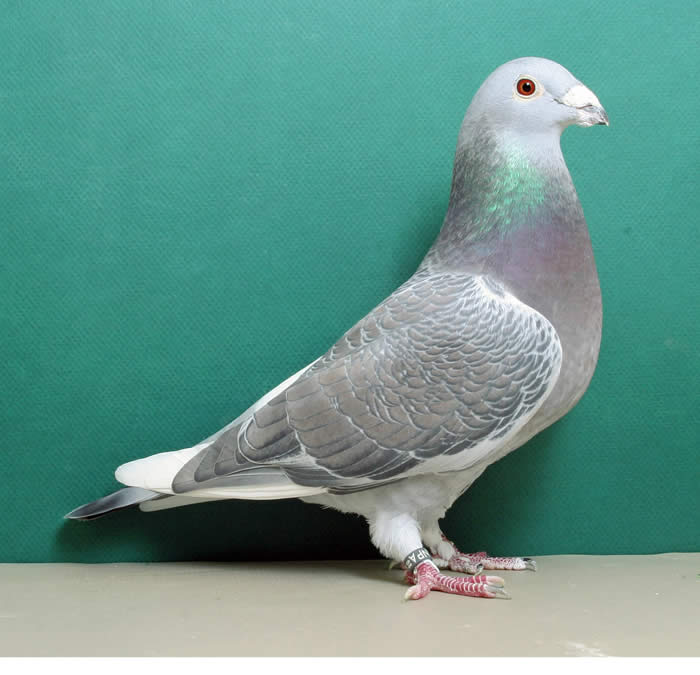
I have been driven indoors today thanks to one of the coldest days of the year, made worse by driving winds and rain from the south. I spent the morning preparing an article for the BHW Stud Book and in between times have been going out to the lofts where I have started the process of pairing the birds. These few days of allowing one pair out at a time in each compartment are time-consuming, but the only way to avoid fighting and possible bloodshed. I am concentrating on the powder blue pairings this year in order to strengthen the stud. The last breeding season I set out to breed mealies and did so most successfully. Even blue to mealy produced only mealy instead of an even split. To avoid the dilution of my strength in the powder blue – my favoured colour, I am taking remedial steps. This week I have taken two stock powder blue hens into Dr Colin Walker our pigeon vet to sort out thickened vent area. I really need these two hens, bred down from the Del Boy and Sapphire lines to provide stock of their quality. Both hens are blue WFs and are sisters and possibly too closely line-bred. I can sort that problem this year if all goes well. I shall report the success or otherwise of this little venture. I am so fortunate having Dr Walker living so close by – about half an hour so can have such problems sorted out fairly easily. As I have mentioned before he has done all the work in proving the Newcastle Disease poultry vaccine and has done it all on his own premises and mainly for no charge whatsoever. The test will continue for twelve months to measure the rate of breakdown of efficacy of the vaccine’s ability to protect pigeons against PMV.
Spring is coming
Judging by the appearance of the yellow wattles in full bloom and the cherries also, it seems that the warmer times are approaching. When we were over in March and April we were so impressed with the displays of daffodils wherever we went – even around Heathrow Airport. Now, the daffodils are out down here in the south and today we picked some from the garden in the form of ‘Cheerfulness’ and one bloom in particular carried fourteen flowers on its stem. My old mentor on Kemyel Farm, Harry Waters would have been proud of such a bloom as that. He grew daffs commercially and I spent many hours with him picking and bunching flowers for the markets. Not only daffs were grown on the farm and cliffs but violets and anemones in flowers and early potatoes were a speciality. Having spent so many working hours up on Kemyel as a boy, I decided to call my stud Kemyel after those pleasures. Earlier in the year Ann and I walked the cliffs from Mousehole to Kemyel rocks where I did so much fishing and was struck that although now feral, numerous daffodils were still growing on the cliff meadows, now overgrown and apparently not used, and the small of violets indicated that they also had survived.
Sadness
I am so sorry to have to mention the death of Kath Baugh, wife of Tony. We all hoped that she was getting over her illness when suddenly it was realised that her health had taken a serious turn and that there was no hope. I know that colleagues have been keeping in touch with Tony at this time of sadness for him and his family. I have known both Kath and Tony for many years respecting them both. Kath was known for her work at the Royal Welsh where she will be greatly missed there but by all in the sport who knew her.
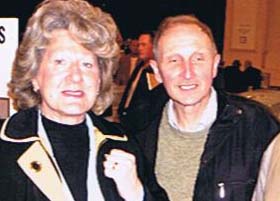
Tony and Kath Baugh at Blackpool
Wisdom from 1927
I was looking through some old material and found this quote from Mr J.R.Billington of Southport regarding the Genuine Flying Homers – which were the Show Racers of those days. Mr Billington and others vainly tried to keep the Genuine Flying Homers as a racing/showing breed but discovered that there were those who wished to impose a standard to make the bird more suited to being a show specimen. The result was that the Genuine Flying Homer became a fancy pigeon known as the Genuine Homer. Mr Billington wrote the following: 'The efforts of many breeders to produce fuller and stronger faces have naturally had the tendency to increase the size and weight of body and many exhibits (at the club’s annual show of 1926) were far too big, thick in tail, and loose in feather, and sadly lacking in that alertness of carriage, tight, hard feather, and compact wedge-shaped body we expect to find in a bird shown under the name of Genuine Flyer.’ I know I keep saying this, but the current trend of trying to breed for head and face, also size of body is changing the Show Racer from a good looking racing pigeon into a breed it was never intended to be. Mr Billington and his supporters were unable to prevent the Genuine Flying Homer from being a truly dual-purpose breed for showing and racing, and unless you breeders in Britain wake up to this fact, you are in danger of going the same way.
Frost
I have lived in Australia for over eight years and for the first time the other morning saw frost on the lawns. I know that we are down near the sea but nevertheless it has been good not having to put up with it. This has been a long and uncomfortable winter this year and after the terrible drought, we seem to be into a wet spell where the reservoirs are now over seventy per cent full whereas at one stage were under twenty per cent. The El Nino factor seems to be changing however and we are told that we may be going back to drier conditions again.
Pigeons in the skies
The vaccination has allowed restrictions in Victoria to be lifted so racing and training can get under way. It is just wonderful to see kits of racers going over again and in the case of where we live by the Bay, they seem to be skirting the bay and not seeking to cross it. I never fail to be thrilled to see pigeons flying about. Whilst the restrictions have been lifted in Victoria, they are in place in all other States so we are unable to take or send our birds across State borders. This will severely curtail racing but I think most agree that some racing is better than none at all. I attended a meeting of the Melbourne Pigeon Society on Sunday last and there were birds on show for the first time this year. I didn’t take birds but may do so next time.
Pairing up
This operation in any show loft takes a lot of thought, planning and effort. As I said before, this year I am planning to strengthen my powder blue base having concentrated on the mealies last season. I like to see pairs in adjacent show pens before making final selections, wanting to observe the points of each with the final product in mind. As with previous years and with such a fixed family connection, I use the pedigree as my final arbiter in these matters. Generally with a good family, it matters less when pairing birds together but I still feel that one’s own tuition and experience of the family can avoid many of the pitfalls of the breeding campaign. This when coupled with the pedigree aspect, helps a great deal and I advise it in a good show loft. Over the years I used crosses sparingly and only as a means of introducing new blood. It wasn’t often that new introductions stayed with me for very long after use for a season. Even then I paired introductions after a long, hard look at them and their potential. One cross in that did stay longer was the ‘Mr T ‘ input from the Speddings and I still have a son of this great chequer cock here today with me in Australia. ‘Mr T’ was a wonderful chequer, one of those birds which come along quite infrequently. I can still picture the fabulous ‘Harry’ in the adult cocks class at Blackpool. When I saw him I resolved to seek out the owner, but Don Spedding got to Harry Spratt before me – and the rest is history. So, I have paired a few birds together and the concentration is on the powder blues but with a sprinkling of the other colours. It is an exciting time of the year and one which makes the initial hard work acceptable and even enjoyable.
Mealies
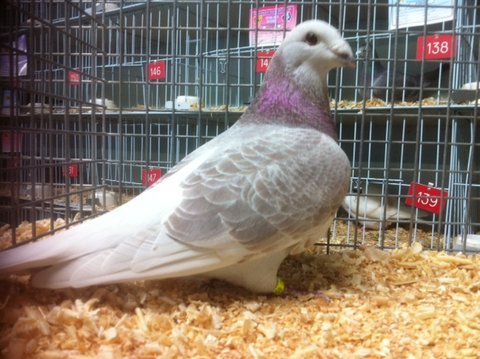
The young mealies bred this year seem to me to be a good group. They are correct in size as good looking racing pigeons. They also carry the sweet expressions so necessary with rich eye colouring set in light coloured heads. This is hardly surprising seeing that they are bred directly from my originals brought across in 2004. The old 2003 mealy cock I brought was not the most perfect show racer but this year when paired to a cream bar hen bred in turn out of mealy and red mating has turned out the goods. I penned them all in the penning room I have in the garage workshop and asked Geoff Nelson to come down to judge them for me. Geoff is now into Australian Show Pen Homers (the American Show Racer) but has an excellent eye for a good pigeon in whatever breed he looks at. He was thrilled with the selection before him and stated that they were handling so well. He selected more or less my choices so I was pleased with that. I left the birds in the pens and asked Ann to judge them for me. She is a good judge of a Show Racer and I was pleased that she again selected those that I preferred. Again, this is not surprising because she has been around Show Racers almost as long as I have. She has managed the birds when I have been away for extended periods owing to my work, and has judged at a classic show. I could liken her ability to that of Janet Rougvie – and I am sure that there are other ladies who could do a good job of judging.
Judges
I return to the topic without apology, for looking in at what is happening in Britain, I feel that mistakes are being made in the selection of judges. There seems to be a desire to have showmen judging Show Racers and while I have always valued good wins under good showmen, I also realise that it is necessary in a breed such as ours to have much of the judging performed by good racing men. The Scottish (East Region) has had a good record in this and I trust that this will continue under ‘new management’. I hear the arguments put forward, that it is difficult to find good racing judges, but they are there and will help keep the Show Racer as something akin to the racing pigeon. There seems little doubt that the use of showmen judging is allowing the birds to get larger as there is little balance being supplied by the good racing input. It is worth thinking about and that is all I suggest, that more thought be applied to the showing of Show Racers. It is good to be able to stand back and to see where things are going. To reinforce my views, can I refer you to a 1932 report I found on the very subject taken from the ‘Racing Pigeon’ about judging qualifications: De Lacy, the writer for the magazine stated that some 25years previously he had subscribed to the view that judges should have experience as exhibitors. Over the years he stated that he had changed his mind and for the judging of racing pigeons he now felt that good racing judges were the best qualified to select racing pigeons. Another scribe known as Quintinian shared this view and added: ‘…the showman judge whose first interest is exhibition, in the course of a few seasons would, by giving undue weight to non essential or purely aesthetic qualities, inaugurate a new variety whose value as racing pigeons would soon be equal to that of the other monstrosities the showmen have invented, not only in pigeons but in almost every sporting animal. It is against this tendency that racing pigeon judges must guard, consistently, conscientiously and firmly. It is their duty.’ Note. Both correspondents were referring to the true racing pigeon and trying to steer shows away from accepting a show version where the top showmen of the day were winning consistently. However, read those words carefully for the talk of show judges selecting for aesthetic considerations such as head and face, size and so on is exactly what I am asserting is happening. Sit back and think about it.
More from the past
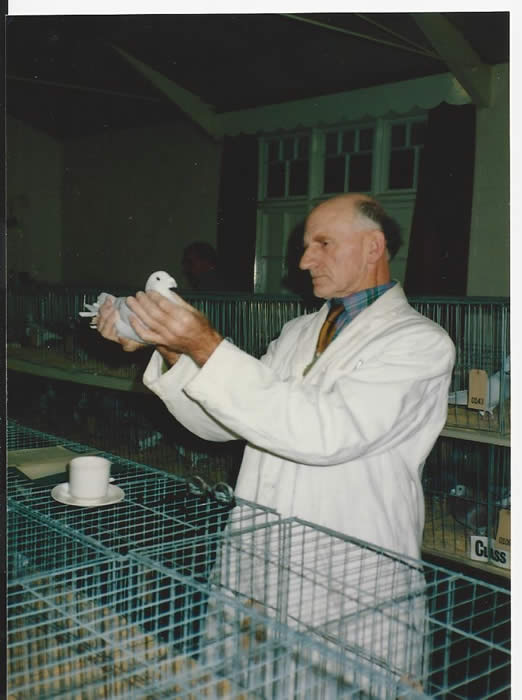
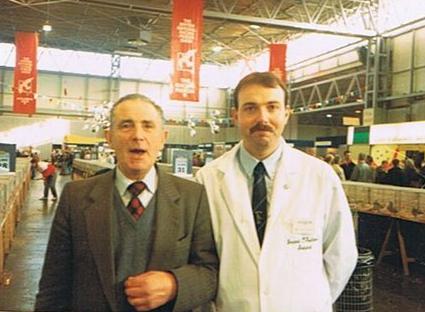
I will round off this month with some faces from the past namely Frank (F.S.M.) Challinor who was for so many years sought as a judge. A former top showman and racing pigeon enthusiast, he continued to judge for many years. Next is a relaxed photo of Gerald Pugh. Even thought out of the sport he visited my lofts just about every year as he travelled down to Launceston to visit relatives. He was pictured here sitting on the steps of my earlier show loft with one of our West Highland White terrier pups. Thirdly, a face most of the older members will recognise, Tony Williams of Bristol, a master at conditioning his birds for the show pen, especially the mealies he loved so much.
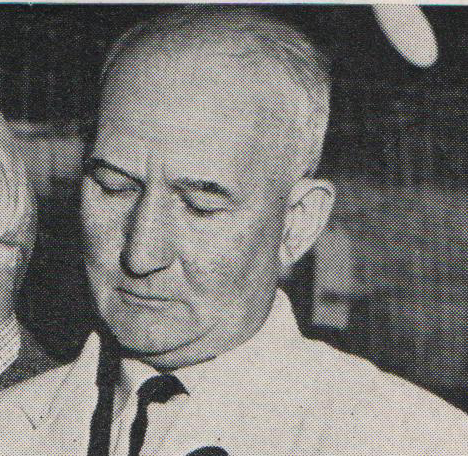
Frank Challinor
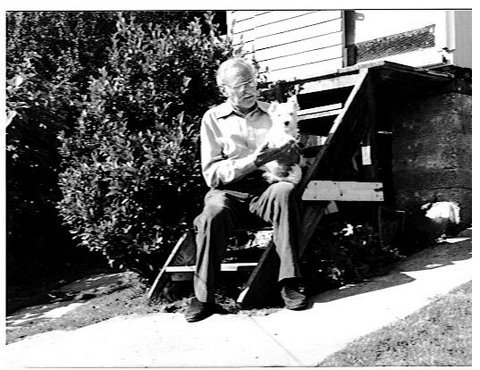
Gerald Pugh
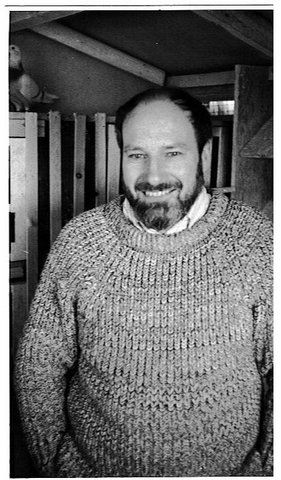
Tony Williams
In conclusion
That is my lot for another time and hopefully by time I write another missive, Australia and Victoria in particular will be warmer. It has been wonderful watching the Olympics and what a great boost it must have been for Great Britain both in terms of success by the athletes but by the success of the Games. I am still at 3 Kunyung Road, Mount Eliza, Victoria 3930 email