NEWS FROM DOWN UNDER
by Doug McClary
Winter and Spring
At last the days are getting warmer although from time to time we are still having to put up with some icy blasts from the south and west. However, it is now more of a pleasure to spend time in the lofts and to see how the youngsters are developing. At the time of writing this I have five only rung – all barred pigeons, so have a long way to go yet. I have a few good eggs so this number will soon increase. I am starting this edition although I have yet to see my last Focus. I know that my Focus has appeared as I have received comments about it. The postal service down here is rather spasmodic and sometimes I get my BHW very quickly, while on other occasions it is late. The initial copies of my book were mailed on the 6th September from the USA but have yet to turn up here in Oz and the thinking is that they have become lost in transit. I am anxious to have it ‘proofed’ so that copies will be available for the Christmas period. Until I get a copy I cannot determine postage rates so things are on hold for the time being. Things have moved on. Firstly my books arrived for proofing and it is so good to see the effort of years in a book form. Likewise with the BHWs. Two arrived in two days, and then today the 8th October, the 5th October edition has arrived. As I have said, you cannot rely on Australia Post; mostly they will disappoint but occasionally surprise one.
A Show
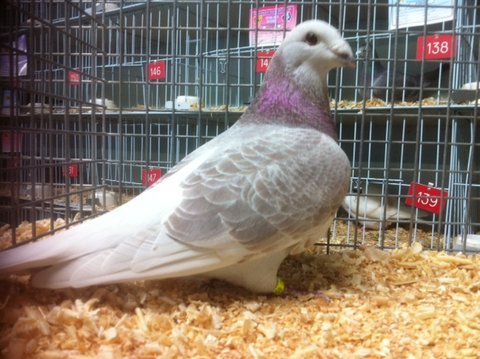
I took five show racers into the morning meeting and AGM of the Melbourne Pigeon Society in the company of Geoff Nelson. The Society celebrates 100years of service to the pigeon showing fraternity of Victoria this year and this is a terrific milestone and achievement. It was a happy show with good feeling at the meetings. A young blue cock of mine – bred by Dr Colin Walker out of one of my blue cocks, won overall best in show. I was pleased to receive an attractive beer mug – which I filled and emptied that evening. The liquid I used was Cooper’s Mild Ale – a rather nice tasting-beer, maturing in the can, but a light colour and not like any Mild I have had the pleasure of sampling in the UK . However, it was good showing again after such a lay-off. I know I keep saying that I don’t mind if I never show again, but it is still good to take some birds along to be judged at a pigeon show. I was able to take a proof copy of my book and that provided some interest.
Two Breeding Hens
Readers may recall my mention of two sisters out of the Del Boy/Sapphire lines which had thickened vent areas. I took them into Dr Colin Walker the avian veterinary who examined them and didn’t feel that it was necessary at that stage to operate. Neither hen has laid – one on loan to Colin and one in my loft. He decided to operate on them recently and his report told me the following: ‘Both hens have had surgery this morning. All has gone well. The BBPH that is on loan to me had an abscess about 3cm x 2cm x 2cm (quite large) in the anterior left abdomen. This has been removed. It is hard to know what the cause of this was but the most likely would be an internal ovulation (where egg material escapes into the abdomen). She will need to be on antibiotics for about 2 weeks now to resolve any remaining infection. At surgery her ovary and oviduct both looked normal and so the hope is that as her problem resolves ovulation will resume. ‘ The other BBPH had a large ovarian cyst (about the size of a golf ball). These cysts are functional and release estrogens which block further follicle formation (and therefore egg production). A small clamp was placed at the base of the cyst and the cyst removed. She will also benefit from a 2 week course of antibiotic. Following this there is a reasonable chance that normal cycling will resume. Hens that have had an ovarian cyst are however vulnerable to developing further cysts. Both hens are now awake and convalescing in heated cages at the clinic. I’ll keep them here for a few days and then they will be ready to go home.‘ I will report further in due course but will ensure that neither hen is paired for some weeks. Both are doing well and I will get them back once the antibiotic treatment has been completed.
Sad News
Almost by chance I have just heard of the death of Hilda Ferguson, wife of Danny of Newburgh, mother of Struan and sister of Alex Wallace. Hilda and Danny had been married for 55 years but had known each other for 61years. I didn’t ever realise that Danny had hailed from Essex and moved to Newburgh in 1949, obtaining a job in the linoleum factory as a designer. Hilda worked in accounts for many years and together they enjoyed holidays abroad. Hilda collapsed in Hertfordshire when they were visiting their second son Alistair and despite being rushed to Stoke Mandeville hospital, died with a pulmonary embolism. She died on the same day as Kath Baugh, July 26th. I am sure that all fanciers will wish Danny well in his life without his soul mate and we send best wishes to Struan and Audrey and their children Liam and Russell; Alistair and Nicola and their children Euan and Ben, and of course Alex, the other half of the Wallace and Ferguson showing partnership.
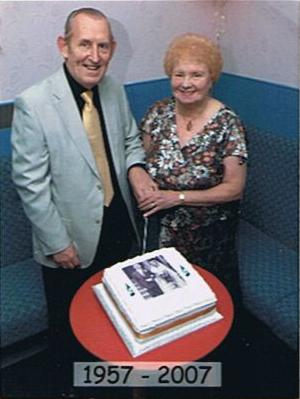
Danny & Hilda's Golden Wedding in 2007
Insect Life
I received a call from two brothers in England who are desperate to find a complete answer to the presence of insect life on their pigeons. In addition to the usual feather lice, they have found a problem with a larger creature – which I would believe to be a pigeon fly which is fast moving and can jump or fly off the birds. I once saw pigeon flies when judging in the USA in the Deep South . I had been warned that a bird coming to me might have some on it and sure enough they skipped off the bird when I handled it. Apparently they are plentiful in Malta and I am wondering whether the global warming has allowed them to flourish in Britain . I would be pleased to hear from anyone with experience of these insects and also a sure way of curing problems of insect life on birds. It shouldn’t be a problem where you have such a wide selection of remedies. It is something I am always working at and have a spray available at all times and any bird handled is given a short spray under its wings.
In Conclusion
That is my lot for another time as I am including this month a supplement on the showing career of one of the doyens of showing, Stan Wheatley. I feel sure that readers will find interest in Stan’s experiences. In the meantime my breeding campaign stutters along, not helped this morning by finding my top blue cock dead on the floor. He was a link between my 2003 bred birds and my present and future, so his loss will be keenly felt. Luckily I have a pair in the nest from him and also a pair of good eggs to be farmed out. Last month’s reference to Father Christmas at Louella, was of course Fergus Wilson. Nobody seems to have come up with that answer. I am still at 3 Kunyung Road, Mount Eliza, Victoria, Australia and email at
Stan The Man - The Stan Wheatley Showing Career
Over many years in the sport, I have always felt pleased to meet up with Stan Wheatley of Middlesborough. His infectious smile and good common sense is always appreciated. Also appreciated was some information from him which takes us back to some of the early days of the keeping of pigeons in the North East. Stan started his pigeon career with short distance racers (milers) from an early age and before he went into the army. When he left the army, many of the streets where the short distance racing had been popular, had been demolished and this caused the ending of that aspect of the sport. Still being a pigeon mad individual, Stan looked for another interest and set his mind to flying tipplers, obtaining two pairs of black badges from Clarence Slade of Bristol. Pigeons bred from them could fly for twelve hours with no bother providing that their diet was right. Possibly those lessons in feeding equipped Stan for his show racers in later years. It was mainly of a soup mix obtained from the corner shop consisting of lentils, pearl barley and split peas coated with a few drops of cod liver oil and then mixed with some Farley’s baby rusks. This was a ‘tit-bit’ feed in addition to the normal feed of wheat and maples. A move of house resulted in the fliers having to be disposed of but the pigeon bug was still deep seated and Exhibition tipplers were obtained from Eric Loach, the then National Tippler Union president. These were later added to by birds from Mel Brooker of Norwich. Stan must have been highly regarded by the Tippler men because he was appointed to judge at the Norwich Championship show where he selected as his best, a blue cock which went on to be overall best in show. Stan was amazed because as he was leaving the show for the journey home, Mel presented him with a box which contained that blue tippler, a great winner for him. Stand mentioned that this was the calibre of sportsmanship which existed in those days.
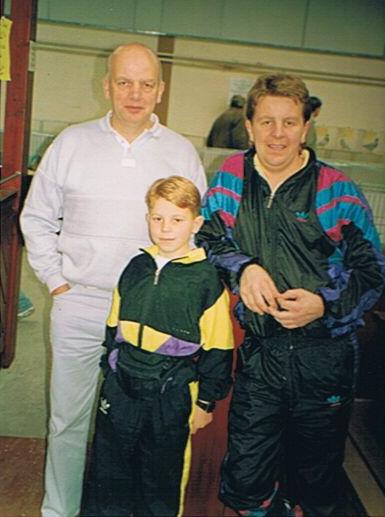
The Wheatleys
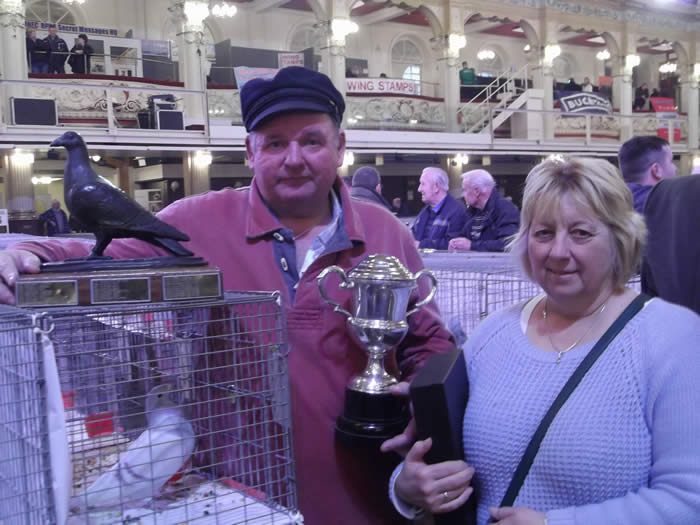
One day, a local fancier, knowing of Stan’s successful career in pigeons presented him with two pairs of feeders which turned out to be show racers. Stan was so attracted to the show racers that he made a career change and disposed of his fine stud of exhibition tipplers. Stan contacted me and was sent two silver chequer hens. I have checked my records and can date this transaction to 1980. The two silvers were as follows: a 1978 bred hen bred from a silver chequer cock and dark chequer hen, and a 1979 hen from two silvers. Stan sought a silver blue cock but as we all know, this is not easy to find. One day when talking to a work colleague, Stan mention this need and a few days later he was given a box in which was a racing silver blue cock which had raced 500 miles, another example of the good will which existed. Stan produced good pigeons using the hens and the silver blue cock, producing silvers of good quality which started to win well for him, allowing him to join the ranks of the Northern Counties SRS in the days of Bob Tate of Boston Spa and Dennis Johnson. Prize cards were hard to win in that Society with such good competition. Stan recalls the first time he entered silvers at a classic show, the G.Y.A. at Harrogate, one won best opposite sex (to my BIS as it turns out). Then, at the NCS championship show, exhibiting only eight silver chequers, Stan took eight firsts and all the specials, one of his proudest moments. Yet another change of address resulted in the birds having to be disposed of and these went to several lofts and he hopes that some of the good silvers around today are bred down from those birds. He got settled into his present address and looked for another challenge. He saw the advertisement placed by John Robilliard and me for all the birds of Mike Hale who had died in 1985. He obtained the top pigeon on offer, the mealy cock which became known as Caesar together with his red hen. The hen had problems in laying so Stan paired Caesar to a red hen obtained from the W.Laughton clearance sale. This pairing his it off and a red cock bred in the first nest, was entered at the Pigeon World Championship show at York Racecourse and won best show racer including a special prize of one hundred pounds. The mealies bred tended to be a little lacking in bar so Stan decided to find a good pigeon to correct this aspect. He went to Blackpool and after examining all the entries came up with a red hen he liked, owned by Eddie Gale who later agreed to sell him the bird. He promised Eddie a red in return and it was agreed to supply the bird at the next Blackpool show, entering it in the young cock class under Don Spedding. The red won the class out of 134 entries but it still went back to Wales and bred very well for Eddie. And a firm friendship developed leading to the exchange of good pigeons. Stan later obtained the full brother of Caesar, another mealy, from Don Spedding who had received him in exchange from Mike, as Don had been the supplier of the hens which bred Caesar and his brother. Stan recalled how difficult it was to get in the prizes at the classics in those heady days when the top names included Tony Williams, Paul Rogers, The Bartles, Walter Murdoch, Lock and Little, Eddie Gale, Don Spedding, Ron McCarthy, Colin Carter, Harry Spratt, John Robilliard, Bill Meader, Keith Foley, David Shuttleworth, Mark Hylands, Tony Baugh, Doug McClary, Jim Fitzpatrick and others. In his concluding remarks, Stan stated that the size of show racers today is not advancement because the added size has taken away back cover and he feels it is a backward step. In his typical ironic fashion, he opines that if they get any bigger they will have to be put on top of the pens like chickens. He states that he always liked racing men judging the birds as they more often than not went for the medium sized, solid birds. I am grateful to Stan for the information which has allowed me to tell an interesting story. Fortunately, Stan is still around and the Wheatley dynasty continues with son and grandson both at the top in showing. My photo of the three generations of Wheatleys may not be altogether appreciated by the younger ones but Stan won’t mind looking a bit younger!
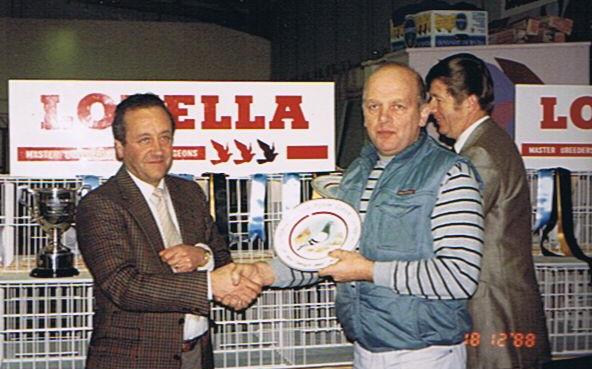
A 1988 snap taken at Louella with Stan receiving a special award from John Massarella.
---