“ON THE ROAD” WITH KEITH MOTT.
LOFT VISITS IN SCOTLAND (PART 2.)
Whenever I sit down to write an article on Scotland, I always think of the great ‘Many Miles with Mott’ video tours that the late Albert Taylor and I went on, north of the border, and the brilliant times we had on them. Scotland, home of the haggis, the long distance ‘doos’ and wonderful people!
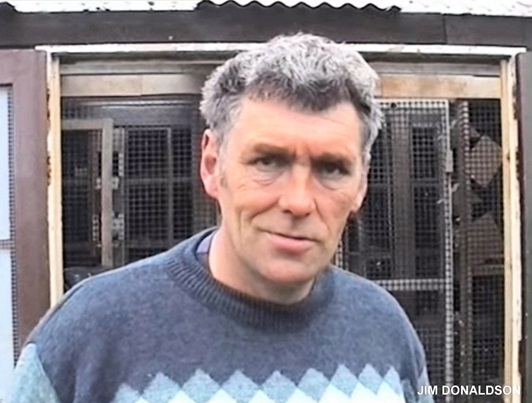
The late Jim Donaldson of Peterhead.
I made the long drive up to Peterhead on the north-east corner of Scotland with my good late friends Albert Taylor and Ian Gray of Forfar, to visit the Scottish National Flying Club ace, Jim Donaldson. Jim is a master at long-distance pigeon racing, winning countless prizes over the years. 1995 was his best season when he recorded 1st Section in all four Scottish National Flying Club Old Bird races and 1st Open Scottish National Flying Club Sartilly (2). A fantastic performance! Jim was flying 605 miles from Sartilly, 650 miles from Rennes and 775 miles from Niort. In the 1995 season the Donaldson loft also won 2nd Open Federation from Sartilly, just for good measure.

Jim started in the sport in 1980 when his son had a few birds and got fed up with them, so he took them over. The family of pigeons at the Peterhead Lofts is 90% Davey Scott of Brechin and down from two pairs of Kirkpatricks obtained from Sid Beard of Hemel Hempstead in 1980. Jim races his birds on the natural system and uses the Federation races for training. He pairs the birds on 15th February, and feeds a heavy mixture when they are rearing, but changes the feeding to a light widowhood mixture for racing. The corn is never 'beefed up' for the long distance and Jim said his pigeons eat hardly anything when they are right for the long-distance races. He reckons hens are his best long distance racers, his Scottish National Flying Club Section winners have all been hens feeding small youngsters. Jim is only interested in long-distance racing and his team goes through to Niort. The Sartilly National winner was a nice apple-bodied blue chequer hen sent to the race on chipping eggs; she had previously won 7th Open Federation Sartilly. Her dam, also a blue chequer, was an outstanding racer, recording 1st and 3rd Section Rennes (both Scottish National Flying Club) and had bred many champion racers. Jim's favourite pigeon was his good mealy hen, who has won many prizes in long-distance events, including 1st Section, 48th Open Niort and 2nd Section, 15th Open Sartilly (again, both Scottish National Flying Club). Jim said this wonderful hen has never let him down and she always sat tight and never exercises around the loft for the week before the main National races.
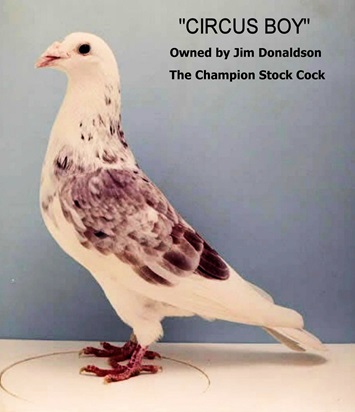
The racing loft at Peterhead is a very smart affair, 30 feet long, with four sections and open-door trapping for the old birds. Ten pairs of stock birds are housed in the main loft, paired up at the beginning of February. The stock team is mainly made up of latebreds taken from the very best racers and Jim hopper-feeds them with a heavy mixture. The best stock cock was the red pied 'Circus Boy', which has bred four 1st Scottish National Flying Club Section winners and his blood runs right through the whole Donaldson team. 'Circus Boy' was bred in 1981 from Scott and Beard stock birds. Jim is very keen on eye sign in the stock loft and said that he always pairs opposite colours, but maintains it means nothing in the race loft. He bred 70 young birds to race each season and they all had to race through to 230 miles, with six or eight picked out to fly the 300 miles Young Bird National race. The first training toss was from 40 miles and the trainers were fed heavily with high quality mixture. The Peterhead loft of Jim Donaldson, one of the best long distance set ups north of the border!
The late John Ellis of Wellbank near Dundee in Scotland.
I was very sad to hear of the passing of the legendary Scottish long distance racer John ‘Jock’ Ellis of Wellbank. John was a legend in the truest sense of the word! I had the very good fortune and pleasure of visiting his home near Dundee in the mid 1990’s and this is a little account of that visit, as my little tribute to one of the ‘all time greats’ of Scottish pigeon racing. I was very happy when my good friend, the late Ian ‘Smokey’ Gray, told me he had arranged a loft visit to the great John Ellis, as John was a fancier I have admired since I started up in the sport 45 years ago. Back in the 1960s, when I was learning the 'trade', I read about John's long-distance performances and his champions, ‘Wellbank Endurance’, winner of 1st, 2nd section, 27th, 82nd open British Barcelona Club Palamos (1,044 mile) and ‘Wellbank Pride’, winner of 1st section, 8th open Rennes in the Scottish National Flying Club, flying 583 miles and so on.
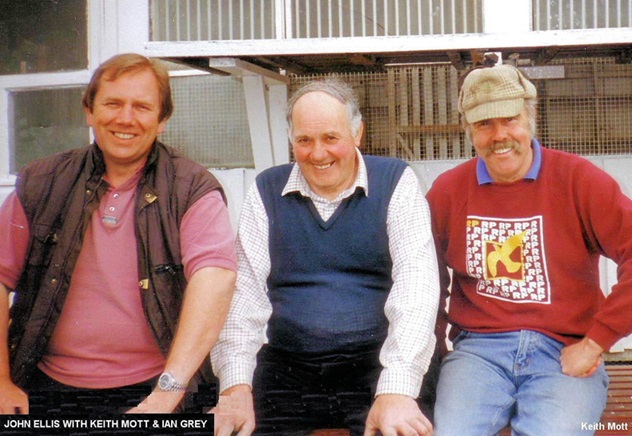
John started in the sport in 1958, with only long-distance racing in mind. His loft has won countless positions in the first ten of the Scottish National Flying Club Open results over the years and recorded 1st and 2nd section, 27th and 28th open BBC Palamos (1,044 miles) in the 1970s. If a pigeon won from 400 miles he was looking for it to win from 600 miles. John had been in the Scottish National Flying Club results every year since 1962, apart from the season when his father died. At that time, one of his most recent champions was the blue chequer hen, 'Wellbank Reliable' who won the Gold Award in the Scottish National Flying Club; by the time she was three years old, winning five times from 540 miles or over. Her best position was 8th open Sartilly Scottish National Flying Club, 540 miles and she liked to be sent sitting week-old eggs or feeding a small youngster. At the start John obtained birds from several top long-distance fanciers in the north and blended his own family. Crosses were brought in from time to time and he told me Stichelbauts obtained from his late friend, Bernard Miles, were produced outstanding birds when put into his own pigeons. He had a grandson of the 'Tee' and a Pol Bostyn hen which were breeding well at the that time. Some more of John’s great racers were: ‘Wellbank Endurance’, 1st, 2nd section E. 27th, 82nd open B.B.C. Palamos (1,044 miles): ‘Star’, 2nd section, 5th open Nantes: ‘Paris Cock’, 11th open Nantes, 30th open Paris (smash): ‘Faithful’, Gold Award winner: ‘The Mealy Pied Hen’, 21st open Nantes (643 miles on the day): ‘Patricia’, 9th open Beauvais.
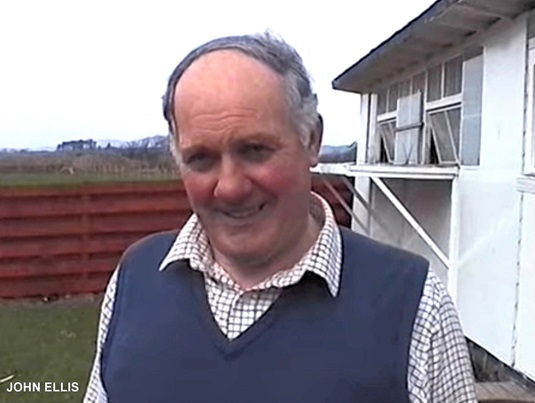
John had a very smart 40ft loft with landing board and drop hole trapping and the old birds were raced on the natural system. John's 30 pairs of old birds were paired up the first week in March and were given about three 250-mile races in the local Dundee and District Club before being entered in the National events. The best racers were consistently paired to stock birds, so their mates were always there in the box on their return from the races. Old birds may have been asked to fly in two or three long distance races in one season. John fed a first-class mixture, based on beans and maize and said he was a very heavy feeder. Because of the extremely bad hawk problem around John’s Wellbank home, he bred a good team of about 50 or 60 young birds each season. He told me they were not raced heavily, but he liked them to have a few races to set them up for later life. His local Federation was very slow getting the birds down to the distance, so John had to jump his youngsters 200 miles into the Young Bird National. They were fed on first class mixtures and got plenty of it. We had a great day out at John’s loft and handled some of the best long distance ‘doos’ in Scotland.
The late, Bobby Carruthers of Bonnyrigg.
On my second trip to Scotland, I visited the National 'ace', Bobby Carruthers. Bobby started up in 1952 with nine young birds and after racing them through to 200 miles was left with eight. He started up when he left school and said all his childhood friends had pigeons. He had recorded countless positions in the first ten of the Scottish National Flying Club results through the years, including 1st open and three times 2nd open. He had had four Gold Award winners and in 1997 won 1st Federation and 4th open Sartilly, 496 miles Scottish National Flying Club on a very hard day. Bobby loved long-distance and said it's for him. He showed us many of his best racers including a blue chequer hen, which in 1995 was raced in the two Sartilly Nationals, being the only bird on the day in Mid-Lothian both times, recording 18th and 24th open Scottish National Flying Club. She had scored many times sent feeding a small youngster, including 7th Federation from a hard Fareham, 360 miles, as a yearling.
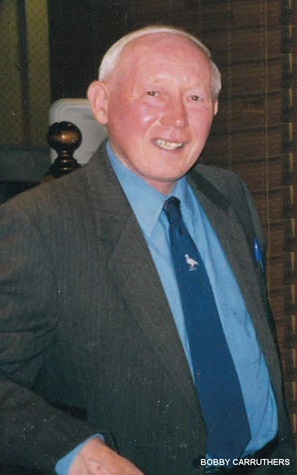
Bobby only raced natural, and never paired his long-distance team until the end of March. They were not put in a basket until the cold north-east winds have gone, and the weather is warm. They then got a 50-mile training toss every day until they were fit to do their work. They were hopper-fed beans and peas all the year round, but when racing starts they were given a sport mixture as well as the hopper. His hoppers were self-built and had a sloping board on the front, so when the birds threw the beans about, they just roll back into the hopper. His main old bird loft was double-decker, made of brick and had grilled floors with sputnik traps. All his nest boxes were closed in, ideal for long distance racers. The old birds used to get an open loft all the time, but because of the hawk problems in Scotland, Bobby couldn’t do it anymore. They were never let out of the loft in the winter, as he would have birds killed every day by hawks.
The main family was Kirkpatrick originally from the late John Carrnichael of Lockerbie. Bobby bred a lot of youngsters each year because of the hawk problem and the race team was normally about 120 birds. The 26ft young bird loft was kitted out with nest boxes, as he liked his youngsters to pair up for racing and they went to all the way to the National race. He said at the time of my loft visit, the darkness system is bad for the birds in the long term, so he practiced the light system where the young bird loft lights are left on until 22.00hrs every evening until the end of April which pushes the moult on. Bobby maintained basket training is more important than lots of road work. He took a lot of trouble to teach his youngsters to eat and drink in the basket and their first three training chucks were from his front garden to teach them how to come out of it. The young birds got lots of training tosses up to 50 miles before the first race and they raced every week, up to 280 miles.
Well that’s it for this week! I hope my readers have enjoyed this look back at these Scottish winning champions of yester year. We will be looking at some more very soon. To view some old video footage of some of these fanciers and their birds go on to my YouTube channel. I can be contacted with any pigeon matters on telephone number: 07535 484584 or email me on:
TEXT & PHOTOS BY KEITH MOTT (www.keithmott.com).