“ON THE ROAD” WITH KEITH MOTT.
Derik and Anne Nordon of Langholm.
One of the premier lofts in Scotland over many seasons must be that of Derik & Anne Nordon, with brilliant performances in the SNFC, including 1st open twice. Derik says not much racing was undertaken in the 2001 season because of the ban on racing from France, but the 2000 season saw the loft win The News of the World Trophy and Ellsworth Trophy for the Best Average for Messac and Nantes. The Nordon loft had a wonderful season in 1999 winning 1st and 2nd Open Stafford (2,847 birds), 165 miles; 4th Open Weymouth (686 birds), 310 miles; 7th Open Worcester (2,376 birds), 203 miles; 7th Open Cheltenham, (1,409 birds), 228 miles; 4th Open Basingstoke (365 birds), 365 miles and in the mighty Scottish National Flying Club they won 6th, 7th, 34th, and 65th Open Frome (3,827 birds), 272 miles; 1st, 2nd and 44th Open Rennes (3,000 birds), 490 miles; 19th Open Nantes (2,862 birds), 550 miles; 9th, 11th, 17th, 102nd and 103rd Open Sartilly (1,973 birds), 447 miles; 11th and 26th Open Leicester Young Birds (3,381 birds), 192 miles. A fantastic loft performance!
I first visited the Langholm loft in the spring of 1997, while on a “Many Miles with Mott” video tour of Cumbria and Scotland and was very impressed from the outset with Derik's pigeons and loft set-up. Derik played Accordion in a dance band for many years and during the day worked in an engineering workshop, with one of his workmates being the ace pigeon racer, Ralston Graham. After several visits to Ralston’s successful loft, Derik decided in 1972 to give up the band and have a go at racing some 'doos'. He won his first gold award in 1982 with a good red chequer cock and says his winning bloodlines still go through the loft today. The Nordon loft won the SHU Dewar Trophy for Best Dual Performance in Scotland and Scotland's Own Bird of the Year in 1996 and 1997. Derik won 2nd Section eleven times before winning 1st Section and then chalked up four, one after the other. He first won the SNFC in 1996 from Sartilly with his good mealy widowhood hen, ‘Anne's Delight’, and she flew the National in 10 hours 44 minutes against a north-east wind. This game hen was a Gilbertson / Van Bruaene and the Sartilly National was only the sixth race of her life. Her sire was a wonderful mealy cock and he flew Rennes with the SNFC six times on the day, for six years on the trot and recorded 10th, 36th, 87th, 175th and 186th Open. His brother won 1st Section, 2nd Open Rennes SNFC in 1995. A brilliant family!
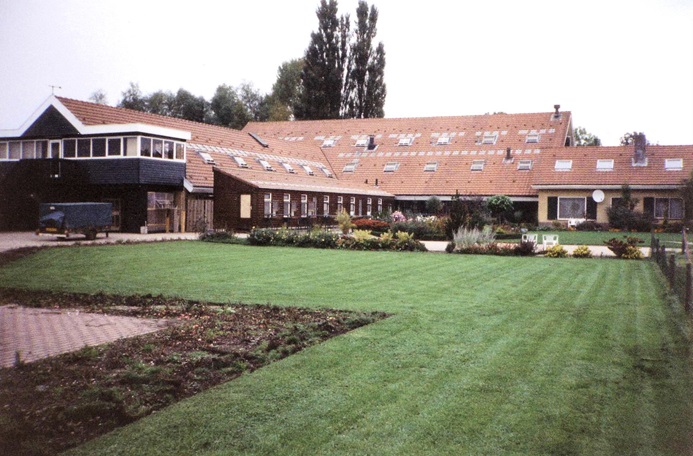
Derik has always raced natural with the SNFC races in mind but got fed up with hawks which attacked his racing pairs every time he let them out of the loft, so in 1996, he changed his nest boxes and decided to have a go at his own system of semi-roundabout, with outstanding success. He maintains that the type of corn has no bearing on success with racing pigeons, but it must be of the highest quality. He used to like feeding beans but now feeds an ‘Irish’ mixture, adding extra maize and peanuts for the longer races. The racers are paired up the first week in March and the birds are not treated for anything. After the season on roundabout, they are re-paired for the last Channel race. Derik has a self-built brick double-decker loft which looks like a small house at the end of his hillside garden. The racers are housed in the top and the view from their sections over the valley and Langholm is really nice. The floors have grilles to keep the birds clean and all trapping is through sputnik type bays.
Premier racers at the Langholm loft today are: ‘Champion Anniversary Girl’, blue hen, 1999: 1st Open Rennes SNFC (2,862birds),490 miles. This great hen won over £1,000 and two gold awards for winning five times from the Channel. ‘Hightower Kieran’, blue cock, 2001: 43rd Open Portland, 318 miles; 2000: 92nd Open Messac, 510 miles; 55th Open Vire, 470 miles; 1999: 17th Open Sartilly SNFC (1,973 birds); 1998: 19th Open Sartilly SNFC (2,042 birds); 9th Open Rennes SNFC (3,019 birds); 1996: 34th Open Sartilly SNFC (2,047 birds). This game cock won seven times in the first 100 open prizes in the SNFC and was Scotland's Own Bird of the Year in 1998. ‘Hightower 3619’, blue chequer hen won 1999: 103rd Open Sartilly SNFC (1,973 birds); 1998: 110th Open Rennes SNFC (3,019 birds); 4th Open, 1st National Hens Frome SNFC (4,005 birds); 1996: 43rd Open Sartilly SNFC (2,047 birds). ‘Hightower 1330’, red chequer hen, winner of: 2000: 4th Open SNFC King’s Cup Messac, 1999: 11th Open Sartilly SNFC (1,973 birds); 44th Open Rennes SNFC (2,862 birds); 34th Open Frome SNFC (4,005 birds); 1998: 38th Open Frome SNFC (3,019 birds). I believe one of Derik's best racers in recent years is ‘Danny Boy’, a blue cock, a champion in the truest sense of the word, winning: 1999: 2nd Open Rennes SNFC (2,865 birds); 65th Open Frome SNFC (4,005 birds); 1998: 5th Open Rennes SNFC (3,019 birds); 1997: 9th Open Rennes SNFC (3,269 birds); 38th Open Frome SNFC (3,272 birds) and over £7,000. A brilliant loft of national racers!
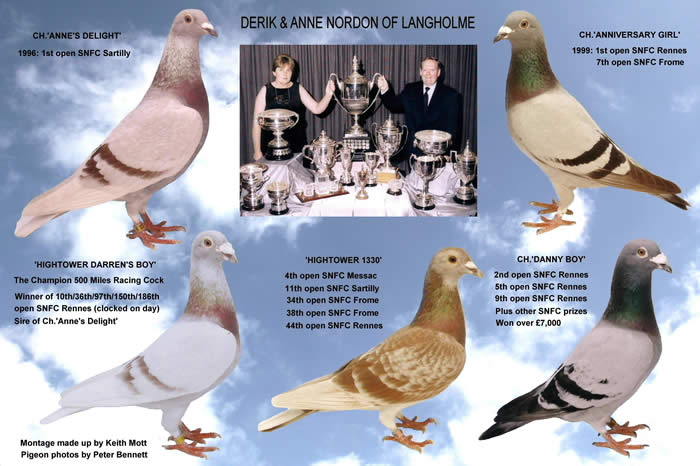
One of Derik’s best pigeons, of all time, is his champion Kirkpatrick mealy cock, ‘Hightower Darren’s Boy’ and he was bred down from the Tommy Gilbertson and Bobby Carruthers bloodlines. This wonderful pigeon won many positions racing, but the longest SNFC race from Rennes was his main event each season, flying Rennes (490 miles) six times on the day of liberation and winning:1989: 150th open SNFC Rennes, 1990: 10th open SNFC Rennes, 1991: 97th open SNFC Rennes, 1992: 186th open SNFC Rennes, 1993: 36th open SNFC Rennes. A fantastic racing record! He was named after Derik and Anne’s first grandson, Darren, and his brother was the mealy cock, ‘Hightower Jamie’, and he was named after their other grandson, Jamie. ‘Hightower Jamie’ was also a top racer, winning: 52nd open SNFC Rennes, 157th open SNFC Rennes and 1st section, 2nd open SNFC Rennes (490 miles), the day when Dal Newcombe won the National race. ‘Hightower Darren’s Boy’ died at 22 years of age, after many years breeding winners in the Nordon stock loft and was the sire of Champion ‘Anne’s Delight’ winner of 1st open SNFC Sartilly. ‘Hightower Darren’s Boy’ a once in a life time pigeon!
Derik races cocks and hens on his own semi-roundabout system and pairs them up in March. They rear a pair of youngsters and are given six 35-mile training tosses while feeding the squeakers. When the youngsters are weaned the cocks and hens are parted and they are on the roundabout. The cocks stay with the nest boxes and the birds exercise separately around the loft. Derik says that, when the hens are in form, they will fly for two hours around home. The birds are allowed to be together for a few minutes on marking night but are never allowed to tread. Their normal build up for the long-distance nationals is two inland races, the Frome SNFC (272 miles), then into the main events from Rennes and Nantes. Derik keeps 12 pairs of stock birds which are paired up in mid-February and housed on the ground floor of his smart loft in sections which have grilled floors and closed-in type nest boxes.
The main families kept are Bricoux / Kirkpatricks from Tommy Gilbertson of Carlisle and the late Bobby Carruthers of Bonnyrigg, with Van Hees obtained from Bernard Miles from the south of England. He did try some Busschaerts obtained from friends and said they were good up to 200 miles, but over that could not keep up with his own birds. Derik isn't hard on his young birds and says some of his best old bird racers didn't have a race as young birds. He gives the youngsters a few training tosses and races them naturally to the perch. Most of the young bird team get only a couple of races in their first year, with a few being sent to the National Leicester race from 192 miles. Derik has won countless SNFC Averages and trophies through the years and was Scotland's Own Fancier of the Year in 1993 and 1999. Well done to Derik and Anne for their wonderful performances in the Scottish National Flying Club in recent seasons. Great Stuff!
John and Nancy Traill of Thornton.
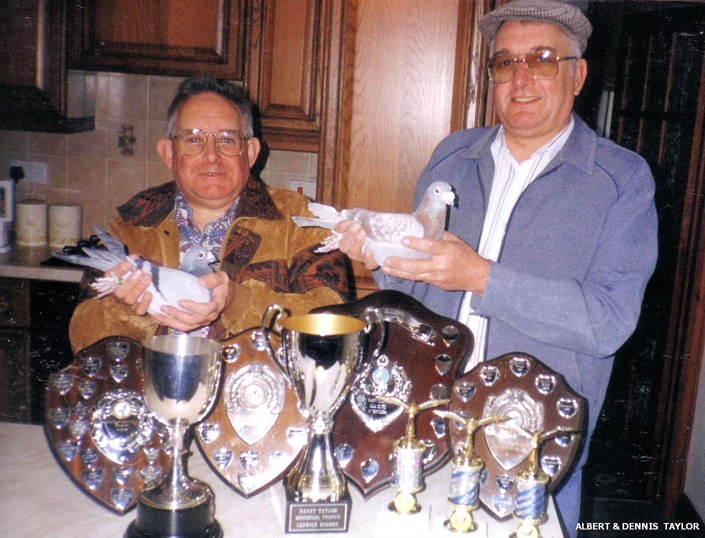
When John Traill passed away in June 2001, the sport of long distance pigeon racing in Scotland lost one of its greatest champions. I met ‘jock’ in the mid 1990’s, when I visited his Fife loft while on a ‘Many Miles with Mott’ video tour with Albert Taylor and we found him to be a real gentleman pigeon fancier. He loved long distance pigeon racing, with the highlights of his 55 years in the sport being twice 1st open Scottish National Flying Club.
John was born in Balmalcom in Fife and when he was five years old his family moved to Ladybank. As young lad he had a pair of pigeons which were housed in an orange box screwed to the wall, but became first interested in racing pigeons at the age of 19, when made regular visits to the loft of his friend, Wullie Henderson. John purchased his first birds, basket and clock from Sandy Stevenson, the local cobbler in Ladybank, who was leaving the sport and top flyers at that time were Norman Dall, Jack Andrews and his old friend Wullie Henderson. John Traill liked to play Bowls and loved to dance, taking lessons in ballroom dancing at one time. The first club he joined in 1951 was the Howe of Fife Club in Ladybank and raced to a small 10ft.x 6ft. loft built by his Uncle Sam. John raced what he called the ‘Heinz 57’ strain and won out of turn at the club races in the early days, but all the time he wanted to acquire birds that would compete and win at the long distance. John’s early mistake was trying to compete in every club race and wearing the pigeons out. He moved from Ladybank to Thornton in 1965. His old original family are J. J. Baird of Liverpool (Barker strain), obtained from Wullie Henderson of Cupar.
On my visit John told me, he could trace his National winning family back to some of those original pigeons he had in 1951. He always raced on the Natural system and kept 25 pairs of racers and 8 pairs of breeders. John paired everything up at the same time, the first weekend in March, and told me he liked to wean all his young birds at the same time, so they were all the same age. When he was asked about the widowhood system, a distasteful expression came on his face and he told me, he would never entertain it for long distance racing. John’s great old 24ft. ‘L’ shaped loft was in a wire compound, with a lawn out in front of it and he said it was built with the pigeons comfort in mind. It was well ventilated, with wire bays and drop hole trapping, and he didn’t use deep litter, but had a few wood shavings scattered around the floors. John was a scrapper man and maintained you shouldn’t be able to smell pigeons in a loft, with dryness being essential to keep the birds healthy. He made up his own mixture of wheat, maize, beans and maple peas, which was fed all the year round, but a few weeks before the main 500 and 600 mile events he took out the wheat and added more maize. He didn’t like to train his birds when they were feeding youngsters, but would train cocks from 20 miles, if the weather was very good and he thought training yearlings early in the season was very important. During the season he would train twice a week and liked his long distance National candidates to have a 7 to 8 hour fly in a club race about three weeks before the main events. John raced his yearlings down to Fareham (350 miles) on the south coast, his two year olds over the channel to Sartilly and his old birds had to go all the way to Nantes (620 miles) and Niort (690 miles) with the Scottish National Flying Club. His favourite nest condition for sending birds to the long distance events was sitting 10 to 12 day old eggs on the day of basketing and never sent feeding youngsters. He didn’t like jumping pigeons long distances and started them in a 60 mile club race and built them up to 600 miles. The birds were fed in pots, in the nest boxes and he told me they always had corn in front of them at all times. He liked to see the hens sitting 10 days, low in the nest bowl with that staring look, and said that was the sign of a hen being keen and in good condition.
John Traill had many premier positions in the Sottish National Flying Club through the years, with his best being: 1995: 20th open S.N.F.C. Niort, 80th open SNFC Rennes, 1996: 1st, 8th open SNFC Niort (690 miles), 1997: 11th open SNFC Rennes, 1st, 30th open SNFC Nantes (620 miles) and he also won 2nd open SNFC Nantes (620 miles) and 1st open Fife Federation Dorchester (400 miles). He won numerous positions in the first thirty open in the Scottish National Flying Club races. His National winners were: CH.’TRAILL’S SPARK’, dark chequer cock, winner of 1996: 1st open SNFC Niort (690 miles, liberated at 06.00hrs and clocked 10.20hrs next day), 1995: 27th open SNFC Niort, 1992: 1st open Fife Federation Dorchester (400 miles). CH.’NANCY’, the frill blue chequer hen named after John’s wife, Nancy. She won in 1997: 1st open SNFC Nantes (620 miles) and in 1996: 8th open SNFC Niort (690 miles).
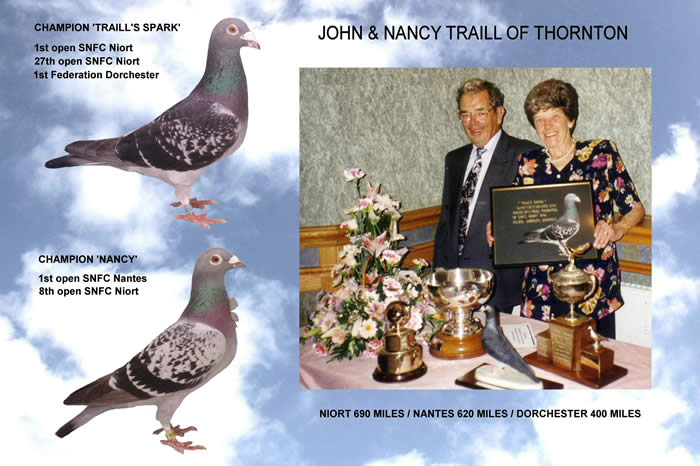
The main stock pair was a blue chequer hen bred down from the old Traill family and before being put to stock, she was a useful racer, winning many major prizes including 2nd open Federation. John told me she was the dam of the loft! Her mate was a handsome blue chequer pied, being produced from a gift egg from Keith Cochrane, and he was bred down from the Eddie Newcombe bloodlines. This wonderful stock pair bred the Niort National winner, Champion ‘Traill’s Spark’. When John introduced new stock he preferred to bring in a good hen, bred close to good 600 mile winners and out of a consistent loft. He didn’t have many crosses over the years, but some successful ones were from Dennis Dall, Bobby Carruthers, Keith Cochrane and J. & J. Keir.
The loft normally had about 50 youngsters for racing each year and these were fed on a first class young bird mixture, with no maize. They were raced natural to the perch and if the weather was good, John would started to train them three weeks before the first Federation race, which was about a 60 mile fly. He started to train them at one mile to teach them to come out of the basket and worked them up in stages to 40 miles. All the babies were raced through the Federation programme, but if he fancied one or two, he had no problem about stopping them at the 100 miles stage. He told me he had tried the nest bowl in the corner trick, but had more success racing them to the perch on the natural system. The Traill young bird team were never put on the darkness system and liked them to have as much fresh air and sunshine as possible in their early life. John liked to race his youngsters well, as he maintained it was important for good experience and would keep them in good stead in later life.
John’s work was a driver on the railway and told me, he had great support from his wife, Nancy, with his pigeons and his family as a whole were very interested in his hobby. He was president of the Thornton Club and Fife Federation for 23 years. A well respected fancier! John would like to see a good eye on a pigeon, but always relied on handling and feather quality, and would quickly discard any bird that didn’t come up to his requirements in the hand. When he judged handling shows, he soon turned the class over, being very quick to returning undesirables back in to their pen. John used to advice novices to go to the premier local fancier to obtain their starting stock, have plenty of patience and establish a winning family by testing them well in racing. John Traill established a line bred family without going to close; he never paired brother x sister or father x daughter, preferring half-brother x half-sister or grand sire x granddaughter matings. His main aim was test any crosses to the full, before let it in to his loft. John would take the odd late bred off any special pairs for the stock section or for breeders for his friends. John always maintained the season started when the young bird races finished the season before! Nest boxes came out of one end of the loft and fitted out with perch for the hens to winter on. The cocks remained perched on the front of the closed nest boxes in the other two racing compartments and the young birds remained together for another month, and then separated for the winter. During the moult the birds were given a good quality mixture and a bit of linseed every two days. They got plenty of regular exercise and baths in the resting period.
There you have it, the late, great John Traill of Thornton, one of my favourite long distance fancier from north of the border! Thanks to Nancy Traill, Peter Patrick and Ian Gilmour for their help with this article. Whenever I sit down to write an article on Scotland, I always think of the great ‘Many Miles with Mott’ video tours that Albert Taylor and I went on, north of the border, and the brilliant times we had on them. Scotland is the home of the haggis, the long distance ‘doos’ and wonderful people! I can be contacted on telephone number: 01372 463480 or on my email:
TEXT BY KEITH MOTT (www.keithmott.com)