STANDING ON THE SHOULDERS OF GIANTS
ROB ROME
by Drew Callan
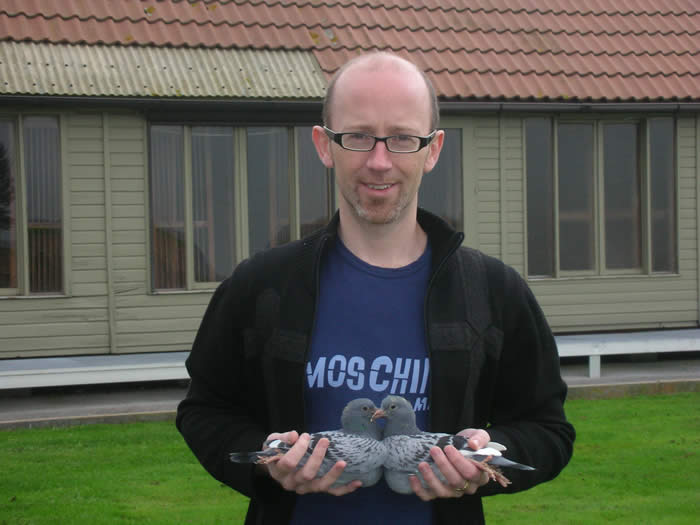
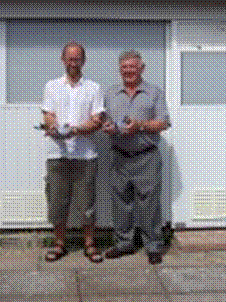
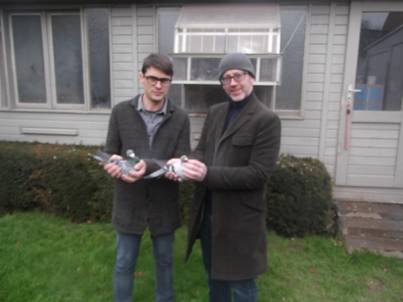
Rob Jnr at the lofts of Silvere Toye, 2009, holding the last 2ybs from Zatopek which are now in the Rome stock loft.
As with any keen pigeon fancier, I like to know who I have to compete against in my own backyard and especially at National level. I like to know where they live in relation to me so that I know what or who to expect on a race day, taking into consideration the wind and other factors. To be honest I have a fair idea of who I would have to beat on the day to have what I would consider to be a good pigeon, and it is against the performances of these fanciers that I judge the performance of my birds on the day. With this in mind I was a little surprised a couple of years ago to see the name of Robert J Rome from Cheltenham popping up in the results of the National Flying Club. My first thought when I saw that name was the father and son partnership from Annan who are household names in Scottish racing so I asked myself was it a case of Rob Junior coming south to undertake missionary work or was it someone unrelated? After a bit of investigation I realised that it was the son of the Scottish Rome partnership who was starting to compete in the Cheltenham area. To be totally honest and I hope this doesn’t sound big headed my first thought was ‘I don’t need someone of that calibre at the bottom end of my section’ as I had enough above me giving me headaches on National race days. Anyway, as each race in the National Flying Club came about the name of RJ Rome became a constant and was always in the mix and once my blind spot had been removed I saw Rob’s name popping up in other Classic club results. The results showed that only a small team was being entered which suggested that he only had a small team to play with as he was only just getting established at his new lofts. I remember having a conversation with fellow fanciers at the Fugare show in Belgium during the winter of 2011/12 that he would come out with a bang the following year with a bit of depth and strength added to his team. The general consensus amongst the fanciers was that he wasn’t in a good enough position to be consistent at the National, but how wrong they were as 2012 saw Rob notch up his first section win from his first attempt at a NFC race, Fougeres 250 miles, and he had a cavalry charge to the loft that day with other quick timings to claim 3rd, 5th, 8th, 12th, 15th Section I with the NFC. To demonstrate the quality of the birds housed and to show a glimpse of Rob’s intent he also claimed 5th Section NFC Cholet at 330 miles and then 3rd and 6th Section NFC Messac 283 miles, so it was clear that he had quickly pulled together a quality team of racers. To further highlight this he dipped his toe into International racing by sending a small team to Agen with the BICC and scored 3rd Section 25th Open at 547 miles.
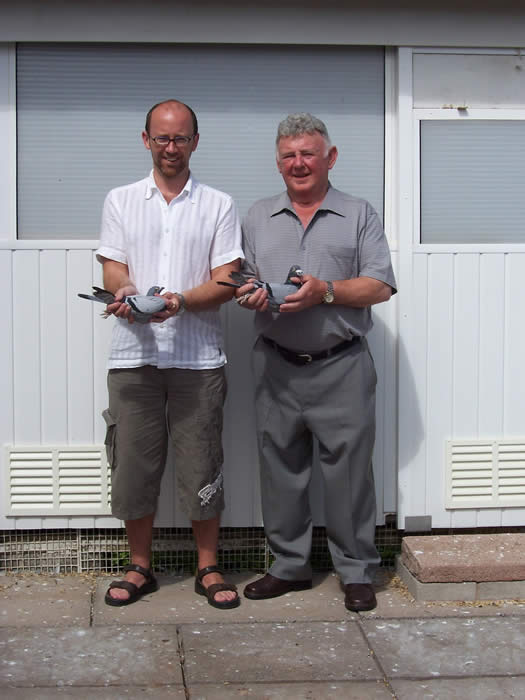
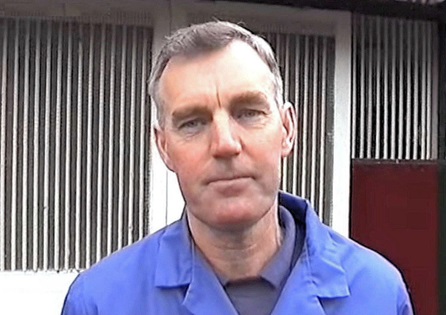
Rob Jnr and Rob Senior
Whilst no longer living in Scotland and having been away for quite a few years whilst concentrating on gaining a further education and a career, Rob has always remained involved with the home loft in Annan. The benefits of this can be seen today in the quality of the stock that both Rob and his dad possess, but it is not enough to have the tools as you need to know what to do with them. Rob will be the first to admit the debt he owes to his dad, who was already an established and successful fancier through to National level when Rob came on board in 1982 as a keen 10 year old. He cut his baby teeth working alongside his dad and the partnership continued to progress as Rob became more involved. The base team that the Rome loft had to work with were the tried and tested SB Cooper distance birds which had a reputation for being hard as nails and reliable in the distance events. To these were added the George Goossen (Brussels, Belgium) pigeons that Rob Senior had selected as a cross when he visited Belgium in 1968 and this lit the fuse under the birds and resulted in two decades of success. How fitting it was that history would repeat itself in 1985, 17 years later, when the Rome boys would find themselves on another visit to Belgium on the lookout for an additional line to put through the existing birds. It was on this trip that Rob Junior was introduced to Silvere Toye and he clearly endeared himself to the Belgian master as Silvere gifted him the young bird that Rob had selected but which his dad was reluctant to buy because of the cost. History shows the impact this and other birds from Silvere have had on the Rome loft, but I think the greatest impact has been the friendship that Rob has cultivated with Silvere over the intervening 28 years. Rob has clearly benefited from the friendship and will be quick to acknowledge how the advice and knowledge gained from Silvere has helped move his racing on to the next level, but we must not forget the bedrock of experience that he has gained from his father that has allowed the progression and evolution of the Rome racing and breeding lofts. Rob is a very intuitive fancier as anyone who has met him will quickly establish if they remain quiet long enough. When talking about the birds and past incidents he will often pepper the conversation with ‘so what had I learned?’ and with this natural intuition and thirst for knowledge he has a clear advantage over those fanciers who thought that they knew it all. So how did the friendship with Silvere impact on the Rome partnership then? Well I think the most immediate was the bloodlines that Silvere selected or recommended to them in the early days, and this continues to the present day with recent additions of Georges Carteus and Gaby Vandenabeele blood being sourced via Silvere. More long term was the shift in mindset that saw the Rome lofts move away from a team worked on the natural method to a team of widowhood cocks who would compete right along the line to the Gold Cup with the SNFC. You need to bear in mind that this was the mid 1980s and the general consensus in the fancy was that widowhood was only for sprint racing up to 250-300 miles and after that it was pigeons on the nest for the water races. Rob Junior had seen how fanciers on the continent raced on widowhood through to Barcelona and wanted to give it a go. Here he not only made use of Silvere’s system but also had the benefit of Silvere helping persuade Rob Senior to put together a small team of widowhood birds to start with. The success of these birds was such that soon the entire team consisted of widowhood cocks and this saw success up to 1st National level and with 3 x 2nd Nationals won up to that date this was something that had previously narrowly eluded the Rome lofts. Indeed the Scottish Rome loft has won up to the present day almost everything possible at Club, Fed and National. The highlights include 4 x 1st, 4 x 2nd, 3 x 3rd, 4 x 4th, 2 x 5th, 4 x 6th, 4 x 7th, 8th, 2 x 9th, 10th, 2 x 11th, 2 x 12th, 2 x 13th, 14th, 15th in Scottish National races. The Scottish Rome lofts have also won 13 x 1st Section with the SNFC plus the South Section Averages and Open National Averages on different occasions.
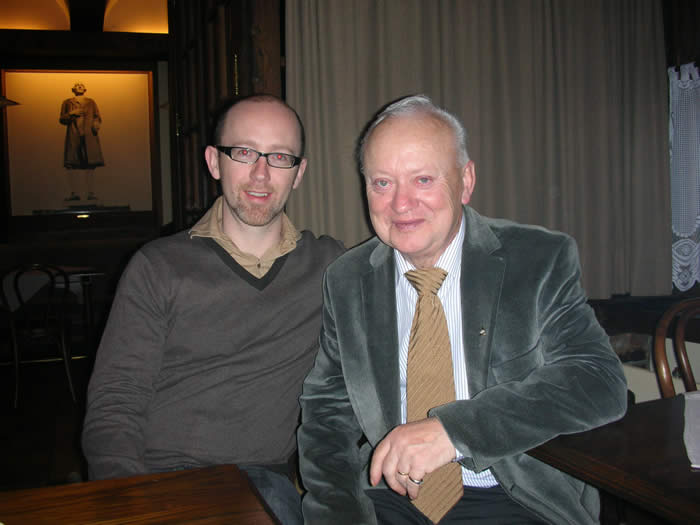
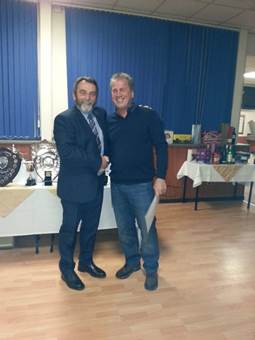
Rob and Silvere at Silvere's club prize-giving in 2007
The present day lofts that Rob has established are based on the skills he has acquired from both of his mentors and he has aligned these with an obvious talent that has emerged at the Cheltenham branch of the Rome lofts. Rob has carried with him an ethos that was built on advice from his mentors and is enshrined in keeping it simple whilst searching for, then having faith in good birds. What is clear is that Rob believes in the need to always strive for better birds even when you are successful rather than leaving it too late and having a mad scramble to improve when the winning line is diminished. To this end he and his father sought the advice of Silvere when they went looking for top distance lines to cross into the lines of “Champion Reimus”, their 2003 SNFC Gold Cup winner from Reims who was proving to be an excellent breeder. Silvere recommended his own Gaby Vandenabeele and Georges Carteus birds that he was having terrific results with himself. Silvere also advised a visit to the lofts of Patrick and Dimitri Houfflijn who were very much under the radar in terms of being well known but they were putting together a fine portfolio of performances and more importantly many big household names in Belgium were in their order books. Silvere had advised to buy from Houfflijn as in his words the Houfflijns were as good as he was and were small-team flyers, sending only 3, 4 or 6 birds to the National races. Rob and his dad visited and witnessed a family that were made from two main lines: a Willequet line cultivated by the Houfflijn loft for 30 years and Vandenabeele, stemming from the Blauwe Fideel and Wittenbuik lines. The Willequets were well known in Belgium for their stamina, endurance and ability to score multiple times from the Nationals from 300 to 600 miles. The Vandenabeele line was used either straight or crossed with the Willequets for the distance races from 300 to 480 miles. The Romes liked what they saw and so they invested in children of all the main breeders and performance birds. These had to be ordered a year in advance and over a handful of years the Romes were able to acquire 30 direct from the best racers and breeders of the Houfflijn loft. These birds made their way in to the Rome stock loft in successive years where they were either kept straight or crossed into the Reimus lines and Georges Carteus lines obtained from Silvere. It is fair to say that the present day lofts are made up of these three lines: Champion Reimus, Patrick & Dimitri Houfflijn plus Georges Carteus and Vandenabeele lines via Silvere. The impact of these birds has been impressive to say the least and Rob has lost little time in pushing them right down the line to test them right through to International level. Rob’s approach goes back to acquiring and having faith in good pigeons and this can be seen by the fact that in 2013 he was 2nd Section NFC from Messac with a young hen carrying nest flights, and if I recall correctly she was having only the 3rd or 4th race of her life and two weeks before had won 1st Club 6th Fed from Carentan, 181 miles. Now this example demonstrates the quality of the stock housed, the skills of Rob as a fancier and the need to put your faith in good birds. If we are being honest with ourselves how many of us would have even been racing a bird that age? I think most of us would have settled for giving it a bit of training and a couple of short inland races.
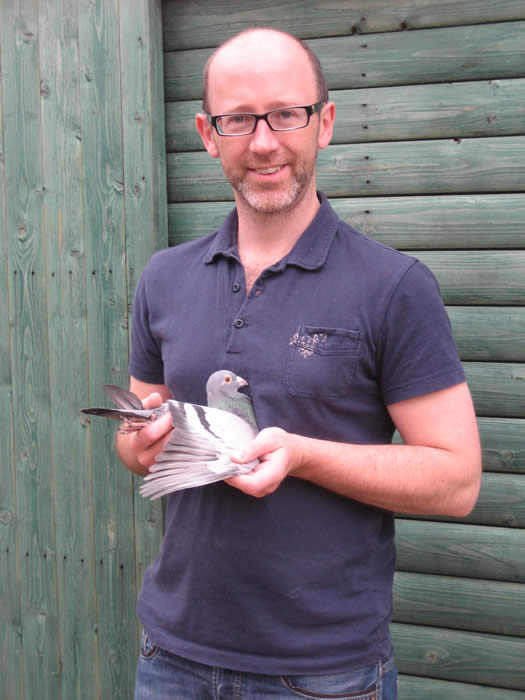
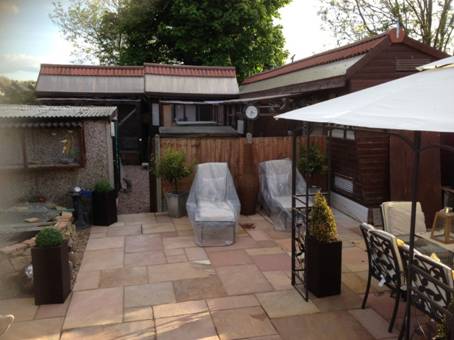
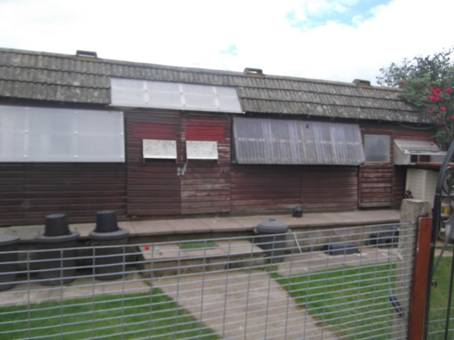
Rob Jnr at the Brockhampton lofts in 2012
The impact of his two mentors permeates Rob’s approach to racing at his own set up. I think the pressures on him when he established the loft at Brockhampton, near Cheltenham would have been high as he had built up an impressive CV racing with his dad. Here he had to stand on his own two feet but he had the strength of conviction to know that everything he had gleaned from his two mentors could be applied to his new racing loft. The loft location is not ideal for National racing being tucked away in the Cotswolds. He is not really on the right side or at the right end of any of the sections for competing in any of the National or Classic clubs that he is a member of but this does not deter him or the birds from racking up an impressive set of results.
Rob works the birds on a sort of total widowhood, with them being paired up in the spring to raise a nest and are then separated and raced celibate right through the programme from 60 to 600 miles. They run together on return from a race but are seldom - if ever - put together before basketing. This system has evolved to match the time restraints that Rob has as he has a busy and demanding job, is in the middle of a major bit of building work and also has 2 small children so there is only really time to rush back from work to basket the birds straight off the nestbox or perch without having to complicate matters again a reminder of the ‘keeping it simple’ ethos passed down from his mentors. Rob told me he leaves for work at 7am and returns at 7pm so all preparation for the day has to be made at night and very early in the morning. In the early and later parts of the year this necessitates the use of a headlamp while changing water/grit etc. All food is prepared prior to leaving for work. Fortunately, there are people at the lofts during the day in the shape of his good lady, Faith and a neighbour, Syd Holland so that birds can be let out and fed as required. Rob is able himself to let the cocks out in the morning and has a short time to assess their fitness whilst returning from work in time to trap and feed the hens.

Rob Jnr and Patrick Houfflijn at the Houfflijn lofts in 2008
There is no darkness practiced here as time does not allow it, nor are there any January bred young birds to be found in the team to compensate for the lack of a darkness team. The young birds are 2nd, 3rd and 4th round mostly bred by Robert Senior in the Scottish stock lofts and are raced through as far as the moult allows. This might be 2 races or it might be more. Some might only get trained as far as Swindon (30 or so miles) when Rob drives there to catch the train to London. You get the impression when speaking to Rob about this that it doesn’t really matter as it makes no difference to the quality of the finished article it’s only for the fancier’s peace of mind that they like their young birds to have 7 or 8 races right through the programme.
Rob is aware that his system appears simple but it is deceptively so and it is built on what he has observed from his dad and Silvere. After the quality bloodlines, it is the health of the colony that Rob takes great care about. Rob states that the best years are those where you have to use very little medication within the season and he tries very hard to follow this but Rob is keen to remove any possible problems (particularly trichominosis and ornithosis) ahead of racing, using natural products where possible. No routine examinations are made of the flock although Rob would recommend this if it is within any fancier’s budget and convenience. If more serious problems with individual birds occurs then he makes contact with the Belgian vet recommended and used by Silvere, and it is the optimum health that runs in tandem with quality birds and a sound skills set that underpins Rob’s success. In terms of feeding, Marimans mixes are in favour but Rob suggests there are many good mixes on the market which clearly do the job, as proven by many top lofts around the country.
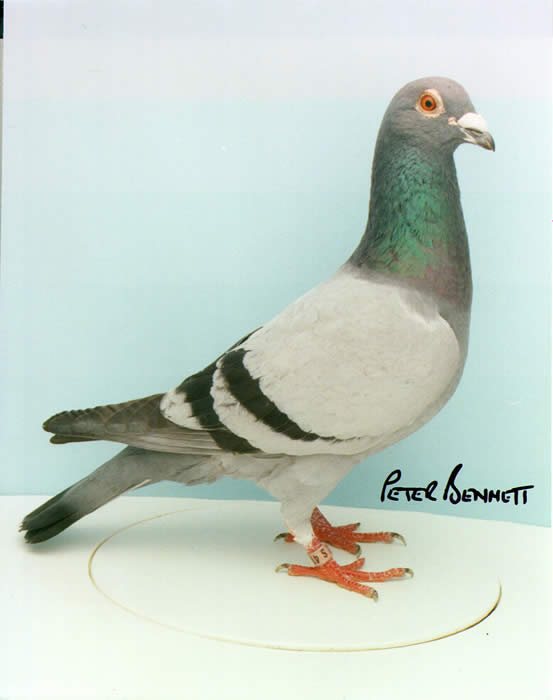
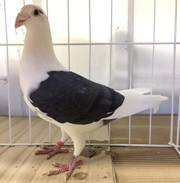
Spartacus - 1st SNFC Sartilly 1996
So after 3 seasons of this approach what is the end result? Well for Rob it has meant a solid reliable team of all-round birds, able to win from 60 to 600 miles, bred and fed right for the task at hand and the proof is most definitely in the eating. A look at the National results the loft has achieved just this year shows that Rob is on the right tracks the loft sent to 7 National races in 2013 and the top 10 Section prizes only are as follows:
12/5/13 BBC Carentan 181 miles 2nd, 4th Section
18/5/13 NFC Carentan 181 miles 1st, 2nd, 8th, 10th Section
01/6/13 NFC Cholet 337 miles 2nd, 5th, 6th, 9th Section
15/6/13 NFC Messac 281 miles 2nd Section
30/6/13 BICC Agen Int. 547 miles 3rd Section
30/6/13 NFC Tarbes 606 miles 5th Section
21/7/13 NFC Saintes 430 miles 2nd Section
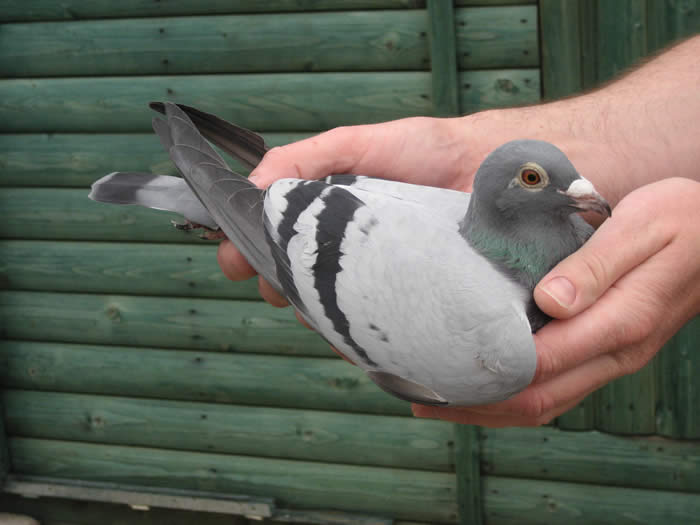
7827 - 1st Sect NFC Fougeres 2012 and 3rd Sect BICC Agen 2013
The results for others with the same bloodlines are also worth a mention with multiple Fed wins being reported each year plus a 1st RPRA Award in 2012 for N&D Wordsworth and 1st Welsh National 2013 for Fishlock Brothers to name a few.
I am not a big fan of listing endless results but should mention that in the last 3 years Rob has won the first two, three, four, five, seven, nine prizes in inland and channel racing and against stiff competition from very good local lofts. I think the performances put up by Rob over the past two seasons show that he has evidently listened carefully over the past 30 years when he has been in the right company and that he has also asked the right questions and sought advice from two of the top men in the game, his dad and Silvere. He has come a long way very quickly in the few short years he has been at Brockhampton but he will admit freely that ‘if I have seen further it is because I have been standing on the shoulders of giants’.
---
Elimar December 2013