Freelands Gem - 40 years in the making
The partnership of Mr and Mrs Bill Lewis have in their possession an absolute racing machine that goes by the name of Freelands Gem. This Powerhouse has made a permanent place for himself in pigeon racing history by being a double Certificate of Merit winner with The National Flying Club for those of you who might not know these things that is 6 times in the top end of the results from Tarbes. Now, it is a game bird that gets on the sheet a couple of times from the NFC Blue Ribbon race never mind claiming one COM, but to my way of thinking it takes a very game fancier to send the bird 6 times. I have told Bill and Beryl that they must have nerves of steel ( or in Bill’s case titanium kahunas) to continue racing this bird as every time he is let out of the loft he is exposed to a range of risks and hazards, never mind what he encounters over each mile he race home. I have no doubt that the partnership have had the views and opinions of many fanciers offered to them as Gem was prepared each season to return to Tarbes, especially as he bagged his first certificate. However, Bill will tell you that any doubts he had about retiring Gem were put aside each new season when he showed his form and condition and each year as Tarbes approached he advanced in to such condition it would have been difficult and possibly criminal to leave him in the loft. Also, once they had successfully prepared Gem for his 5th trip to Tarbes the thought off pulling off the unthinkable must have loomed large in their minds as Bill and Beryl saw the new season approach. Let’s remember that at this point Gem had 5 top turns from Tarbes and they had on their hands an absolute machine that had nothing left to prove. In addition these results were achieved in all possible wind and weather conditions, these resulted in arrange of velocities that he had to compete in. Whilst no Blue Ribbon race is easy by any means Freelands Gem competed in what are accepted in 2 of the hardest races on record. It is these sorts of races where you would start to worry about getting your bird home, but let the records show that the big boy dug deep, put his head down and never once disappointed the partnership who were waiting to see him home.
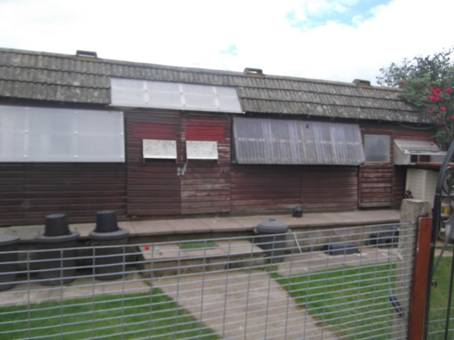
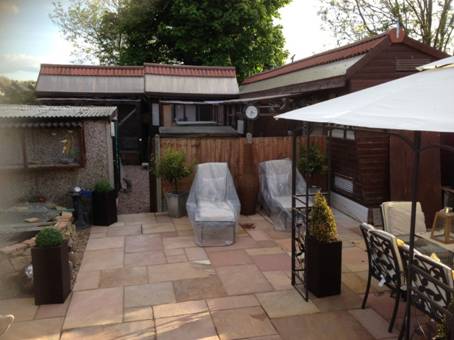
The no frills loft that Gem flew home to.
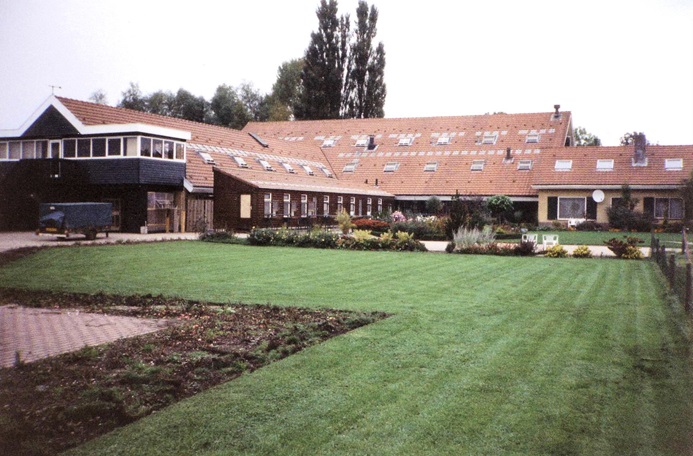
A bird of the calibre of Freelands Gem does not come about by accident. Bill will tell you that he has been 40 years in the making, for that is how long ago Bill approached a lady in his village who had a large paddock by the side of the house to ask about putting up a pigeon loft. She agreed to this and so the story of pigeon racing at Freelands began. In time Bill was offered the opportunity to buy the house that went with the land and so duly became a home owner and set about expanding his pigeon empire. The current family that Bill and Beryl race has been moulded over the past 30 + years from a sound and wise basis. The partnership approached the legend that is Tommy Lawley who raced a cracking team of Stichlebaut birds. Although Tommy was known for sprinting these birds but Bill had other ideas. These Lawley birds stood up to the ultimate test from Pau and scored Bill and Beryl their first position - and it was 1st section, needless to say these played a central role in forming the old family. Always looking to improve, Bill contacted the Massarella family as he was interested in investing in a successful, all round family that could pull off head line grabbing results. His interest had been tweaked by the Silvere Toye family that Louella had recently invested in, and the main performance bird Peter Pau. This blue cheq cock had just won the Pau International in 1984 into Kortrijk in Belgium and had done so handsomely with a 1 hour lead over the next bird in the national and this on a warm, hard racing day. Peter Pau was from Silveres’ old family that was strongly influenced by Cattrysse bloodlines; these had been sourced from Robert Reybroeck in 1970. From these came the Legendary Kleinen who was not only a racing machine but became one of the key stones in Silveres loft. Silvere had a painting gifted to him that showed a large grape vine that incorporated Kleinens ring leg, and the huge bunch of grapes has the ring numbers and main performances of his descendants painted in almost every grape. This painting is now proudly displayed in the apartment where Silvere lives in Kortrijk today. Let’s not forget that Kleinen bred Mirabelle who was the main breeding hen in the Toye colony, and when paired to ‘Old Tarzan’ produced The Tarzan line that remained at the core of the Toye strain up until the end.
I have rambled on a bit, but I think it’s important to know that Bill had clearly done his homework and realised that the Massarella family had bought from a loft that was on the way up, with Silvere constantly at the top thanks to Peter and Carl Pau and the Dikkop cocks. Also, this is the bedrock that 30 years of performance have sprung from and knowing the ancestry will help explain how the partnership stamp their presence in distance racing across a range of velocities. In Silvere Toye we had a loft that went on to totally dominate the national races in Belgium, especially at the longer distances and with this in mind I don’t think it was by accident that Bill opted for this family and bided his time until the right calibre and breeding became available. At the time that Bill had approached the Massarella family they were not in a position to sell anything from Peter Pau, as they were consolidating strong base around him to strengthen their own breeding lofts. Bill was offered other Toye birds that were grandchildren of Peter and no doubt fine representatives of the family but he was not interested in these, wanting the originals. In time, he persuaded the family to sell some children and he was sent the list of all the hens that Peter Pau was paired to so he could see what he had to choose from. The end result is that Bill and Beryl chose 6 birds to start the new family and these were the first 6 birds ever sold of Peter Pau. These birds were bred from and the resultant off spring tested well in the races through to national level, and by juggling the pairs around and then putting some of the best racers from the first generation back across the originals and each other. This allowed the partnership to quickly expand their breeding stock and more importantly let them identify the key birds within the family that they then bred around.
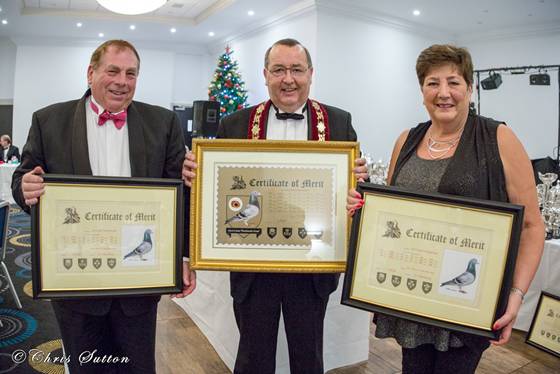
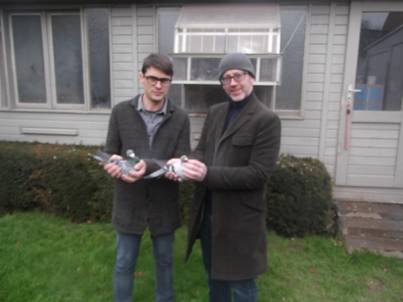
Bill and Beryl receiving the 2 COM awards won by Freelands Gem.
This cluster of Toye birds has been added to over the years, and Bill confesses to being partial to buying from The National Flying Club young bird sales that are held each year. He sees this as the perfect opportunity to purchase the best from lofts that are at the pinnacle of success in the best club in the land. These young birds are all put in the race team and have to prove their worth before he breeds from them some don’t survive to contribute to the gene pool but a select few have been incorporated in to the Lewis family and have contributed to the ongoing success that the partnership have sustained for 40 years.
Alongside the domestic and national racing, the partners are very keen competitors in one loft racing and have competed on a regular basis in OLR’s . Their approach to this is very interesting and shows the logic that they apply to pigeon racing. They believe in the old adage of ‘horses for courses’, and as such they have a separate family that provides the OLR candidates. They have a stock loft that houses a family based on top performance and Ace pigeons from a range of OLR’s from around Britain and Ireland. Some of these are their own birds that they have bought back and others are from other successful OLR fanciers. Bill has 3 sections with 6 boxes in each, and each year he moves the hen of the pair in to the adjoining section to pair to another cock. This carousel approach allows them 3 years to test off a pair before they will be put back together ( or not as the case may be). These birds are all now in some way related somewhere within the third generation and they are judged solely on how their off spring perform under someone else’s management and often in a different climate and environment. The net result of breeding around this one aim with one clear selection criteria is that Bill and Beryl have bred a type of bird that is medium in size, and as OLR results show they are the right shape breeding to represent the Lewis loft in the range of OLR’s that they enter annually. This interest in the pigeon racing scene outside of their own back yard extends to attending the Pigeon Olympiads around the world and in their Trophy cabinet are a range of mementos from these trips including the Seoul Olympiad in 1988 and other Olympiad races that the partnership have competed in.
Bill has always found time to be a premium, he works within Engineering, specialising in Calibrating high specification machinery such as hardness testers that are used in car manufacturing and the aircraft industry amongst other areas. Since starting his own business he has to go where the work is and work hard when the work is available. In his time away from the loft Beryl stepped up to the mark and during the season was often the senior partner and decision maker on a day to day basis. Bill is quick to point out that Beryl has always been an integral part of the set up and is a constant presence around the loft. She has a natural affinity with the birds and, especially the young birds and hens. Bill has clearly been very impressed by her skills and keen attitude to the job as she has quickly promoted the through the ranks and she now no longer has to clean out the birds!!!
Their two sons now take a very active role in the family business and it is hoped that Bill can step back a bit and free up more time to spend with the birds. He is also looking to augment the Tarbes blood in the loft so they can send stronger teams to this race point and maybe even further out to Barcelona if the opportunity arises. To this end - and bearing in mind the ‘horses for courses’ attitude the partnership have -they have invested heavily and wisely in some Jan Aarden blood from a number of sources, with The House of Arden being well represented in the birds chosen. These are a bit of class, and fine representatives of the family that Steve and Lesley Wright are cultivating, and Bill has high hopes for these. As with the Toye birds, they have done their homework and purchased a few of these that will form the nucleus of the new family, and I think that Bill will be tempted to put a few in across the existing Tarbes birds he has. Looking at a couple bred from Gem, I think the partners would be missing a trick by not throwing them in to the new blood. Personally, having seen what he has to work with I think it will be a case of lighting a fuse and waiting for the bang.
The partnership race classic widowhood with the cocks, but have occasionally sent a few hens to the old Hens National, but again it’s a question of time. They have cut their cloth to meet their needs In terms of having time to race and they have found that the cocks are easier to manage in the time available and so that is the system that has evolved. Bill would like to race a team of hens on a celibate system as he feels this would get the best out of them, and this is on his to do list once he can free up some time away from the business.
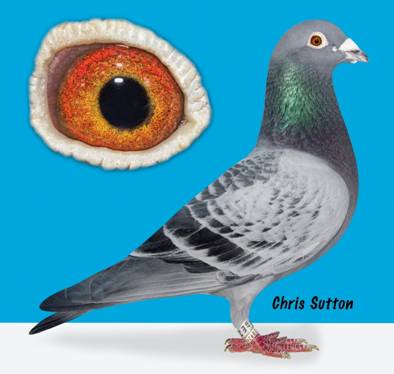
Freelands Gem The History Maker.
So, let’s look in a bit more detail at Gems record of achievement. In putting together the set of results that saw him enter the history books he topped the section twice, was 2nd section twice and was 3rd and 4th on the other 2 occasions. His positions in the open competing against the cream of distance lofts in the Blue Ribbon race are as follows: 45th, 60th, 18th, 21st, 42nd and 88th. truly remarkable. His lowest velocity was 853 ypm and his highest was 1075ypm. He clearly relied on his heritage to grind out the results and gain those 2 Certificates of Merit. What I find incredible about this cock and his performances is the preparation he received, and I this in it shows how well the partners know each individual bird. Gem was always wary when outside the loft of hawk attacks and as a result was very reluctant to take any exercise. Also, the partnership lock the birds up all winter because of hawks and they never got their freedom until around Whitsun weekend in May. Gem would have a couple of tosses, a couple of short races usually 1 inland and I across the water, but not always - and then in to Tarbes fresh as a daisy. I remember when Bill first told me this I questioned the level of preparation but as Bill pointed out he already knew the way home from Tarbes!! So, what runs through this champions veins then? I think many people are aware that Bill had misplaced the breeding book for 2007 so wasn’t sure how Gem was bred and made no secret of this. He was however of the opinion that he was from the tried and tested Toye base given his record at 600+ mile racing. So, imagine Bills surprise when he found the book last summer whilst having a sort out as they were having work done to the house. He was bred in the race loft from a German cock bred by a Mr Coenen from Juchen that the partnership bought in one of the Rohnfried Futurity sales. He raced well and won a tidy sum in the actual race and went on to race well but went down in the battlefield. Bill has no details of the breeding of the cock. The mother of Gem was a good racing hen and was on the result from Tarbes with the NFC, and she was the old JL Roberts blood. They got this blood from Robert Lonsdale, who by coincidence is the cousin of the current NFC Chairman Phil Curtis. The will help explain the tenacity that Gem displayed to gain his double COM awards.
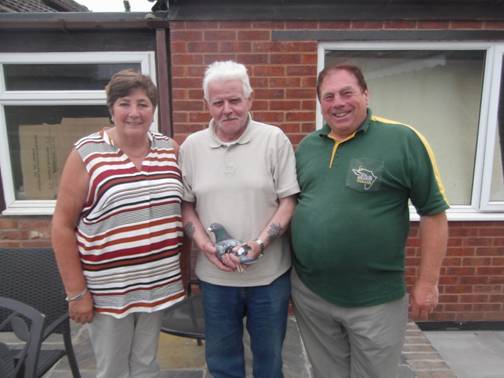
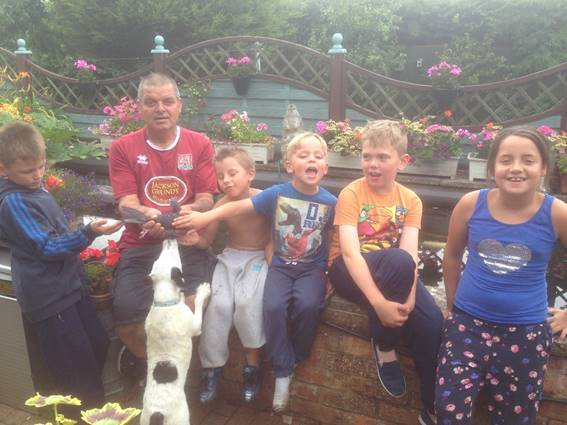
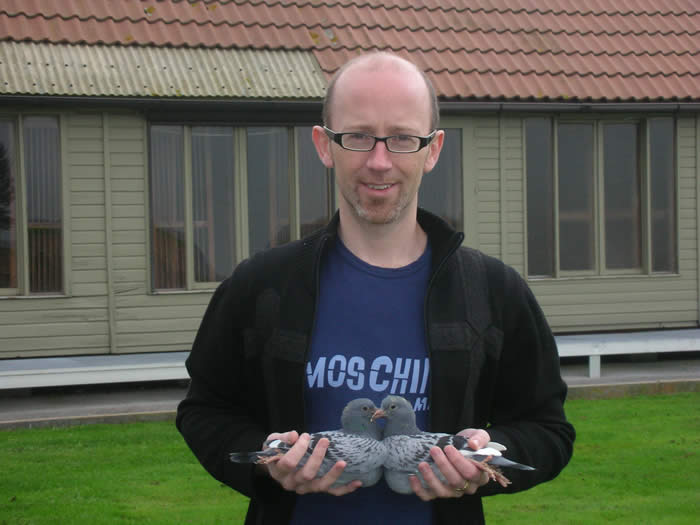
Bill and Beryl with their loft boy holding Gem.
As with all successful fanciers, Bill and Beryl make things seem straightforward and are quick to place the focus on the birds. However, let’s not overlook the skills involved in both breeding and racing a bird of this calibre. It takes an awful lot of faith to race a bird out to Tarbes over 6 consecutive years, and some would say a heap of luck. But to my way of thinking it takes a whole lot more skill to place that bird in the top 4 of the section and well within the top 100 of the open each time. Freelands Gem is now enjoying his superstar status in the stock loft, but the partnership are on the lookout for the next big star and the fame and clamour surrounding Gem has not changed them. They will freely admit that they had a shocker out of Tarbes this year which will have brought them back down to earth with a bang, and at the time of my visit they were concerned about the lack of vigour and fizz in the young bird team, just like most of us. I think one small detail that shows what is important to the partnership is that one of the trophies that has remained in the trophy cabinet is the first trophy Bill ever won which is from 1965 and was awarded for Best Junior Flyer in Malvern Link Club. Bill still beams when he brings this out to show people he has come a long way since then.
In closing, I don’t want people to think this partnership have been riding on the coat tails of Gems success they have been consistently challenging for top honours at national level and have raced a strong team for many years. They won the section before Gem arrived on the scene and judging by what I ran my eyes and hands over during my visit they will continue to do so for quite a few years to come.
Drew Callan