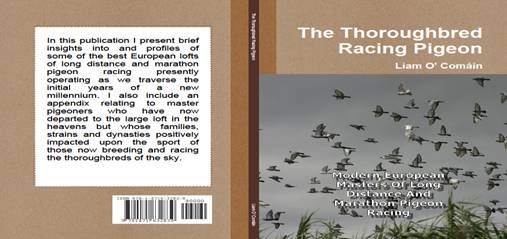
by Liam O'Comain
Off Into The European Sky They Go To Orientate Homewards
Flying Hundreds Of Eduring Miles Across The Land Of Europe
On The Toughest Of Tough Routes -
To The Land Of Ireland
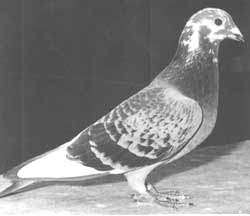
Moonlight Mannequin
Preface
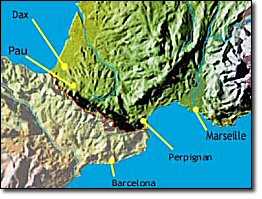
When one writes about pigeons that have flown the route over and from Europe's mainland across the English Channel, over the island of Britain and then across the Irish Sea one seeks to pay tribute to those who have successfully faced what the Canadian, Gordon Chalmers, once described as ' The toughest of tough routes'. Therefore I offer this piece entitled 'Irish Pigeon Gold'. Unfortunately not every athletic stalwart can be considered due to the space available.
Introduction
In preparing this article within the context of the above space limitation I had to select mainly from personal memory and initially I recall Billy Locke's famous Elizabeth who was 5th Young Bird National from Milford Haven (203 miles) in 1953 and 6th National Redon (508 miles) in 1954. This great athlete also flew Landereau (531 miles) as well as being a great producer. Into Bangor, Co.Down, A.E.Jamison raced the great Irish Wonder, a unique thoroughbred who scored 2nd and 3rd in Irish Nationals from Le Sables and Redon respectively. Or who could forget McGugan's famous Invincible. This Belfast family won at least three important races from between 500/600 miles from France with Invincible winning the Irish National from Le Sables at a distance of 600 miles. J.M.K. McGugan's pigeons were in the first six at least 12 times in Irish nationals. There's also the Ballymena fancier Tommy Harper and his Iron Man. For this outstanding black cheq cock was sent across the channel 22 times and was clocked 21 times. Scoring 16th Open Dinard twice, and from St. Malo 30th Open. The Iron Man in fact won from 100 to 500 miles with velocities as low as 600ypm and as high as 2,400ypm. He was also an outstanding breeder. In his illustrious sporting career Tommy Harper won many positions, a few of which is as follows: 2nd Open National Redon (beaten by 1ypm for the King's Cup, the blue riband of Irish distance racing), 3rd Open National Nantes ( a daughter of the Iron Man), 8th Open National Rennes, 11th Open National Nantes, and so on. There's also Joe Doheny of Dublin who has won the Irish National Open twice. First in 1982 when he was awarded the much sought after King's Cup from Le Sables, France, and again recapturing that trophy in 2002 from Redon, France. Thus Joe Doheny has entered the elite by being one of a few double winners. Nancy was a five-year-old red hen raced very lightly before the National.Then in the 2002 National from Redon his courageous blue bar known as Tiny won with the velocity being in the 900 y.p.m. range. The McDowells of Bangor, Co.Down also won the National twice. In addition to winning two Nationals this family built a reputation second to none as long distance and channel flyers. Their first National win was from Redon (France) in 1953 whereas their second National win was from Nantes (France) in 1973. A great grand- daughter Mournview Queen of the 1953 winner - The Star Of The County Down - was successful in 1973. Redon was 505 miles and Nantes was 543 miles. They also won in 1975 the Friendship National from Beauvais in France. Therefore three Nationals from the land of the Eiffel Tower. Some flying! Over the years the McDowells also gained other good positions at the distance, scoring 4th, 15th, 17th (on two occasions), 28th, 40th, 49th, 51st, 53rd, 57th, 62nd, 63rd, 77th, 81st and so on. Surely a confirmation of belonging to Ireland's creme de la creme of distance racing. Let's recall also that E.A.Robinson from Belfast won twice from France under the auspices of the Old Irish Combine which preceded the Irish NFC in 1947. Nor can one forget the success of Jackie Patience (Dollingstown) who was 1st and 2nd respectively in the Irish National when in 1995 Lady Virtue won the coveted trophy.And there are many, many more...
Obviously it would not be possible for me to state what flying athletes amongst the many who have traversed such a route as the one referred to as being the best of all but I offer 6 who in my opinion are amongst the top of the creme de la creme. Of course their managers played an important part in their achievements and are also due acknowledgement. Interestingly of the 6 considered hens are to the fore.
(1) Leathem's Queen Of Ireland
One pigeon who initially comes to mind is the Queen Of Ireland, a light mealy hen bred and raced by the late Jack Leathem of Downpatrick in County Down in the north of Ireland. Her owner was in the opinion of many of the earlier writers on the sport one of the top distance flyers in the early years of the 20th century.

Leathem was a fancier from boyhood and through a long pigeon career he served for a while as the loft manager of the great Irish pigeoner E.A.Robinson. In fact when Robinson won 1st, 2nd and 4th National in a Kings Cup race in the 1930s Jack Leathem was his loft manager. That was in 1937 and it was the very same year when Leathem scored his most notable success as a pigeoner. Some years prior our subject had obtained a cock bird from another Irish stalwart of the sport named Izaac Greenaway and although lacking information re its mate it fathered a light mealy hen which in due course flew Redon (France) twice and in her racing career won seven firsts, eight seconds and four thirds. Well with such an outstanding racer in his loft Jack Leathem like all great pioneers dreamt dreams that never were and asked why not. Thus his precious mealy hen went to San Sebastian with the English based National Flying Club and won 150th Open position in the National. There were 1,728 pigeons in the convoy. Now we all know or can imagine what it is to face such an awesome task into Britain from the Spanish race point but to continue on ones own across the Irish sea into the north of Ireland confirms one as the thoroughbred athlete of thoroughbred athletes. For taking all into consideration- the distance, the terrain, the time in the basket and the travelling circumstances, etc., Jack Leathem's mealy exhibited one of the greatest acts of flying in the history of pigeon racing.And although lacking Leathem's measurements the distance must be approximately 800 miles.
(2) Kenneally's Lerwick Hen
I would bet if I was a betting man that there are not many fanciers even in Ireland who would know about the subject of this piece yet apparently she is the Irish distance national record holder at 640 miles from Lerwick (North Road Racing) to the City of Cork. This magnificent achievement took place in 1961 and although Anthony McDonnell's (Coleraine, County Derry) Bann King set the record in the Irish National Flying Club's National from Les Sables (France) in 1963 at 633 miles Kenneally's flight is one of the greatest pieces of endurance in Irish pigeon racing history. Of course this is not a slight on the win of Bann King whom I have an everlasting respect for.
From 1930 Dan Kenneally was a pioneer in the long distance flights into the south of the island. Thus when a decision was made to organize a race from Lerwick Kenneally was one of the first who made a decision to participate. As a result his courageous blue checker hen arrived on the 3rd day to finish 3rd National, beaten by two birds flying approximately 150 miles less. Of course what would one expect from a fancier who brought a natural scientific approach to management. For example Kenneally fed his birds according to their weight. That is he varied the food to put on or take off weight. Interestingly the Lerwick Hen weighed fifteen and a half ounces departing for the race and upon her return weighed eight ounces. Being 8 days in the basket and 2 days on the flight home. What a difficult flight she must have had and indeed a courageous example of love of home, etc,.
Dan Kenneally always remembered pigeons as part of his life for when there were not many clocks about in private hands he remembers acting as a runner for his uncle. In 1924 however he started on his own with stock from a Rev. J. H. McKenzie, whose Shearing- Logans were to be his base. Another interesting aspect of his management was the fact that in an age with heavy emphasis upon high protein he always fed about three quarters maize. A forerunner of the continental revolution in pigeon feeding, perhaps.
(3) The Smyths' Leading Lady
For the Smyth brothers of Ballymena, Bobby and Hughie, the good harvest appeared in 1948 when they were 11th from Rennes, France, at a distance of 510 miles. Being named, Rennes Queen, she was one of only 12 birds in race time. This hen also took 18th Open from the same race point in 1949 beaten by her daughter, Northern Leader. The latter was 7th Open in a race where only twenty-five pigeons were timed.
In 1951 the partners scored 23rd Open in the National from Rennes, a very hard race with the winning velocity around 800 yards per minute. To be followed in 1953 with 33rd Open NIPA Derby from Landerneau, France, and 62nd and 75th Open National Redon, France. The latter a distance of 532 miles. The following year 1954 saw the strain winning three positions in a tough National from Redon with only 28 birds home in race time. The positions were 20th, 21st and 24th Open.
The brothers scored again in 1955 from Redon, the velocities were down around 700 yards per minute, when the pigeon who was 21st in 1954 won 4th Open National. This was the famous Leading Lady who went on the following year to win 6th Open from Redon at a speed of 579 yards per minute. Then this great racing pigeon in1957 scored 9th Open from Redon. Another tough race but Leading Lady was only three positions behind her cousin who scored 6th Open. The latter being National Effort who went back in 1958 to Redon and finished 36th Open. Also in this race a grand daughter of Leading Lady was 38th Open National.Thus 4th, 6th, 9th and 21st Open National positions for Leading Lady involving speeds as low as 579 and 700 yards per minute.A magnificient pigeon.
(4) Erwin's Moonlight Mannequin
Without much success initially at racing and then acquiring a taste or desire for racing at the distance William Erwin of Ballymoney decided at the beginning of the 1940s to purchase some distance bloodlines. He looked at some of the great British strains of the period and then decided to base his distance ambitions on the Osman strain. His first buy was a mealy cock bird from the Heathcote Bros., of Stoke- on- Trent, England, to be followed by a blue cheq pied Osman hen from Tommy Harper. The Osman pied hen came to Harper via A. H. Cornes and was a grand-daughter of Osman's famous Olympic.Erwin's choice was the right one for in due course the mealy and the pied produced winners with each other and with other stock. The mealy being the base sire of the Erwin family. Other purchases were made over the years plus a blue cheq cock known as 'Meadow Triumph' which arose from a gift of eggs from the Smyth Bros. A fateful gift for in time Meadow Triumph won the N.I.P.A. St. Malo Derby for the Erwin lofts. Other sources of good bloodlines arose through close friendships with other great fanciers such as Bob Harkness of Crumlin, County Antrim. Harkness was another distance specialist and he loaned the sire of 'Moonlight Mannequin' who won 1st Irish Open National from Nantes for Erwin at a distance of 570 miles. Others such as the McCartney Bros. of Moira made a similar contribution to the Erwin family. In fact through the vehicle of friendship the Erwin pigeons contained some of the best distance Irish bloodlines ever.
The family ultimately moulded by William Erwin was small of size with silky feathering and small heads, often referred too as pinheads, objected to by some writers in the sport yet here we see a family pivotal in the history of Irish pigeon racing with this trait. They numbered 10 pairs of racers and 3 pairs of stock birds. About two dozen youngsters were reared each year and via this small stud William Erwin competitively competed against the best in Ireland and indeed his bloodlines proved successful beyond the shores of the Emerald Isle. And when the races were tough the Erwin's were usually to the fore for they were a breed for a difficult race. Amongst other positions the Erwin pigeons scored 2nd Open I.N.F.C. Rennes, 510 miles; 5th Open I.N.F.C. Le Sables, 611 miles; 11th Open I.N.F.C. Nantes; 59th Open I.N.F.C. Nantes; 1st Open N.I.P.A. St. Malo Derby, 467 miles; 2nd Open N.I.P.A. Dover Derby 410 Miles; 10th Open N.I.P.A. St. Malo Derby, 467 miles; and 25th Open N.I.P.A. Dinard Derby 470 miles.
(5) Murray's Dream
The 1998 Irish King’s Cup race from Rennes proved to be one of the most difficult races for many years, with no birds home on the day. However, the Dundrum, County Down, partnership of Archie Murray and his son Patrick clocked their blue chequered five year old cock now known as ‘Murray’s Dream’ at 5.53am on the second day of the race to win not only the King’s Cup but at least £3,500 and also a car, a timing clock, an electronic clocking system and one of the coveted Hall of Fame diplomas for being a prize-winner three times in the King’s Cup Irish National from the contintental mainland.
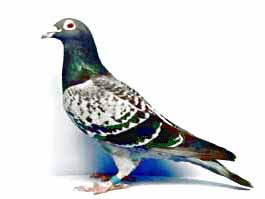
Born in 1993 and rung IHU 93 N 36633 this half Van Bruaene (Belgium) x quarter Walkingshaw (Ireland) x quarter Channing (Wales) faced the English Channel and the Irish Sea to win in a velocity less than 900ypm to win the Blue Riband of Irish pigeon racing sport.
Prior to this triumph this great athlete had won: 1994- 2nd club, 7th South Down Fed. Penzance Yearling National 286 miles; 1995- 1st club, 3rd South Down Fed. 13th Open EDC Dinard (France) 422miles; 1996- 2nd club, 2nd South Down Fed. 23rd Open INFC Old Bird National Rennes (France) 460miles, velocity 924ypm, 1067 members sent 2954 birds; 1997- 1st club, 1st South Down Fed. 19th Open INFC Old Bird National St. Nazaire (France) 505 miles, velocity 733ypm, 728 members sent 1901 birds.
In total 4 times conquering the English Channel and the Irish Sea from France into Ireland.The last two flights producing velocities of less than 900 ypm. A truly great thoroughbred.
3682 (The Maid Of Derry)
William Mason settled in the north west of Ireland in the early years of the twentieth century after leaving his native Scotland. Prior to his state of exile Mason had along with his brother raced pigeons and the latter was the one and only founder of the '1210' strain- Alexander Mason. (Mason's 1210 strain appears in the pedigrees of some of the greatest Scottish and British winning pigeons). Upon his arrival in Ireland William Mason established a loft based upon the best of the '1210' strain and began achieving outstanding results on the difficult north west route.
Racing as a member of the Londonderry Club after 1927 the loft won a few old bird averages outright and by the year 1935 his name was on the new average cup. But perhaps Mason's greatest achievement was the recording of 3rd Irish National in 1935 from Laval in France, a distance of 557 miles by a beautiful black pied yearling hen known as '3682' or The Maid Of Derry. The latter was of the best of bloodlines for its grandam under 'smash' conditions flew from Le Sables in 1930, a distance of 636 miles. Again in 1931 the grandam scored 16th in the Irish National from the same race point. Some flying in those days, when one considers the reality surrounding the racing of pigeons then.
I wonder did Alexander Mason ever envisage that an Irish writer would be referring in 2004 to the exploits of the '1210' strain which he founded. Or that his strain would be beating the best into Ireland in the nineteen thirties or indeed into County Antrim in 2004. Yes we have come full circle for the 2004 Irish National winner of Jimmy Greer contains the bloodlines of '1210'. For the 2004 Irish National winner contains Mason’s as well as Aarden and Jansenn bloodlines on the sire's side whereas the dam was of Norbet Sierens bloodlines. Yes, in pigeon racing blood will tell and here it has reached through the decades.
In Conclusion
In this new millenium many Irish pigeoners will still prepare their candidates to face the acknowledged 'toughest of tough routes' and as a result there is joy for some and heart break for many.Perhaps this is as it should be for our sport is a combination of a science as well as an art and accompanied with a bit of luck some will succeed and others will not.But the joy lies in the dedicated trying... The difficulty of the route is reflected in that of the approximately 60 plus races held since the formation of the INFC for the King's Cup only approximately 18 have attained a velocity over one thousand yards per minute, and over half of the latter did not reach eleven hundred yards per minute. 2/11/06