NORTH ROAD CHAMPIONSHIP CLUB
Looking back at Lerwick . . . 5
By
George Wheatman
Memory Lane can be a long, long road, with lots of twists and turns, diversions and surprises, especially if the starting point is the Shetland Islands and the journey covers more than 500 miles.
It took me to Boston, in Lincolnshire, in this, the fifth in the series of Looking back at Lerwick, and meandered around the country, and beyond, as a result of speaking to North Road Championship Club chairman, Brian Garnham, who lives in the village of Butterwick, just to the east of Boston.
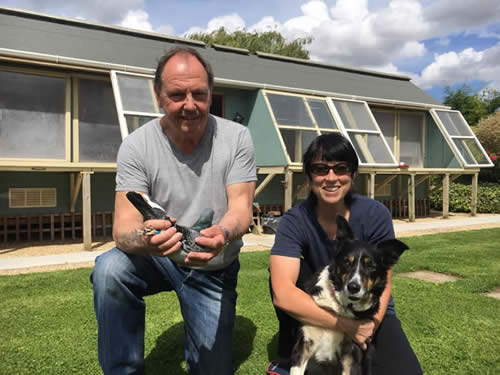
Brian, in partnership with his wife Angie, won the coveted King’s Cup race from Lerwick back in 1998 and declared the experience as being “almost life changing.”
Moreover, the success of their outstanding pigeon Bon Ami was the culmination of a five-year plan aimed at taking their “all right” performances to a new level.
Recollections embraced fellow successful Boston fanciers, trips to the North East and into Scotland, the key part played by men in Nottinghamshire, and the role of the convoyer for that race, himself also a former King’s Cup winner.
But first the story of Brian and Angie Garnham and how they forged a five year plan in the hope of moving up the racing pigeon ladder. They may have dreamed of reaching the top and that is exactly what they achieved with Bon Ami.
The re-structuring of their team started when they noticed that fanciers from the Ollerton area of Nottinghamshire were winning out of turn and particularly potent was the partnership of Kevin Porter and John Richardson.
Brian decided to pay them a visit, and was suitably impressed by their loft of Wildermeersch pigeons, and particularly by the fact that they had in their loft offspring of King’s Cup winners raced by Jake Cotterill, of Boughton (1991) and Mitchell Brothers, of Bilsthorpe (1993); indeed they had the Mitchells’ King’s Cup winner.
Suitably impressed, the outcome was that Brian purchased six summer bred youngsters. Most of these turned out to be hens, so a trip was organised to a sale by Frans Wildermeersch, where Brian was guided in the direction of three cock birds one with a sprinting background, another sprint to middle distance, and the third with distance blood in its pedigree.
Brian was able to purchase all three and, just how good these buys were, was proved by the fact that cock No 1 bred the winner of 5th open Berwick young birds; cock No 2 bred a club winner from Thurso; and cock No 3 bred Bon Ami.
The dam of Bon Ami came from a different source from a sale at Boston Central RPC, in fact. On offer, via the late Frank Tasker, were the birds of another Lincolnshire fancier Dave Jackson, following Dave’s death.
In the sale was a dark hen which Brian said “looked a treat”, and which Angie had also spotted so there was no marital conflict over the decision to bid for it!
It had won a breeder-buyer race for Dave, and was bred by Frank Bristow after he and Frank Tasker had bought its mother on a trip up north to Frank Faulkner’s sale. As they made their way into a crowded sale room, the shrewd Mr Bristow had suggested that they try to buy the first bird up for auction while other would-be buyers were trying to assess the market.
This they did at a reasonable price before the remainder went for big money.
Brian and Angie bought their choice for £95, and it proved to be a bargain.
“She was a brilliant little hen,” said Brian.
Bon Ami was four years old when he won the King’s Cup at his third attempt. The previous two races were too fast for him, won, as they were with velocities of 1770ypm (Mal Waller, Norwich) and 1570ypm (Mr and Mrs Payne, King’s Lynn). “Both times we saw him come off the Wash,” said Brian. “The second time he had gone by us.”
In 1998 the winning velocity was down to 934ypm, and it was a year when convoyer John Norris had to show all his skill, knowledge and independence of mind to get the pigeons liberated on the Sunday.
He recalled, when I spoke to him, that the weather in the Shetland Islands had shown an unnerving pattern of being pretty awful in the mornings, at what would have been a traditional liberation time, but brightened up to provide sunny afternoons and brilliant visibility.
So Saturday passed, and Sunday arrived very much the same. Locals, on whom John relied more than anything else, predicted that this pattern would continue for a few more days.
Weather advice, from the East Midlands Weather Centre, was that it was foggy in Lerwick. John could witness for himself that it was not, and he could see for miles.
So the decision was his, and he decided to liberate in the early afternoon at 1-30pm he recalls so that no birds could get home on the day. “I aimed to land them in Yorkshire before nightfall,” he said.
I believe that there was, in fact, a bird into Hull (part of the liberation, but not competing with the NRCC) on the night, but it would not have beaten the NRCC winner.
So the Garnhams were up early on the Monday, Brian being confident that they would have an arrival before leaving for work and so they did, but Brian never went to work at all that day and celebrated with a day off. Ever conscientious, Angie did go into work.
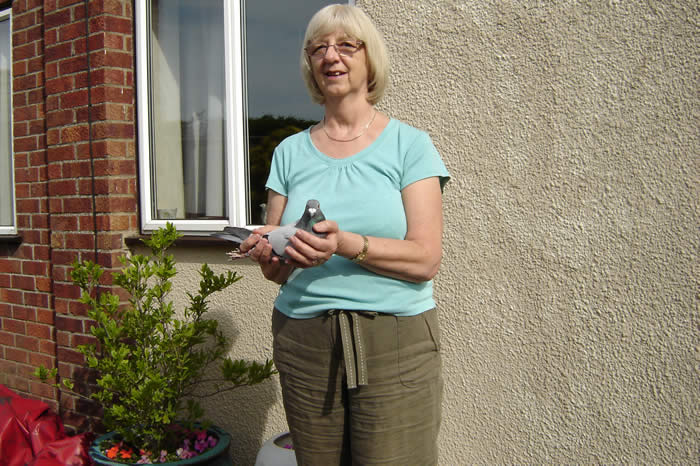
Angie Garnham
Bon Ami was timed at 8-40am to make that long-standing dream come true. It was an emotional moment when they realised that they had won the King’s Cup, the best pigeon racing day of their lives. It was pouring with rain when he hit the loft.
It was a defining moment, in fact for Brian, as, since then, he has always been striving to give something back to the sport, and no-one can deny that he has done that over many years, particularly as chairman and race adviser to the NRCC, jobs that are prone to inviting close scrutiny and sometimes criticism from some sources who give scant regard for what is being done of their behalf.
Bon Ami was an out and out distance bird, and had shown he was up for the job by being 7th from Crieff when there were only seven birds home on the day a few weeks before being sent to Lerwick.
He proved to be a handy pigeon at stock, too, but many of the best offspring went to other fanciers as gifts.
“We got wet timing him in,” recalled Brian. “There were a few hugs and tears. There were some good performances that day, some a long way down the country. We still get a buzz when we think about it; it never leaves you.
“We were also pleased for John, the convoyer, who had backed his own judgement.
“We had made a five-year plan and had done what we had planned for. We spent the kids’ holiday money in the process.
“The following year we won the NRCC averages and that was important to us.”
Another excellent race for this husband and wife team was from Saxa Vord, 540 miles, when they had four birds hit the trap together, and two were timed on the same second.
Born in Ipswich (perhaps that is where he was tarred by the long distance racing brush?) Brian was a great friend to Boston’s pigeon racing supremo, the late Frank Perkins, who won the King’s Cup in 1964, and was runner-up on three other occasions. “Frank was my mentor,” said Brian.
Brian and Angie are currently embarking on another five-year plan. This time they are dreaming of success on the south road, perhaps from Tarbes or Barcelona.
But north road racing, and the NRCC, remains their first love. This year they will be celebrating their 50th wedding anniversary. Victory in the 100th NRCC race from Lerwick would be a fitting gift.
Having entered the story already as convoyer on the Garnhams’ big day, we now travel down Memory Lane with John Norris, another Lincolnshire fancier, but from Grantham. This time you will need a passport at least John did as the recollections cross country, as well as county, boundaries in the build-up to his King’s Cup win of 1993.
First stop Gran Canaria, one of Spain’s Canary Islands off the Atlantic Ocean and well-known to the pigeon world for its famous one-loft race.
John and his wife were there for just that reason, to witness arrivals to this big race and, during their stay; they met up with a group of fanciers from the Sunderland area.
One of them was Andra Naylor, of the Naylor Sons and Richardson partnership. Over the week that followed their meeting when dining at the next table to each other, John and Andra became good friends.
Continuing the story, John says: “When we got home he rang me and said that there was a little girl who had leukaemia in his village, and they wanted to raise money to send her to Disney World, and they were going to hold a sale could I get some birds for the sale?
“I had a word with other fanciers and got some birds together and took them up to the sale, in fact three or four of us went.
“Not knowing the fanciers in that area, or the birds they had given, I gave Andra £50 to buy me a youngster.
“He had put a bird in the sale and bought it for £50, and sent it down to me.
“It was a dark chequer Busschaert cock bird, and it had one race as a young bird. As a yearling it had two positions in the first six, from Berwick and Sedgefield.
“When he was showing the right form, all he would do was land in a large conifer tree in our garden, and clap off. He would not exercise with the other birds. I rang Andra and told him this. He laughed and told me the bird’s father was called The Lamp Post Cock and all he would do when he was in form was land on this lamp post, and clap off, just like my pigeon was doing in the conifers.
“He was going through this routine in the build-up to the Lerwick race when I sent him as a two-year-old. He was bouncing, and he went and won the King’s Cup on a velocity of 1575ypm.”
John’s pigeons were in good form that year, and he had three more birds in quick succession.
The winner was 22 seconds in front of the runner-up timed by Dave Brackenbury, of Boston.
For Dave, now treasurer of the NRCC and one of the prominent fanciers breathing new life into the organisation, it was second time unlucky because he was also runner-up when the King’s Cup was won by F Parkinson and Son, of Spalding, in 1982.
But top fancier that he is, he has had consolation in winning NRCC Open from Fraserburgh in 2001, and the young bird national in 1987. These were two totally different types of races. The Fraserburgh win was a helter-skelter affair on a velocity of 1981ypm, while the young bird was a bit of a slog on 1035ypm.
John Norris was chairman and convoyer for the NRCC at the time of his big win but, after his resignation some time later, he did not compete with the organisation for a number of years until the lure of Lerwick proved too much and he re-joined to win his section in 2014.
He competed well again last year, and hopes to be among those fanciers aiming to win this year.
“I have had some good pigeons over the years,” he reflects, “but I think the birds I have now are the best I have ever had.”
John is a big supporter of Tottenham Hotspur and, when we spoke, they had just moved into second place in the Premier League.
A good omen for the 2016 Lerwick race on June 25th?
CLICK HERE FOR - Looking Back at Lerwick...No 6