NEWS FROM DOWN UNDER
by Doug McClary
Winter
Winter is here and after drought conditions for some months, the rains have arrived. The main lawn cutting season is upon us always in the winter months when the wet encourages growth, whereas in the summer, growth is almost nil. Walks with the dogs are less enjoyable though in fairness, what they call cold out here would be easy to put up with in Britain. Living down by the sea we rarely see any frost so can count ourselves as being fortunate in that respect. At least the sun shines and this seems to lift the temperature and make conditions even better. We are still able to sit outside with coffee or a glass of wine occasionally.
Show at Albury
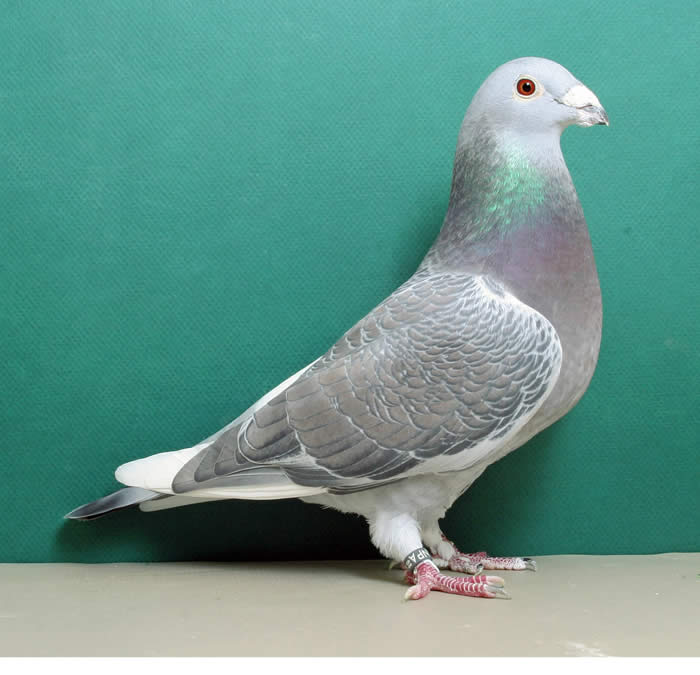
Our daughter Joanne has been over in England for three weeks which meant that we had to care for her dogs and aviary of birds as well as her house. As a result Ann was unable to travel to Albury with me for the Southern Classic show. Normally we go up together which allows a sharing of the driving and an enjoyable trip. On this occasion I travelled up with Ian Austin, formerly of Yorkshire who lives out in the country about an hour away. Ian and Joanne have a very nice bungalow set in sloping grounds which provide plenty of room for the pigeons, dogs and poultry. It is a countryman’s ideal situation and they are extremely happy living there. The journey for me is normally over 400km each way but this year a few extra miles owing to my detour. We had a most enjoyable trip up, using the country roads for most of the distance though on our return we kept to the main highway, surmising that it would not only be quicker but that there would be less of a problem with kangaroos. Ian is a pouter and cropper enthusiast who also keeps a team of performing rollers and some Oriental Frills. The rollers get plenty of attention from the hawks and falcons and the poultry have visits from marauding foxes. There is plenty of wildlife including visits from varieties of deer. Well over a thousand birds were entered in the show with Modenas, Show Pen Homers and British Show Racers having the largest entries. The show racers attracted 120 birds for the judging of Melbourne doctor and racing man Tim Owen. He had never judged a show of this calibre before so we were interested in how he would cope with the numbers. In the event he seemed to do so very well with the winners being spread about. He was true to form as a good racing man in that he knew what he wanted and judged accordingly. Thinking back I think I did not select my ideal team for Tim, in that I went for the birds I liked whereas I should have selected those which were of a more racy type. The two winners I had were both smaller birds. Fred Frendo of Sydney collected the best in the section with a blue hen. Barry Shoobridge of New South Wales won reserve best, best opposite sex and best young bird. Incidentally his reserve best in show winner was the hen which came second in her class to Fred’s best in show winner. This proved to be a little controversial to some but it is a quite correct procedure for judges to adopt. All in all it made an enjoyable day out, but an expensive one, involving a night in hotel accommodation. This show is a popular one with several of the New South Wales exhibitors travelling down to Albury which is on the NSW/Victoria border, rather than go to the shows at Sydney. The large entry fee is hardly met by return with no prize cards and rather limited accommodation and facilities. However, that is showing here in Australia and it is as good as anything else.
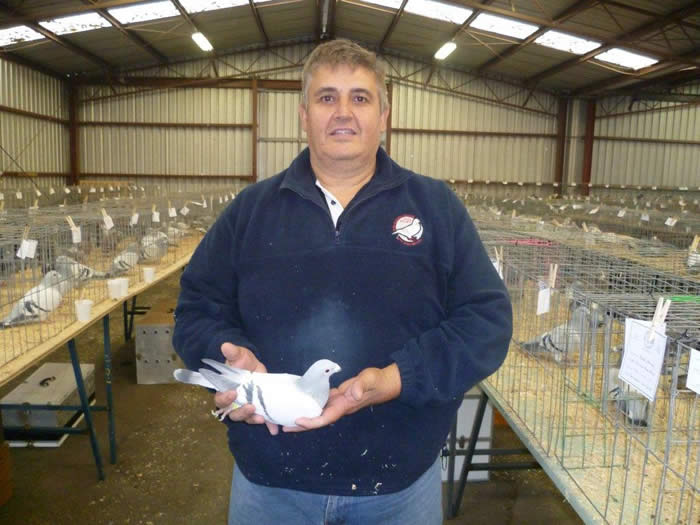
Fred Frendo with his winning blue hen at Albury
Ventilation
I have been intending for some time to open up some more of the loft to provide better ventilation. I have noticed lately that despite wearing a mask when cleaning out I seem to get a sore throat. Therefore the wall opposite the door of open wire, I have removed an area and substituted it with fixed wooden louvres. This provides a cleaner area along the corridor which runs along the front and should remove even more of the dust. The floor, being of wire grills allows much of this to drop through but it is at times of cleaning that I have been noticing ill-effects. Time will tell of course whether I have been successful. The job took many hours of frustration for me for my carpentary skills are hardly of the highest for such projects. Living here in Australia, the needs for ventilation are somewhat different to what was required in England. My loft is just about the same design as my Exeter structure with rear ventilation and glass louvres along the entire front but I have found myself able and needing to add ventilation out here in this hotter climate with only occasional problems with driving rain. Since coming to this country my sensitivity to pigeon dust has been lowered and I have put this down to the extra ventilation and perhaps spending less time with the birds. The provision of good ventilation is a subject which has always interested me and it is never a simple one to advise anyone about. I recall a little widowhood loft I had in Exeter which had never seemed right for the birds until Dick Lipski across from the USA advised the use of ventilation on the south-facing wall and the provision of a low level window. This allowed the early morning sunshine in, made the floor dry and warm which immediately helped the roof ventilation. It was an inspired piece of advice and one which changed the atmosphere within that little loft. Indeed, it was east-facing so the provision of light and air from the south made all the difference. When I moved to that address in Exeter my main loft was east-facing and was never a successful one. When I had my new loft constructed facing south, it was altogether a better situation. The easiest advice to fanciers, whether in racing or showing is to be always thinking about how to improve matters both for the birds and the fancier.
David Brown
David was interested in my notes about Bumsy the opal mosaic cock bred by Don Spedding and my little story about a powder blue cock bred here this year. Birds which appear to be dodgy at first do not always turn out that way and he recalled in 1978 breeding a pair from a blue cock from the famous A & H Whitelaw Dordin family and a blue chequer hen from Mr Rodger of Hamilton. The nest produced two blues, one of which seemed small but both went on to race from 500miles more than once. When shown, the blue cock was only beaten into second in its class at Edinburgh, the same year that the hen, the small bird mentioned, went on to win her class and take best in show. The cock went on to win the Lothian show twice including best in show on one occasion. It just goes to prove that first impressions are not always right and this is why I have always recommended that young birds are allowed to develop before drastic decisions are taken about them.
Rugby
My interest in the rugby continues with the Lions visiting Australia and my son Stephen and I have tickets for the test match in Melbourne. Meanwhile I have been able to watch some of the Lions’ matches and also the French playing in New Zealand. Cricket also now comes to the fore with the Ashes about to commence. I continue to support England and guess that I always will. Nobody will be more pleased than myself if England retain the Ashes. And if they lose, that hardly bears thinking about in this country of cricket lovers with an insatiable attitude for gloating.
Fanciers I have known
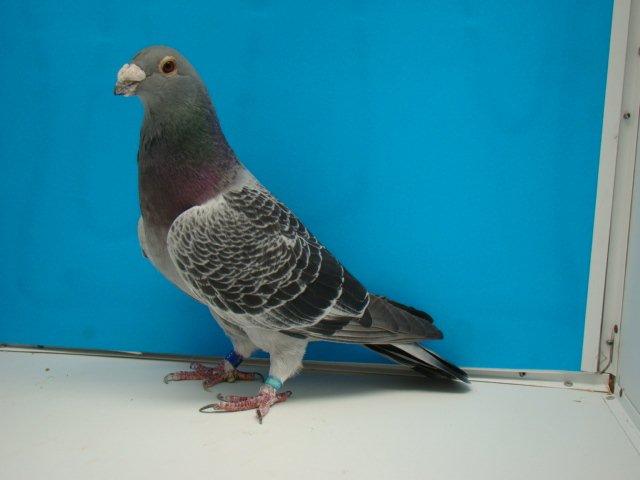
My subject this time is Percy Mitchell of Bideford. Percy was a small-team fancier who kept a small loft at his Bideford home. It was never possible to keep numbers so the birds there were always of the highest quality and because of lack of room, they were tame and always under Percy’s control. The loft was only four feet in width so the birds were bound to accept human contact. I got to know him when I came into showing in the mid to late sixties. He had formerly shown as P & K Mitchell with his son Ken from 1953/57, but when Ken moved down to the Plymouth area, Percy showed on his own. It can be claimed that he was the main pioneer in the development of the opal mosaic. In those early days the y were regarded as belonging to the ‘funny colours’ and not highly regarded. The first time I saw opal mosaic mentioned was by Harold Aze of North Devon and by a Mr Davis of Exmouth. I am sure that Percy obtained his original regard for the colour from Harold Aze. Percy burst on to the showing scene in 1954 when he sent a two bird entry to the People show, and won a 1st and a second. In 1960 he sent four birds to the Show of the West where they took three firsts and a second, most points and BOSex YB. He valued his classic wins more than anything and in terms of success against small entries, he had no equal. He was particularly pleased to win a class of 388 in a Birmingham Mail selling class with an opal mosaic. Until 1954 he had shown locally only, having obtained his original stock in 1934 in his area, but in 1950 bought birds from John Bartlett of Tonbridge Wells and from Len Garner of Leicester. Percy became known for his opal mosaics and stated that he had been offered open cheques for good dark opal cock but he knew just how difficult it was and how the cocks rarely carried the good opal colouring of the hens. Self-criticism and honesty were virtues displayed by Percy together with a wicked sense of humour which came through his somewhat dour expression. He liked winning with birds he fancied to win and was always honest to state surprise when an unfancied candidate won a prize. He was never loud, never boastful and always quietly pleased when his birds won for him. I always enjoyed his company and like to feel that I gained a great deal from it. He was a credit to the showing side of the sport.
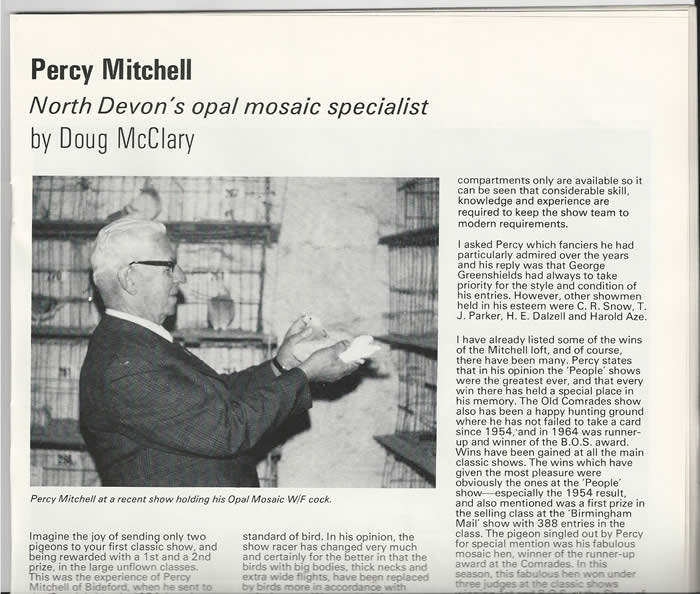
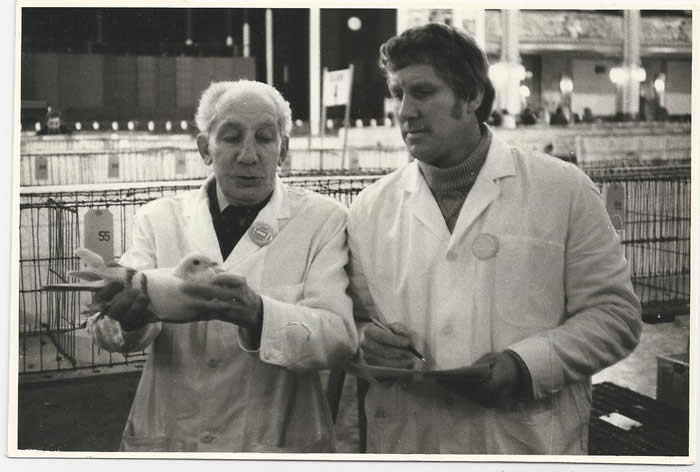
Percy Mitchell judging
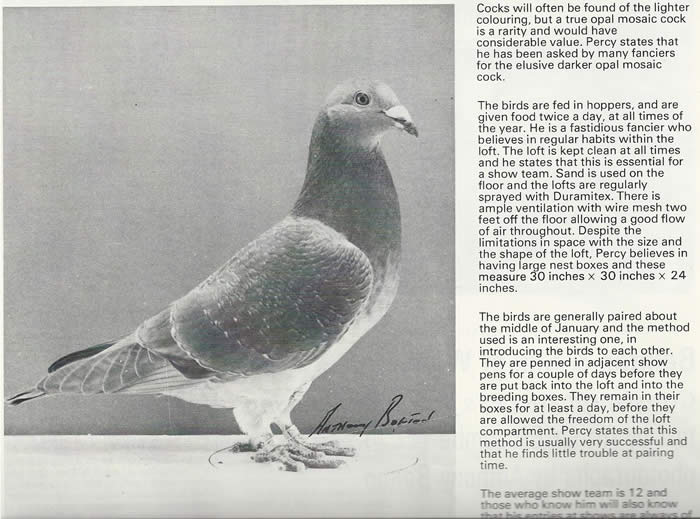
One of Percy’s early winning opal mosaic hens.
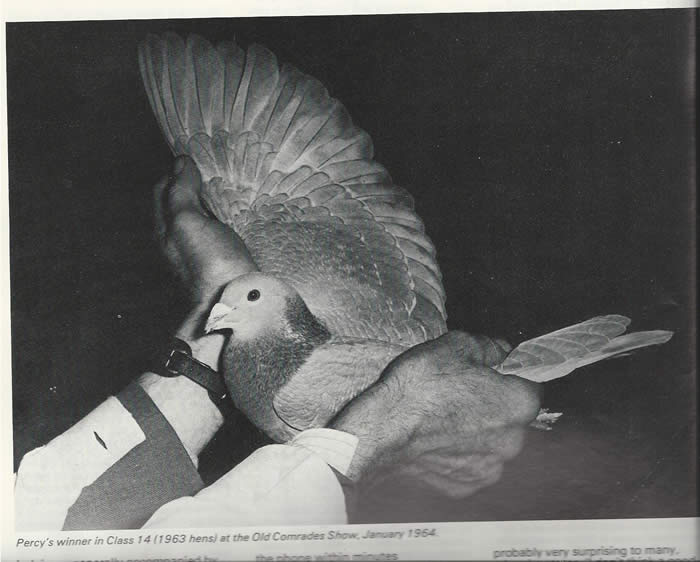
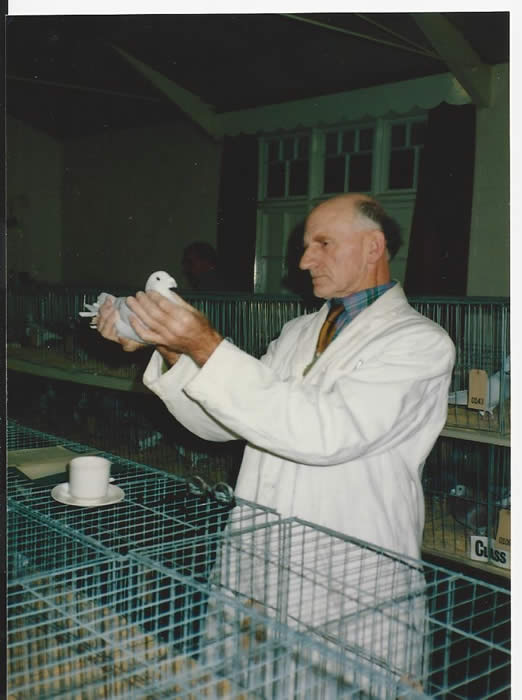
Percy’s winner at the Old Comrades 1964 being judged
International racing
I have just heard from John Tyerman informing me that members of the BICC won the first four positions in the Pau International. I would like to express my admiration for those four, namely Geoff and Catherine Cooper of Peasedown, Des and Darran McFadden of Cranleigh, Mark Gilbert (of course!) and Mr Draper of Yalding. This speaks volume for the state of the sport in Britain and the quality both of birds and fanciers. Well done to all concerned with the BICC.
Concluding thoughts
Our National show will be at Adelaide this year in July and travelling over to judge will be Roland and Julie Thresher. We are looking forward to their company and their judging. They will fly into Adelaide and then travel back here for a few days before moving on to Sydney. It will be useful having him visit my loft and birds and of course he will be handling birds which he last saw in 2003 when he came down to go through my team for Australia with me. I am grateful to Dennis McKane of Guernsey for his advice on how to put up with him and for his generous offer of tranquilisers ! I will be able to make mention of their necessity next time but it will be a rare treat to have someone like him with me and my birds for a decent visit. I am still at 3 Kunyung Road, Mount Eliza, Victoria 3930, email