THE ELIMAR INTERVIEW
featuring
GARETH WATKINS
Please introduce yourself and tell us how you got started in the sport.
My name is Gareth Watkins and I am a retired Chief Med Lab Scientist. I have been associated with the sport from a very early age as my father and uncle both had pigeons when I was growing up in the South Wales valleys. Both my father and uncle were very successful fanciers and I can remember staring in awe at oil paintings of my uncle Caradoc’s winners from Pau and Bordeaux. I have been writing about pigeons for 40 years now.
Which races do you target?
When I became an active partner with my father in the 1960s I was immediately drawn to the long distance races which at that time were Thurso 486 miles and Lerwick 589 miles to our loft here in the Rhondda. My father and I were quite successful in these races winning the club and gaining top Fed and National prizes from the Scottish racepoints despite moving loft six times in the 1960s and 70s. However in the early 1980s the “in thing” was widowhood racing and so I went along with the crowd and developed a sprint family with birds from Albert Babbington, my good friend the late, great Frank Tasker, Billy Parkes and Arthur Beardsmore. Further introductions came from my good friend Bob Bolitho of Cornwall. These formed the basis of a family of birds which helped us to R/U spot in the then massive Welsh NR FED with 1,500 competing lofts sending 360,000 birds to a 25 race programme. Most lofts in Wales turned to south road racing in the mid 1990s and the same family of sprint pigeons went on to win on this route as well.
In 2000 I went into partnership with an old friend Doug Cockcroft, and we set about rejuvenating the sprint team with SVRs from the late Rod Baxter and Mr & Mrs Jimmy Dickens plus Janssens and Van Loons from Phillips, Son & Williams. This new blood helped us win 70 x 1sts in four season’s racing, including 1st Combine 8,673 birds and 1st National 4,073 birds from Brussels.
Unfortunately a long standing back problem resulted in my having to undergo spinal surgery in 2005 and Doug died shortly afterwards. I then parted with most of the sprint team and decided to concentrate on long distance despite having to undergo a second major spinal operation in 2006 which led to my early retirement.
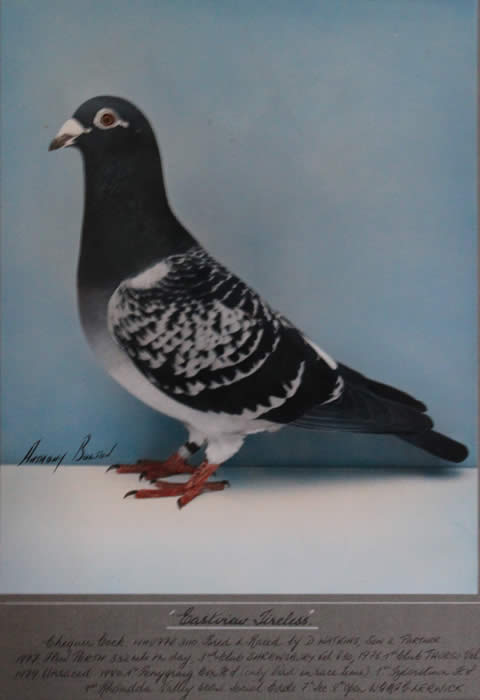
Eastview Tireless - 1st RV 600 Mile SC 8th National Lerwick.
With this in mind, which bloodlines form the base of your loft?
When racing on the north road in the 1960s and 70s we raced a team of predominantly Westcotts, Fabrys and Vernal Hansennes. In the late 90s I introduced Southwells from John McLaren and others which led to success on the south-east route through to Kassel and Giessen in Germany. At the present time I am attempting to develop a team of long distance “Internationals” and have based my stock on Jan Aardens from Ray Strawbridge, Van Wanroys from Paul Woolliss and birds bred direct from pigeons that have flown successfully from Barcelona from my friends in Kent and others who have been successful from Barcelona. I also have the “old family” of Van den Bosch/Haelterman/Van Loon as they are still winning through to Combine level for myself and others. Recently I have introduced birds from Mark Gilbert from his Deweerdts and Southfield Supreme lines plus some Carteus and Brockamps from my friend Phil Sendell of Cardiff. When introducing these birds I have always tried to get pigeons bred directly from the winners or their parents.
Which individual pigeons are proving to be your key breeders and racers?
At the moment, apart from the “old family” lines and birds I introduced from Alain and Dirk Van Den Driessche, the best hen I have in the loft is a Van Wanroy from Paul Woolliss. This hen has bred winners with different cocks from 57 miles through to 602 miles and one son has won the first prize Silver Trophy with the Rhondda Valley 600 miles Social Circle twice from Tarbes in 2011 and 2012 finishing well up in the National both times with 7th & 25th Open plus a 15th Open National Saintes 14 hrs on wing when there were only 16 birds on the day into Wales.
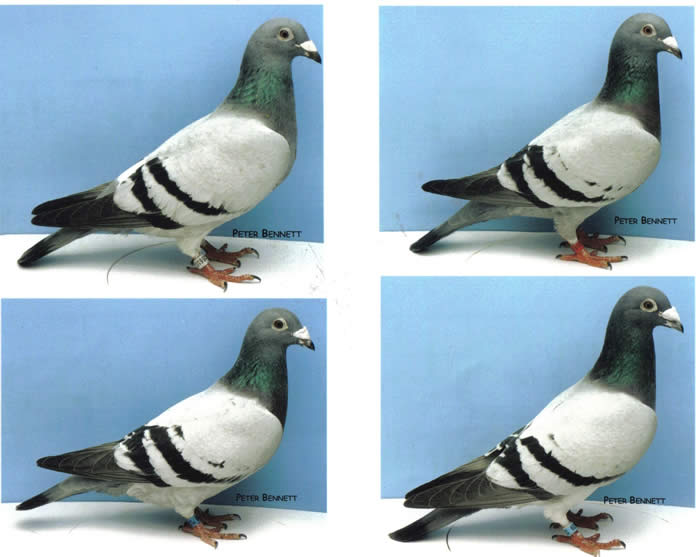
Sophies Girl - 1st National Combine Brussells (top right) with her brother and sister, both Fed winners, and mother La Gioconda (bottom left).
When sourcing your base pigeons, what attracted you to them?
The performances at the distance that I wished to win at whether it be sprint or long distance. I always try to purchase pigeons directly bred from the winners. I also like to ensure that the source fancier is producing winning pigeons for others – proving that the pigeons must be good and therefore it’s not all down to loft location and system.
Have you evolved a particular type or line most suited to your methods?
Yes I think I was forced to do so as since I don’t drive the birds had to be conditioned at home with carefully modified feeding and home exercise. When I was working in Cardiff the birds had to be tended to i.e. fed, watered, exercised and cleaned by 7.15 each morning during the racing season as I was away from home for up to 12 hours each day. In winter the same system prevailed except obviously the exercise as it was dark when I went to work and dark when I got home in the evening. The “old family” had to adapt to this and as a result they seemed to produce pigeons which needed very little road work, were calm and easy to manage and they went on to win at all levels for myself and many others who had them from me.
How much emphasis do you put on motivation, and with this in mind what methods do you adopt?
Widowhood methods vary and I learned a great deal from Frank Tasker and Jimmy Dickens, not to get the widowers too worked up early in the season. When racing natural I always spent a great deal of time watching the birds on their first round of eggs, especially yearlings, looking to see when they were at their keenest and thus in best condition. I would then try to reproduce this nest cycle for their target race.
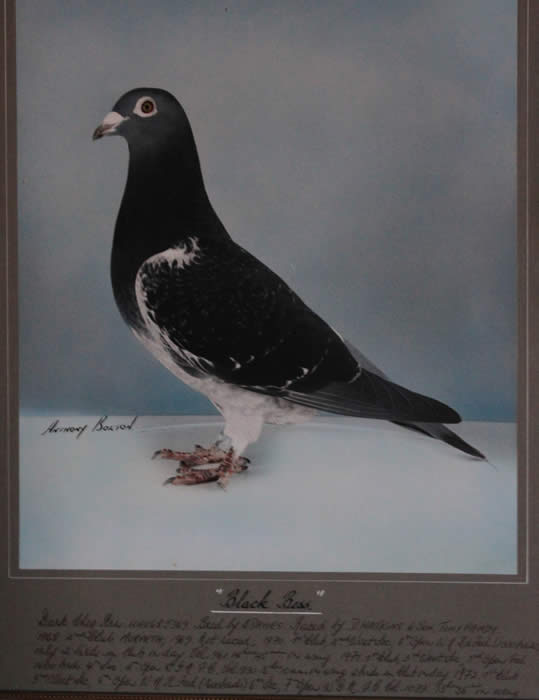
Black Bess - 3 x 1st Thurso on the day, 5th & 7th National. No pigeon in Wales ever beat her twice in three years racing from the Thurso National.
How important is feeding?
For sprint racing on widowhood VERY IMPORTANT. For long distance racing I don’t think the feeding is as important as the pigeon you are feeding the food to. If the pigeon hasn’t got it in it to fly the distance, no amount of specialist feeding will make it. Having said that I think you have to take a sensible approach with the build up of fats in the last few days before basketting and then hope that the pigeon is up to the job in hand.
How has your approach to feeding changed over the years and what feed do you now favour?
In the 1970s I devised a feeding system working out all the fat %ages, carbohydrate %ages etc and calorific values for a home-made mixture for sprint racing but was unable to put this feeding system into practice. When in the 1980s, I met and was befriended by Frank Tasker, he gave me the constitution of his mixtures and lo and behold they were virtually the same %ages as I had worked out in the 1970s which were ideal for sprint /middle distance racing. There are so many good mixtures on the market now that I don’t think the fancier needs to tamper with them. The Versele Laga and Garvo range of mixtures covers virtually all bases – sprint/ middle distance and extreme distance. Always assuming you have birds that are up to the job.
Have you found any supplements of benefit?
I rate cider vinegar, garlic and honey as well as pellets. When rearing early young birds in winter I always tried to ensure that the birds were fed a heavy protein mixture last thing at night so that they would feed the babies and this “slow release feed” would sustain the babies through the long periods of darkness until their next meal. The first feed next morning always had a fair %age of pellets in it so that this could be quickly digested and assimilated by the babies first thing in the morning. One thing I have always done when rearing early in the season is to mate the yearlings and racers a week later than the stock birds. When the stock birds' youngsters are just coming off soft food the racers are due to hatch and then the stock babies are placed under the racers and so get double the dose of soft food and also are more closely covered by the racers for a longer period. As for other supplements, I’ve probably tried more than most but I am still unsure how much help they are to the birds.
What medication, if any, do your birds receive?
I have always believed that only fit pigeons win races and to get them fit they must be healthy. To this end I have always treated the birds for canker when sitting their first round of eggs and before racing they get a course of treatment for any respiratory problems that they may be secretly carrying. Other than that I leave them well alone but always have medication to hand just in case a problem arises during the racing season when you can’t afford to have any impediments to race fitness.
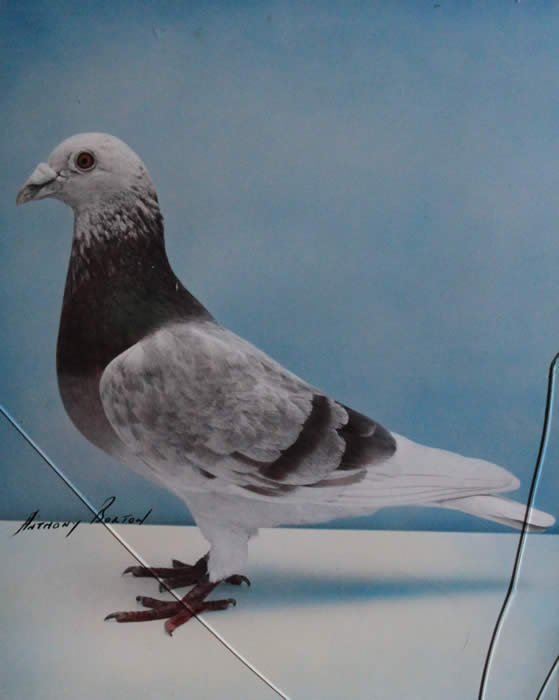
Eastview Billy - 1st RV 600 Mile SC, 1st Fed 2nd National Lerwick on the day.
What balance do you strike between workload (home exercise, training and racing) and rest when preparing a bird for its main target?
I always like to get as much racing miles under a bird's wings in preparation for a long race as the distance the bird is expected to fly in the target race. When flying north road this was around 600 miles for Lerwick pigeons. However I think it's hours on the wing rather than actual distance flown that is the important factor in the conditioning process. Home exercise usually amounts to two one hour sessions per day which is forced if necessary for birds raced natural and voluntary for widowers. Widowers when fit need no encouragement to fly quite the opposite in fact.
How do you get a pigeon to peak?
Hopefully, with the right feeding, motivation and fitness levels, but at the end of the day you have to have the right tools to work with.
Describe, if you can, how your birds handle at basketing time when in top form.
Full bodied but light and corky for widowers; when you pull them out of the basket at the marking station they handle better than they did when you placed them in the basket in your loft. However, in the 1970s we had the pleasure of racing a hen that we named “The £800” that handled like a bladder of lard when she was at her peak and she won £800 racing with 8 x 1sts, 7x 2nds & 6 x 3rds at all distances from 60 miles to close on 500 miles.
How great a bond do you have with your pigeons?
I spend time with the birds being gentle with them and talking to them. I always say “good morning gentlemen/ladies/babies” when entering the different sections and talk to and stroke the birds when they are on the nest. My father who died in 1979 and late flying partner Doug were absolute geniuses at getting birds to respond to them.
How much emphasis do you put on loft design?
I have visited hundreds of lofts all over the UK and in Belgium and the things that they all have in common are good ventilation, absolute dryness and no overcrowding. I have never been in a successful loft where there is a “smell of pigeons”.
Which fancier has influenced you most, in the way in which you fly your pigeons?
My father and the late Frank Tasker.
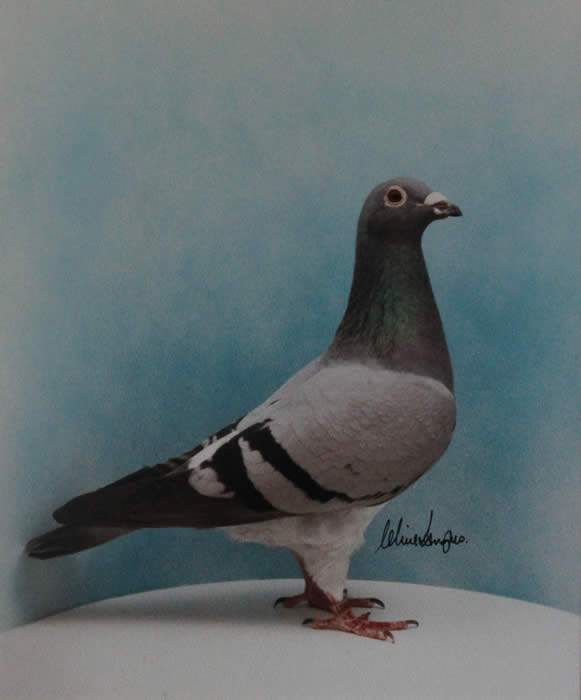
Eastview Endeavour - 1st RV 600 Mile SC 9th National Pau.
Who do rate most highly of today’s fanciers?
There are far too many to single out any one fancier but obviously Mark Gilbert with his incredible run of success at National and International level. People bang on about the number of birds Mark sends but having visited Mark on a number of occasions I can assure you that he would win out of turn in any competition even with a 16ft x 6ft garden shed, such is his obvious ability and stock sense and the quality of pigeons he has at his disposal as a result of that stock sense. People should also remember that he only sent one pigeon to Marseille with the BICC in 2012 and won it. Some fanciers amongst others, who I have the greatest respect for are Arthur Beardsmore and A. H. Bennett of Church Stretton a former King’s Cup winner from Pau with the NFC plus Brian Sheppard and my old friend Bob Bolitho.
Please give the readers the most memorable results that you have achieved.
Winning the National and topping the Combine from Brussels must rank as one of, if not the best performance. However, winning the Rhondda Valley 600 mile Social Circle for the sixth time is also up there near the top of the list as we are the only fanciers to have won it more than three times in the 50 year history of the Social Circle. Clocking our good hen Black Bess on the day from Thurso in 1970/71 and 72 after 15 ½ hours, 15 hours and 13 ½ hours on the wing also sticks in the mind. No pigeon in Wales beat her twice from Thurso during those years.
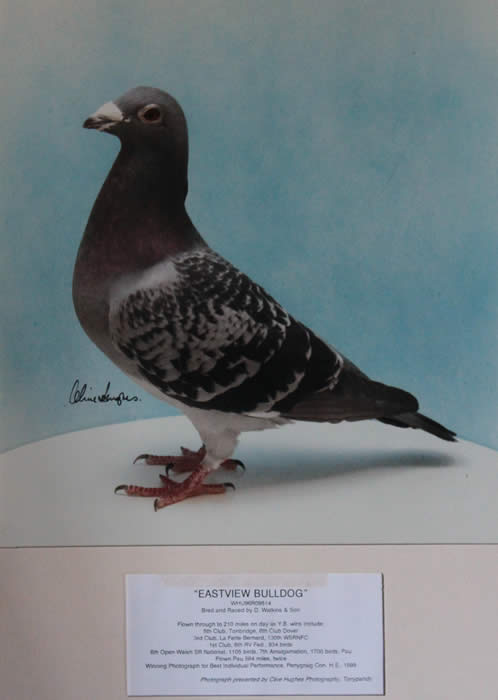
Eastview Bulldog - 1st RV 600 Mile SC 6th National Pau.
What are your future ambitions?
Getting a pigeon to fly Barcelona at 754 miles to my loft. It is an ambition I have had since I was a small boy when looking at oil paintings of my uncle Caradoc’s winners from Pau and Bordeaux. I’ve given myself 5 years to do it and then “I’m outta here” although I suppose I will never be without pigeons – I just won’t be racing them.
Do you have any further comments about anything that we may have missed?
I feel strongly that fanciers should realize that THE single most important thing in pigeon racing is the pigeon itself and unless you can get hold of good quality pigeons then pigeon racing is an expensive form of misery. I have been lucky enough to obtain top class pigeons from top class fanciers and I think I have developed over the years, the knack of being able to pick out good pigeons. My father had an incredible ability to select pairs to mate together whether related or otherwise. He could put a pair of pigeons in a nest box and virtually realize the type of the resultant offspring just by looking at the pairs, many times swapping birds around until he was happy with the selected pair. I think it’s called stock sense.
February 2013