MARK & DICK EVANS
OF MYRTLE LOFTS IN WHITLEY BRIDGE
by KEITH MOTT
After many successful years in pigeon racing Mark and Dick Evans told me their most thrilling experiences in the sport is having the telephone, texts, and e-mails going week after week with winning reports from different fanciers all over the world achieving top performances by racing their bloodlines. They both decided to introduce the Gaby Vandenabeele bloodlines back in 1995 with the intensions of putting together a family of pigeons for middle-distance Classic & National racing. Their main ambition was to try and put a 1st Open National winner to their own list of achievements. Back then in the nineties when purchasing these birds little did they realise what outstanding bloodlines they had invested into and how famous they were about to make the name M & D. Evans become world-wide. These bloodlines have amazed even Mark and Dick achieving far more than they could ever imagine. Fifteen years later and the father and son partnership are proud to pronounce they have to date 71 x 1st Open winners reported in Classic & Nationals which include 46 x 1st OPEN NATIONAL WINNERS that contain their M & D. Evans bloodlines. They have also had winners reported in America, Canada, Hawaii, South Africa, Taiwan, Kuwait, Belgium, Holland, Germany, Hungary and all parts of the UK. For Mark and Dick these outstanding results for other fanciers are far more rewarding than any 1st Classic or 1st National winner in their own lofts.
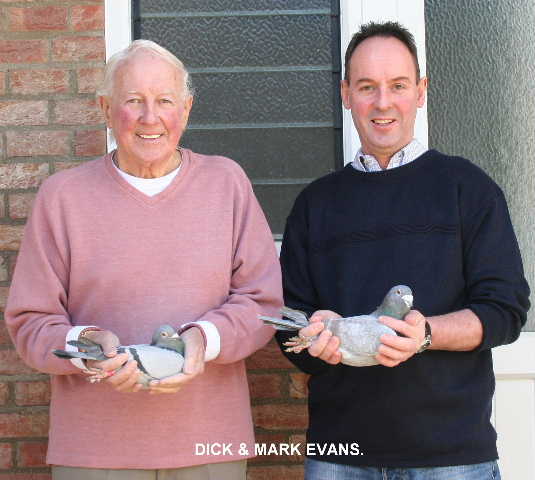
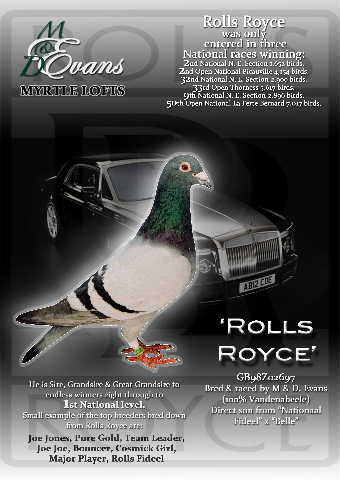
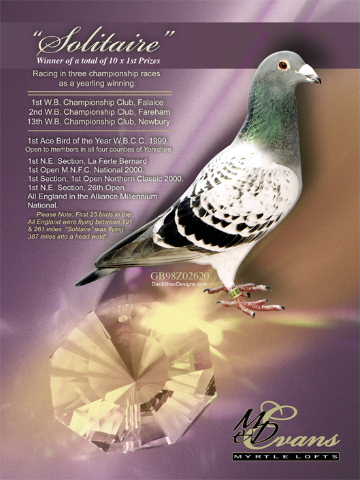
Mark & Dick have worked extremely hard to build a family of pigeons that will win from 70 miles to 550 miles and with the ability to perform better in head winds. They both enjoy all races that they have entered over the years but National & Classic racing at middle-distance is their favourite competition. The father and son partnership like any races that are one day events. One of the best cocks they bred for National racing was ‘Rolls Royce’ who only raced as a young bird and a yearling due to injury. He was entered in three National races winning 2nd Section (1,652 birds), 2nd Open National Picauville (4,154 birds), beaten by a loft mate when ‘Myrtle Lofts’ recorded 1st, 2nd and 3rd Open National, then he won 32nd Section (2,900 birds), 33rd Open National (5,617 birds) and 9th Section (2,896 birds), 50th Open National La Ferte Bernard (7,017 birds). What made ‘Rolls Royce’ so special to Mark & Dick is because he achieved all these three top National results racing into head winds giving over 120 miles to the front loft locations. After ‘Rolls Royce’s’ injury he became one of the best breeders at ‘Myrtle Lofts’ breeding many top races and breeders He is sire, grandsire & great grandsire to endless winner’s right through to 1st Open National level. His bloodlines for example: ‘Joe Jones’, ‘Pure Gold’, ‘Team Leader’, ‘Joe Joe’, ‘Bouncer’, ‘Cosmic Girl’, ‘Major Player’, ‘Rolls Fideel’ etc. Another super racer and breeding pigeon for Myrtle Lofts is ‘Solitaire’ winning as a yearling ‘Ace Bird of the Year’ in the W.B.C.C. open to members in all four counties of Yorkshire. As a two year old he won 1st Open Northern Classic, 1st Open MNFC National and was 26th All England in the Alliance Millennium National, with the first 25 birds in the All England flying between 191 and 261 miles, ‘Solitaire’ was flying 387 miles into a head wind, with 1,435 birds competing on a 5 bird limit. ‘Solitaire’ was then retired to stock where he proved to be an outstanding breeding cock breeding generation after generation of winners right through to the highest level. The winning reports back to ‘Myrtle Lofts’ are fantastic! D & J. Hawkins from Doncaster won 1st and 2nd Open M.N.F.C. National G.R. Picauville with two grandchildren (nest mates) from ‘Solitaire’, also a direct daughter from ‘Solitaire’ bred 1st Section, 1st Open Northern Classic also for D & J. Hawkins. Another direct daughter bred 1st Section, 1st Open M.N.F.C. National for Clive Yates from Tamworth. Another example of the quality of ‘Solitaire’ was shown in 2005 when five different pigeons were placed in the top twenty Open National, they won 2nd, 4th, 8th, 18th and 20th Open National when (7,131 birds). All five were grandchildren from the wonderful ‘Solitaire’. ‘Rolls Royce’ and ‘Solitaire’ are only a small example of the top races and breeders housed at ‘Myrtle Lofts’.

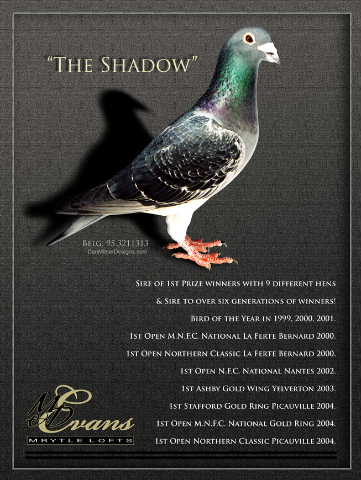
One of the all time best breeders at ‘Myrtle Lofts’ is Belg 95 3211313, Champion ‘Shadow’, bred by Gaby Vandenabeele. He is sire of winners with 13 different hens and sire of over six generations of National & Classic winners. He is himself responsible for 1st Open NFC Messac, 1st Open NFC Angers, 1st Open London & SE Classic Bergerac, 1st Open BBC National Carlisle, 1st Open Welsh S/E National Oudenaarde, 1st Open MNFC Yearling Alencon, 1st Open Welsh National Bergerac, 1st Open MNFC Carentan, 1st Open MNFC G/R National, 1st National AU race Stockton California USA, 1st Open MCC Lessay, 1st Open CSCFC Lessay, 1st Open London & South East Classic Guernsey, 1st Open CSCFC Messac, 1st Open BBC Fougeres, 1st Open NFC Nantes, 1st Open BBC Bordeaux, 1st Open BICC Falaise, 1st Open MNFC National Treble Chance and 1st Open London & South East Classic Club Tours. That’s 19 x 1st Open winners in Classic and National races. Even the latest top performance of 1st UK 3rd Open Sun City Million Dollar Race winning $75,000 (approx. £48,000.) was also a granddaughter from Champion ‘Shadow’.
Before retiring from racing at Myrtle Lofts, Mark & Dick raced 32 cocks on full widowhood and between six to ten hens raced on the natural system paired together as lesbians. The 32 widowhood cocks were paired up around December and they would be expected to breed at least one round of youngsters so that the cocks were very strongly bonded to their nest boxes and their partners. These cocks would remain paired together until four weeks before the first race when the hens, eggs or any second round youngsters would all be removed from the loft together. In this four week period before the first race the cocks would be trained on every opportunity from a starter training flight around 12 miles right up to about 50 miles and on the weekend of every week prior to the first race the widowhood cocks would have a dummy race returning back to their hens. This means by the time these cocks had their first proper race of the season it was like their fourth race to them which reassured that all the yearlings understood the widowhood system. Once the cocks were on full widowhood they would be exercised twice a day except on race days. Also once the racing had begun the widowhood cocks would be trained Tuesday, Wednesday and Thursday mornings at distances between 35 miles and 50 miles depending on the wind so they would achieve about 45 minutes on the wing. On the Tuesday and Wednesday training flights the birds would return to an empty loft but on the Thursday training flight the cocks would return to their hens which proved to be a better advantage to the older system of showing the hens on a Friday night before basketing for the races. By showing the hens on the Thursday training flight rather than the Friday night, would guarantee that the cocks would travel to the race less worked up and stressed prior to the next day’s race. These widowhood cocks would race every race right through the season and would not be repaired.
Mark & Dick do not believe in breaking down. The cocks were fed the best quality corns possible and as much as they could eat. Feed hard work hard was Myrtle Lofts policy. By feeding top quality corns every day of the week ensured that the cocks had a full tank of fuel at all times. The widowhood cocks are fed on Super Diet & Sneaky Mix 50% x 50% seed mix in the morning and then Super Widowhood 75% & Junior UK 25% at night all hopper fed. Also two to three weeks before their first race Mark & Dick added Blitzform in the water Tuesday, Wednesday & Thursday for the night feed (Fresh clean water in the mornings)
The six to ten old hens were selected because of their outstanding results as young birds. For several years Mark & Dick use to say because of only racing widowhood, how sad it was to stop young performances hens and not carry on racing them on as yearlings. These selected hens were put in with the young bird team and flown on the darkness for the second year running. These hens would pair together as lesbians and Mark & Dick would prepare them for the Classic races mid-way through the season. Due to the fact Mark owned his own transport company these hens would be doubled and singled up at all distances right through to the south coast at 200 miles. These hens may only have two club races before the Classic but regarding training they would know the countryside from one end to the other. Mark & Dick won with these hens 1st and 2nd Open Northern Classic Fougeres 368 miles with a five bird entry, 1st, 2nd, 19th, 20th and 27th Open Northern Classic Picauville with a nine bird entry, also winning 3rd, 5th, 8th, 16th and 108th Open N.M.F.C. Picauville with a five bird entry. The hens were prepared so they were always feeding an eight to ten day old youngsters for these races. This wasn’t hard to achieve because Mark & Dick could get the hens sitting and because they were infertile they gave the two hens a youngster from the breeding lofts. Once the youngster reached ten days old Mark or Dick would swap the youngster for one two days younger so the young bird would never get bigger than ten days old. This ensured the two hens were only feeding one young bird between them and it would never become hard work due to the age.
Because Mark & Dick no longer race in the U.K. the present day lofts are only used for the Myrtle Lofts breeding programme and house all the top breeders responsible for the outstanding success story behind the M & D. Evans bloodlines. If the partners were to decide to restart pigeon racing here in the U.K. this loft could be easily adapted to race both old birds on widowhood and young birds on darkness. The lofts are built from brick with a Spanish slate roof. They have been built higher than most normal lofts to keep the inside more ventilated which makes a fresher environment for both Mark & Dick and the pigeons. Outside the lofts there are two large open top aviaries which are both 20ft long x 12ft wide are 12ft high. In the roof of the aviaries there are built in showers which are used throughout the warm summer seasons. On the bottom of the aviary floor there are hard wood floor grills with a built in drainage system under the grills which is ideal for washing out or for removing rain water after poor weather conditions. Inside the loft is a small working area with built in sink with hot & cold water and toilet which then leads into a corridor that leads the full length of five breeding sections which all have ventilated windows and doors to give maximum ventilation throughout the warmer summers. Each breeding section is fitted with electric cleaning nest boxes. These nest boxes and floor sections are cleaned at least once and sometimes cleaned out twice a day. Mark & Dick do not like deep litter and believe the birds would be much healthier in a cleaner environment. The full length of the inside roof is open doweling which can be closed up completely if need be in cold winter conditions. The most important factors: The lofts must be clean, dry and well ventilated. Mark & Dick believe the biggest mistake most fanciers make is that they over crowd by housing to many pigeons for the size of their loft space. Overcrowding courses stress in the pigeons which then leads to serious health problems.
The M. & D. Evans bloodlines are made up from about 80% Gaby Vandenabeele crossed into bloodlines from Karel Herman, Robert Willequet, Flor Vervoort, Noel & David Lippens, and Louis Deleux. Mark & Dick like to keep their family Vandenabeele based but are interested to cross in any bloodlines that achieve top National results on hard working days. In the breeding lofts Mark & Dick have 50 pair of proven breeders and then they have a breeding section called their experiment section that houses approx 20 direct children from their main breeders plus one or two new added introductions. In the experiment section each bird is paired to at least three different mates and where all youngsters from these pairing are judged on performance and intelligence. It is then and only then the decision is made to either add the pigeon into our main breeding loft or cull the bird with disappointment. Mark and Dick believe this is the best way of working to ensure they never weaken their main breeding lofts. The stock birds are paired up around the 28th December and are fed all year round on Versele-Laga Best All Round mixed with Super Diet & Sneaky Mix. The stock are also given a lot of greens, lettuce, Kale, water cress etc.
Mark and his father pay no attention to eye-sign. They have never believed in this theory from day one and to be honest they believe more in Father Christmas than they do in the eye-sign. Mark’s opinion is that an eye is only good if you can see accurately through it. It doesn't matter about the colour that comes from the genetics side of breeding. Most of the experts don't fly well at all, and if they're so good at selecting through eye-sign alone, they would have a loft full of top racers and breeders. Top winning success in racing and breeding is down to good judgment when first purchasing new stock then after a length of time, ensuring that you, by the selection of the basket finish up with only the very cream of your new family. Mark say’s the only eyes you should study are the eyes of the person you are purchasing your future stock from and if any doubt or signs of dishonesty show then leave them alone. Mark and Dick would advise any new starter to spend lots of time working alongside a successful fancier who lives in their own area. Volunteer to do all jobs for free in return for good advice in management, breeding, feeding, training etc. No different to a jockey working his apprenticeship as a stable boy before becoming a top jockey or top trainer in the race horse game. Only take advice from a successful winning fancier who can show winning race results to back his opinions.
The partners are both big believer in inbreeding, line breeding but also realising you must out breed before becoming too inbred. Any new stock which is introduced to Myrtle Lofts will only be purchased from a proven racing loft with winning success not only for themselves but like Mark and Dick they must have a successful record for producing winners for other fanciers. All new pigeons purchased must carry a full pedigree with top winners or breeders no more than two generations away. Many fanciers do say the pedigree is of no importance, they could not be any further from the truth. Honest pedigrees can give you valuable information about the background of a family of birds. The pedigree teaches you how to keep a successful winning line going over a period of several generations by using combination of broad based line-breeding, but please remember inbreeding and line-breeding should only be practiced with world-class pigeons. Then at the right time careful out-crossing is always an integral part in the long range view of any successful inbreeding loft. Never start in-breeding with anything but the very best stock. Do not expect to take mediocre birds and improve their quality by using this system. In-breeding quickly shows up all the good qualities, by allowing the best association of genes, but it also shows up the faults. At ‘Myrtle Lofts’, Mark & Dick work and study extremely hard to in-breed, line breed and cross breed all the hard day working pigeons together; they have been known to cull the parents to winning pigeons which can only achieve top awards on fast days. They both strongly believe that with the right management any family of pigeon will win on high velocities with the wind up their behinds, but when you want to win on slow hard working days with the wind on their nose and giving 100 miles to the front lofts in national races you need a family with the ability not only to win, but achieve results which most fanciers only dream about and think it is totally impossible to achieve. But this does not mean to say that they think one should overdo line breeding or in breeding. Mark & Dick will dare to breed closely and cross breed afterwards. But they do advocate bringing in some new blood every year, but it has to be the Crème de la Crème. Mark states you must never let it reach the state that you’ve bred as far as you can go. On top of that you have to bear in mind that every new feather is not guaranteed success. Mark & Dick do believe all their pigeons, races and breeders must have a good healthy stress free moult. They both believe that all birds should be parted at this period of time. They feed top quality corns all year round and will never look for a cheaper option in the winter period. The two partners believe very strongly that special care and management in the winter time plays a large part in their success throughout the racing and breeding season. Success is achieved by working and caring 24/7 and the full 12 months of the year.
Before retiring from racing in the UK the Evans partners use to race approx. 50 to 55 young birds per season. Except for the last season when they raced, when their young bird team was 73 strong due to trying out several new bloodlines. The young birds here in the UK were raced on the darkness system. This year 2011 they will be racing about 68 young birds on the lightness system at their racing lofts in Florida U.S.A. The darkness youngsters here in the UK were darkened at 5 o’clock at night and then taken of the dark at 9 o’clock the next morning. All young birds went straight on the darkness at 28 day’s old straight from the nest. The young bird team would be added to the loft from early February right through to the middle of April. The darkness system was completely removed on the longest day of the year 21st June. An important fact regarding the darkness system is! If you remove the darkness before this date your young birds will drop into a second moult before the final races of the season, which to be honest is the major requirement for the system in the first place. Also if you leave your youngsters on the darkness system after the 21st June you will struggle to get your young birds through the wing for yearling racing the following year. The main secret to been successful with the darkness system is that when you close the loft down at night is to ensure the air ventilation to the loft is adequate for the required amount of youngsters housed.
The training the youngsters would be started approx. ten weeks before the first race at about 3 miles from home and then each day the training would be increased to 5 miles, 7 miles, 9 miles and then 12 miles. The youngsters would not be taken any further than 12 miles until they were racing straight home doing a mile a minute on a regular basis. Only after Mark and Dick were happy with the 12 miles return would the training be increased again each day until they reached the distance of 50 miles. The youngsters would never be trained off line regardless of how far they would drive from the major road ways. Once the racing began the youngsters would be trained Monday, Tuesday, Wednesday and Thursday mornings at about 35 to 50 miles depending on the wind. Dick told me, ‘Regarding feeding the youngsters were fed on (all Versele-Laga corns) Best All Round mixed with a small amount of Super Diet & Sneaky Mix until you get them eating well on their own. Then once the young birds were flying around the loft they were fed on Super Diet & Sneaky Mix 50% x 50% in the morning, small amount to keep them under your control and at night Super Widowhood 75% & Junior UK 25% giving them as much as they can eat. Also starting two to three weeks before their first race the young birds were given Blitzform in the water Tuesday, Wednesday & Thursday for the night feed, fresh clean water in the mornings and this continued throughout the young bird season. All young birds were raced paired up and all young birds were expected to fly across the channel (300 miles) in the young bird National or Classic races’.
Dick Evans’ pigeon racing started taking place in the village of Whitley Bridge in 1944 when he left school and in those days the lofts were named Double Diamond Lofts. The birds he started off with were mainly J. Cope’s of Congleton and McCabe’s Putmen of Northern Ireland. Dick started off on the winning trail from the word go, winning the first race he ever competed in with a dark blue chequer yearling Putmen cock that needless to say got him hooked. Success carried on when he got down to Didcot and he had the only bird on the day, an outstanding achievement in those days to say the least. The next first prize for him was at the channel race from Rennes when only two birds made it through on the day. Dick clocked at 5.40pm the next fancier at 7.45pm. Dick’s first job after leaving school was travelling the country with show jumpers and rode quite a lot of ponies at County Shows. He also became very interested in greyhound racing, a sport he had much success in over the years. Competition with animals and pigeons appeared to be like a magnet to Dick and all this carried on up to approx. 1960 when he sold all the birds, baskets, clocks etc. That was the end of pigeon racing as far as he was concerned. His son, Mark’s interested in pigeon racing started from the very young age of six years old when he use to visit a neighbour called Robby Barker. Robby was an elderly gentleman who used to let Mark spend hours helping him clean out his pigeons. It was shortly after then that Mark tried to persuade his father to build him his own pigeon loft at home. Dick tried to talk him out of it telling him it was the worst sport possible for disappointments, but he wasn’t to be deterred, his mind was made up. It was at this time Dick built for Mark an 8ft x 6ft racing loft and a 14ft aviary with nest boxes in one end. This loft was then named after the family home ‘Myrtle House’.
After starting in the sport in 1970 Mark was offered free pigeons from several different fanciers in his local area but he remembers his father very clearly saying that it would be much better to purchase from just one successful racing loft. He stated that there is only one way to success. Purchase the best bloodlines possible and then get yourself out of bed in a morning and spend hours of dedication getting them right for the job. Mark’s first year racing was in 1972 winning 9 x 1st prizes racing young birds only. These nine first prizes that Mark won in 1972 became Myrtle Lofts worst season’s performances in almost 40 years. The young Mark had no other interests and has been just obsessed with pigeons all his life. All through his school life his only interest was to get home to look after his feathered friends. Mark was once put in front of the headmaster at high school and was given a lecture about needing to find an interest in some other field rather than pigeons. This so called advice from his headmaster just went in one ear and out of the other.
After Mark persuaded his father to build him his first pigeon loft in 1970 it was fanciers like Jack Taylor from Askern in South Yorkshire, who was better known in those days as ‘Jack the Cat’. Jack domineered the local area at the time with his top performances winning 1st, 2nd, 3rd and 4th week after week and it became so often that fanciers not knowing the local result use to just ask “who’s won 5th then this week”. Other top performances at this period of time were achieved from the lofts of Jack Hugall, Ward Brothers, Alwen Paddy, all very good fanciers at this period of time. Interesting fact was that all these fanciers raced the same strain of pigeons, Karel Hermans from Belgium. When Mark started in 1970 there were many strains of pigeons about but after close scrutiny Dick soon realised that most of the winning lofts were flying Hermans so after giving the mater a fair amount of thought Dick decided he would start his son Mark in the sport with Karel Hermans. They were extremely fortunate to have friends who lived in the Midlands who for many years had spent holidays in Belgium with Karel Hermans and had obtained many of his stock birds so obviously when they were offered some of the direct imports they jumped at the chance without hesitation. Mark & Dick obtained sixteen in all with most of the top Herman bloodlines such as the ‘Scherpe’, ‘The Velthem’, the ‘Two Blacks’, ‘Bordeaux’, ‘The Famme’, ‘Aglangouleine’, ‘The Faury’, ‘Old Marseille’, ‘Westerloo’, ‘The Houban’, ‘Meil’, ‘The Pol La Princess’, ‘The Cahors’ and ‘The Vetters’. Anyone knowing the Hermans will realise they had purchased the very best. Mark & Dick Evan introduced endless different families over the years but nothing could compete against the Hermans. And the rest is pigeon racing history!
I hope my readers have enjoyed this very special article this week! Next week we are having a Mark and Dick Evans part 2, which will feature their racing partnership with John Marles and their loft in Florida USA. Mark Evans recently said to me, ‘the appointment that we made in 1992 to visit the loft of Gaby Vandenabeele was one of the best decisions we’ve ever made in pigeon racing’ and I agree with that! I can be contacted with any pigeon banter on telephone number: 01372 463480. See yer!