MARLES & EVANS
of Florida in the USA
by Keith Mott
This week we are going to have part 2 of the Mark and Dick Evans story. In our last article we looked at their fantastic lofts in Yorkshire and this time we are going to feature their racing partnership with John Marles, and their racing loft in Florida USA.
Between 2002 and 2005, Myrtle Lofts sold three small shipments of M & D. Evans pigeons into North America and from the very beginning they showed some outstanding results for different fanciers who managed to obtain youngsters bred down from these bloodlines. Because of the impact of these achievements, Mark & Dick started receiving many more e-mails from U.S.A fanciers requesting information on their birds. Unfortunately, due to the large demand for their birds here in the U.K. plus orders from other countries it was becoming almost impossible to keep shipping their birds to America year after year. Mark & Dick explained they would very much like for their bloodlines to achieve more outstanding results over in the U.S.A to the same extent as they have in their own country here in the U.K. However, without their birds being circulated throughout America, this would be impossible, so with this in mind in 2005 Mark & Dick offered their very good friend John Marles a partnership at his own loft in North America. John spoke to his wife in detail what this offer entailed and both his wife and himself couldn’t see any disadvantages for either parties and decided to accept this North American partnership with Mark and Dick. John admits his decision wasn’t taken lightly as there were, respected reputations at stake on both sides of the big pond.
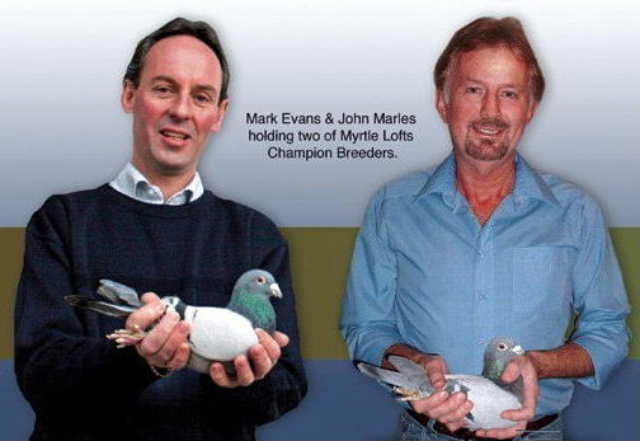
As soon as Mark heard the good news from John he immediately put together a team of their best bloodlines and made arrangements to ship 34 pigeons to John’s loft in North America. They included direct children from all their champion breeders, many of them parents to four, five and six generations of winners. These birds will be added to John’s already successful team of M & D. Evans breeders which he has obtained from them over the last few years. Out of these birds, John will keep the first round of youngsters each year for his own race loft and then he will offer the next couple of rounds to the American fancier. This opportunity gives Myrtle Lofts the chance to fulfil another of their dreams in breeding as many champions in the U.S.A as they have already done here in the U.K.
John first met Mark and Dick in 2002 when he came to England to purchase some of their M & D. Evans bloodlines. He had read about the phenomenal success of Mark & Dick and what these birds had achieved in Classic and National competition, but wanted to see their operation first hand and to choose youngsters from specific pairings. The three of them struck an immediate chord and a solid friendship has emerged. What started as a friendship soon turned into a partnership and six years on neither party regret their involvement in joining forces and working together. As soon as John was involved with the M & D. Evans bloodlines, he decided for the first two years to place some youngsters in selected lofts in the Toronto area. This exercise would help John sort out quicker which breeders were producing the best lines. The chosen fanciers were asked to fly them as they would the rest of their young bird teams. At the end of both young bird seasons, it was more than obvious that the M & D Evans birds had made their mark on the winning pages. Every loft that John chose to race for him reported successful winning lines.

One fancier called Joe Ferriera has been a successful flier in the Up North Combine (140 active young bird fliers) for many years and as such is always looking for ways to improve his stock and take his racing level up a notch. Joe is a very small team flier by today’s standards racing approximately twenty-two old birds and maybe thirty-five young birds. In 2004, he had thirty-seven young birds of which only five were bred from M & D. Evans stock. Four of the five were bred from a pair which carried the lines of Ebony, Benetton, Victor Reid, Jester, Carrie, Rolls Royce and Love Bird, all well-known names at Myrtle Lofts. The young bird season consisted of eight races ranging from 180 kilometres to 530 kilometres (approx. 110 – 325 miles). The Evans birds beat his in seven out of the eight races. With these birds, Joe won five club races out of the eight. One bird, banded CU 2004 YR 1833, won two club races and finished four times in the top of the combine, earning her “Ace Young Bird” in the club and “Ace Young Bird” in the Combine. An example of her positions includes 2nd Combine, 450km (911 birds), 4th Combine 520km (798 birds), 16th Combine, 370km (1333 birds). After such an exceptional year Joe insisted that John should take her back and put her in stock for one year to see if she could breed as well as she flew. The following season from her first six offspring, Joe Ferriera raced three and John Marles raced the other three. Five of these youngsters scored throughout the season. One of Joe’s achieved 1st “Ace Bird of the Year” in his club and John had both 1st and 2nd “Ace Birds of the Year” in his club. By the end of the 2004 season, Joe Ferriera was hooked on the M & D. Evans bloodlines.
John said after only three years from accepting the partnership with Mark & Dick the results of the M & D. Evans birds continue to pour in daily. An example in one combine 300 mile race the Evans birds had a field day winning 1st, 8th, 14th, 16th, 18th, 21st, 23rd, 27th, 55th, 61st, 63rd, 64th, 73rd, 76th, 78th, 81st, 84th, 86th and 100th Combine, from 77 Lofts sending 1,063 Birds. This represents almost 20%, 1 in every 5 birds was an Evans bird and yet this was achieved by 2% of the lofts in the Combine. Another Combine race the Evans birds won 1st, 2nd, 5th, 6th, 7th, 8th and 9th Combine with 84 Lofts sending 1,260 birds and what makes this result even better was that 1st and 2nd Combine winners are actual nest mates racing for two different fanciers to two different lofts. Another fancier called Mike Valente that John chose to help him select the best breeders won the first three races of the season winning 3 x 1st Combine wins in a row with the Evans birds with many more loft mates in the result. Another Combine race show the Evans bloodlines in top form 1st, 2nd, 3rd, 14th, 15th, 16th, 17th, 19th, 21st, 25th, 33rd, 45th, 53rd, 58th, 61st, 94th, 97th Combine when 82 members sent 1,210 birds, with 34% of the Combine result were of Evans origin..... It didn’t matter what part of America or Canada these birds were racing the results seem to show a mirror image just like they have for different fanciers in the U.K. John said to Mark over the telephone that these are the best pigeons that have been imported to the USA for many years and he was extremely confident that this is the next wave of pigeons to refresh and enhance the quality of the existing gene pool. As the Janssens, Van Loons and Husyken Van Riel did in the past, and he his 100% sure the Evans bloodlines are going to perform in America as their ancestors are doing in other parts of the world.
John often read in the American Racing Pigeon Digest, stories about the great competition in America’s “Little Belgium” area of Florida, an area boasting over 200 lofts in a six mile radius! The Unit Ten Highlands area has around a hundred lofts in a half mile radius and is the original “Little Belgium.” John visited the area and loved it. Soon he yearned to race there. Canada had no competition like this; the number of lofts in the Toronto area was steadily dwindling. John visited the Florida area several more times, visiting lofts, watching races, going to the grand GHC club house. He dreamed of racing there so John then talked over his plans with Mark and Dick. They were almost as excited as he was! Their foray into Florida racing as “Marles & Evans” soon began…. John studied years of big GHC club results to find the perfect spot to race from. He found it on the short end in Brooksville, on top of a hill overlooking the race-course, a wonderful location to compete from. John had to wait two years for the land on that hilltop to come on the market, but the wait was well worth it. In Canada he had 65 miles over-fly in the Combine, which was a big disadvantage; now he was up front and centre; ten miles short. John also studied several successful Florida loft designs, then after consulting Mark & Dick they had a nice, functional loft built. John then brought down his Evans breeders from Canada, and bred a few youngsters for their first year racing in Florida. Now the big question was: Could their M & D. Evans pigeons from cold, damp, rainy England handle Florida’s heat and humidity? Local fliers doubted they could and come out with comments like “Just wait till he flies here. Those Canadian/English pigeons will never win in Florida!” These comments were quite understandable due to the fact this area has more All Americans, more Hall of Fame winners, more North American Champions, more National Champions competing, than anywhere else in all of the USA! Can this new breed of British pigeon succeed where all before them have failed?
John joined America’s biggest club, the 210 loft strong GHC (Gulf Coast Homing Pigeon Club), which encompasses the whole area, ten miles from short to long and only a half mile wide! John also joined the smaller, 35 lofts, short-end FSI (Florida Suncoast Invitational) club, both flying in the Greater Tampa Bay Concourse. In their first season Marles & Evans began racing the M & D. Evans bloodlines in the FSI Club with a small team of just 23 birds. His performances surprised everyone because it usually takes fliers several seasons to acclimate themselves and their pigeons to the Florida climate and competition. But they scored in their first ever race: 1st FSI YB Average Speed; 1st, 5th, 7th, 12th, 19th, 21st and 24th YB Champion Pigeon FSI; and 1st Champion Loft FSI! Even more surprising, in the big Greater Tampa Bay Concourse, with the big GHC Club also competing in the Concourse, the Marles & Evans team scored 1st YB Average Speed GTBC; 2nd Champion YB Loft GTBC; and 2nd & 3rd Champion Young Bird GTBC!! Wow! Ten young birds, six hens and four cocks, actually did most of Marles & Evans’ winning. John Marles racing under the name of Marles & Evans opened a lot of eyes!
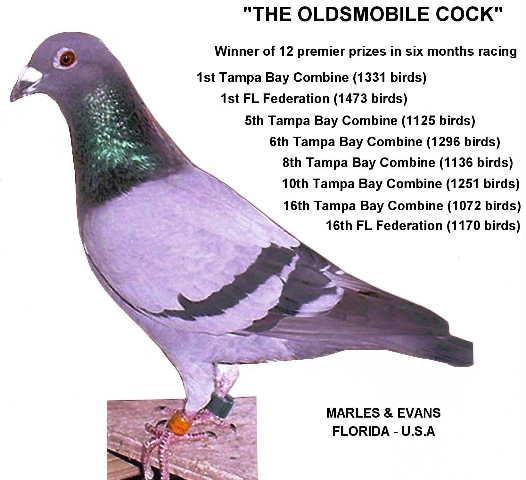
Other results included 1st FSI Club 1st, 35th, 36th, 38th, 41st, 43rd, 51st and 74th Greater Tampa Bay Concourse (1,358 birds), 1st, 2nd, 3rd, 4th, 5th, 7th, 10th FSI (527 birds); 1st, 2nd, 3rd, 4th, 5th, 7th and 10th Greater Tampa Bay Concourse (1,331 birds); 1st, 2nd, 3rd, 4th, 5th, 7th and 10th Florida Federation (1,473 birds). Everybody was really talking now!
Mark says “It’s essential to look for the strongest competition possible if you’re aiming to establishing a world class gene pool from which you can work. You’re only kidding yourself if you’re looking for easier competition to own a red card. You will only become world class by racing against world class pigeons. There are many new records to be broken and with the right bloodlines they become easy”.
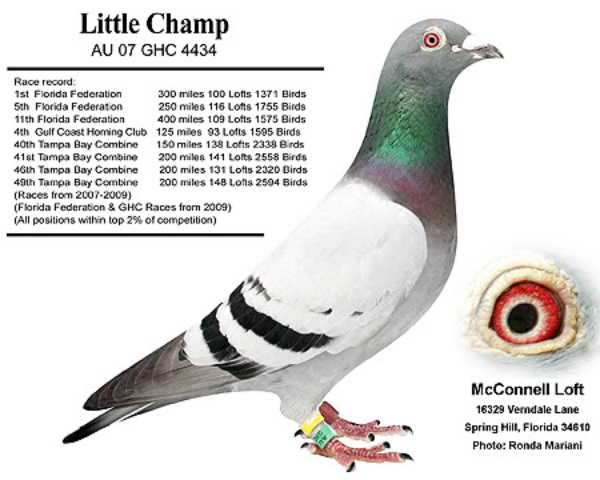
Marles & Evans aren’t the only fanciers winning with the M & D. Evans pigeons in “Little Belgium” as there are many more realising these are super pigeons for this kind of competition in the USA. Laurie McConnell of Spring Hill, Florida is a fine example to show what can be achieved with these bloodlines. Laurie has been around our sport for well over half a century, and he's won a lot of awards, including having several "qualified contenders" for the AU Hall of Fame, but winning a rare double in the coveted 2009 North American Ace Pigeon Awards is the highlight of his long pigeon racing career. His pigeon "Little Champ" (100% M & D. Evans bloodlines) AU07GHC4434 not only won 1st North American Middle Distance Ace Pigeon (Old Bird), but achieved a rare "double" by also winning 1st Overall North American Ace Pigeon (OB) Division 2 Average 1001 - 2000 birds! “Ace Pigeons” are both rare and unique in the racing pigeon world. They are akin to thoroughbred horse racing’s “Breeders Cup” winners. They must put up several outstanding performances in one season. Although 1st place winners often receive more publicity, “Ace Pigeons” are coveted by knowledgeable fliers. The North American Ace Pigeon & Ace Loft Championships, sponsored annually by the American Racing Pigeon Digest, acknowledges these champions and the fanciers that race them. This championship is open to all AU (American Racing Pigeon Union), CU (Canadian RP Union), and IF (International Federation of American Homing Pigeon Fanciers) members, as well as independents, in North America, which numbers somewhere around 15,000 lofts, making it the most competitive championship in all North America.
Laurie’s Double North American Ace Pigeon “Little Champ” is bred out of M & D. Evans bloodlines purchased from Myrtle Lofts partnership loft (Marles & Evans) when they were still based back in Canada. “Little Champ’s” sire is a grandson from Myrtle Lofts Westkapelle, Band of Gold, Rolls Royce & Queen of Diamonds. “Little Champ’s” dam is a daughter of “Sylvan Laura” 1st Champion YB in Club and 1st Champion YB in the Up North Combine 2004, You will remember earlier in the article she was flown by Joe Ferreira in North America. “Sylvan Laura” also has all the great M & D. Evans bloodlines in her background too, Logan, Pure Gold, Benetton, Jester & Carrie etc. It’s not hard to realise with these bloodlines why “Little Champ” is a double American Ace Pigeon Award winner. Mark, Dick and John are all very proud to have moved into new competition and achieve such outstanding results right from the out start and more so when they were constantly told it was impossible to move in to “Little Belgium” and become an overnight success. I do know that these three fanciers didn’t leave a stone unturned and took into consideration every bit of good advice given. Mark and John spend hours on the telephone talking plus trips to and from America to mull over any new ideas which may improve performances. John quoted earlier that when he joined Mark & Dick as a partnership that there were reputations at stake on both sides of the big pond but with the results already achieved the partners of Marles & Evans have no worries at all. They have proved they are world Class fanciers with world class pigeons.
John Marles has had pigeons for fifty-five years and he started when his grandfather gave him two street pigeons when he was five years old. He started racing in the junior club at age eleven and raced pigeons in Canada for about forty-five years and in Florida in the United States of America under the name of Marles & Evans for the last three years. His loft in Canada is one where he could modify part of the structure to suit the conditions of the day. John has a loft within a loft and has placed large aviaries directly in front of the loft which are enclosed with a plastic material for the cold and rainy parts of the year. When the weather changes for the better then the plastic material is taken down. The loft is made of wood and can be closed down if needed to maintain the heat or the many windows can be opened fully to take advantage of a nice day. Inside, John has twelve small exhaust fans which span the forty-eight foot loft and this is most important in Canada when racing on the dark system and especially for those days when the weather is hot and humid. In Florida, due to the hot and humid conditions which exist for at least seven months of the year the loft must have excellent air exchange. When the humidity reaches or surpasses the air temperature it is critical to get the sticky hot air out. In Florida John has four large roof vents for the seventy foot loft that work on both humidity and temperature. On those days when the air is thick with moisture, he turns on all the fans to create some air movement. In Florida it is also important to capitalize on the sun by positioning your loft so that the sun’s rays can penetrate right to the back of the loft to dry out the floor and therefore prevent mould and dampness. It is also important to be able to close down any windows as the weather in young birds and the beginning of old bird racing can get very cold, down to 18 deg F, -10 C, relatively speaking.
In the 1970s John Marles raced both natural, double widowhood and we’ll call it pure widowhood, and raced cocks only. He was driven crazy, but the results were fabulous! Then with a young family he raced just double widowhood and in 2009 in Florida racing under the name of Marles & Evans, and he raced their fifteen yearlings on double widowhood. The partners told me, in 2011, they would like to also race a few pairs on natural as John feels they can be very valuable for the long end. In the nearly forty years that John’s raced double widowhood he has tried to implement any good sounding ideas and he has tried breeding one, two and no young birds from them prior to racing but preference is for them to raise young ones and wean the young bird as soon as possible. On shipping night, John has tried many different methods and settled on showing the hen for a few minutes. Each fancier seems to find the method that suits his/her own time schedule. The length of the race determines the time he will leave the pair together and when the distance of the race is short then so will the time be that he leaves them together. If it has been a real tough race then he might leave them together over night and John tries to race the majority of the birds to at least the 500 mile stage.
Regarding feeding to race in Florida: This is very different now Mark & Dick are concentrating in racing in Florida. Mark & John have had to change their thoughts on the weight of a pigeon going to race, as it is critical that you do not start too early to add the fats otherwise on Friday evening at shipping they may have put on too much. Due to the weather being hot they do not expend any energy maintaining their body temperature and therefore it is most important that you do not add WEIGHT before they are shipped. Although they must be shipped with enough energy to get the job done so you need to re-examine just when, what and how much do you need to add before a race. Then depending on the distance of the race they would add the fats that they felt were appropriate. First of all, they would check out the weather for the weekend and try to determine approximately how long the race would be taking into consideration the wind, temperature on course and cloud coverage. Then they would feed according to the hours on the wing. An example would be for a 300 mile race of six to eight hours on the wing he would add some fats to the carbohydrates on Thursday evening. The fats would include rape seed, hemp seed, sunflower hearts and peanuts, all purchased from a health food store.
Over the years the number of young birds John Marles kept has also changed and in the 1960’s and 1970’s John kept no more than twenty five young birds. In the last ten years racing in Canada John generally kept between forty and forty eight young birds. John had two lofts which ran a total of forty eight feet and therefore one bird per foot. In the late 1980’s John raced on the dark system and as soon as the old bird races were over they would be retired to aviaries and his young birds would be spread over the 48 x 10 feet of loft. John used the dark system giving them about 8 hours of light each day and the 50 CFM bathroom fans would be on twenty-four hours. He would then separate them and race them on the sliding door method. In Canada, John raced the young birds out to 400 and 450 miles and some young birds would bounce back the next year and score again and yet others would need at least a year off. John said he would prefer only sending them to the 300 mile stage as this will give you an indication as to their worth as an old bird. Now that John is racing in Florida he uses the light system because the dark system would definitely compromise their respiratory systems. The lights are on for about twenty hours a day and they moult somewhat like they do on the dark system. Then in the beginning of June John cuts the ninth and tenth flight about an inch from the top and then eleven days later these two flights are pulled and the young birds are shut down for six weeks to allow the new flights to grow in. This is done so that the young birds will have a full wing when the money races are flown in November and December. In Florida Mark, Dick & John have decided the furthest they will race young birds is around 300 miles.
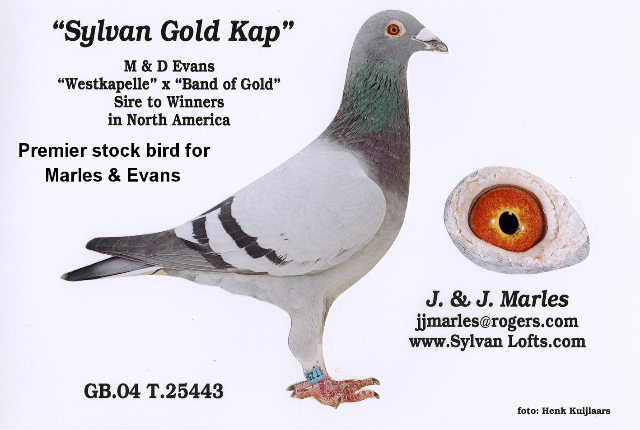
John houses about ten pair of stock birds in Florida and a few new pair each year that Mark sends in to audition for the part. The birds are put together around 25th November. They are fed a high protein mix with about ten percent pellets two weeks prior to mating and John tries to keep the amount of food down, but the quality up. At this time of the year the food is normally coated with brewer’s yeast, human baby formula or powdered colostrums to name a few of the additives. Now, more than ever results dictate John’s search for new additions. This is in fact how John found Mark and Dick Evans after reading an article in a British magazine highlighting their fantastic results and this prompted him to contact them and eventually fly over to England to see for himself. John said that he definitely made a connection with both Mark & Dick and after three years of John racing the M. & D. Evans’ birds very successfully in Canada they offered him a partnership. John immediately accepted the partnership and he’s never looked back. One of the best stock birds that John has ever owned was bred from Myrtle Lofts super breeder “Westkapelle” when mated to “Band of Gold”. This GB 04 T 25443 bird bred either their best or second best young bird in 2005, 2006, 2007, 2008 and 2009. These young birds were Ace birds in Club, Federation and Concourses and won many awards. In 2010 a son of 25443 was Ace young bird and Digest Award winner and he bred the best young bird for another fancier. Another prolific breeder is GB 2005 T 19010 from Champion “Shadow” when mated to his granddaughter “Blue Ace”, the car winner and 15 thousand pounds in Europa One Loft race. Many lofts throughout North America have raced very well with offspring from this cock when paired to different mates.
John’s enjoyed both long and short distance racing. However, when he looks back over the years he well remembers those long distance races when he was one of the only lofts to clock a day bird from very challenging distances. When he was sixteen he raced in the men’s club when they had well over 200 lofts in the Toronto area. There were only 5 day birds from a Gruelling 500 mile race and he had one. In the 1970s at the 600 mile race John had the only day bird into Toronto flying some 60 to 80 miles further than the short end lofts. Since 2002, John has raced the M. & D. Evans bloodlines that have proven that they can race at any distance and at any speeds. They also have proven that whether they race in Belgium, England, Canada, South Africa, United States, etc. the results are the same. They really seem to excel over bodies of water as their results from islands in Hawaii, Puerto Rico and Trinidad indicate. As far as pet theories John believes like most that you only get out of the sport what you put in. John also agrees with those who feel that this sport is a 365 day commitment if you are to succeed at the highest level. Each year John tries to motivate the birds by keeping them very tame and in this way he feels he gets just a little more from the birds than he would normally.