“ON THE ROAD” WITH KEITH MOTT.
Looking back at London & South East Classic Club winners (Part 19).
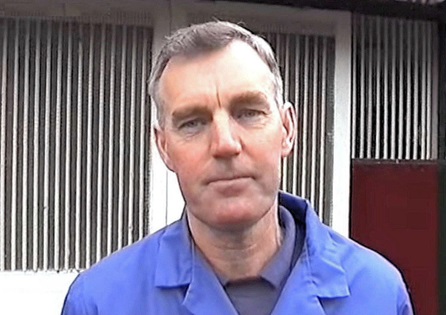
Derek Squire of Addlestone.
The London & South East Classic Club started the 2004 young bird season by sending 2,142 youngsters and 564 old hens to Guernsey. The convoy was liberated on the Saturday morning at 10.00hrs in a North West wind, in what seemed to be perfect racing conditions, but the race turned out to be a very hard event and some members returned their clocks empty.
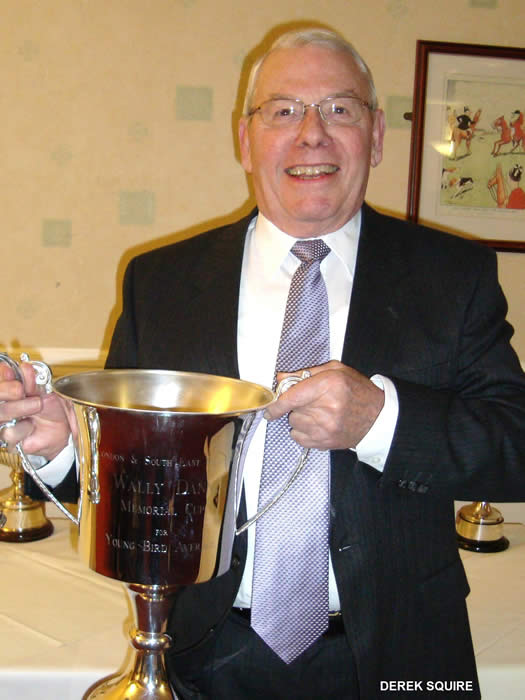
Derek Squire of Addlestone had a brilliant race, having several young birds drop on his loft together and recording some premier positions, including 1st and 2nd open. He puts his youngsters on the ‘ darkness’ system from the time they are weaned until 1st June when they are left alone for two weeks before training begins. Derek says he doesn’t mess around, starting them off at 10 miles and working them up to Winchester (40 miles) very quickly. For Classic and National racing they are tossed off the beach at Hayling Island. All the Squire young bird team race to the perch, although his roomy young bird section has deep box perches and, if the inmates want to pair up, they can. The youngsters are fed on a light mixture in the morning and a good 1oz of heavy mixture after their evening fly, with Hormoform, which Derek has used since it was introduced many years ago. The Squire 2004 young bird team were in wonderful form, also being 5th open in the second Guernsey classic and winning the newly introduced ‘Wally Dann Memorial Cup’, for the best average in the two young bird classics.
Derek had his first pigeons at the age of ten and started racing in the old Addlestone club, in partnership with a friend at the age of 15. They broke their novice status in their first season racing, winning 1st and 2nd club Wadebridge with young birds. He had a break from pigeons for several years while he served in the armed forces and re-started in 1969. The Squire loft is no stranger to success at the highest level, having won 1st open L&SECC Le Mans with a yearling Janssen cock in 1988 and in 1994 he won the Yearling Derby and 2nd open Tours also in the L&SECC. Derek won 1st open L&SECC Guernsey young bird classic several seasons before with his good blue chequer hen, ‘Vera’s Delight’, which was a darkness youngster, raced to the perch. Her sire was Derek’s good Jan Aarden cock, winner of 107th open NFC San Sebastian in 2001, when paired to his sister. Derek told me the idea of this mating was to boost up the Jan Aarden line of his old ‘ace’ stock cock, which had stopped filling his eggs and was the double grandsire of ‘Vera’s Delight’. The main families raced are Jan Aarden and Janssen, which all go through the race programme to Pau (550miles).
His very smart 24ft. racing loft has a closed front with glass louvers and trapping is through sputniks, into a corridor, which runs the length of the structure. He races his own basic widowhood system and normally keeps about 12 cocks for racing. He pairs up at the end of January, but if the weather is bad, he will wait until it improves and gives the racers about six training tosses before the first Federation race. He locks the cocks out of the loft for an hour twice a day, but says they never fly for more than 15 minutes in their exercise sessions. Derek likes middle distance racing and says the greatest thrill in pigeon racing and says the greatest thrill in pigeon racing is to get a bird on the day of liberation out of Pau (550 miles). He can’t get into sprint racing and maintains he re-pairs the racers three days before basketing for the longest old bird races. Derek’s fourth London & South East Classic Club win was well deserved as he is a good worker for the sport and tells me he has set pigeon clocks since he started in the sport at the age of 15. A wonderful fancier!
Mick and Lyn Chaplin of Woking.
The London & South East Classic Club got the 2003 young bird season off to a good start, when the members sent 2,036 youngsters and 395 old hens to Guernsey. The Saturday morning of the race kicked off with full cloud cover over Guernsey, but the convoyer played the waiting game and liberated the convoy at 11.15hrs in a light northerly wind, with bright sunshine on the baskets. The birds cleared the Island well and returns were excellent.
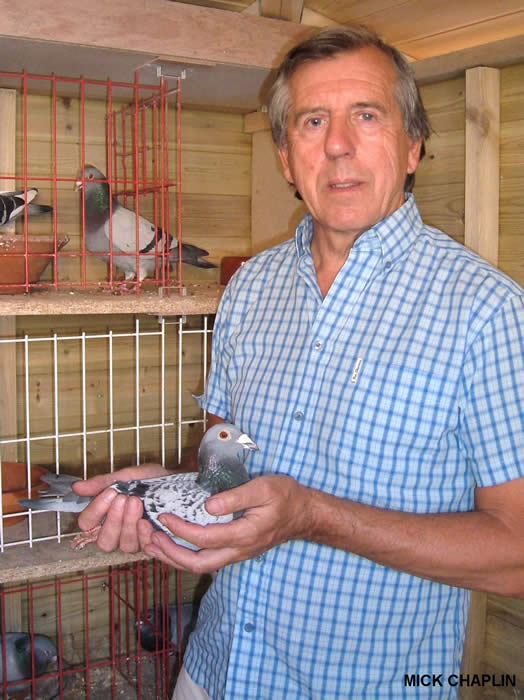
Mick and Lyn Chaplin of Woking had the race of a lifetime, recording 1st open Young Bird Classic and 1st and 2nd open Old Hens Classic. When I visited Mick's home a week after the classic, he was bubbling with his brilliant success and he said it was the best race he had ever had. Mick clocked his Young Bird Classic winner first at 14.22hrs and it was his good "darkness" blue pied Frans Van Wildemeersch hen, “Chaplin's Girl", raced to the perch. This game little hen had three races on her build up to the Guernsey Classic and is bred down from "The Champ", who Mick says, is the father of the loft. Mick tried the "darkness" system for the first time that year and halfway through the season, Mick and Lyn went away on holiday for three weeks and their non-fancier son looked after the pigeons. He was given the instructions on how to keep the ‘darkness’ system going, but Mick is doubtful that he followed them and is not sure if his youngsters were in total darkness or total light for the three weeks he was away. Mick said at the time whatever the lad did he did the right thing, as the Chaplin youngsters have been coming brilliant! Mick told me that prior to the Guernsey classic the youngsters were flying well around the loft and in the week before the race, the whole team including the old hens were given four 40 mile training tosses, which he maintains put them right. He says the loft was on good form for about a month and recorded 1st club, 2nd Federation, 5th open Combine Bergerac (450 miles), 39th, 80th, 125th and 149th open L&SECC Bergerac, clocking all four birds on the day of liberation, just a couple of weeks before the Guernsey classic. He breeds 35 young birds for racing each season and they are put on the ‘darkness’ system from weaning. After they are weaned, they are fed on maple peas for about four weeks and then are raced on a quality young bird mixture. The youngsters are raced to the perch, but five nest bowls are put in the section and if they want to pair up for racing, they are allowed to, Mick told me he trains and races his young birds very hard.
At the time of his Classic wins, Mick had a very smart self-built loft; 20ft. long with three sections and stall traps. The widowhood section had 16 nest boxes and the loft was cleaned out every day, when a light dusting of sand is thrown on the floor. He raced 16 cocks on the widowhood system and these were paired up in mid-January, with most of the team flying the whole programme. Mick sometimes re-paired a few cocks for the long distance events and told me his good old ‘49’ cock won 1st club, 1st Federation, 7th open Combine Le Mans, 13th open L&SECC Pau, 6th open L&SECC Pau, being re-paired and sent sitting six day old eggs. At the end of old bird racing, the racers were re-paired so the widowhood hens could be trained with the young birds and sent to the L&SECC Old Hens Classic. This practice had been very successful for the Chaplin loft in past seasons and that year they hit the jackpot by winning 1st and 2nd open L&SECC Old Hens race. Mick's Old Hens winner was his good three year old Frans Van Wildemeersch blue hen, "Chaplin's Lady" and she was a widowhood hen sent to the classic sitting ten day old eggs, after being re-paired. The Chaplin loft is flown a basic widowhood system, with the racers being paired the same time as the four pairs of stock birds, so the breeder's eggs can be floated. The cocks are put on the system while on their second round of eggs and are given ten training tosses before the first race. The birds are never broken down and as the races get longer, the corn is beefed up with maple peas. The hens are shown to the racers on marking night and get their mates for about an hour on their return from the race, but if a cock is late he doesn't see his hen.
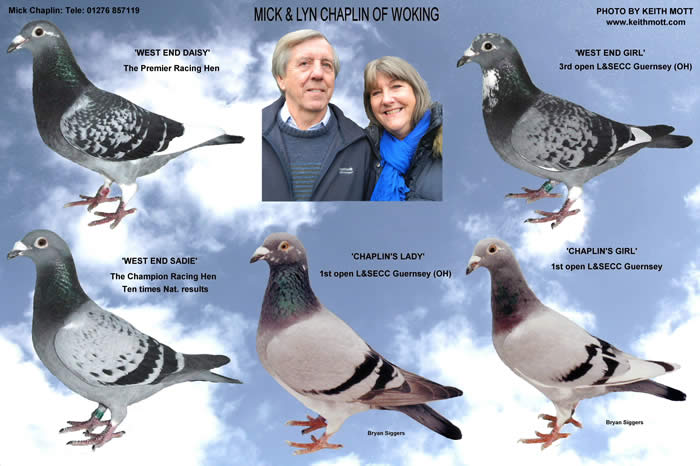
Mick says that the late, John Furness of Woking, was his mentor and taught him most of what he knows about racing pigeons. When he was younger he spent a lot of time at the Furness loft and quite often clocked in and cleaned out for John. In 1987 John Furness lent Mick several pairs of Frans Van Wildemeersch stock birds for three months. These, with a few of the Furness Burghers, are the base of the Chaplin loft today. Mick's great old cock "Champ" was bred from these original Van Wildemeersch pigeons. Mick started up in pigeons as a 15 year old, in 1962 and raced in the old Woking R.P.C., which was one of the premier clubs in the Surrey Federation at that time. He recalls that he won his first race from Nantes in 1966, with a little black pied hen, and all the premier fanciers in the Woking jokingly said it must have escaped from the basket. He married his wife, Lyn, in 1971 and says she has been a brilliant help with the pigeons all through the years. Mick now races in the Pyrford club (Three Borders Federation), which is only a small club, but is full of quality, with no less than four of its members at that time being winners of 1st open with the London & South East Classic Club.
The late Cyril Luxton of Worplesdon.
The London & South East Classic Club kicked off its 2001 season with a 180 miler from Plymouth, when members entered 1,687 birds. The Classic's committee decided the revamped race programme nice and early, so the membership could plan their 2001 racing season. After the French ban on our pigeons because of the foot and mouth epidemic, and Plymouth was the first of two races from the West Country, before swinging north, with two long distance events from Scotland. The liberation site at Plymouth was the spacious Home Park car park next to the football stadium, with the only drawback, apart from no real facilities for the convoyers or watering the birds being a ‘park and ride’ system operating which gets very busy after 09.00hrs. My main aim was to try and get an early morning liberation, so the pigeons had several hours fly in the cool before being hit with the midday heat. On the Saturday I rang my race adviser, Steve Appleby at 06.50hrs to receive a first-class line of flight forecast and with excellent conditions at Plymouth, I decided to liberate at 07.00hrs in a light east wind. On liberation the convoy broke into two batches and cleared the Plymouth site instantly.
A premier fancier who had been outstanding in the London & South East Classic Club in recent seasons was the late Cyril Luxton of Worplesdon, near Guildford in Surrey, he recorded 2nd Open Plymouth, after his major success in the 2000 season, when he won 2nd Open Bordeaux (440 miles) L&SECC. Cyril's star pigeon from the Plymouth Classic, recording 2nd open, was a 2 year old widowhood blue cock, bred down from the best Braspenning and Soontjen bloodlines of Brian Clayburn and Eric Higginbottom. This handsome blue cock was half-brother to Cyril's Braspenning champion, blue chequer cock `The 02', who was retired to stock after winning eight times 1st club, plus 1st open Federation, amongst many other Federation positions. I visited the Luxton loft two weeks after the Plymouth Classic and Cyril showed me all his champion racers, including `the 24', a four year old Janssen blue chequer cock, which recorded 2nd Open Bordeaux L&SECC in the 2000 season. This widowhood cock was bred down from a long line of outstanding racers, with his grandsire being 'The 02'.
Cyril started racing with his son, Neil, in 1978 and broke their novice status in the second old bird race in 1979. In 1980 the Loxton’s were top prize-winners in the Guildford Club, winning five races and in 1981 started racing in the strong Godalming Club and won seven times first that season. The main families raced in the early days were Dordins from Alf Vickery and a few Van Der Espt from the Southampton fancier, Nigel Llewelyn and was highly successful racing both hens and cocks on natural and widowhood. Cyril was the son of a farmer, so had a great knowledge of livestock. He put it to good use when he started up in the sport of pigeon racing. Previously Cyril & Neil were mighty successful at showing Australian finches and won many top positions, including ‘Best in Show’ at Edinburgh Scottish National Show. Cyril was a top class judge, travelling all over the British Isles and judged the 1980 Cage Birds National show. Cyril said he remembers his first major mistake when he was a pigeon novice, he took his kit of youngsters for their first toss and lost the lot. Cyril Luxton had come a long way since those days, leaving all opposition reeling with his outstanding performances.
Cyril raced cocks and hens on the widowhood and said the main reason for this was that the system is easier than natural racing. In his opinion, having hens laying etc., makes pigeon racing hard, and on the widowhood system it only took him about five minutes to clean out in the morning. He paired his 12 pairs of racers and stock birds at the same time in February and kept about 25 young birds each season. He purchased a new 18ft x 9ft loft from Parkhall Lofts and maintains that the most important factors in good pigeon loft design is ventilation and light. The new Luxton loft was a very smart affair, with extractor fans to suck out the old air, and open door and drop hole trapping. The main family raced were Ponderosa-based Janssens, with Braspenning and Van Loons added over the years and Cyril told me at the time, they should now really be called ‘Luxton's’, as he bought his first Janssens from the Birmingham sale in 1981. He liked all the birds to fly the Classic and Federation programme and the old birds got two or three training tosses, although they were on the widowhood system, with the youngsters being trained as much as possible. Cyril only raced South Road, but did have a couple of seasons on the North Road with outstanding success, winning 1992: three times 1st club, including 1st Thurso (only bird in race time in the area), 1993: five times 1st club, lifting RPRA Southern Region Award for the Best Individual Performance North Road 251 to 450 miles. Only the best quality corn was fed, using corn purchased from Brian Wall of ‘Gem’. A light mixture was fed at the beginning of the week, then a heavier mixture on Thursday and Friday. A few peanuts were fed as an extra, but not very much else.
Cyril had put up many premier positions through the years in the Federation and Classics, but was very proud of his wonderful record over that last six seasons, winning a fantastic 70 times 1st, 56 times 2nd and 43 times 3rd. A brilliant performance with a small team of pigeons! At that time he says his best performances to date were: 4th open Young Bird National NFC, 2nd open Combine Nantes, 2nd open Bordeaux L&SECC and then 2nd open Plymouth L&SECC.
Three premier L&SECC winning lofts this week and I hope you have enjoyed reading about their wonderful success! My phone number is: 01372 463480.
TEXT & PHOTOS BY KEITH MOTT (www.keithmott.com).