JOHN DAVID'S
RAMBLINGS
Should 600 mile races be liberated early/are ETS rings safe?
I pose one the above questions as half an hour ago my wife called me from Frome when basketing my only entry for Bergerac with the CSCFC to say the ETS ring was not on my bird entered for the race. It was the clip on ETS type ring which has been on the pigeon for the whole of this season and the bird had previously had four national races south from Carentan, Cholet and Niort with the WSRNFC, one race from Cholet with the NFC and six races south east to Maidstone with the South West Glamorgan Federation. In total the distance flown was an excess of 1700 miles and each time the bird recorded on the Bricon ETS system. The ring was not in the basket as one of the markers at Frome rang to advise me he had checked this. All was not lost as the bird could be rubbered and a conventional clock could be used. My thanks go out to Charlie Silver (WSRNFC Secretary) and the Maerdy club for allowing me use of their spare clock set for any problems like this involving their members.
I would take this opportunity of complimenting Charlie on the rapid progress he has made in his new role as secretary to the South Road National this season. Fanciers will be aware that he had only weeks to get into his new role as the post was literally dropped upon him at the last minute and only last weekend he had two National races to contend with on the same weekend and yet within four days the final results were published and within seven days the results were being send to the press for publication. Inevitably, as Charlie would be first to admit, a few mistakes were made at the start but being National secretary is a steep learning curve. However Charlie is quick to learn from any errors made and what is an excellent quality is that he stays calm under pressure, learns from the experience gained and puts it out right by the next race. Welsh fanciers are indeed lucky to have him at the helm as good secretaries are like gold dust and should be nurtured.
Getting back to the ring incident, if other fanciers are using the clip on type I would recommend that they check them regularly to ensure they are tightly fastened as another one came off my best racing hen last season and was later found in the loft. So obviously I was particularly careful this season that it did not happen again and that they were tightly fastened. I rang the CSCFC secretary Clare Norman at 10.50am to inform her of the problem as I had previously indicated on my entry form that I would be using ETS and just caught her leaving her home. Marking at Southampton starts at 3pm but you can see Clare needs to be there many hours earlier to ensure everything is prepared in readiness for the race marking to start. Clare you really have a wonderful team of helpers in Frome. When my wife arrived at 10.15am one fancier came forward to carry her basket and when the bird`s ETS ring was missing two of the people marking sifted through the straw to try to find the ETS ring before ringing me to explain the problem; when my wife arrived home she could not speak more highly of everyone so don’t say the age of chivalry is dead!
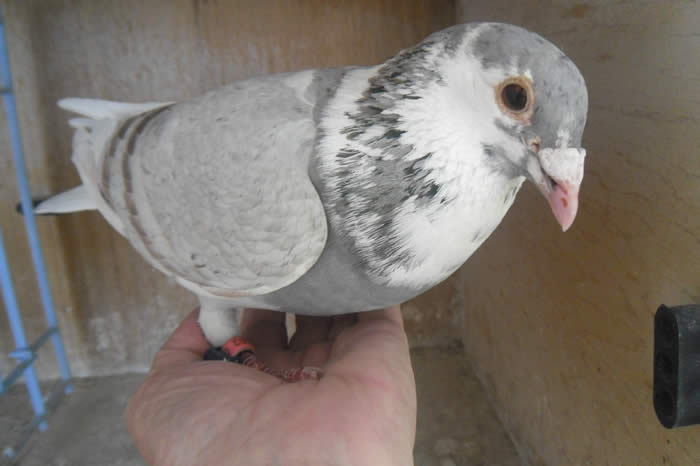
Incidentally the missing ring was not in the loft as I checked thoroughly and was certainly on the bird the day before basketing as I recorded him on camera carrying twigs back to the loft when his ETS ring was clearly visible (see pictures). I actually observed him over a two hour period on both Sunday and Monday carrying straw and pieces of twig back into the loft. Interestingly the longest was 6 feet in length. I estimated this to be 200 trips back and fro and each time the cock would have to take off and fly 5 feet up to the trap then down to the floor where I had encouraged him to nest and back up to the trap etc. Each trip was about 35 metres in length which equates to 7,000 metres in total or 4 miles. However I do believe the effort put in to this exercise is greater than if the bird had a single up toss from 100 miles and the pectoral muscles become very strong. Of course when a cock is waiting for his hen to lay he is reluctant to fly around the loft a great deal but in this way he can still have a very worthwhile exercise. In the case of my mealy pied his hen laid her first egg on the Friday and of course he was still very anxious until her second egg was laid on the Monday so with basketing early Tuesday morning he would miss out on normal exercise around the loft for at least the last five days. Of course tossing is an alternative option but I have found this is an anxious time for cocks and with so many hawks about is a highly risky strategy.
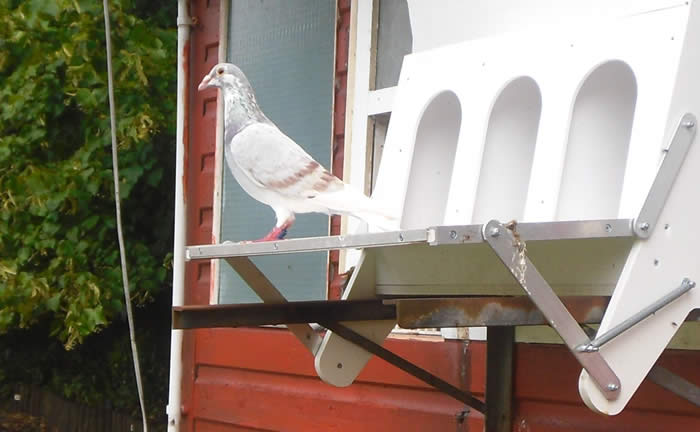
The mealy pied with his ETS ring in tact the day before basketing
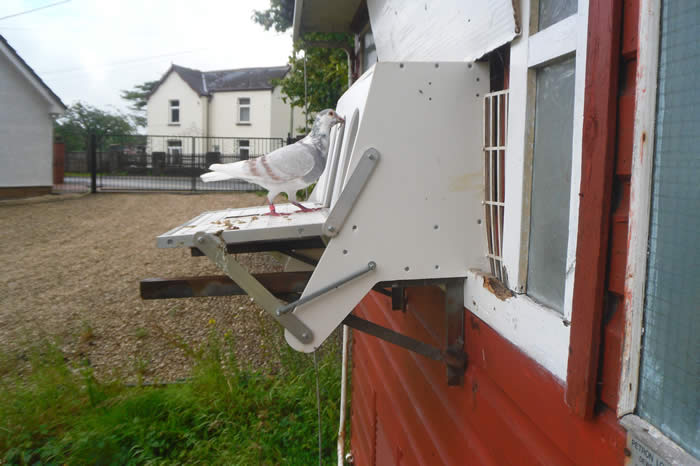
Working hard at nest building carrying straw
I remember in my early days in the sport I bred two mealies (one a silver mealy) out of a hen that won Thurso for me when paired to a gift bird from Jack Clarke of the New Tredegar area. He was a Red Grizzle (unrung) cock but had a pedigree as long as your arm. He was a gift from Jack who had a wonderful reputation for breeding winners in those days and the bird was of the Sion family. Anyway the silver mealy returned from a 30 mile toss as a YB ripped wide open and I had to put twenty stitches in his breast and crop. My sewing ability in those days wasn`t brilliant and I remember when he drank, water used to drip from his crop but after two weeks of healing he was entered for his first ever race from Shrewsbury. When the cotton used to hang down I would cut it off and the stiches were still in him when he came home to win the race by a clear 5 minutes in the club. Every year without fail he would win at least one race each year from all distances up to 400 miles and always if his hen laid her first egg the day before basketing. It seemed to me at the time he was so anxious about his hen laying, and then after she laid he was very contented and would be in his very best form. Of course most of the time, I arranged for the egg to be placed in the nest on the actual day. However looking back I recall he used to work like a beaver building an enormous nest so this clearly made him very fit. It also seemed to me that he was repaying me for saving his life!
Of course fitness and motivation is not the only consideration, the weather has to be right on the day as some birds prefer westerly to easterly winds or head winds/tail winds etc and of course the distance must be right for the strain of the bird as well as the moult (I try not to have gone beyond the third flight) plus many other factors.
My other question raised this week is about early liberations from 600 miles especially as this took place with the NFC on the weekend of 1st July from Tarbes. I must admit this was uppermost in my mind after basketing my one entry at Frome two weeks ago. I was very well aware that north easterly headwinds were forecast over the whole route through France on the day of liberation which meant that birds would struggle to get into the UK on the day of release. The distance to the Cherbourg area is about 470 miles and assuming the birds make 35mph then it means the leading birds would make this area of France by 7.45pm just giving them 2 hours to cross the channel before dark. As fanciers will by now be aware only 7 gallant pigeons made it to their lofts on the night with the channel stopping many others. In view of this should a later liberation have taken place to ensure no birds were caught on the channel at night time? I must admit I really don’t know the answer to this and I am sure if we were to conduct a poll of all NFC competing members on this question I do not believe there would be a resounding victory for either camp. On the one hand many quite rightly feel that by allowing birds 16 hours flying time this finds out the fittest and best prepared bird on the day. No one can really argue with this philosophy especially if the goal posts are in a straight-line all birds competing from the south of England for example but with the NFC of course there are many birds flying up to 800 miles and for them to home on the day is an impossible task. One incredible pigeon was clocked in 153rd Open position flying 817 miles to Mr & Mrs Bowden of North Shields who should be congratulated on their fantastic achievement.
Then of course we have the hours of darkness which are a bone of contention. Are darkness hours standing at 21.58pm to 4.49am realistic for 1st July when you consider that here in South Wales it was light until at least 10.30pm and again at 4.20am in the morning. In other parts of the country it is lighter much earlier and vice versa. One could argue its swings and roundabouts, lofts in the east gain extra light in the morning and western lofts stay lighter in the night. However I can always recall the hours of darkness being here in Wales 10.30pm until 4.30am so this represents a difference of 51 minutes flying time. On the other hand of course when it’s a cloudy overcast evening it gets dark much earlier etc.
When the birds are not liberated early a lot of top fanciers believe the result can then become a lottery. Of course if they stop for the night in a misty valley their progress can be delayed by several hours the next morning. I have heard it said if you are lucky your bird might be resting in a French farm overnight where a tractor is started at first light and wakes the pigeon early.
I know in Belgium Roger Vereecke was very upset when the Pau National pigeons were liberated late for quite a number of years, which in effect made for two middle distance races instead of birds being able to home on the day of the race. This changed in 2009 when the birds were liberated early and Roger won 1st National from Pau (the 7th National win of his illustrious career). In Pau of course there is a tendency for misty mornings and it is not wise to hold pigeons over for long as with the heat they can soon deteriorate in the baskets.
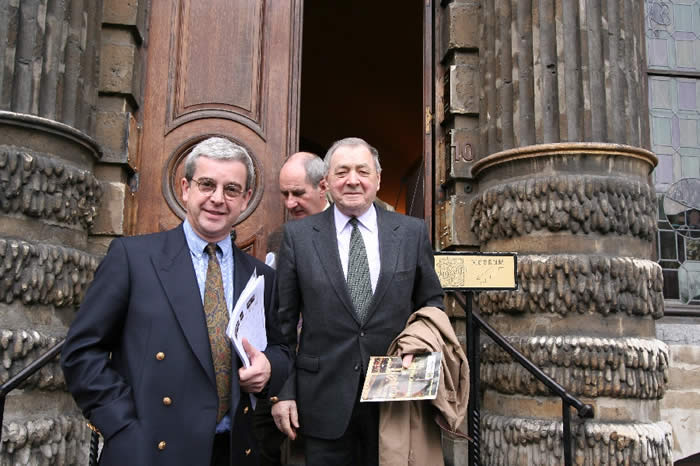
Georges-Henry Bodson (Sec of the Royal Belgian Flying Club) with Roger Vereecke (prior to his hospital confinement) leaving HQ in Brussels
Talking about Roger Vereecke, I know many of his friends in the UK will be pleased to know he has made very good progress after his major setback earlier in the season. Roger was rushed into hospital in early January when it was discovered he had an intestinal obstruction. He underwent a four hour operation which was successful despite his 90 years but was unable to eat afterwards for 21 days. Roger was allowed home in early February and wrote to me in April to say he was getting stronger by the day. For several weeks he could not walk to the lofts and since he has only one hour of help each day in the loft it was therefore important for him to be to get back among the birds ASAP before the season was in full swing. This of course put his race colony/preparation back several months but it was wonderful to see him clock a good bird in the Belgian National from Libourne on 12th June when he finished 86th National against 8,269 pigeons. His closest friend and confident Georges-Henry Bodson, secretary of the Royal Belgian Flying Club, has kept in constant contact with Roger by telephone throughout his setback to encourage him every step of the way. Georges-Henry of Momalle also has his loft in good form of late winning top positions including 38th National Brive(10,082) birds with a bird of 100% Roger Vereecke bloodlines (son of Ivalid)and 62nd National Orange (440 miles)with a 50% Vereecke 50% Tossens lines. Georges-Henry also was 1st to announce an arrival in Liege from the Barcelona International and clocked four good birds in the race by 10.17am on the second day from 640 miles. Incidentally the Belgian Pau National winner in 2011 to the loft of Peter Symaeys of Bruges contains the bloodlines of Roger Vereecke (Zwarte Vereecke) obtained via Chris Hebberecht.
Do you believe the Tarbes birds should be liberated early or late? You can Email me your views to the address below.
John David Havachat Bungalow, Mwyndy, Pontyclun RCT CF72 8PN Phone 01443-226809 Email