JOHN DAVID'S
RAMBLINGS
Lost in France or killed by a hawk in South Wales? Why do your winners fail to return?
As I was waiting for my birds to return from Niort on Saturday afternoon I had a call from a friend Karen who lives in the Llanharry area of South Wales who said at about 12.30pm a pigeon dropped out of the sky and landed by her feet in her garden. It was dead on hitting the ground and she saw a large hawk flying away who had clearly dropped the bird. Karen is not a pigeon fancier but is an animal and bird lover and was most distraught by the whole episode. After acquiring the ring number from Karen, and clocking from Niort, I reported the bird to the RPRA by Email and within an hour or two had the message back that the bird belonged to Collins & Stevens of Stalybridge, Cheshire which is just east of Manchester. I failed to make contact with the partnership until Monday evening when they advised it was a blue hen flying that day from Messac, a distance of 390 odd miles after 6am liberation. The blue hen 09 was a Busschaert/Van Houtte flying on the dual Widowhood system. The partnership name is made up of the Christian names of both partners which is rather unusual but the hen when found was on track to win a top position had it not been for her untimely and very sad death, which is typical of what happens to our birds when making their flight home due to these uncontrolled large numbers of predators. The hen was given a special burial by Karen and her family.
I have had of late some very interesting feedback from my recent articles which is well worth mentioning. R. T. Williams (Ray) of Treorchy contacted me about the race from Lerwick when I had a good bird in 12 hours' flying time from this 600 mile race point, which I reported on in the fancy press in the edition of May 6th. Ray said my report on early morning liberations stirred up recollections of the proposition he submitted off the floor at the 1961 AGM of the Welsh Grand National FC at the Rose & Crown, Pontypridd “that pigeons at Lerwick and Thurso would not be liberated before 6.00am”. This was rejected. Again Ray submitted the same proposition in 1962 and was passed and his reasoning accepted. Ray’s idea came not from the “The Northern Lights” as he was not aware of the phenomenon in those days but more from observation at his loft in the early hours of the morning. Having purchased his loft and pigeons after his demob from National Service in 1956 when he restarted competing from Thurso in the late 50s, he was at the loft at 4.15am or thereabouts for four or five years. Observing the behaviour of the pigeons in the loft he was aware that although he had a large fly-in at the entrance to the aviary which was open 24 hours a day, some birds would fly down into the aviary to drink from the piped water, then fly back to their perch and “doze” until about 5.30 to 6am before taking to the air. This made Ray realise that a pigeon's time clock meant that if it was half asleep in Treorchy then the same would be the case in Thurso and Lerwick. Hence the reason for his proposition. Ray has no idea why at Lerwick the rule wasn’t adhered to when liberations took place in the years 1963-4.15am; 1964-4.30am; 1965-5am; 1966 (Elgin substituted); 1967-5am; 1968-6am; 1969-5am; 1970-5.45am. From Thurso from 1961 to 1971 the birds were liberated at 6am or later every year with day birds on every occasion.
Ray had the opportunity to speak to Joe Tyrell, the convoyer on this issue and asked what he had to do to wake the birds. Joe replied 'Oh, I walked around the baskets singing, whistling, shouting and kicking the baskets to wake them up'. He then thought his idea must be the correct one! Ray reminded me that there were many disastrous Lerwick returns with many good Thurso birds lost which was the reason Ray did not compete in many of these races. As example: 1959-4am liberation, 22 birds timed in race time, 214 birds; 1963-4.15 liberation, 15 birds timed from 206 birds; 1964-4.30 liberation, 30 birds timed from 262 birds; 1965-5.00am liberation 7 from 352 birds.
Ray, I believe you are right, and the idea of the northern lights came much later in the days of Horace Roderick being convoyer for Lerwick. However, I also recall one of my best ever cocks, a blood red winner of 4x1st prizes, being lost in Lerwick after a 5am liberation and being reported in Bergen in Norway, which is due east of Lerwick and the fancier informed me that the northern lights were visible at that time along the east coast of Norway and if the birds were half asleep at the time of liberation it is quite easy to understand why they would make for the bright skies when it was dark looking towards Scotland. Incidentally Ray, you always flew a great pigeon, especially from Thurso into Wales and it is lovely to know you are still taking an interest in the sport!
I also had a few interesting comments from last week about my story of the three year old Van Hee hen who won a hard Elgin race with little or no training and exercise. One of these suggested how much better this hen would have flown with the right preparation throughout her racing career. To some extent I agree but I am also quite sure many fanciers burn their pigeons out by continually racing them to the bitter end. For example, I know of several fanciers who send all the pigeons that are left in their lofts to the longest race and have heard the comments “They have not won anything so they have got to go”.
When I moved to Llantwit Fardre to live, which is two miles north of Mwyndy where I flew very successfully for many years on the north road, I had hoped to buy a plot of land at the rear of my new property for my pigeons but failed. However, Eddie Pearce, a butcher living in the village, allowed me to rent a plot of his land where there were already several other lofts situated. I remember the only suitable plot was right alongside an electrical sub station which was of some concern to me until a top fancier Terry Davies, a fire fighter from Caerphilly, said it was a fantastic location for a loft as the electrical impulses in the air would help the pigeons locate the area easily and they would fly very well to this location. Terry’s words certainly came true with many Thurso and Lerwick wins recoreded to this loft and perhaps the icing on the cake was when my good three year old Van Hee hen won the Louella car when she topped the Welsh Combine against 15,126 plus birds competing against very many widowhood cocks.
Eddie Pearce was quite a character in his own right and flew bachelor cocks and lesbian hens. The bachelors were never paired and were out flying from dawn until dusk and were therefore super fit. The lesbian hens were allowed to sit eggs and were also given their freedom all day. I remember Eddie gave the birds all the waste products from the Butcher's business which he referred to as pigswill. Eddie lived for the Lerwick National race and he would often lift his Lerwick team into this 600 mile race point with no road training whatsoever. If they were raced before Lerwick it was usually no more than one race about four or five weeks prior to this national race from about 250 miles. I remember using this method Eddie was 3rd Open National on two occasions. This could have been improved quite considerably had ETS been in operation at that time as when a bird arrived home to the upper storey of a double decker slaughterhouse a bell would ring in the butcher's shop. Eddie would then have to finish serving a customer or two in the shop before locking up, going around the back of the building and ascending an almost vertical ladder so ten minutes or more would often be lost on the bird time.
I remember the year I moved my loft to his ground, I along with Eddie Thomas to another loft, broke our birds in during the heart of winter and started training them to their new location when the snow was on the ground, much to Eddy’s (Pearce) amusement who, as I said, did not believe in training. I remember I gave my birds at least ten tosses and they were coming well and then one day I decided to take the birds to Brecon town about 35 miles north. Suddenly Eddie said “Take twenty of mine if you want”, wanting to prove a point that his birds were much fitter than mine. I was quite confident mine would knock spots off his so was up for the challenge. I liberated the forty at 10am in a fresh to strong northerly wind. A batch of six dropped at 10.45 which consisted of three for me and three for Eddie and then we never saw another pigeon for an hour. They had overshot the lofts and over the next few hours they worked back single up with Eddie getting the majority of these and of course then they had to work hard into the wind and fitness played a major part. Many of mine struggled back later in the day and some the next day. I got my revenge in the first race of the season winning the club and taking three positions in the top ten in the Fed section. However, I will never forget the fourth race of the season from Burtonwood that year which proved a very hard race when the birds were liberated in what can only be described as a dead atmosphere. Both Eddie and I entered twenty pigeons each and velocities were down to 1000ypm when two birds arrived together, one for Eddie and one for me. Mine landed on my trap board and tumbled over as his legs had failed and he was very weak. Eddy’s pigeon was so fit he flew across, treaded my mealy cock, flew back and trapped before my bird. As a result Eddie was 1st club and I was 2nd. The amount of stick I took in the next few days was unbelievable. He told me the only place for my bird was a hole in the ground. I said my bird was clearly dehydrated and it’s possible the other bird found water on the way home and the two birds met up near the home end. Whatever excuse I made Eddie ribbed me every time he saw me in the garden over the next few days telling me in no uncertain manner that the mealy cock was not worth keeping.
I let the cock recover and then I started to force him to fly with the flock by banging a drum with a steel bar every time the birds came in to land and making them fly over the coming weeks for at least 2 to 3 hours each day over a three week period. Every time Eddie saw me he would mock my actions and said quite categorically I was wasting my time and energy as the cock was worthless. Having said all that it was all taken in good fun but I was out to prove Eddie wrong. About four weeks later I entered the mealy in a team of 8 sent to Elgin and Eddie sent 12 including his Burtonwood winner. It was terrible day weather wise and no birds were clocked on the day in the Welsh North Road Federation. I remember the mealy cock was the only bird clocked on the second day around 10am in the Llantwit Fardre club and although he did not top the fed he won 1st in the Fed Open race. The morale of this story is never write a pigeon off for a one-off bad performance but ask yourself “Was the pigeon fit enough for the job in hand”? Eddie actually did me a great service as a week or two before Elgin that year was when I topped the Combine from Perth winning the Massarella car. It’s strange but on that day atmospherics were not good with thunder storms breaking out during the day in North Wales. I mention this simple to show that sometimes you can change your system for the better even if it seems cruel at the time!
I started arranging coach trips to Belgium, Holland and Germany in the early 1980s and tried to persuade Eddie to come on one of these as he had then retired from the Butcher's business and had lost his wife a few years earlier. I ran these trips for five years running until my son was born and never had an empty seat on the coach. It took me six months to persuade Eddie to come on the trip as he said he would not know anyone. However, after persuading him I sat him on the coach by an interesting fancier who was also on his own. Eddie really had the time of his life as he had never been out of the valleys of South Wales before and could not wait until the trip the following year. He said to me later “the trip to Belgium really opened my eyes about the pigeon sport and if I knew now what I learned over there I would have done things a lot differently”. Sadly Eddie died before the following trip but I can tell you Eddie the Belgians would have learnt quite a lot from your system, I am quite sure of that!
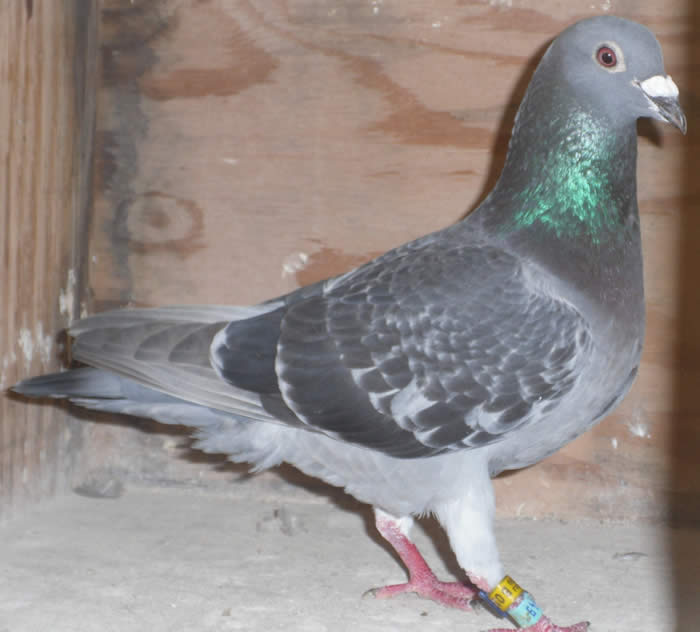
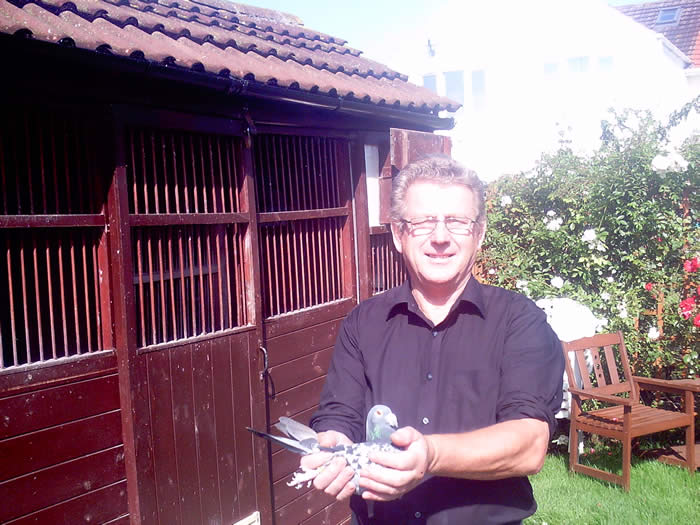
For those of you who are wondering what happened to the yearling Mealy cock that would not exercise around the loft and only had three short tosses up to ten miles as a young bird in 2010, well I lifted him after three races to Maidstone 173 miles on the south-east route into Fougeres with the NFC for his very first channel race in 2011. If fanciers remember there was a lot of south in the wind that day and many birds overshot their lofts. The mealy failed to get home on the day and over the next few days the weather was appalling with heavy rain and strong winds. Imagine my delight when he dropped onto the loft after 10 days away with a nasty injury in his side so his lack of exercise around the loft has certainly not affected his homing ability and I think his future is bright if he can avoid the hawks. He has now had a good look around the countryside and this can be an invaluable experience to a young pigeon before future channel races. I also believe when birds live rough on the land for a week or more their stomach shrinks and you cannot over-feed them in the future so they maintain a better racing weight and are more easily conditioned for racing. I can give dozens of examples of pigeons winning major racing after spending days or even weeks away from their lofts. Not straight away of course but even this has happened on occasions! My good mealy pied cock that was 7th WSRNFC from Cholet (328 miles) two weeks ago after losing three minutes trapping went missing last year for six weeks in the Saintes race before turning up. This year he has flown consistently well and as you can see from the photo is very tame. However, he will fight my hand vigorously if I go anywhere near his box, or if I try to pick him up from the loft floor for that matter when he is courting his hen.
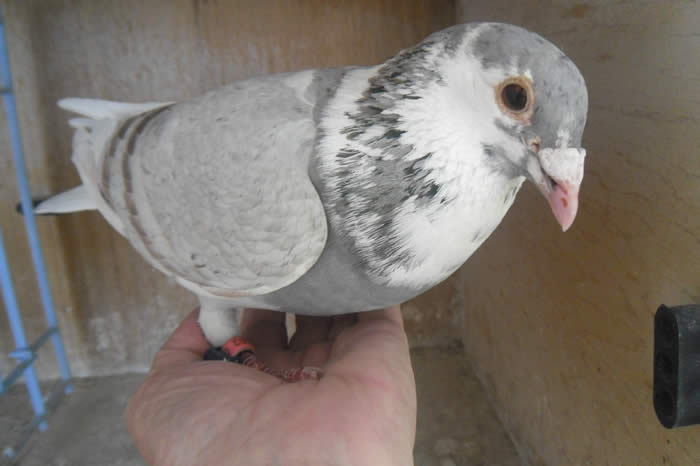
The mealy pied, winner of 7th WSRNFC Cholet for me 2 weeks ago showing his tameness! He went to Cholet sitting 10 days. This picture was taken before basketing fot Niort last weekend.
My other photos this week were taken at the marking for the NFC race from Tarbes at Frome. They feature the WSRNFC birds being transferred to the NFC crates, which were kindly transported down to Frome by the National President Charlie Bradshaw free of charge.
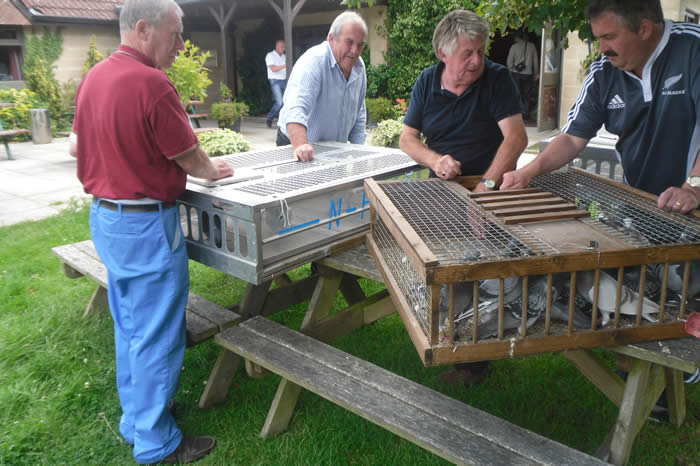
The Welsh South Road National birds being transferred to NFC baskets at Frome for the Tarbes National race. Left to right Den Chambers Devises, WSRN President Charlie Bradshaw, Richard King of Bristol and Brian Davies from Wales.
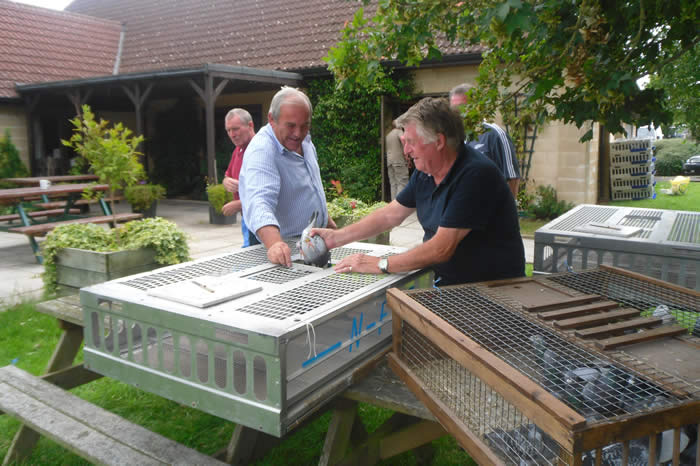
Great care taken in the transfer showing Charlie Bradshaw of Ystalyfera and Richard King.
A close up of the birds leaving for Tarbes.
John David Havachat Bungalow, Mwyndy, Pontyclun RCT CF728PN Phone 01443-226809 Email