JOHN DAVID'S
RAMBLINGS
Did 40,000 birds clash in mid France on Friday 15th July?
Should there be more liaison/cooperation between countries in the future?
Reading the reports in the press on 22nd July about the Bergerac race held on Friday 15th July including the WSRNFC, the CSCFC and the London & SE Classic there were many tremendous performances put up and we should all give credit to these wonderful pigeons that won top positions. Friday 15th was an excellent flying day with clear blue mainly cloudless skies in Southern France and light variable winds before the birds picked up a south-westerly flow of air over mid France. The leading bird in the CSCFC to the loft of Mr & Mrs M King achieved a velocity of 1290ypm (44mph) which was 43 ypm ahead of the next pigeon and 100 ypm covered the first 18 birds in the Open result. A truly great performance by a wonderful pigeon. Another magnificent performance was put up by Mark Sparey here in Wales whose pigeon not only won the Welsh South Road National but was also placed 5th in the recent Tarbes National. Mark, I tried to ring you but you've changed your number so many congratulations on your great achievement.
In total out of a convoy of 2,500 pigeons only 200 made home on the day within the three organisations and every pigeon and its owner should be congratulated on their achievements.
However, I beg the question: is 8% home on the day acceptable in this day and age with all the modern technology at our disposal? Also when you consider the truly excellent flying conditions on the day and a helping wind over much of the course why were the birds not tumbling in to their lofts in large numbers? Some will say remember we were flying 400-500 miles but remember many of these birds have been specially prepared for this race over a twelve month period.
It must be said that many very good fanciers failed to record an arrival in race time and many others were at least 50% of their birds down by the time the race closed, many only having only 20% home. Is this what we must come to expect in this rapidly changing sport of ours? At a time when not only are we failing to get young people into the sport for whatever reason, hawk attacks are on the increase, to cap it all clashing seems to be occurring on an ever increasing scale. You may say “what has changed?” This is not a new phenomenon but with technology so advanced these days, people from different countries can keep in touch through Emails within seconds so one must question why this is happening?
The first thing to be said is weather patterns throughout the world are changing at quite an alarming pace. I can never remember a season like those of 2010/2011 when so many races were delayed, cancelled or postponed through adverse weather conditions. This never happened in the old days. The race programme never changed like it does today, birds always went on the appointed day; there may have been the odd holdover but only once over a forty year period can I remember the birds having to be brought back home without being released.
However, only a few weeks ago it was stated after a week’s holdover that unless the Tarbes International was liberated on the Wednesday they would be brought back home for the first time in the history of the organisation. The birds were liberated from Agen on the Wednesday and a fairly successful race took place into Belgium given the circumstances but it was noticeable that the Dutch were missing. I understand the reason why was because they knew the weather forecast for Saturday was poor and as a consequence many of their largest organisations raced on the Friday instead to try to beat the weather! The Dutch actually left for Tarbes on the Wednesday and liberated on Friday at 8am with over 100 birds clocked on the day. It certainly makes one think why the Belgians went on the Tuesday for Saturday liberation with much less distances to travel than the Dutch.
I think I am right in saying that a number of organisations like the CSCFC and the SMT Combine changed several of their races from a Saturday to a Friday several years ago to try to avoid clashing, which was good thinking, and of course these are then advertised in the press for all to see, but when other organisations cancel races within days prior to the races taking place then of course there is no record of this in the press so no-one knows where they may be liberated or at what time. It’s a pity there is no database held centrally on computer that would indicate late changes in race dates (with contact numbers) due to adverse weather patterns, which all organisations would have access to and could update as and when required.
On the 13th July the Welsh South East Combine basketed a day early for the 450-600 mile race from Pont-a-Mousson, which was then held on Thursday 15th July, which seemed a wise move at the time as then it appeared they would have two days of good weather to get home. One would not have expected clashing on the Thursday but regrettably the race could not be regarded as a success. Some clubs had only a small number of birds recorded in race time and although some top fanciers clocked exceptional birds with velocities over 1000 ypm it was quite alarming that only 18 birds recorded over 800 ypm. Clearly the convoy either clashed or hit bad weather along the route. You may say there were no birds to clash with but who knows what the hundreds of European organisations were thinking and it only takes a small number from each country to do the same for clashing to occur. Special mention should be made here of Derek Flowers of Pontypool who certainly bucked the trend winning the National and clocking four exceptional birds on the night and four more the next day - fantastic flying by any standard of competition. A & I McFenton also had an exceptional bird into the West of the principality taking 2nd National after almost fourteen hours on the wing.
I read with interest Nigel Rigiani’s (convoyer's) report about the CSCFC birds in his charge when he stated that as he was leaving Bordeaux on Thursday morning after spending the night there ten transporters with 22,000 Belgian birds were seen arriving. Nigel stated there was an element of good luck here as he was told by the Belgians they would not be liberating the next day until mid-day. However he went on to say the Dutch in Bergerac had a call from the Belgians the next morning to say there was a change in plans and because the rain was coming in later in the day they (the Belgians) would now be liberating around dawn (5.40am). This left the Classic in a virtually impossible situation; go early and risk clashing or go later and have more clashing and be caught out by the weather and give the birds little or no chance of homing on the day.
In addition to this a Dutch National (12,987 birds) had been rearranged for the Friday from Bordeaux along with other organisations not in the National also was being liberated at Bordeaux. So with 40,000 plus birds liberating that morning starting at first light and with the race points being on the same latitude and 54 miles apart it was inevitable that clashing would occur after about two hours (90 miles) into their journey time. (See Map of France showing line of flight of CSCFC birds into UK from Bergerac and Belgian and Dutch organisations flying from Bordeaux)

Don’t think for one minute I am criticising the decision of the CSCFC to liberate at 5.45am that morning, far from it, I am quite sure had any of us been in that situation we would have done the same. What is particularly worrying however is that British organisations liberating at Bergerac were not aware of these mass continental liberations taking place less than 60 miles away or if they were aware it was merely by accident that they found out!
I feel representations at the highest level should now be made between the Dutch, Belgian, French, German, English and Welsh Unions to prevent this sort of thing happening in the future.
I decided to speak with the race controller for the Surrey, Middlesex and Three Borders Combine, Mr Peter Notridge, who advised me that although a number of their birds made good velocities from Bergerac they suddenly stopped arriving and then there were very large gaps between arrivals with a lot of birds missing. Peter did confirm that his organisation changed to Friday liberations for some of these races to try to prevent this very thing happening and in the past had tried unsuccessfully to liaise with overseas organisations over this very problem. The poor returns were confirmed by Brian Batchelor of Elstead, Surrey who flies with the SMT Combine who told me that some fanciers clocked early but then it was as if a tap was being turned off. He never saw a feather until the Sunday when his birds came through and brought a Belgian stray with them, which tells its own story. Incidentally, they liberated at 6am, fifteen minutes after the CSCFC. Of course many Welsh pigeons working back from Belgium would have still had a further 120 miles to fly after reaching the Surrey area, which was a very tall order when they were very tired and must have lost a lot of body weight after flying for three days. It certainly takes an exceptional, well tried and tested bird to keep going under such circumstances and it’s inevitable that many birds would be lost.
My good friend David Evans of Gelligaer had nine out of ten home from Pont- Y-Mousson with four in the National result so his loft was in good form but he failed to record an arrival out of 10 entries from Bergerac until the Tuesday with two more turning up on Friday morning within minutes of one another. Incidentally, four of these were previous section winners. Another top fancier, Don Chaffe of Maerdy only clocked two of his 8 entries on the second day, the first being his Bergerac winner from the previous year. Don’s birds were specially prepared for this race and had a long rest (five weeks) after the hard Messac race when his team had ten to fourteen hours on the wing so he was clearly very disappointed with his returns as was Graham Thomas (ex-Welsh South East National secretary) of the Llantwit Fardre club who lost two old hens that had previously flown successfully from many of the longest races throughout their illustrious careerS over a period of very many years. As Graham commented, birds of this calibre should never get lost from a 500 mile race!
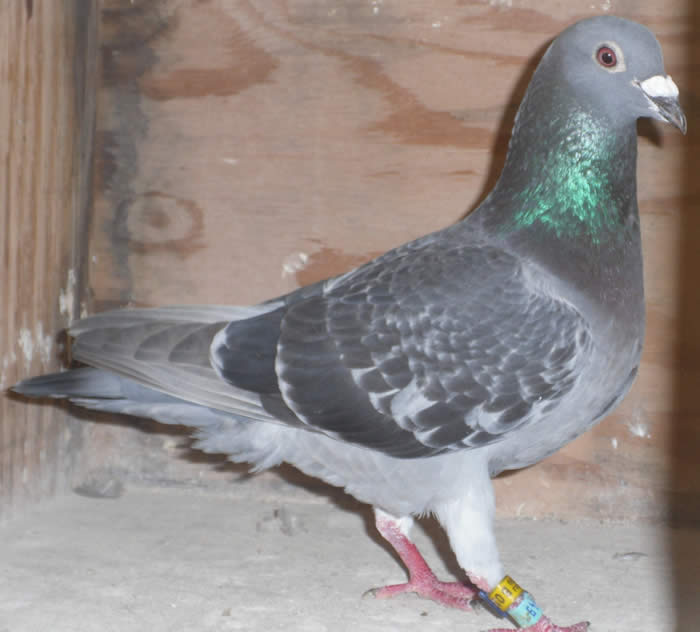
Fanciers may be wondering what happened to my good mealy pied cock who was previously 7th Nat Cholet and featured a few weeks ago building a nest having lost his ETS ring prior to basketing. He was sent as fit as a fiddle sitting a few days and feeding a twenty day youngster but failed to get home in race time. Previously this season he had flown for 13 hours to get home in the NFC race from Cholet and had nearly 12 hours on the wing from Niort with the WSRNFC so he was certainly fit for the job. I was delighted however when he got back none the worse for wear after 14 days away. In fact he came home on Saturday 30th July in between my young birds returning from their first race from Swindon. As usual despite his gruelling fly he did his customary two laps of honour before alighting on the roof of the loft obviously to our great delight.
Some people may be of the opinion that my heading is over exaggerated and alarmist. Maybe so but if it has made the people in authority in the various unions at home and abroad read the article and sit up and take notice and discuss this problem and try to take preventative action for next season then it will have been worthwhile. I read the other day that many of our birds won’t face a head wind when flying from over the channel while others put their head down and go for it and this is a reason for high losses. Surely if birds won’t face a head wind in France we should not be keeping them as racing pigeons. No, in my opinion it’s much more likely that because of weather patterns changing throughout the world the days are limited when the weather is suitable for racing and of course on the continent vast numbers of young birds are flying from France into Belgium and Holland.
I noticed on the weekend of 30/31st July 54,000 birds were competing from Bourges and 22,685 from Narbonne and it was quite easy with other organisations racing that weekend to reach well in excess of 100,000 birds flying across France. So in reality our organisations flying from the Channel represent very insignificant numbers but I am sure if they are approached our continental friends will help in every way possible. After all, the more entries in the International races from the UK will help boost the overall numbers competing and of course after 2011 in particular when Britain had greater than ever success in these races then maybe there is no better time to act to gain cooperation from abroad.
Whatever your view when up to 50% of fanciers fail to clock in many of these classic races, as was the case this season, and moreover many top notch fanciers lost up to 50% of their entries in several races when the weather was good, I am quite sure you will all agree something should be done about it before it’s too late.
I had quite a large response to my last article about early or late liberations etc and will cover these in my next report.
John David, Havachat Bungalow, Mwyndy, Pontyclun. RCT CF728PN. Phone 01443-226809. Email