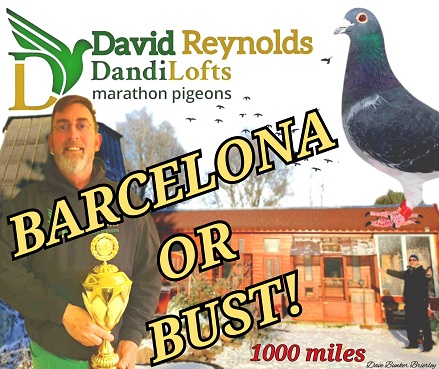
JIM EMERTON CHATS TO BOLTON'S FRANK KAY ABOUT HIS PASSION FOR BARCELONA
Describe your feeling on clocking at 869 miles out of the Barcelona international?
After the initial excitement it’s a feeling of walking on air. You feel lifted both in body and spirit, full of the joys of spring, knowing the confidence you have in your pigeons and management has been rewarded. To clock from the Barcelona International at my distance, 869 miles, is always going to be a feeling of elation, no matter how many times you do it, as each year has different weather conditions.
What prompted you to race such a marathon distance?
I felt I needed more of a challenge for both myself and the pigeons. Your Barcelona challenge was just what I needed. Also I needed to get out of the pigeons all that was in them and I feel there is still more if there was further to go, say 1,000 miles or more. I would take up that challenge. Barcelona is the furthest I can go.
Do you see yourself as a modern pioneer of the sport?
Some would see me as a modern pioneer. I see myself as a person who likes a challenge who is getting out of the pigeons all that is in them. If it was easy, I wouldn’t be doing it.
Please detail your race preparation.
The pigeons I prepare for the Barcelona race are paired up around the 15th March. They sit for five days and are then split up, re-paired up on the 20th April and sit again for 5 days then split. The eggs are transferred to yearlings. They go to the first preparation race in May, which is usually 120 miles, the second one is 150 miles and then the coast 212 miles. They have one channel race then prepare for Barcelona, usually sitting 10 days at the most. I try to leave plenty in them as Barcelona at 869 miles is a hell of a fly. Other than that they must want for nothing 365 days a year. Feeding is kept simple. I use the same mix all year round. They are fed to appetite with the usual grit and cider vinegar in the water. A few red skin peanuts are given in the last two weeks for their fat content. Natural health and vitality is what we are aiming for; you should see this when they are flying out at home. If they are right they will put the work in better than any training toss. The only time my pigeons go into a basket is when they go to the club for preparation races.
How do we achieve great flying condition for Barcelona?
We achieve great flying condition by not over taxing the pigeons and building the condition slowly in order to reach peak form when it is required.
How do you build ‘Kay’ Barcelona strain?
The Kay Barcelona strain is built on a very hard regime. Two-year-olds and over go to Barcelona, 869 miles, and the yearlings go to Tarbes, 726 miles. Therefore the only ones left to build the strain are the survivors. At the end of the season I am only left with birds that have flown Barcelona or Tarbes and the young birds that fly 120 miles and 150 miles, no training. The only interest I have in pedigrees is having the parents flown Barcelona and at my distance they are very few. If I was to lose all my pigeons and had to start again, I would let hand selection be my judge because as soon as I get a pigeon in my hands, I know if I can work with it. It’s the man that makes the pigeon. Without the man to get out of a pigeon all that’s in it, it’s just another pigeon. Pedigrees this and pedigrees that means nothing until the pigeon is put to the tasks and not many survive the grim reality of the Barcelona International at my distance.
What qualities are needed for life at the top?
I would say to be your own man, set yourself a goal and keep on striving to achieve it. Go where others fear to tread and don’t be side tracked by the doubters.
Can we improve racing for all?
Yes we can, by coming together more and filling the transporters. Combine-type races could be done on a weekly basis.
How do you wish to be regarded in the future?
As someone who got out of his pigeons all that is in them and was never afraid to be different.
Any thoughts on pigeon politics and management?
I try to stay well clear of pigeon politics although I must say I am not in favour of all the one-loft races that are kicking off to produce so called ace pigeons. It all detracts from encouraging future fanciers into the sport who are prepared to both breed and race their own pigeons and not just purchase pigeons to send to one-loft races. At the end of the day the credit must go to the loft manager; only pigeons that respond well to his management will succeed. If this was the only way for fanciers to test their pigeons it would be a poor outlook. As for pigeon management I only know my own ways. Aim at natural health; use your observational skills - droppings right, pigeons responding as they should, the greeting you get as you approach the loft. Simple things a born fancier takes for granted.
Who do you admire in pigeon racing?
The ones I admire are all fanciers who strive to do well at whatever level suits them best. It makes pigeon racing more colourful when we all have different targets to aim at, i.e. sprint, middle distance, long distance, marathon distance and of course the show pigeons.
How do you see the future of pigeon racing?
I see the future of pigeon racing as being very exciting with all the modern technology. With a microchip in the pigeon’s wing we should be able to follow its flight path; this would be great from Barcelona. We have already got state-of-the-art transporters, pigeon lofts like mansions, and the best bloodstock in the world. I would like to see more of us flying the flag for British pigeons in the Internationals.
Anything else to add?
I do have something else to add. I am never happier than when I am at home on the farm going about my work whilst waiting for Barcelona pigeons. It is something that brings real contentment. I shall go on producing Barcelona pigeons as long as I am able. If this article encourages others to have a go, I will be more than satisfied. The pleasure I have had from my pigeons is immense. Long live the racing pigeon.