The Elimar Interview
Jim Emerton chats to BIRMINGHAM ROLLER ENTHUSIAST
GRAHAM DEXTER

Please describe the genesis of your life in connection with these acrobats of the skies.
I have always been fascinated by these brilliant acrobats of the air. Since I was 12 years old, yes over 50 years ago and since the very first time I saw my first somersaulting bird I was hooked. It seems so incredible that a bird can perform such a feat with beautiful symmetry and grace, when clearly it is the most unnatural feat of nature. I have the same fascination when watching the Olympic high board divers doing their triple somersaults with tucks and twists. They are just fantastic, and so visually enthralling.
Since my obsession began, I have bred, trained, flown and competed with these champions of the air. They have delighted, frustrated and from time to time exasperated me, but never bored me! They say you need two lifetimes of watching rollers before you can truly understand them, I think that is probably an underestimate.
I began with pigeons, as most I believe do, with a couple of racing homers obtained locally. In my case it was from Derby Market, to which I returned on many occasions to repurchase my pair after they had been released (in a vain attempt to settle them) and returned home. Eventually it was my father who took me in hand and took me to see the closest pigeon fancier locally to be instructed in the art and science of pigeon husbandry. For me, I believe, luckily that fancier happened to be a flying tumbler fancier. Consisting of mainly yellows and reds he let me have a pair and showed me how to settle, feed and breed the same. Although “Henry and Min” as they were christened were useful as pets, it soon became clear that Mr Hannibal’s (that was the gentleman’s name) would not be enough for me. Once I had seen his tumblers in the air, I knew I would have to have some to fly, not just as pets. At this time I spent most of my time with my head looking up searching the sky for any other somersaulting birds and my endeavours were soon rewarded as only half a mile away I spotted some remarkable birds, not just tumbling but spinning. This was my introduction to the Birmingham Roller. A guy called Bill Birdette was flying some rollers at that time, and once again I was quite lucky as Bill was a chap who liked change. One week he would have racers and the next tipplers and then back to rollers again. So I was fortunate to be around when he was changing his kit of rollers for racers and I acquired my very first proper rollers to fly.
I progressed from tumblers to rollers to Birmingham Rollers through people like Bill Burdette, Harold Adams, Frank Bryant and Harold Brunt in Derby until in 1972 I met some of the greats like Bob Brown, Bill Barrett, Ollie Harris, Ken White, Ernie Stratford and John Lenihan. These were the people that continued to inspire me, and helped me persevere with the rollers while I continued to attempt to achieve perfection.
In order to enable more and more fanciers into the hobby I formed the North of England Flying Roller Society in 1978 and Barry Shackleton and myself supplied most of the original Birmingham Rollers whose progeny now occupy the skies over Middlesbrough and the North East. In 1982 I formed the National Birmingham Roller Association in order to allow the individual clubs to compete against each other for National honours. My sense is that that is probably my greatest contribution to the roller hobby and one I am most proud of.
My book “Winners with Spinners” was first published in 1989 and the 2nd edition in 1997. Despite its title I do not consider myself a great competitor. Over the years I have won some of the major prestigious competitions available to me, yet my greatest pleasure is not in the trophy but the ‘crack’ of the group on the flys, and the birds themselves. I am still fascinated by the Birmingham Roller in the air, doing its stuff, and the pleasure to see a good spinner, whether at my home or on my travels is more important to me than winning a competition.
One of the reasons for writing the book was to ensure the wisdom of the time, which was invested only in the great fanciers’ heads, was recorded for posterity. The ideas, skills and knowledge of those great fanciers could easily have been lost, as none of their views had up to then been recorded. I don’t quite see it as my book. I see it as a resource for future fanciers.
What does a roller do to live up to its name?
Pensom’s definition of what a true Birmingham Roller should do is the definitive. He wrote that ‘A Birmingham Roller should turn over backwards with inconceivable rapidity for a considerable distance like a spinning ball’. No-one has really surpassed that definition. I would add that there are several variations of what describes what a ‘good’ BR should do. I believe it should be graceful in its operations; these days we often see very ‘fast and frequent’ performers, but some of these lack the symmetry of a spinning ball, and the roundness is sometimes lost with the wings being held slightly out of the perpendicular, thus giving it what we now call ‘winginess’. To be perfect the bird needs to commence its roll with confidence and complete its roll with snappiness, facing the direction of the kit, not seeming confused and flying away from the kit. It needs to spin fast enough to create the illusion of a spinning ball, but not deviate in its speed or trajectory during the roll. Some rollers seem to change speed during the roll and this makes the illusion appear disjointed and not smooth (not graceful). I prefer a bird to be graceful rather than superfast, although it’s great when both appear together. I know some people advocate that the bird should show a ‘hole’ when viewed from the side when executing its roll like a donut or polo mint, but I have seen birds like this that don’t quite look like a spinning ball and some that do. The roundness and compactness of the bird in motion seems like the most important thing to create the illusion and the considerable distance is also important so that we don’t end up with short rolling birds that hardly give us time to evaluate or appreciate the roll before it’s over.
Why have you devoted your singular life to these pretty birds, as author, official, and competitor?
I think I have probably answered this question or at least illustrated it in my previous splurge. However, I can easily reiterate they fascinate me! They are unique in the bird world. Simply being able to fly is great, but to somersault backwards at breakneck speed and do this in unison with another 19 birds alike, is a feat of astonishing accomplishment. To breed these acrobats is no easy feat: to select the pairs; watch the youngsters develop (never quite knowing or believing they will have the same ability as their parents); live with the disappointments of loss through flyaways; devastation from the birds of prey; and their ability to ‘let you down’ on fly day tends keeps the interest at a peak!
You are a noted academic, with insights into many subjects, especially as a psychologist. Does this assist in your analysis and intuitive understanding of roller pigeons?
As a psychologist my greatest assistance is in the understanding of other fanciers rather than the birds themselves. My earlier career as a Nurse and then Nurse Tutor, led me into the study of physiology and medicine, and these knowledge bases have had great value. Understanding the physiology of the pigeon and disease processes has been enormously helpful to my roller friends and I. Pigeons have some unique psychological features, such as mating for life, protecting their eggs and offspring, and their sociability. Each of these offer interest and intrigue. For example, I note that hens will choose to be fertilised by a stranger when the egg is ready rather than fidelity to her cockbird if he is not available. Cocks will tread any available hen, yet will not tolerate a strange hen in his nest box once paired with another. Perhaps humans could learn a little from these notions! There can be observed ‘emotions’ in the loft, certainly there can be jealousy notice how some hens will try to prevent her cock from treading another, yet will seldom leave her nest to do so. Cocks will tread any hen (pretty or ugly) but will try to keep their hen from all other prospective mates at all cost. Sexual promiscuity appears to be well tolerated in the loft, and I know of no divorce proceeding ever taking place for whatever reason. Watching the day to day activity in the loft still has great interest for me even after all these years. I am not aware that I differ that much from any of my fancier friends in this regard, so I think my analysis and intuitive understanding is no greater for being a psychologist!
Does the hobby consist of a global community of characters, friends and competitors?
Yes, the hobby is now worldwide, with fanciers linked up via the internet through chat rooms and webpages. The USA, Canada, South Africa, Australia and more recently European Countries all compete in the World Cup, and that has made communication with like-minded fanciers much more integrated. The UK and Southern Ireland for geographical and cultural reasons have more immediate and closer ties, and many of the English fanciers have solid friendships within and outside our borders. Even though I have spent several years living in Portugal, I have been able to keep close contact with my friends in the hobby across the globe. One of my main reasons for returning to England 2 years ago was to be in more personal contact with my pigeon buddies and the immense fun and stimulation I get from the meetings and competition flys. Frankly, despite the internet, I missed the smiles, handshakes, and nonsense talked at our get togethers.
Can you please relate to us about the leading lights in rollers?
I have some great friends in the hobby, all of whom are successful with their rollers. Success is available to anyone that enters the hobby, for I believe success is about personal achievement and personal satisfaction. The fanciers who look up at the sky and watch their kits of rollers and feel the joy and thrill of these fascinating birds are all successful in my eyes. In terms of the leading lights, there are those that win competitions, those that sell birds for extraordinary prices, and the silent majority who continue to promote, persevere and perfect the Birmingham Roller in their back gardens all over the world. I probably have more regard for the latter than some of the leading lights. It behoves me to mention a few names, although I do this reluctantly, as I am likely to miss people out that really deserve a mention, so forgive me if I have not mentioned someone. My choice for restocking with rollers if I had a disaster would undoubtedly be Dave Moseley and Bill O’Callaghan as they, for me, are the fanciers that live for their birds and are always are striving for perfection. They are champions in competitions and in the heart of the hobby. In the North of England we have some premier fanciers who both breed, supply and support the hobby continuously, people like Deano Forster, Les Bezance, John Wanless, Ali Milne, John Hall, Eddy Baldwin and Ross Young. The west has its own key players like Ken and Trevor Weaver and Wayne Grove who supports the hobby with his excellent website. There is Donna Chantry who virtually single-handedly runs the All England Roller Club, and lots of emerging leading lights like Dom Butterworth and Mark McCrory. In the Midlands we have George Mason, who has won everything over the years and is vintage in the hobby always up there with the leaders of any competition, and a mine of information should anyone care to access it. Darren Deacon in Leicester demonstrates his persistence and skill with his rollers and takes some of the highest and consistent honours each year. There are also the Midland stalwarts of the hobby who have been around for many years supporting and encouraging others: Steve Taylor, Paul Green, Tony Bagley, Kevin Bowden, Chris Rhodes and Terry Harper. These are men who will turn out a team anytime, judge a fly, or attend a meeting simply for the love of the hobby. In the very south the rollers are losing ground. Now John Lenihan and Ian Lawrence have both given up rollers for health reasons, we have very few aspiring fanciers. It seems to me that good rollers seem to congregate around central figures - wherever one eminent fancier emerges there are also followers, and if that eminent fancier retires from the hobby the energy is lost and the whole area suffers.There are many new faces that yet I have to know better. Emerging young blood is always good news for a hobby. You all deserve a mention, and yet there are thankfully too many of you to do so personally. Finally I must mention those fanciers that never give in, despite incredible losses to thieves, birds of prey, or disasters like paramyxovirus, and they continue and like cream always rise to the top, people like Morris Hole. Morris can be seen in the results at the top or near the top every year. This is despite having his birds stolen from his allotment year after year. It is a miracle that he is still in the hobby and still maintaining his position at the front.
What are the basics of roller management to aspire to competitive condition?
Good food, clean water and a waterproof loft. Rollers need very little to produce good results, but the art and science of creating excellent teams for competition cannot be summarised in a few passages in an article. Getting the best stock, listening to good advice, asking sensible questions, and using your eyes and ears properly will enable the enthusiast to make good headway in rollers and roller competitions.
Does knowledge gleaned in the racing pigeon media help you Graham?All good information is welcome and the racing pigeon fraternity is full of good information. However, lots of ideas and methods for racing pigeons do not translate into usefulness for rollers. Racing pigeons need to be at peak fitness to compete, and rollers need to be just coming up to a peak. Fly rollers at peak fitness will result in long flying, high flying, and less rolling. So breeding methods, such as the bull system, and requirements for general health offered in racing pigeon literature is helpful, but loft construction, feeding and training methods are not so helpful.
You created many of the rules for competition roller flying. How is a competition judged?
The National Birmingham Roller Association rules are generally the rules which most clubs use as their basic set. All clubs are at liberty to make local adjustments to meet the individual needs of their club members though. Generally teams consist of 15-20 birds and are judged for 20 minutes. The judge’s job is to award points for spontaneous simultaneous rolling of groups of birds in the team. So if 5 to 9 birds roll (with reasonable quality) together a single point is awarded for each bird. If 10-14 birds roll together double points are awarded. And if 15 to 19 birds roll together triple points are awarded.
In addition to this there are points for the compactness of the kit kitting points. In the event of a team of 20 keeping together compactly for the whole 20 minutes then 20 kitting points would be awarded.
Finally, up to a maximum of 200 points can be awarded for the quality of the individual birds within the team. So should 5 of the team be high quality rollers in their individual performance then 50 extra points should be awarded. This is a means of ensuring that the frequent performers which are often of inferior quality in their roll but good enough to score, do not penalise and beat a team of high quality rollers which may have less frequency. In the past I have awarded no quality points to a team, and once in Middlesbrough awarded 160 quality points. These are the points that should enable quality rollers to win through over the more frequent inferior quality birds.
Do you and your pals value strains of the birds, and what is a strain?
It is said that after a few years of line breeding you have created your own strain, and so theoretically once a fancier has died or retired from the hobby then after a few years their strain cannot exist unless a like-minded individual continues to line breed in a similar way. More broadly a strain is the consolidation of some collective qualities, attitudes or abilities attributed to a close family sharing common ancestors. This broader way of thinking allows us to believe that there are still prevailing ‘strains’ such as the Bob Brown strain, the Bill Barrett strain, the Ollie Harris strain, the Ernie Stratford strain, the Pensom strain. More modern equivalence would be a Mason, Bezance, Moseley, O’Callaghan and so on. Personally I have grave doubts about the validity of this thinking. I do see some enduring qualities of some families of rollers, but there has been such cross breeding between the ‘strains’ that there are very very few fanciers who can claim that uniformity of roller that breeds true to the ancestral quality. Having said that after perhaps 6 or 7 generations of line breeding it would be reasonable of that individual to claim they had produced their own ‘strain’ providing no outcrossing of any note had been done. It might be more authentic to say there is a Northern strain of rollers and a Midland strain. The former largely influenced by birds bred by Dexter, Shackleton, Bezance, Forster and Wanless, and the latter through Mason, O’Callaghan, Moseley, and Bagley. I can only say this from my own observation as there seems to be definite differences, the former on the whole being faster and shorter and the latter being slightly more graceful and deeper, with many many subtle variations along the way such as lower flying, gentler temperament, greater homing ability and so on.Large claims, which are largely unsubstantiated are made for families of birds ‘going back to x’s strain’ which quite frankly are fanciful.
How can we spread the roller gospel into the mainstream and into child education?I think the simple answer to this would be to ban television, computer games and mobile phones for children until they are 30. Introducing livestock husbandry into the National Curriculum would perhaps increase children’s knowledge and thus stimulate interest, and I believe that if schools were to create livestock projects that would enhance a child’s quality of life. The roller in this way would advertise itself, for if children and young adults were to look up instead of down they would be intrigued to see such magnificent acrobatic performances.
Please tell us about early, influential fanciers like Pensom, and your seminal books.Pensom’s books and articles were my original source of information. Very few authors did greater service than Pensom. His book is still read and revered now. Much more information and practical help came from Bill Barratt, Bob Brown, Ken White and Ernie Stratford and this was the main reason I wrote ‘Winners with Spinners’ so that all that wisdom was not lost when they died. I have read many articles in the American journals, much of which is interesting and helpful, and some of which makes me wonder if the authors have ever seen a Birmingham Roller of note.
Have you observed a perfect kit of spinning rollers?
I doubt there is a completely perfect kit, because in a team of 20 there is never going to be a consistent performance across a period of 20 minutes. However I have seen some magnificent teams. The notable ones at Bill O’Callaghan’s, George Mason’s, Dave Moseley’s, Les Bezance’s, Deano Forster’s, John Wanless’s, Peter Stripp’s, Maurice Hole’s and John Lenihan’s. These notable kits are due to the dedication and diligence of their owners. I have no doubt there are numerous other fanciers who fly magnificent kits, but for them to be on show the observer has to be there often enough to see them in their best condition, in the right weather, on the right day. I wrote an article a few years ago entitled ‘the perfect team’ which represented what I believed to be the way to produce one and the ingredients which might make up perfection. It is however likely to be something to strive for, rather than an everyday event!
Are you stimulated by contact with nature in general?
No not really. Other fanciers often have chickens, dogs, canaries, finches, fish, or interests in gardening and other interests in cultivation. I have been totally single minded in my obsession with Birmingham Rollers.
Do aerial predators have an impact on the hobby?
Birds of prey have had a devastating effect on the hobby. Whereas at one time we seemed to be attracting more fanciers to the hobby, now we are losing lots. Some of these are even long serving fanciers, who you would not have expected to lose. However when you consider the time and effort that goes into producing a high quality bird, which you may have mentally earmarked as a potential stock bird, and you see plucked from the sky by a peregrine falcon, the effects are far reaching. When your losses begin to exceed the amount of good rollers you can breed, it is a question of whether you are breeding birds for yourself or to feed the predators. More hidden impact can be seen when one appreciates that a good kit of rollers will fly a very slow pace with a butterfly wing action. This is the flying style that produces the big ‘breaks’, when the majority of the birds roll together. After a peregrine attack, even an unsuccessful one, the teams slow flight will be quickened. This increase and change in wing action and flight speed may become chronic or permanent resulting in a devastating loss of performance of the team. Recently it appears that sparrowhawks have now adapted to hunting in the air. At one time they were a menace only once the birds had landed and would take one off the loft top. As they are not capable of flying far with a roller being carried in its talons, it was possible to retrieve the bird by scaring the hawk and rescuing its prey. Now they are attacking like the falcon, sometimes from a great height whilst the team is in the air, and thus able to carry their prey much further and hide whilst it devours the unfortunate victim. For me the peregrine is a magnificent bird and I have a sneaking respect for it. The sparrowhawk on the other hand has no saving graces as it does not kill cleanly but simply eats its prey alive. Once the peregrine and sparrow hawk were endangered species due to the use of DDT on crops and the effects this had on hatchability, now surveys show that they are thriving and becoming a danger to other wild birds as well as domestic flocks. It seems odd that penalties for protecting one’s livestock are still in force!
Are many fellow fanciers dedicated purists, or does commercialism rear its ugly head?
Most of the fanciers I associate with are dedicated to the hobby and are eager to be of help to the new recruit. However the price for rollers has inflated considerably over the last few years. This is largely due to increased competition and the rarity of high quality rollers. Also I note that some clubs now have cash prizes. This I believe, creates a commercial component that I fear does little good for the hobby generally. There is also an unhelpful attitude emerging, that seems to suggest fanciers need to buy the ‘latest’ most fashionable ‘strain’ of roller. I believe this to be a distraction for if one is always looking for that elusive ‘something better’, especially on reputation rather than observation, then focus and concentration on your own birds can be lost. Many fanciers are changing ‘strains’ and buying in stock, which in my opinion may be of less quality than they already have, but have not spent the time and effort to explore it properly. To evaluate any stock or ‘strain’ properly a fancier must breed from it for a least 4 seasons to truly see what they have.
Rollers are lovely on the eye, can you show us some pleasing photos - a myriad of colours?

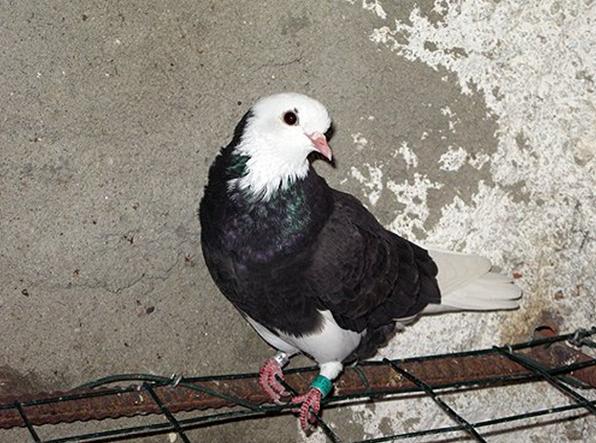
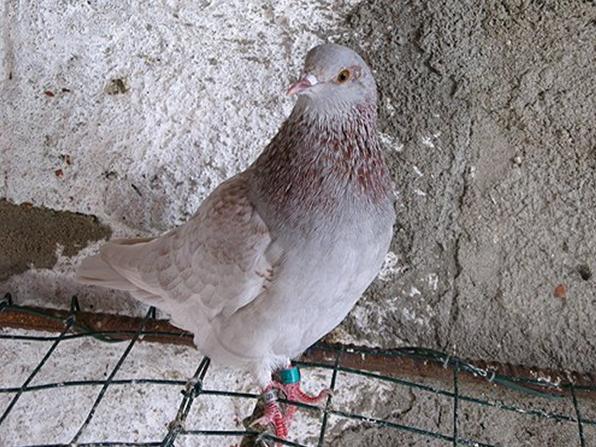
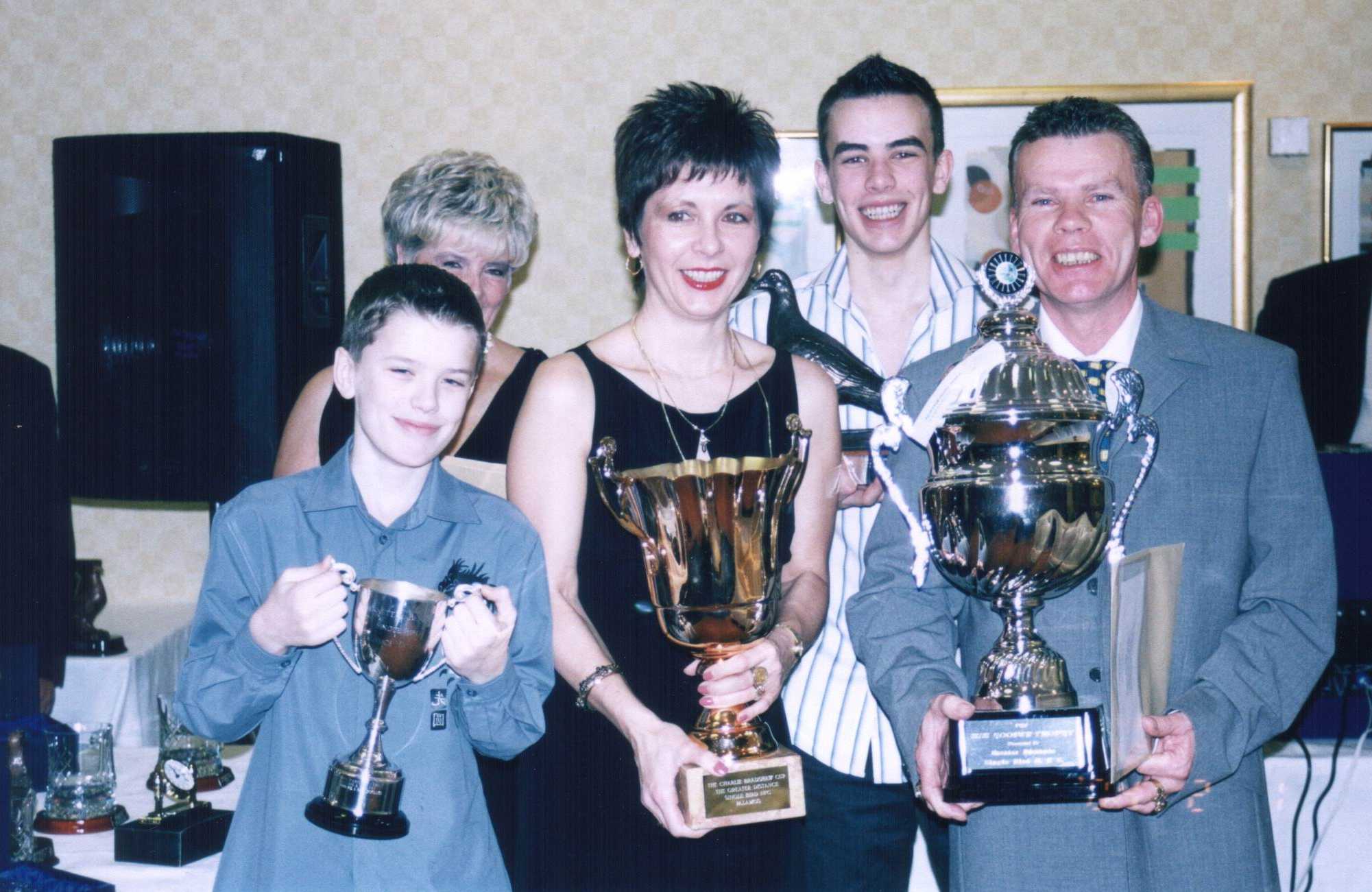
Specimens of classical Birmingham Rollers, of Graham Dexter
How do rollers differ from tipplers/tumblers/cumulets and other high fliers? Tipplers are duration fliers bred specifically to fly long hours and are power houses of stamina in a small pigeon. Cumulets, as the name suggest, fly like ‘white clouds’ like butterflies in a flock making pretty patterns in the air. These are similar to other high flying varieties, small and dainty in looks and in varieties of different colours, feather configuration (such as shell crests or peaks), and are easy on the eye to watch in the sky. Rollers are part of the tumbler family, but in contrast to the floppy singular somersault of the common tumbler they are the proficient aerial acrobat “turning over backwards with inconceivable rapidity for a considerable distance like a spinning ball” (William Pensom).
My life with tumblers began in 1962 and my life with rollers in 1964. This makes a vintage 50 years with rollers. Some say brilliant, some say what a waste of time. I say I wouldn’t change a thing!
---
Elimar - March 2014