THE COLLECTED WORKS OF
JIM EMERTON
VOLUME 2
INBREEDING, WHY?
In York, England there are many of my birds which I take an active interest in. Some of which reflect 36 years of my own breeding. There is a son and daughter of Velvet Destiny, a hen with 21 times my No.1 pair in her breeding.
It is known that my four Descamp van Hasten-based Stichelbauts used Remi of 54, Izeren Stichelbaut, the Ware Izeren, Creonne Witooger etc. For historical details (assumes correct history), please refer to the history of the Belgian Strains Vol II. With this apparent knowledge, I went brother to sister with the Iron Man and the Iron Hen. Note both of these were performance inbred birds to my two foundation Descamp van Hasten bred birds.
The key to inbreeding is to breed around performance genes inferred by the good performances of the actual racers. It is a fine feeling to look at the same birds today in 2012 and see all my performance birds at National and International level in their origin. This is a very personal and individual thing to do and I say that after more than 25 years of this practice you can your family your strain i.e the Emerton Strain.
In terms of heterosis or hybrid vigour, I introduced two very inbred hens out of Brian Denney’s Dangerman (Stichelbaut-base) which catalysed some of my own birds. To inbreed then you persevere over many years with closely related birds up to brother x sister and always test the progeny in hard racing from 71 to 879 miles. Yes I can reflect on my breeding over 36 years.
Some not closely related birds are introduced from time to time from top birds at 700 plus miles but are absorbed back into the strain. Some inbred birds are too refined and small (may show recessive genes in the phenotype). These can be excellent for out breeding (crossing). Others may grow into absolute specimens. Therefore, as Geoff Cooper and Deweerdt do, stick to your own and with intuition (stock sense) keep focused. Make the birds your own.
Like all lines of birds, I would suggest that less than 1% of mine would fly 879 miles at Barcelona International. Now, other than Rome, this is where your birds should be going.
Many of you will continue to buy birds for outcrossing as Van Hee did, yet the pundits like Geoff Cooper and Jim Donaldson keep to their own.
To summarise then, you inbreed to performance breeders and racers and send them to International level.
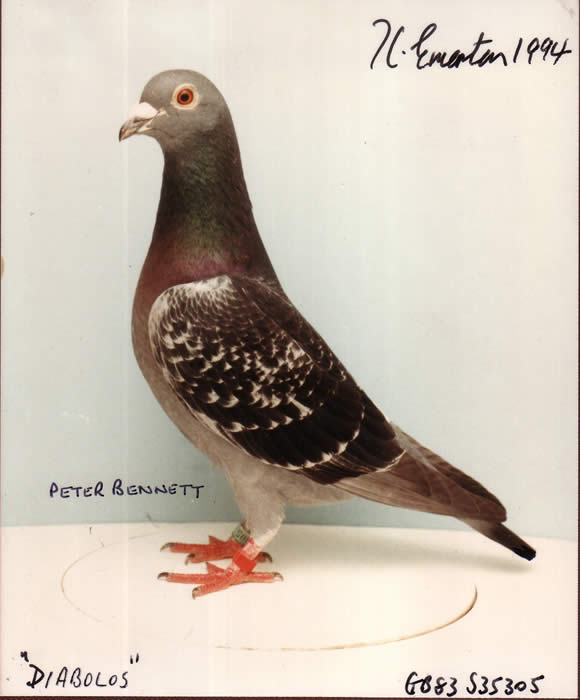
Diabolos - my top racer and breeder. Rung GB83S35305, he died at 22 years of age and fanciers at long distance level use his descendents today, amongst them Donaldson, Gordon, Robinson, Booth and Shipley.
PHYSICAL TYPE
To me all pigeons are beautiful! Quality racing pigeons come in a myriad of colours, shapes and sizes due to genetic diversity in their origins. My birds were mainly cheqs/darks and dark velvets via breeding and race selection. I prefer darks with silky feather classed as yellow and being small or medium balanced birds with nice deep pectoral muscles and smooth and tight in the hand. An exception was Barcelona Dream - a giant of a cock bird. If a bird becomes a champion at any distance it follows a priori that its genotype and phenotype are satisfactory in the reality test of racing. There are birds to score from 90 to 735 miles at Pau like my Dedication, which are rare. A good bird usually gives out to the mind's eye an essence of its quality i.e in the eye of the beholder. In practical terms hard racing under optimal management will produce the desired physical type and genotype since there is no set physical type or eye type at any distance - the latter will manifest family traits and characteristics and it is fascinating to make studies of these. The greatest fancier alive knows little yet racing will put your knowledge and theory to test in the fire blade of experience.
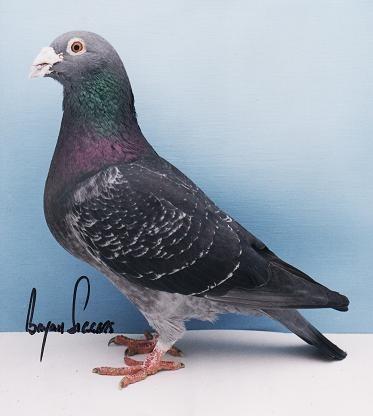
Champion Barcelona Dream, the record distance holder in the BICC
at 879mls being 13th Open National and longest flyer Barcelona International
20,936 birds in 1995.
THE PURIST PIGEON FANCIER
Many personalities slot into the role of fancier throughout the world of competitive racing from geniuses to artists to labourers - it is almost all embracing in its variety of characters! in my personal view there are certain principles and criteria that should be met to make the concept as complete or pure as possible from my biased perspective. A person will do well to compete successfully at all levels from club sprint to national and international level to give a total profile and experience. Ideally a particular family or strain of genetically related birds should be created for this purpose, calling upon the factors of time and patience and severe progeny testing at all levels of racing. An individual can project his personality into pigeon society via politics/sales/writing and any other activity applicable to the sport of pigeon racing up to global level. In reality it can be an expression of self reality in the big pigeon world. The secret is to enjoy the journey in pursuit of the self as an individual in the vast sea of humanity. Perfection and purity are relative but in the cold light of truth is it not a noble exercise to pursue them? A few ideas for you to contemplate - and be happy.
A LEAP OF FAITH
Sending to any race point is a journey into the unknown. The birds primed for the task in hand are at the cruel mercy of the elements. We may feel secure in our guesswork of the outcome, yet the beauty lies in uncertainty. Will we produce the rare champion, a strain maker to propel our name into the future? The race may test our metal, our inner self resolve, in our attempt to triumph over nature or be at one with it. In competition with our peers and rivals we have stirrings of a primal nature - will the ambitions be realised? As man conquered Everest, our highest aspiration may be Barcelona. It is a spiritual odyssey to self realisation, a giant leap of faith into the future.
BASKET OR JUDGMENT?
In racing the key is to get your birds to the chosen race so that race reality will decide the outcome under those particular conditions! You may have been wise enough via a prior decision to nominate your leading bird with accurate decision making from pure experience of a perceptive, thought and intuitive nature and sound stock sense. Some people develop the art, others rely on say chance. Pooling for money may hone the required skills.
There are too many variables for breeding/racing to be an exact science and much of the success is down to the personality of the fancier in juxtaposition with the intrinsic qualities of the birds. Assuming that we have some control of our pigeon destiny, then with quality judgment I recommend ambitious fanciers to persist with dogged determination until you are happy with the results - plenty of room at the top! The pioneers continue to push the boundaries of possibilty, creating champions in the process.
THE NORTH/SOUTH DIVIDE
Humans tend to be prejudiced into believing or asserting that fanciers in the south or north are the best, especially in England. The motivation is often a seeking of superiority allied to the male ego! In UK racing different distances can be involved, say up to 700 plus miles in the south to over 900 in the north of England or 1000 into Scotland. We race for personal reasons from club to international levels with success dependent on many factors. Degree of difficulty may be related to time on the wing - distance and environmental conditions being some of the variables. I have lived north, south, east and west and believe me, there are quality fanciers and birds in all those quadrants. For myself, I am biased towards racing in the north of England over 700 miles and in internationals. The latter is difficult and I hope to see more participation in this onerous task. In the final analysis each race is what it is and may you derive pleasure from the activity. In the future many records will be broken and sporting icons will emerge from the heat of competition.
FIELDING
Most people frown upon their birds using local fields and in some cases this is wise practice with notable exceptions to the general practice. As a freedom lover myself and in the village of Holtby all my birds ranged as they needed to to ingest grain, minerals and some vegetable and animal supplements. From 1976 onwards very few were shot, with some predated by sparrowhawks. My birds were pin sharp and almost wild returning to the loft to nest, feed, drink and roost. Young and old walked the fields, sat on wires and sunned themselves on barns, and they were out all winter even in snow. Dorothy and I would break the ice, feed hoppers of pellets and supply all the birds' nutritional needs. At times it was bliss. Neil Bush and Nic Harvey do something similar, and for marathon races it works, and is beautiful in its simplicity. Ideally this applies to selected rural locations having checked out local conditions. In my system all ages of birds were together on deep litter in the same loft at all times - a free ranging pampered colony of pigeons. We absolutely loved it and recall those days with fond remembrance.
CHARACTERS I HAVE MET
In 1965 I stayed with John Shinn, crack shot and big game hunter in Kenzie the wild goose man's houseboat moored on the Wash saltings. It was a wild, rugged and remote wilderness of tidal creeks, sea lavender and samphire. At high spring tide the boat lifted on its moorings and you were floating on the edge of the North Sea. At times like this my imagination was fired and intensified - will the moorings break and the boat float out to the eternal sea? Cooking the potatoes from the local fields was done on a parrafin stove with sea water scooped from the depths. A foggy cloud enveloped the boat and the calls of the common seals intensified in the murky dampness. At dawn the great man arrived, Mackenzie Thorpe himself - artist with Sir Peter Scott, ex-jail bird, middle-weight boxing champ, poacher and wildfowler par excellence. His eyes were deep with knowledge, face craggy with wind and salt exposure - a unique and solitary figure in this lunar landscape. John and I embraced nature full on as we learned the Wash secrets of the hoards of waders, the ducks and geese, the marsh harriers floating by and the wily marsh pheasants as they tried to evade the gun. We lived the boys' adventure tale and these essential times by the sea, sun and stars framed my life and instincts forever. Old Kenzie passed away in 1976 when the houseboat was torched by Romany tradition and John is soon to enjoy the adventure of a wild boar hunt in Turkey, hardcase that the man is.
INTROVERT OR EXTROVERT?
These are terms created by CG Jung, the Swiss psychiatrist and are now in current parlance. As a general observation, introversive fanciers tend to be more studious, detached and focused on long term future goals with an enriched psychic inner life. With the right total personality in place they may be excellent long distance fliers where great and enduring patience are prerequsites. I would expect such a character to create a strain and be singular and unique in outward presentation.
Extroversive fanciers tend to require fast results and are competitive, being people and mainstream orientated. They may do well in sprint and middle distance events, where quick excitement and rewards are the keynotes. They may seek publicity or financial rewards for their efforts and be fame driven.
All very simplistic and floats on the surface of human complexity, yet fascinating yes? Who do you think you are? Look in the mirror... and read the reports. Only takes a life time.
DEGREE OF DIFFICULTY
The severity of a race depends on human perception of it and is a variable concept. We all can conjure imagery of our most difficult race points and races in the whole spectrum of racing. Some 500 mile races are in fact more easily attained than 100, depending on the race conditions. The management and the sheer quality of the bird - the beauty of racing/breeding are the unknowns, and the triumph over difficulty. It is often thought that races over 500 miles are the most difficult and sometimes this is reality. Pigeon racing beliefs are embodied by prejudice, myth and human personality - I am no exception!! In reality testing of your birds, International racing will always sort out your better birds of any named family or strain, a practice which I recommend at least once in a pigeon lifetime. In my experience of looking at the Barcelona International races into the UK, I have yet to see one without a relatively high degree of arduous, mind bending difficulty. Have a go next year and beyond.
---
Elimar - February 2014