The Elimar Personality Profile
NICHOLAS ADSHEAD
(Questions by Jim Emerton)
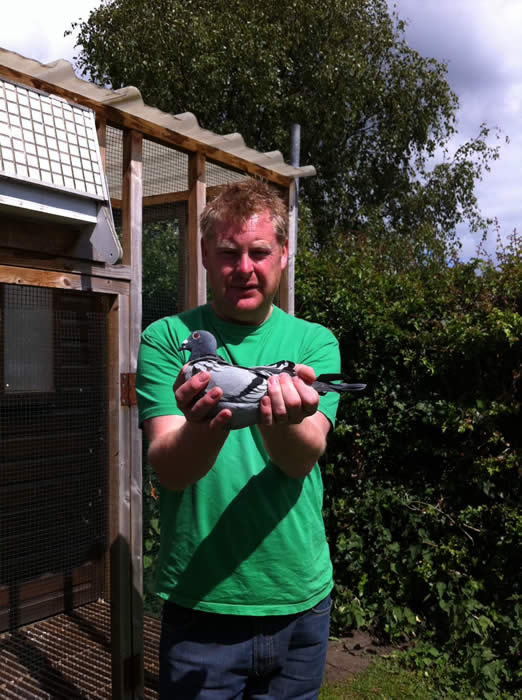
Nick with Billy Whiz
Did you love and observe nature as a child, and were your parents keen on pigeons?
I grew up in the mining Town of Cannock; my late farther Norman Adshead had a great affinity with all sorts of animals, from cattle to mice. My dad also loved his pigeons and was a good fancier in his own right, but winning races was never his top priority he just loved pottering around with the birds. I owe a lot to my late dad, for I feel his affinity with animals was passed down to me, in particular his stockmanship. I truly believe to be a successful fancier you must also be a good stockman.
How did your competitive instincts in life develop, and what and who inspired you to dedicate yourself to winning, and are you motivated by greatness?
As a young lad, like many others football was my first love. I was quite a decent player but found it difficult to get to the games and I wasn’t perhaps as competitive as my team mates so I stopped playing following a bad injury to my knee. This is something that I have always regretted. With my pigeons on the other hand there’s nothing like winning and winning against the odds. This in itself is all the motivation I need.
Did your early education and peer groups sow the seeds of your future success?
Yes. Like I have said previously, I feel growing up with all sorts of animals around me, I ‘learnt’ how to know instinctively what’s right for the birds, whether that’s for their care, health or motivation. Observation is king.
Are you motivated by pigeon celebrity fame and culture or do you wish to remain relatively detached from it all, as some key fanciers do?
I believe credit should be given where credit is due. There are a lot of famous pigeon fanciers here in the UK and abroad who quite frankly couldn’t fly a kite. Their success was the product of the pen. I think the internet has helped a lot as many of the results, particularly those from abroad are now published within hours of the race finishing. You cannot hide from results that are there in black and white.
Have you made a study of books on the art and science of pigeon racing?
Over the years I have read a lot of books, magazines, articles on the internet and watched a load of videos. These were a great source of information particularly in the early days when they helped me to form my own ideas on how to feed and race my pigeons. But the best education you can get is by talking to great fanciers who have achieved all that you aspire to achieve. Once I made my mind up to concentrate on the marathon races from Tarbes the first thing I did was to pursue what I thought to be the best bloodlines to enable me to achieve my goals. By doing this, it also allowed me to speak to these great fanciers in person and form my own racing methods, which is in essence bits and pieces of knowledge gained from talking to the likes of Menne and Daughter, Mark vd Berg, Peter Dehaan and the legend of distance racing Nico Volken.
What is the ultimate goal in your pigeon racing life?
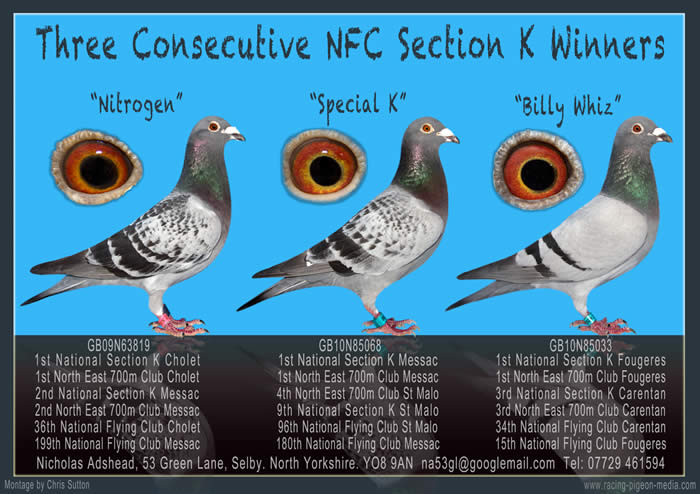
My ultimate goal in racing pigeons is just to top Section K in the NFC from Tarbes and Saintes. And by doing so I would have topped the section at every race point. I think this will be a great achievement and one which wouldn’t have been done by many.
Is strain creation still valid today?
Yes I think it’s important to form your own winning strain. First of all you need to have a vision, an aspiration of what you really want to achieve in the sport. Over the years I’ve always achieved top results from races in the NFC from distances of 300 464 miles. I achieved this with my family based on original birds obtained from Peter vd Merwe, Koopman, Sepers and Comb B&W. I soon found out that it wasn’t the birds who won in the local club that won at national level. By pursing my target I lost a lot of very good club pigeons, but by only racing in the NFC I soon found a family which I could rely on in these races regardless of the weather. The funny thing is that most of my successful birds come from the very same line, of my Super Breeding Cock and his daughter. I don’t believe this is a coincidence.
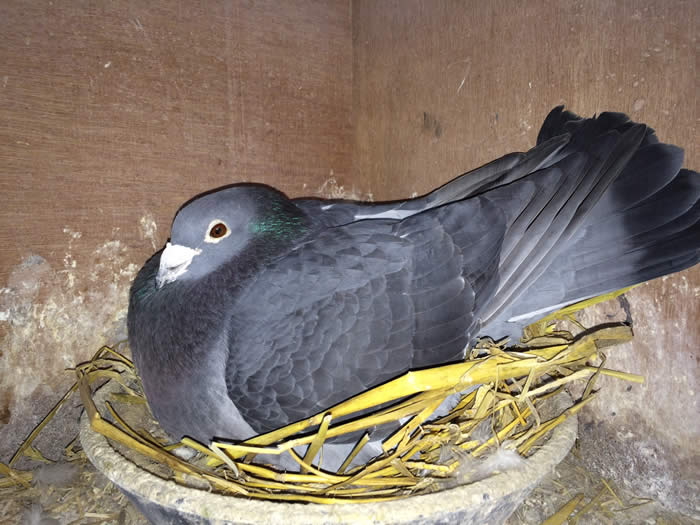
Sire of Patience
Now that I’m concentrating on the marathon races I will do exactly the same as with my middle distance pigeons in that I will select my birds by the basket. I’m a hard task master and I will expect all my yearlings to fly at least Saintes (555 miles) and all 2 year olds Tarbes at 730 miles. You will all be aware that this year I did very well from Tarbes with my good yearling hen ‘Patience’, who was the furthest flying bird home on the winning day. I sent a few yearling hens to prove to myself that I was on the right track and the birds that I have invested in were capable of achieving top results in the races that I had purchased them to do. Thankfully ‘Patience’ proved that I’m on the right track. I am convinced that you can only create a family of birds by selective breeding and racing birds in the races you want to win and by doing so the weaker birds soon fall by the wayside and you are left with a family of birds which you can call your own.
What must a pigeon racing great achieve to be given the distinction?
In my eyes a top pigeon is one that performs at the very top against all odds, be that loft position, distance or wind. In every national race there’s always at least one super performance. These are the birds I most admire.
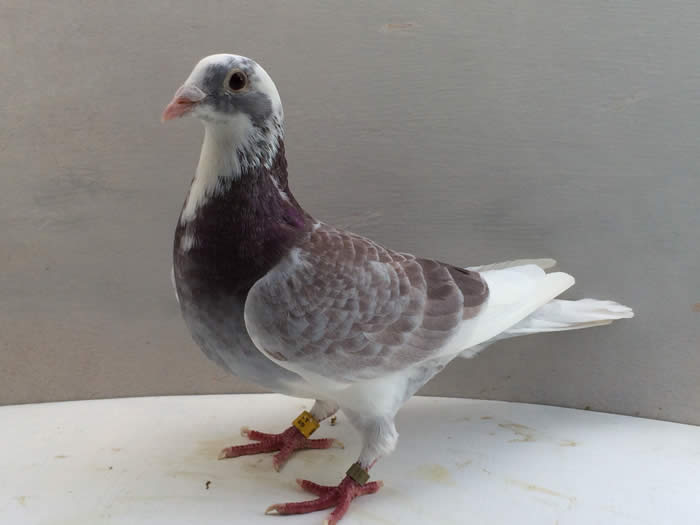
Dam of Patience
Which is the top pigeon racing nation on earth?
That’s a difficult question to answer, many would say Belgium, but I feel they are too commercial. For me I prefer birds from Holland, as the Dutch birds have always flown well for me. I have recently been to a few lofts in Germany and they have performed well from the start. So I guess to answer your question, there isn’t one nation but there are lots of top fanciers across the world.
How do you wish to be remembered in history?
As an honest man who flew a good bird.
---
Elimar - December 2014