AN INTRODUCTION TO PIGEON RACING IN THE ALGARVE, PORTUGAL
by Kevin Spencer

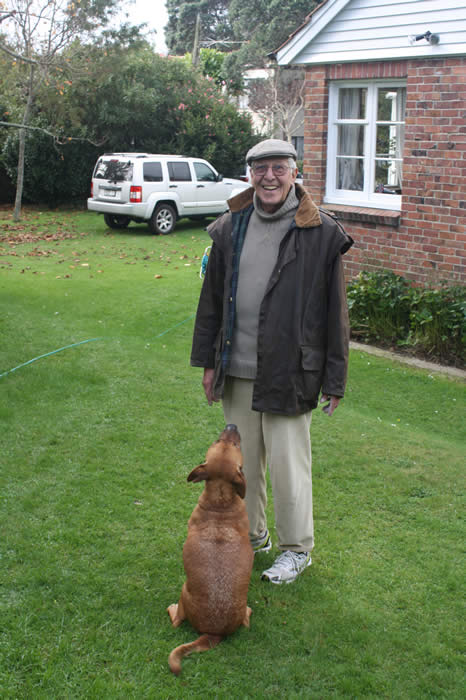
Myself with my wife Joan
Portugal as a whole is a hotbed of pigeon racing. One racepoint, from a place called Algoz in the south of the country in the Algarve, sees over 80,000 birds liberated and turning the sky black whilst the birds get their bearings to make the journey back home to Braga in the north of the country.
This article is about the hotbed of racing inside the Algarve area in the southern part of Portugal where there are 23 different clubs stretching from the East Algarve "Vila Real de Santo Antonio municipility" close to the Spanish border, all the way to "Lagos" in the West Algarve, a distance of 140 km via road. There are also short interviews I did with two of the best fanciers here, an Englishman called "Freddie Hunt" and a Portuguese ex-professional footballer called "Helder" or "Papo Cheio" as he is widely known.
There is no young bird racing in the clubs here but yearlings can either be raced against the older pigeons in the race schedule or a race within the race solely for yearlings against each other. This is the fancier's own choice but you must pay for different teams before the season begins, unlike the UK where you pay for each pigeon sent. Here you can have an A team for the main race, a B team for the main race and a team of yearlings. The pigeons for each team must be designated before the season begins and then they can only race in this team. For example, if I were to put a bird I had designated for my B team in the wrong basket and entered it in the A team by mistake then this bird would not count in the result even if it came home fast to win the race, as It would be disqualified.
You are allowed 15 birds per team and 20 birds if you have a yearling team but then the yearlings only race against yearlings if entered this way. Most fanciers have just one team, an A team, due to the expense of each team, and besides the main race here in Portugal for the Velocidade (short distance) or Meio Fundo (middle distance) they can send extra birds that do not count in the main result in a format called "Sport". 25 birds can be sent along with your 15 in the real race and they have their own private race. They are trainers really but in their own race.
Although trying to win the race is still important, team racing here in Portugal is more important. The first 20% of pigeons in the liberation in club and federation classify and the idea is to classify as many of your entries as you can. Each individual pigeon wins points for each separate race. The higher in the result, the more points it wins.
A lot of Portuguese fanciers have big teams. 100 plus racers is common here and many fanciers have even more, so they need to get them away to keep them fit. This season, racing began in February and ended in June. It is over before you know it but there are 18 club races during that time.
The shortest race is about 170 miles from a place called Sardoal towards the north of Portugal and the longest races are from Dax International with Algarve pigeons racing with Andaluzian Spain pigeons from France at 600 plus miles. Portugal's only National race from Barcelona at the end of June is again over 600 miles to us in Zone 5, which is the Faro area of the country.
To give you some idea of the weekly birdage flying from the racepoints back to the Algarve, in a velocidade (short distance) there would be approximately 8,000 pigeons. In a meio fundo (middle distance) race, around 7,000+ pigeons and in a fundo (long distance) between 3,500 to 5,000 pigeons. There are 23 different clubs in the Algarve alone all racing at the same racepoint each weekend.
I got involved with pigeons here in the Algarve by accident really as my wife Joan and I went to buy a satellite dish in the city of Portimao. We had just moved here as we both loved the place, the people and the weather. As we were leaving the satellite shop on the tiny industrial estate I saw a batch of pigeons circling overhead. I looked around and saw a Portuguese man with a beard sat by an animal feed shop doorway and went over to ask him about the birds. He spoke very good English and his name was Antonio Dias. Antonio invited me to go with him to see the huge liberation of 80,000 birds at Algoz that I mentioned a little earlier. After that Antonio and I became friends and I helped him out some days at his loft. At this point I should point out that I had pigeons before in Blackpool, England along with my father and we had enjoyed the odd success racing.
This was in February 2010 and tragically in September 2010 Antonio suffered a stroke and was unable to look after the birds. My wife Joan and I took over for him and his 400 plus birds became in our charge. Joan has a problem with the pigeons in that the dust gives her a chest infection, but she still persists by wearing a mask and helping me everyday and has pitched in and is a huge help feeding the stock birds and keeping them clean while I set about trying to sort the birds out and get numbers down.
I also enlisted the help of an Eyesign expert, Myron Kulik, who lives in Florida U.S.A and by photographing eyes and sending them to him via email. Myron has been using his expertise to help me identify the best birds to breed from. I will go into more detail about this towards the end of my article. Some of you may find Myron very helpful and interesting - I certainly do.
Amongst Antonio’s birds he has some of the tough long distance Bostyns strain and in our 1st season here it was difficult, but we timed in a good bird from 2011 Dax International, 600 miles plus in searing heat (high 40s in Spain), high 30s in Portugal. the hen finished 7th in the Algarve and only 12 brave pigeons made it in race time. We were happy at probably my best result ever in pigeon racing.
The 2012 season has been very similar to 2011. Our best result has come at the end of the season in June again. With no Dax this year but instead this time at our 1st attempt at Barcelona National, where we clocked a very good bird to finish 6th Zone 5 (for birds flying more than 950 km); he was the 3rd pigeon into the Algarve in Zone 5. This result was every bit as good as the Dax the season previous, once again showing that this colony of birds excel in 2 day races. It's a shame there are only one or 2 per season! The link to the official 2012 Portugal National from Barcelona is here below:
http://www.fpcolumbofilia.pt/barcelona2012/main025.htm
Now, as promised, I have done a short interview with, in my opinion, two of the very best pigeon fanciers here in the Algarve, probably in Portugal, namely Freddie Hunt from England and afterwards Helder or "Papo Cheio" as he is known.

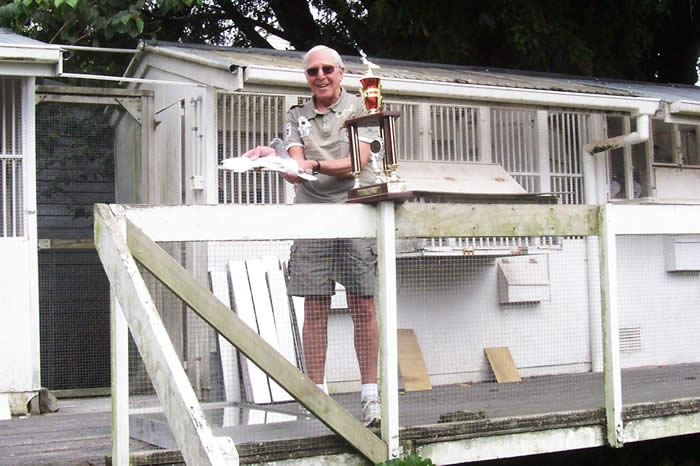
Freddie and Sue Hunt
MY INTERVIEW WITH FREDDIE HUNT AT HIS HOME NEAR FARO, ALGARVE, PORTUGAL
I am here in the Faro district talking with Freddie Hunt, who flies in the very strong Faro Club or Columbofilia, here in the Algarve.
Q. How long have you been here in the beautiful Algarve?
A. We came here about 6 years in October. we were over on the other side of the Algarve in Lagos first then we moved to Faro. We didn’t keep birds in Lagos but started to keep pigeons in Faro probably 5 years ago.
Q. Did you keep pigeons in the UK before you came here?
A. Yes, I was probably involved with pigeons from being around 8 years old, and started more seriously when I was about 21, so I have quite a few years under my belt really.
Q. What made you decide to move here?
A. The wife loves the sun and I like pigeon racing here. It is very competitive and it’s increasingly popular here, whereas in the UK it seems to be dwindling as fewer young fanciers are coming into the sport. We love everything else here: the people, the food. You just cannot go wrong here.
Q. When you moved here and joined the local Columbofilia did you know what sort of pigeons you were going to have or did you know a Portuguese pigeon fancier and get some birds from him, or her?
A. No, all my birds were brought over from the UK. They are mostly Vandenabeeles, the odd Janssen and some Heinz 57, which I have mostly got rid of by now and that’s about the size of it really, but they came from the UK.
Q. Roughly how many pigeons do you have and from those how many are racers and how many breeders, or do you combine the two?
A. I have around 50 birds. I would like to combine the two but if you want to get serious you have to have stock pigeons. I like to race them first, see what they can do and if they perform well, put them to one side and hope I get something decent from them.
Q. When racing the birds here, what do you find different in Portugal than in England?
A. Well I think it is the weather really? I mean it is the wind and rain which makes it hard in the UK, but turn it around and here in Portugal it can be the sun and the heat, so I think it's six of one and half a dozen of the other, but it is certainly different and very competitive here.
Q. So what results have you achieved in the Algarve, and what are your best results, in your opinion?
A. I have been flying four years and have had three 500 mile wins, one 260 mile win and a young bird win, which to me is quite a lot as these are actual wins and there are a lot of members in the Faro club and it is believed to be one of the best in the Algarve. I don’t expect to do much better than that to be honest, but I will keep trying.
Q. How did you find Portuguese fanciers when you joined the club. Were they helpful?
A. Yes, they were helpful, I find them good people. They like a laugh and a joke, which I can't always join in as I don’t do the language, which breaks my heart as I do like the camaraderie, but we do have a few that speak a little English and they are all nice fellows all round, I think.
Q. So with regard to racing the pigeons do you prefer the sprint, the middle distance or the long races, or do you have no preference and what are your birds best suited to?
A. When I was in the UK I used to like anything that came along from 70 miles to 300 miles, but since being here in the Algarve I prefer the longer races. I only go as far as Vitoria, which is about 550 miles, which is as far as you can go in the club (I can only say miles as I am no good at kilometres). I know there are longer 2 day races to Dax and Barcelona but to be honest, they are not my cup of tea because I am afraid of losing good birds.
Q. When flying your birds do you fly widowhood, natural, a mixture of the two or do you do something totally different?
A. I don’t do anything different from what they do here, which is the roundabout system of hens one side, cocks the other. I wanted to try widowhood, but found it was a waste of hens, so decided to do the Portuguese way. I think there may be a bit of trickery here or there which everyone has, but really it's down to decent pigeons and good management.
Q. Do you have any tips for a novice fancier from the UK who is coming to the Algarve to fly here?
A. Well I think when you start to race here you have to not be disappointed if you don’t do well for a while. We have all been there. I have been last a few times, but if you continue and keep pushing it will all come good in the end. You might want to try to buy some birds from one or two of the decent flyers at your club and keep stock pigeons and go from there, but the main thing is don’t give up.
Q. There is no young bird racing here in Portugal, as we do in England, the Portuguese start as yearlings, so how do you keep your young birds. Do you train them or just let them grow and train them as yearlings?
A. Well as you say there is no young bird racing here and to me that is a blessing as there is young bird sickness and I had young bird sickness for 15 years and quite honestly I was sick of it. Yes, I only breed young birds after the racing, which is around July/August as I find it easier. I then start training them around November for 10 miles, 15 miles, 20 miles, 50 miles etc until they start racing in February.
Q. Do you train them as a flock or do you single them up at all?
Well if I get a little bit of time I do single half a dozen whom I think are the better birds but send the rest as a flock, otherwise I would be there all day and I like to get back to see how they are doing.
A. What happens to your yearlings, how do you treat those birds?
Yearlings I guess I treat the same. I don’t do anything different with them. I nurse them and won't take them more than 250 miles and next year push them a little bit harder.
Freddie then went on to say –
There is one bird of mine I would like to mention, she is called Baby Girl. She is a four year old Vandenabeele hen and I am retiring her this year and putting her into stock. She has won four Gold Rings over the distance and I have just found out last week that she has also won what they call a Gold Wing. I have yet to see it but I think this is brilliant for one pigeon, so I think she is worth a particular mention. (The Gold Wing won by Freddie’s pigeon, Baby Girl at Long Distance or Fundo, is awarded for the Champion Bird or Ace Bird in the Algarve for points scored during the series of Long distance races and is a prestigious honour to win). Any bird that wins this award is a true champion pigeon.
I would also like to mention my wife Sue who helps me a lot. She helps train them and when I am not around helps feed and look after them as well, so a big thank you to Sue.
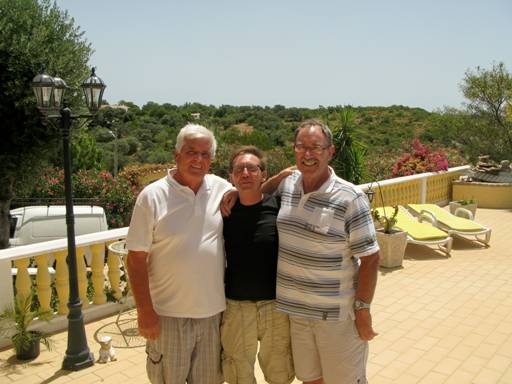
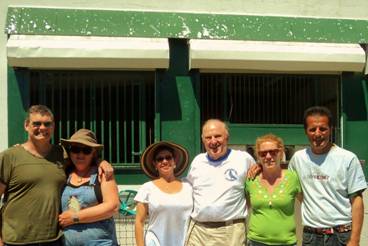
HERE IS A PHOTOGRAPH OF “FREDDIE AND THE DREAMERS”
ALIAS FREDDIE (Left), WITH TWO OF HIS UK FRIENDS IN THE ALGARVE,
ALAN FROM ESSEX (Centre) AND ROB FROM SCOTLAND (Right)
My wife Joan and I would also like to thank Sue and Freddie Hunt for a lovely day out at Freddie's loft and for taking us to one of their favourite local restaurants near to their beautiful home here near Faro.
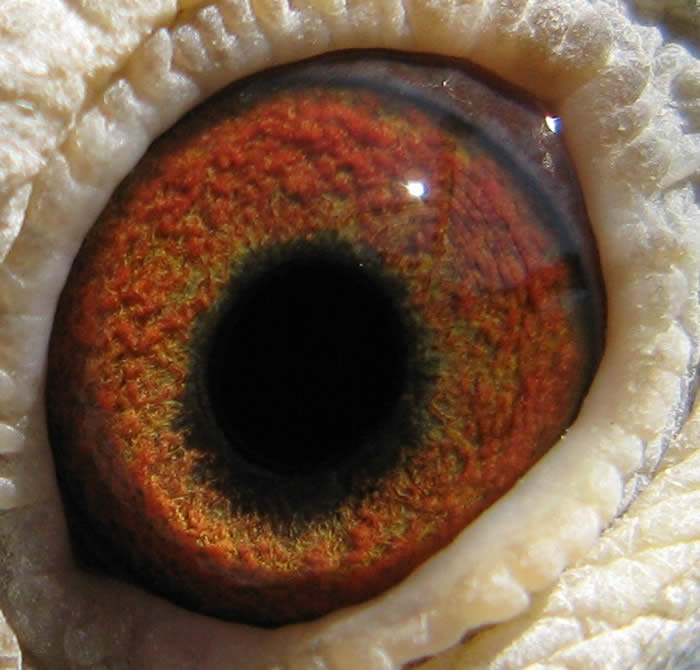
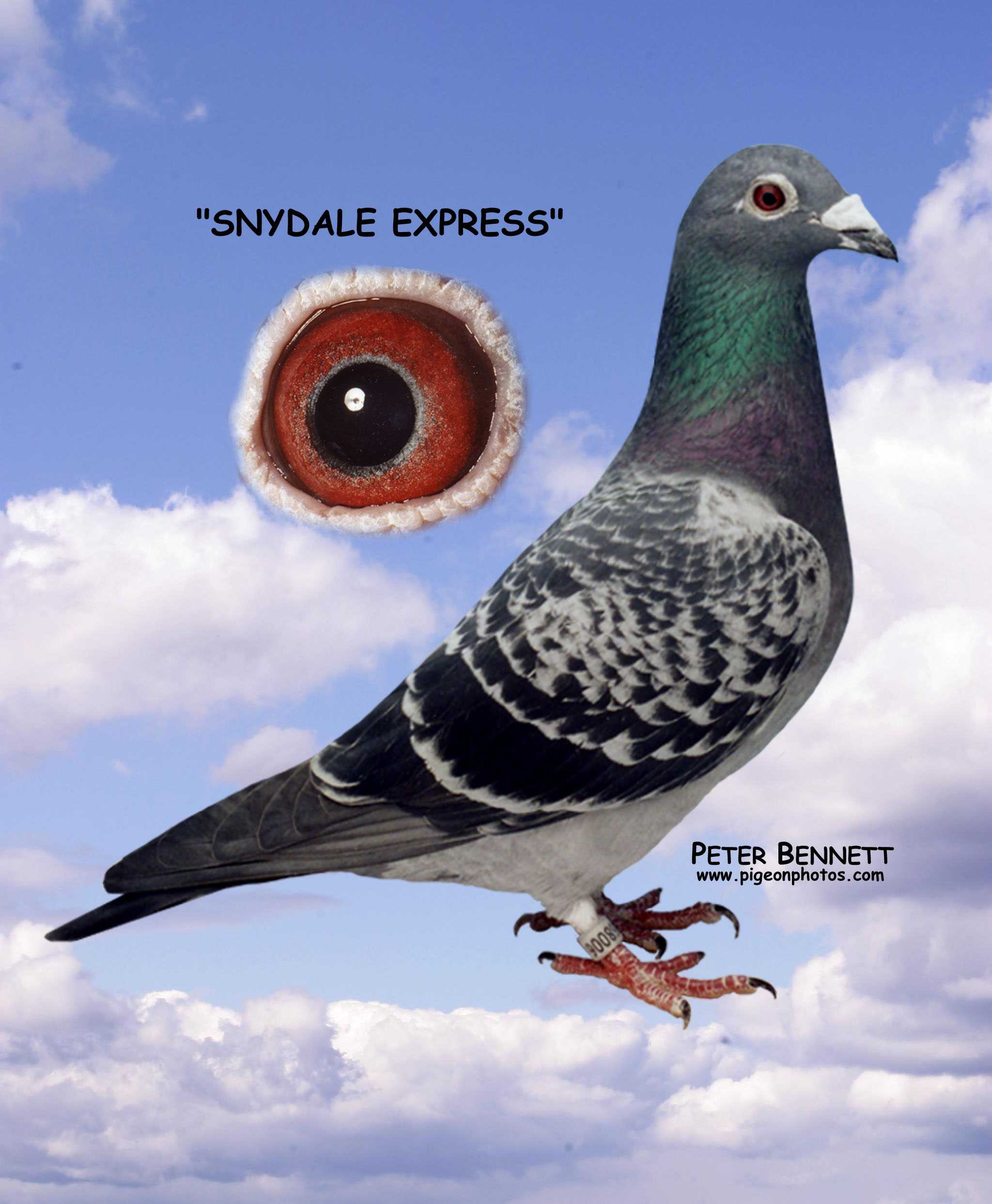
While we were at Freddie’s loft my wife Joan and I took some pictures of some of his birds eyes.Freddie did not tell us what the birds had achieved either racing or at stud. I then sent the pictures to Myron Kulik, my friend who is an eyesign expert, living in Florida, USA. Freddie has since given Baby Girls identity to me and he is, sensibly in my opinion, retiring her to stock after her unbelievable 2012 racing season as she has nothing left to prove racing. Below is a picture of Champion Baby Girl's eye and Myron's comments on her.
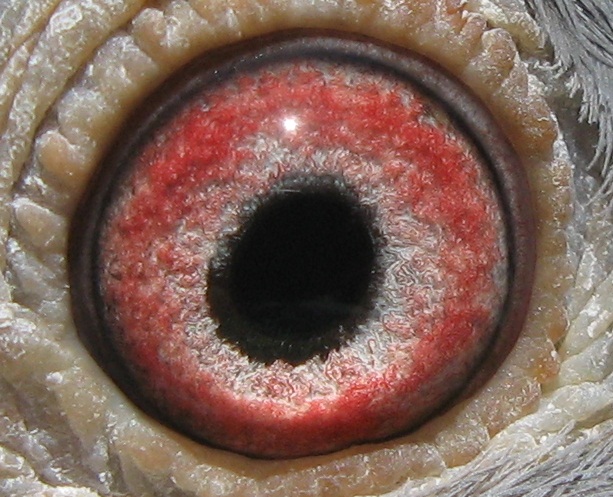
Myron says: This bird has a single tubed iris. It has a wide circle of adaption. Super racer and breeder and will win and should breed birds that will win hard races.
I am now at Helder’s (Papo Cheio) loft near Lagos and he flies in the Portimao Columbofilia. He is one of the very best pigeon fanciers in the Algarve, possibly in Portugal and he has kindly agreed to help with this article by answering a few questions for us.
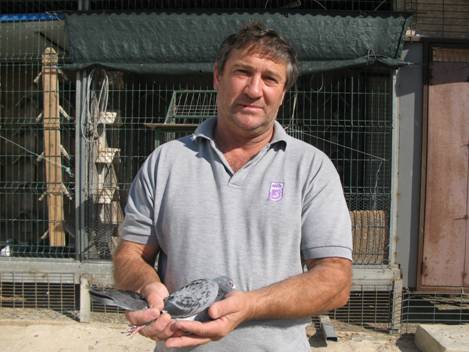
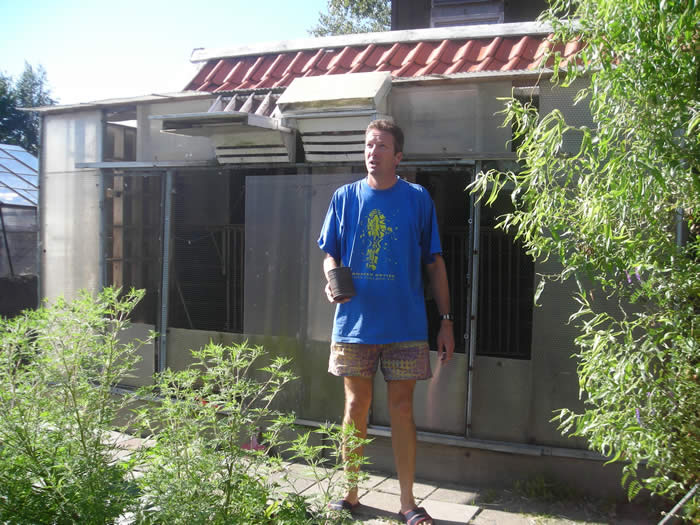
HELDER (KNOWN LOCALLY AS PAPO CHEIO)
HOLDING HIS FAVOURITE CHAMPION PIGEON
Q. Firstly, Helder, what age did you start with pigeons and when did you decide to be a pigeon fancier?
A. At eight years old I had pigeons. I also had a neighbour with pigeons and I got jealous of him because when I saw his pigeons I wanted to get eggs from him as he had beautiful pigeons. That is how I began.
Q. Roughly how many pigeons do you own and do you keep any significant breeds of pigeon. If so what is your favourite bloodline?
I have around 200 pigeons, including the breeders. I have the old bloodline, I have told you before. I have had a grizzle line for the long distance, for almost 25 years. And I have kept this bloodline until now and they still produce winners. I added some Gaby Vandenabeeles and a few other Belgian lines and they too have done very well, but I still believe in my old grizzle lines.
Q. Your old line are your own breed then?
A. Yes, my own breed from pigeons I have bought and I know are good pigeons, they are good racers. I like long-distance races.
Q. You have already answered my next question which was to be – do you like sprint races, meio fundo (medium distance) or Grande fundo (long distance) races best?
A. My birds fly all distances, but I love the long distance races and don’t like short races. My birds, however, win at all distances.
Q. What system do you prefer, i.e. widowhood, etc?
A. I race cocks and hens separate on a roundabout system as my hens are good racers and I don’t want to waste them flying widowhood.
Q. When you buy new stock, what do you look for, and do looks matter to you when buying new stock?
A. I like birds that are good pigeons. I really don’t care about the lines or where they came from, I just look for good birds, not “paper” pigeons. If the good pigeons have a pedigree it all helps with future breeding.
Q. Do you use medications during the season, if so, what kind and is it just minimum medication?
A. Yes, I treat for usual pigeon diseases, canker, coccidiosis etc., but I make a system with natural products. I only treat for respiratory at the start of the season. If I see something wrong, then I will treat the bird.
Q. What advice would you give to a new starter attempting to build a team of good pigeons?
A. A good loft, well ventilated and dry of course and find good pigeons. If he could start with my pigeons it would be very good for him (Helder is laughing and says this with good humour).
Q. When exercising your pigeons do you fly them around the loft morning and evening, or do you train, or do you do both?
A. I fly around the loft two times a day, morning and afternoon and two times a week I train online, around 100kms.
Q. You believe in online training then?
A. Oh yes, of course, I believe it helps.
Q. Do you give special feed to them before a race?
A. No.
Q. Do you give anything special to the birds to get them into good condition?
A. Just the normal feed.
Q. When the racing season is finished, do you separate the cocks and hens?
A. No I have them together, to breed one or two youngsters each, then I separate October/November.
Q. Do you give anything special to your birds to help them with their moulting season?
A. No, I don’t give anything special. I only sometimes give something to help them win. It is something I have done for many years and I never change.
Q. Do you mean Amino Acids etc?
A. Yes, amino acids or nuts, which can be expensive, but makes them come in well. Nuts before a long distance race helps them come in well. Some people don’t believe this but I think it is true.
Q. When pairing up the birds what do you take into consideration, do you say put a large pigeon with a small pigeon, pair a dark eye to a light eye or just pair best to best?
A. I never pair eyes with the same colour. An old friend told me that you should never mix the same eye types, always cross with a different eye. I always try best to best and sometimes blood lines, i.e. sons to mothers and daughters to fathers etc., to keep the bloodline. In other words some experimental inbreeding
Q. Do you take notice of the ventilation and temperature of the loft and the way it is built?
A. Here it is always hot and dry, so ventilation is important. England of course it is different with dampness but this is not a problem here. Dust however is a problem and that has to be kept to a minimum. That is why my lofts are as open as possible.
Before we left Helder’s (Papo Cheio) loft, I asked him if I could photograph a couple of his stock pigeons. The eye below is Helder’s favourite old grizzle line, a hen which has bred him many, many winners. Below the eye are Myron Kulik’s comments:
A very unique hen with very special features. The 5th ring and iris are light in colour but this hen makes up for that in the circle of correlation or c/c, because it is huge or super wide to start with and then very heavily serrated. This is always a big plus or benefit as a breeder. The circle of adaption is also very wide and roped with beads, another plus factor for breeding or flying, but especially as a breeder. This hen is a rare gem to be cherished. A killer hen who could pair with a broomstick and still breed winners.
As you can see from the above, Myron has a good sense of humour as well as being very knowledgeable. Here is a little about him.
MYRON KULIK
EYESIGN EXPERT FROM FLORIDA, USA
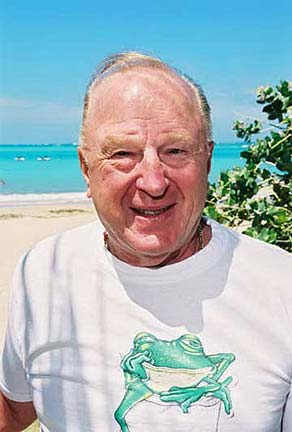
I BECAME INTERESTED IN RACING PIGEONS AS A 14 YEAR OLD YOUTH WHILE LIVING IN THE NEW ENGLAND AREA, USA. FOR 65 YEARS I HAVE BEEN LEARNING ABOUT EYESIGN. I HAVE LOOKED AT THOUSANDS OF EYES AND HAVE CONCLUDED THAT THERE IS A STRONG CORRELATION BETWEEN CERTAIN CHARACTERISTICS OF THE EYE AND RACING AND BREEDING ABILITY. THE ARTICLES ON MY WEB PAGES ARE A RESULT OF A LIFE-LONG STUDY OF EYESIGN.
I HAVE VISITED MANY LOFTS AND WITHOUT KNOWING THE BIRDS HAVE CONSISTENTLY PICKED OUT THE BEST FLYERS AND BREEDERS STRICTLY BY LOOKING INTO THE EYE. BY USING THE INFORMATION ON MY SITE YOU TOO CAN SAVE YOURSELF TIME AND MONEY AS WELL AS A LOT OF FRUSTRATION IN BREEDING A FAMILY OF BIRDS THAT WILL MAKE YOU A TOP FLYER.
IN CONCLUSION, IF YOU START WITH BIRDS POSSESSING EXCELLENT EYESIGN YOU WILL BECOME SUCCESSFUL IN THIS SPORT MUCH QUICKER. THE OTHER PHYSICAL CHARACTERISTICS THAT SUIT YOUR OWN TASTE SUCH AS BODY, WING, FEATHER, AND KEEL, CAN BE BRED INTO THE BIRD MUCH EASIER.
TO ACHIEVE SUCCESS QUICKLY THE KEY IS KNOWLEDGE OF EYESIGN. BY STUDYING MY SITE AND APPLYING THE EYESIGN KNOWLEDGE THAT I AM SHARING WITH YOU, WILL BRING YOU SUCCESS FASTER AND ALLOW YOU TO ENJOY THAT SUCCESS FOR AS LONG AS YOU FLY AND BREED PIGEONS.
I THANK THOSE FANCIERS THAT HAVE GIVEN PERMISSION TO USE THEIR EYE PHOTOGRAPHS. WITHOUT THEIR CONTRIBUTION, THIS TUTORIAL SITE WOULD HAVE BEEN IMPOSSIBLE TO CONSTRUCT.
MYRON KULIK.

http://www.tourdesmaritimes.com/Eyesign/Eyesign101/myron_kulik_intro.htm
In conclusion, as you can see from the above, since moving to the Algarve my wife and I have adapted quickly and made lots of interesting friends both in the pigeon world and outside. Portuguese people are very kind, welcoming, friendly people who go out of their way to help you, especially if they know you are trying your best to involve yourself in their culture and ways too. Most of the people speak a little English and whilst Joan and I are taking language lessons, we still have ways to go before holding a conversation with any of them, but because we try and they recognise this, they are always willing to try and understand us with waving of arms and smiles, which we all seem to do quite well.
I recommend anyone reading this, if they are starting to feel in a rut, then make a move to the sun. Portugal is a wonderful place to be, and as proven above, especially to a pigeon fancier.
Kevin Spencer
July 2012