|
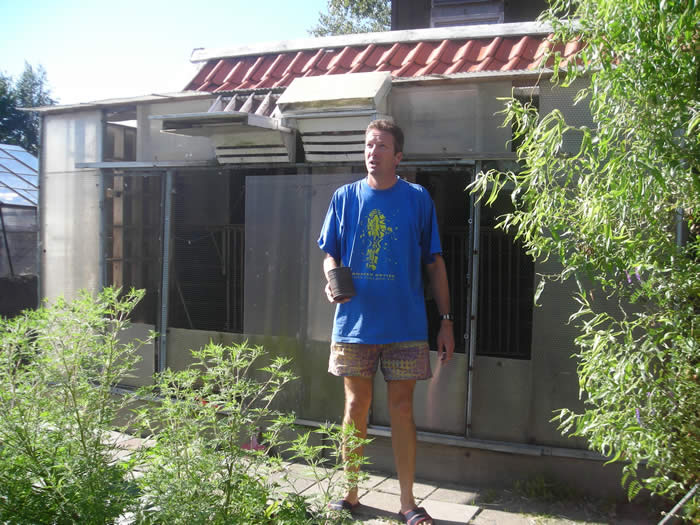
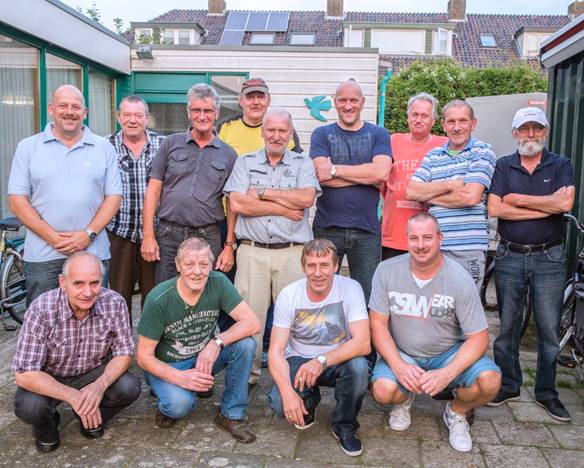
FRED DUKKER - THE RACING TEACHER by Adrian Duggins Fred Dukker from the Netherlands had a marvellous season. He was 3rd general champion of the strong combine “The Westland”. The last 3 races of the year he even won the first prize in this combine and with a bit of luck he even was the fastest on these last three races of the national section no. 12 or, as we say, the federation, "The Kuststrook". The last race his pigeon kept on flying, lost the first prize by 6 seconds and won the third prize in the federation. So 6 seconds away from a Hatrick in the federation!!!
Fred Dukker is pigeon fancier since he was 13 years old. He started in 1977. After 4 years of racing with different results he went over to Leo van Rijn and bought there a few pigeons you even now can find in the pedigrees. Over the years he learned the methods of Leo van Rijn. Also the most pigeons have this origin. This resulted in winning the un-nominated general championchip of "The Kuststrook" in 1993. Again in 2006 Fred won the nominated general championchip of "The Kuststrook" . Fred races in the club "De Hoogvliegers" in De Lier where he also lives. The club has 28 members including the strong combination van Rijn-Meeder. Fred starts the season with 40 old birds played on total widdowhood and with 55 youngsters. Later, on the middle distance races, he boxes 20 old birds and a maximum 10 on the long distance races. Over the last 3 years Fred was the general champion of his club. The village of De Lier is situated in the well known region "The Westland" between Den Hage and Rotterdam. This is a famous region for its glasshouses with the production of vegetables, cut flowers and pot plants. There is one secondary school especially for this profession and Fred is teaching there. In combine "The Westland" there are 12 clubs in a 10km radius in which 250 lofts are competing weekly, averaging a birdage of about 4.000 birds! The next step is the national section no. 12 or, as we say, the federation "The Kuststrook", three combines averaging 10.000 birds weekly in a 30km radius.
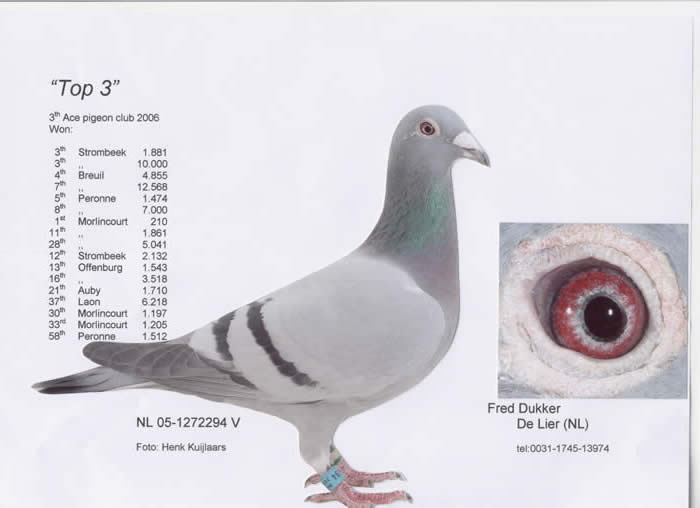
A few results over the last two years (2006 and 2007): Station Distance Birds Prizes Duffel 99 km 2.103 p 8, 11, 27, 34, 70, 85 (18 in race/12 prices) Duffel 99 km 1.953 p 3, 11, 61, 62, 64, 74, 93, 95 (33/22) Strombeek 120 km 1.881 p 1, 3, 28, 38, 43, 47 etc (18/14) Strombeek 120 km 2.300 p 2, 5, 7, etc (24/15) Auby Les D 192 km 1.930 p 1, 7, 9, 20, 22, 25, 41, 43, 50 etc (30/20) Auby Les D 192 km 1.710 p 4, 20, 21, 62, 65, 76 etc (18/12) Arras 213 km 7.527 p 10, 12, 16, 27, 58, 60, 80 etc (66/31) Arras 213 km 1.926 p 2, 3, 30, 42, 46, 54 etc (28/16) Peronne 246 km 1.518 p 1, 3, 7, 13, 17, 26, 28, 36, 37, 40, etc (28/24) Peronne 246 km 1.512 p 2, 10, 58, 59, 60, 77, 92, 97 etc (20/15) Peronne 246 km 1.529 p 1, 3, 4, 6, 7, 15, 24, 25, 28, 40, 41,etc (30/23) Morlincourt 282 km 1.134 p 1, 2, 3, 12, 13, 17, 27, 28, 29, 30 etc (20/20) Morlincourt 282 km 1.186 p 1, 2, 4, 5, 6, 9, 14, 20, 21,22,23,39 etc 28/23) Breuil L Vert 317 km 2.421 p 11, 14, 25, 26, 36, 62, 98 etc (20/10) Chantilly 334 km 2.500 p 4, 19, 32, 35, 61, 86 (20/9) Championships In ‘The Westland’ 1st Un-nominated 4st nominated natour jong 1st Un-nominated 1st nominated generaal 3rd Un-nominated 6th nominated Ace birds general 10th natour young 1st, 6th, 9th, 10th natour old 2nd, 7th, 8th Breeding Fred starts pairing up all his birds the 15th of December. Fred tries to pair his pigeons a little bit inbred like niece x cousin or uncle x niece or half brother x half sister. He has 18 couples in his race team and 15 couples of breeders. The eggs of 12 couples of the breeders are put under a part of the race team. There are mostly 6 pairs in the race team from which he also keeps one round of eggs. The 12 couples of breeders come on eggs for the second time and breed them out. On this way he has a lot of youngsters in a short time. One youngster from each nest in the race loft goes with the hens to the youngster loft at an age of 14 days. After 10 days the other youngsters are also placed in this loft and the hens then go to the run. The straw from the year before is on the floor in the youngsters loft until they are 35 days old. Then it will be refreshed. In this way Fred hopes that the pigeons get a little bit of resistance against diseases. 6 couples of breeders stay for a third and fourth round of youngsters. These youngsters can be placed in a different part in the youngster loft or will be given away for a ticket or sold.
Racing old pigeons In the second part of March, Fred puts the hens and cocks from the racing team and 9 couples from the breeders together. Hereby the breeding hens are paired with a good racing cock and the breeding cocks are paired up with a good racing hen. In this way his racing team has for 50% always a partner at home. That’s a better stimulance for them to be motivated through the season to come home fast. He does this with the older birds and the best youngsters. After they have eggs for 5 days they will be taken away and then the widdowhood starts. The racing cocks stay in the loft in which they have been breeding. The breeding cocks and hens go to 2 different runs and the racing hens go to the loft where the 9 breeders were placed. In this loft they have a small place to sit on before each brood loft. During the season on boxing day he sometimes puts for 5 minutes a breeding hen in the brood loft, where she was breeding in December. The hen that has now owns this brood loft since March goes fighting with the ‘intruder’. This gives also an extra stimulation to come home fast. Before the first race he brings them away 2 or 3 times at a distance of 20 miles. Every boxing day the hens and cocks stay together for 20 minutes. On the race day they stay together the whole day after arriving and on long distance races sometimes untill the next morning. He trains the birds once a day in the afternoon for an hour and uses the flag to keep them in the air. From the longest day till the end of the season in September he starts lightning from 6.00 o’clock till 22.00 o’clock. At the end of the season the birds may come on eggs for the last 5 races in August and September, called natour. Then he only races with the hens. They have 4 day eggs on the first natour race. The hens train earlier in the afternoon (between 16.00 and 17 o’clock) because they are not on their nest at that time. The cockss stay on their nest during this training. On boxing day he takes out the cocks to give the hens more motivation or the hens are boxed in on friday at 10.00 o’clock. Racing young pigeons The youngsters are brought away in May for 8 times. The reason that he does this in May is that he wants to be ready before the darkening stops. At the moment he stops with the darkening there are sometimes problems with coli. When there is, he has time enough to cure them for a week. They are darkened from the first week of April until the first week of June. The first race is the second week of July. The first 2 races he doesn’t separate them, but after that he playes them on the door. On boxing day they stay together for 2 hours and after returning home on saturday they stay together untill sunday evening.
Feeding and medication On Saturday, Sunday and Monday he gives a light mixture of grains and not to much. They get a bit of brewer's yeast over the grains and on Saturday and Sunday morning also Ronidazole against canker. On Tuesday they get 50% race mix (of the Zwarte Vogel) and 50% light mixture. On Wednesday morning 75% racemix and in the evening 100% racemix. On Wednesday evening they get more (depending to the race distance) and on Thursday they can eat as much as they like. On short races with boxing on Friday they get also as much as they like in the morning and that will do. Every 2 weeks he gives a medicine against the Ornithose complex like Orni-red (vd Sluis) or Belgatai (de Weerd) or Tylan (Herbots). He likes to chanGe every time because he's afraid of resistance. He gives it for three drinking shifts (one and a half days). On Thursday they get vitamins (Herbots) over the grains. In March the Vet injects for paramyxo virus of course and in November a preventative cure against paratyphus, with Teraprim or Trimetroprim-sulfa through the water. The pigeons Racing on a high level started in 1982 with a cock of Leo van Rijn. Many pigeons have their origin on the loft of Leo v Rijn (racing as Comb v Rijn-Meeder). They have 3 lines:
Pigeons of Leo van Rijn are famous in America, Germany, Dubai, Australie, New Sealand, Great Brittan and of course The Netherlands. Many first price winners in ‘The Kuststrook’ have his origin.
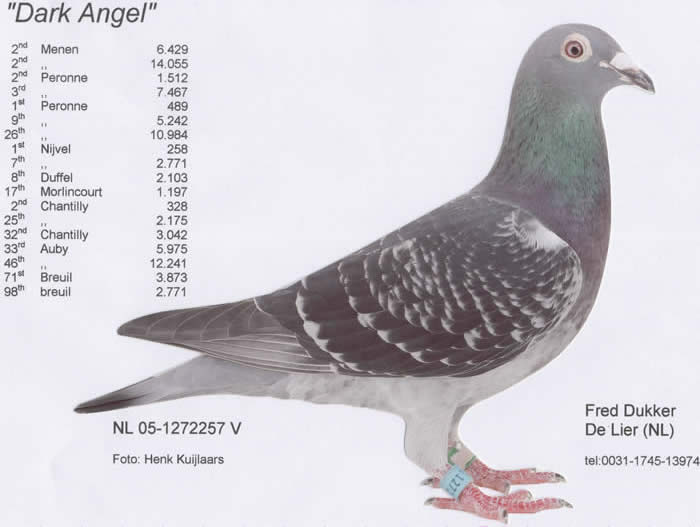
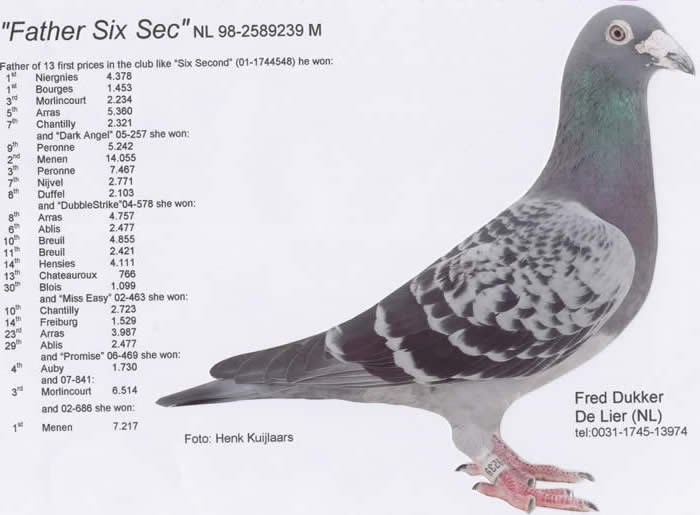
The Tournier line is also important on the loft of Kees van Koppen. For example, Kees had a super couple in the Real King x Blue Queen. Real King is from the Tournier line. The super couple gave Eurostar, winner of 1st Chantilly of 9.909 b and 1st Chantilly of 4.895 b and 3rd Chantilly of 8.404 b. Only 2 birds of Kees were crossed and gave many succeses even up to 600 km. The last 5 years Fred purchased a few pigeons of Kees van Koppen and Cock Blaak. As crossing material they are perfect. Ideas are often talked over with Kees. Kees' pigeons are famous in countries like Italy, Spain, Portugal and especially Germany. There his pigeons are sold as youngsters for 600 pounds. An excelent bird in Fred’s loft is Father Six Seconds 239-98 (ringed with an old ring in 2000). The 239 is father to 13 first price winners in the club like:
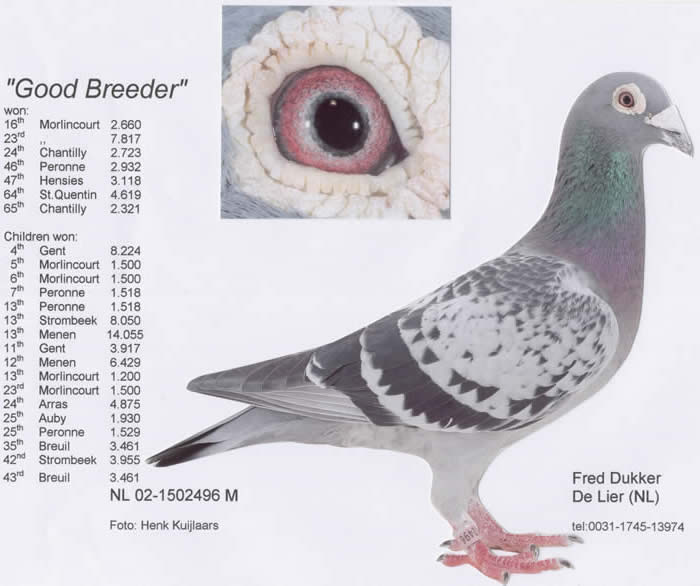
His grandchildren won in the Westland already 1st, 1st, 2nd, 2nd, 4th, 5th, 14th, 16th, 19th, 21st, 22nd, 23rd, 24th, 25th, 26th . Another Super is 02-688 (inbred Kees) He’s father to:
19/12/07 |