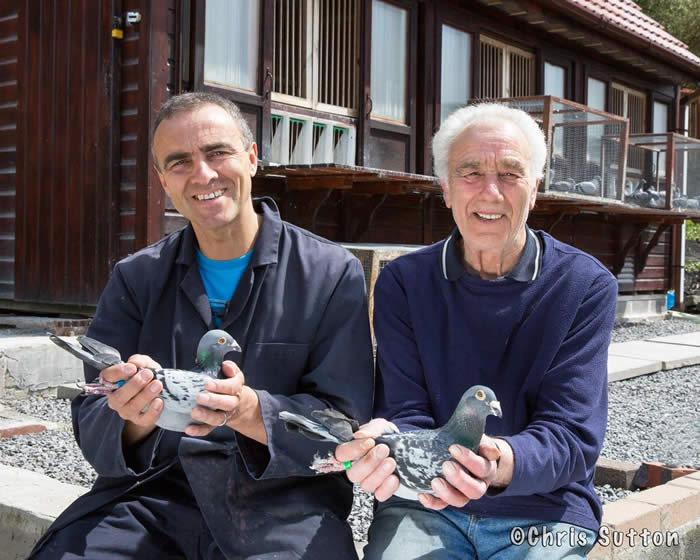
THE LEGEND THAT IS FRANK TASKER
Part 3
by Gareth Watkins
In the first two articles in this trilogy I have attempted to outline the origins and subsequent development of the Tasker strain of multi National winning pigeons. In this, the final part, I will attempt to outline the methods of this master fancier and also give the reader an insight into some of the performances achieved by Frank Tasker and others, when applying these methods to his multi talented family of pigeons. Hopefully, some reader somewhere will glean a little knowledge from these pages which will help him/her to achieve future success in the sport of pigeon racing.
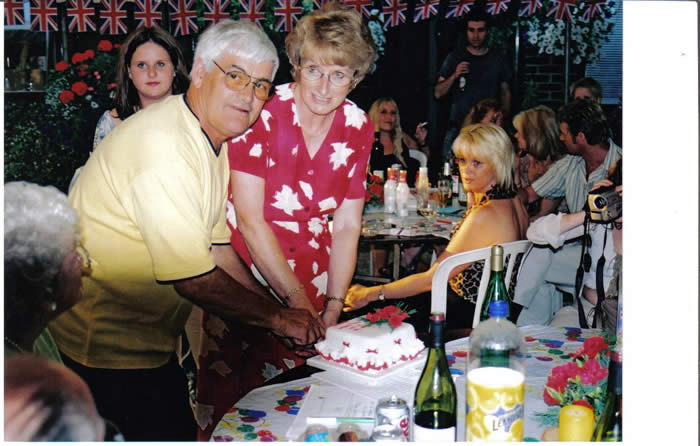
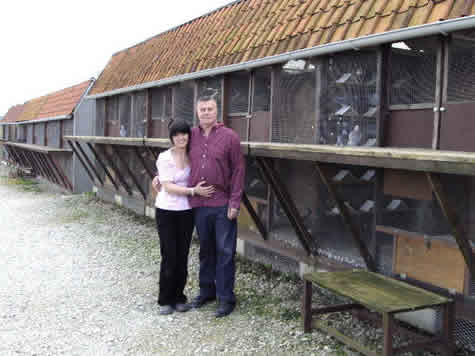
Frank and Ann Tasker's Ruby Wedding party
The Tasker old bird race team is usually made up of 48 widowhood cocks and a small team of 20 or so widowhood hens. These are mated in early December and allowed to go to nest. When the youngsters are 12 days old the non racing mates are removed and the racers, both cocks and hens, are allowed to finish off the rearing of the youngsters alone. Once the youngsters are away Frank sends some droppings samples to Belgium to be tested for cocci and worms and if the all clear is given then the birds are not treated for either of these parasitic complaints but left alone. However, a strict treatment regime for other diseases begins once the racers have been separated and this begins with a seven day treatment for canker. This is then followed by three days of herb tea and honey before the second treatment for Paratyphus is administered. This lasts for 10 days and the drug of choice is Baytril. Once again herb teas and honey are administered via the drinking water for three days following treatment with Baytril. If the birds were found to be clear of worms and cocci in their earlier testing then no further treatment for these complaints is needed and the final treatment will be a seven day course of medication for ornithosis followed by three days on tea and honey. During March the birds are allowed their liberty for an hour or so on good days to enjoy free flight in preparation for the coming season.
Once early April arrives the racers are re-mated and are given a few short training spins whilst sitting their second round of eggs. They are also sent to the first race whilst sitting but are immediately widowed on their return. When on widowhood, the widowhood cocks do not see their hens prior to basketting for the race but are merely allowed to have access to their nest pans. However, the hens are always waiting for the cocks on their return from the races. The first feed for the returning racers is always a few peanuts. The cocks are then allowed in with their hens and have access to a drinker filled with electrolytes and glucose. When the hens are taken away the cocks are allowed to eat their fill of a high carbohydrate “basic” mixture that Frank makes up to his own formula. This basic mixture is developed from combining two commercial widowhood mixtures along with depurative, barley, maize, safflower and white dari to give a light, high energy mixture, which is fed to the racers from Saturday until Wednesday night. The Wednesday night feed, or sport mixture, is made up from two different widowhood mixes to which extra maize is added. This sport mix is then fed in each feed up until basketting. The amounts of both the basic and sport mixes are strictly measured at each feed until Thursday evening, when the racers are allowed to eat their fill. On Friday morning, basketting day for the short races, the cocks are allowed to eat their fill of the sport mix and are also given extra maize in the afternoon just before basketting. Various vitamin and herbal additives are given with the feed throughout the week, the aim being to cleanse and replenish the system at the appropriate times. Herbal teas, to which honey is added, are generally to be found in the drinkers throughout the course of the week.
The exercise regime is also strictly adhered to as the cocks do not go out of the loft until Monday evening after their return from Saturday’s race. This Monday evening exercise takes the form of half an hour’s free flight with no forcing. From Tuesday morning until Friday morning the widowers get one hour’s free flight twice daily. They are not forced to fly nor are they locked out of the loft but are allowed to come and go as they please. The system is virtually the same for the hens except that they are strictly rationed with the same feed mixtures to ensure that they do not start to mate with each other. The hen’s exercise is restricted to one hour once per day and they too are left to do as they please with no forcing. Neither cocks nor hens are trained by road after their pre season training programme – the home exercise routine is enough, when allied to their strict dietary regime, to keep them fit and keen.
The young bird system employed is more an exact science than an art form as Frank is meticulous in his attention to detail, care and education of the babies, as they are after all, the loft’s future widowers and widowhood hens. When weaned the babies are fed just peas for a few days and this is followed by a few days feeding solely maize. This ensures that the youngsters are used to eating the larger grains in the basic mixture – the same basic mixture fed to the widowhood cocks at the start of the week. This is made up by combining widowhood mixes, depurative, barley, maize, safflower and white dari. This mixture is then fed to the youngsters for the remainder of the season at the rate of a dessertspoon per bird in the morning and as much as the youngsters can eat at night after exercise, once the youngsters start to leave the barley the feeding stops. Brewer’s yeast and glucose are added to the mix once or twice per week and vitamins are also administered via the feed mid week. After weaning, the babies are vaccinated against paramyxo and a few weeks later against pigeon pox. They are also given a treatment against canker and coccidiosis during this preseason quiet period. The youngsters have their liberty to come and go as they please between 12 pm and 4 pm each day. At 4 pm they are called in to their evening feed and any that are AWOL get no food on their return and they soon learn that the “canteen is open” at 4 pm and no later!
The youngsters are put on the darkness system from 21st March until the 21st June and the lofts are darkened down for 12hours during this time. This can be from 6pm to 6 am each day or whatever time is convenient to each fancier BUT it must be the same time each day. Care should also be taken that the ventilation in the loft is not compromised during this darkening period and the loft should be designed to ensure that light is kept out but air is still allowed to circulate within the loft during the period of darkening. This can be achieved by various means, possibly the most effective method is by the use of extractor fans which can be set on a timing system. The youngsters are gradually allowed to become accustomed to natural daylight hours in the week leading up to the 21st June when they are finally taken off the darkness system. Over the years Frank has not noticed any deleterious effects on the babies in their subsequent old bird careers after being put on the darkness system as young birds. Nor is he worried if individual birds do not complete a full moult in the year of their birth, as he has topped the Federation with yearlings that were growing their last flights in April!
The youngsters will by now be ready for training, but only after they have been subjected to the same medication regime that the old birds underwent prior to their first race of the season. When Frank is satisfied that they are A1 health wise then the training begins with a few short tosses at ½ a mile moving on gradually in short stages to 25 miles. Frank has found that it is beneficial, if you have the time, to liberate the young birds in small groups, a basket at a time, so that if a bad toss is encountered you literally do not have “all your birds in one basket”. Once this initial private training programme has been completed ,Frank likes to get his young bird team into a couple of communal tosses with other birds from the locality, the young birds’ initial education is then complete and they should be ready for the races. The usual practice is for the young cocks and hens to be separated after they have competed in the first couple of races. They are exercised separately once per day for one hour and are allowed to mix together on the afternoon of basketting. However, Frank has had equal success when leaving the young cocks and hens together to mate, lay and rear, so it is a matter for the individual fancier to decide which system is most convenient for his set of circumstances. I should point out here that Frank rarely cleans the young bird loft as he employs a deep litter of straw, aubiose and dry droppings. The deep box perches are also rarely cleaned and the accumulated droppings soon dry and as such represent a minimal health hazard to the young racers. Everything possible is done to ensure that the youngsters are fit, healthy and content and to this ends the birds are bothered as little as possible between exercise and feed times. Very often during the season they are given an open loft to come and go as they please or to just lie contentedly in the sun relaxing.
The weekly routine for the young birds when racing follows the usual pattern as set out below.
On race return they are given as much of the basic mixture as they will eat, always feeding a little at a time and ensuring that at the end of the day every bird has eaten its fill. This mixture is treated with glucose, lemon juice and beer yeast and a herb tea to which electrolytes have been added, is placed in the drinkers.
Sunday they get the same mixture to eat with glucose, beer yeast and lemon juice added and are allowed to eat their fill but only fed in the evening as in the morning they are still digesting Saturday’s food.
The feed is never altered throughout the season, as they get the basic mix at every meal fed at the rate of one dessertspoon per bird in the morning and as much as they want at night after their daily exercise period. Various vitamins are mixed with the feed and great use is made of different types of herb tea to which honey is always added. The above methods keep the youngsters in tip top condition so that they can give of their best on race days.
That then is a brief outline of the methods employed by this master fancier. I will not bore readers with a catalogue of wins achieved by Frank as I can assure you they are many – far too many to mention here! I will however highlight a select few, so that the reader can better appreciate just how good a pigeon fancier this man is.
I have already mentioned that Frank has won 1st Open NRCC on six occasions and to these outright wins can be added literally scores of other top one hundred finishes with thousands of birds competing. Between 1991 and 1997 alone Frank’s birds won 57positions in the first one hundred Open with the NRCC and remember this was at a time when he was diagnosed with throat cancer and was spending a great amount of time hospitalised. The Federation performances during this time were equally impressive with 7 x 1sts; 6 x 2nds; 7 x 3rds Federation [Provincial] Open and 70 top 20 finishes with up to 6,900 birds competing.
In the 2000 season the Tasker pigeons won, amongst other prizes, 1st, 2nd, 3rd & 5th Federation Bubwith; 1st, 2nd, 3rd, 4th, 5th, 7th, 8th, 9th & 10th Federation Berwick; 1st & 2nd Federation Bubwith; 1st, 5th, 6th, 10th etc Federation Waldridge Fell 1st & 2nd Federation Northallerton and in each of these races they were competing against many thousands of pigeons in one of, if not the largest north road Federations in the UK. This level of success has continued right through to the present day despite two further bouts of ill health which have needed further extensive periods of hospital treatment. I think it is fair to say that Frank Tasker’s record at Federation and NRCC level can stand comparison with any other fancier in the history of these two illustrious and highly competitive organisations.
The Tasker success story does not end with Frank’s own outstanding record of wins but extends to many other fanciers who have been fortunate to obtain pigeons and sound advice from this genius of a pigeon man. The list of fanciers who have benefitted from this association reads like a who’s who of the British pigeon fancy and encompasses fanciers from across the length and breadth of the British Isles. The Hall of Fame includes:-
1st MNFC Angouleme 1986 by Geoff Kirkland.
1st London NRC Morpeth 1988 by Graham White.
1st MNFC Fougeres 1991 by Geoff Kirkland.
1st London NRC Hexham 1992 by Steve White.
1st CSCFC Bergerac 1994 by Staddon Brothers.
1st CSCFC Rennes 1994 by Tony Heynes.
1st MNFC Nantes 1996 by Dave Sherratt.
1st MNFC La Ferte Bernard 1997 by Terry Sherratt.
1st NFC Pontorson 1998 by C. Allwright & Son.
1st Welsh SENFC Bonn 2002 by Haydn Minett.
1st NFC [old hens] Guernsey 2002 by Mr & Mrs Jeremy Wright.
These are literally the “tip of the iceberg”, as there are, I can assure you, very many more winners at club, Federation , Combine and National level plus Queen’s Cup winners who have in their make up the Tasker genes.
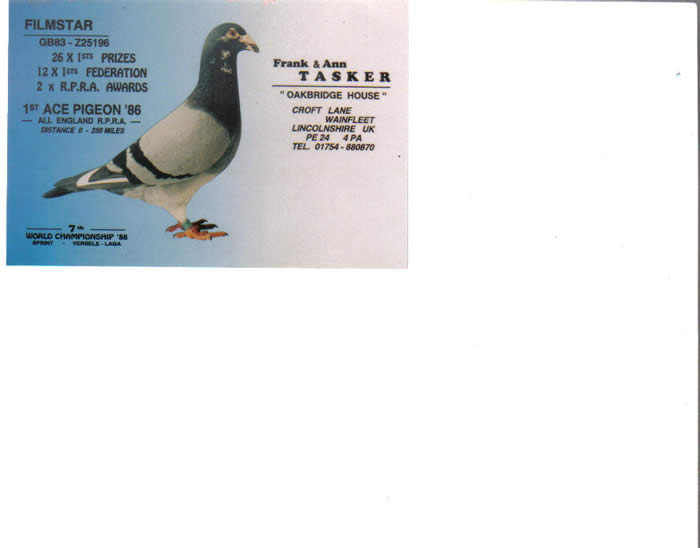
I have included here photographs of some of the top performance pigeons that contain Tasker bloodlines. Some of special note are “Perrott Filmstar” which was gifted as an egg to John and Mike Staddon and was bred in 1984 from the immortal “Filmstar” before “he was famous”. This cock won 3 x 1sts as a young bird plus 1st in an Open race before being placed in the stock loft where he sired two 1st Open CSCFC winners including “Perrott Paul” a winner of 1st CSCFC Bergerac and 3rd Open BBC Bordeaux.
Champion “Home Alone” who’s photograph is also included, was bred and raced by John White of Radstock from pigeons introduced from Frank and amongst his many wins were 1st West of England South Road Combine Dax at over 500 miles being clocked after 15 hours and 53 minutes on the wing to be the only bird clocked on the day. This terrific performance earned him an RPRA long distance award.
Yet another top class pigeon that contains the Tasker blood is “Champion Digit” bred and raced by Dave Sherratt . Digit’s wins include:-
3rd Fed Cheltenham 84 miles;1st Fed 1st Combine Sartilly 304 miles; 7th Combine Rennes 347 miles;39th Combine Nantes 407 miles; winning an RPRA award for the above series of performances in one season. Digit then went on to win 1st MNFC Nantes in 1996 and also won his second RPRA award. Some pigeon!
The photograph of Ced and Clive Allwright’s Gay Blue Pied hen Starlett, winner of 1st Open NFC Pontorson young birds with 6,947 birds competing, is also included here and shows the influence of Champion Filmstar as she was bred from a grand daughter of Filmstar gifted to the partners by Frank
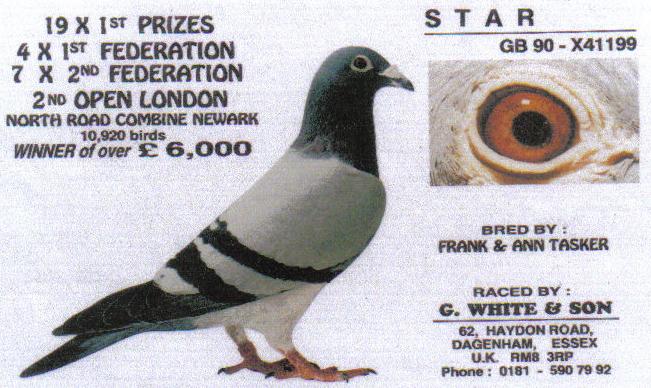
Finally we come to two out and out champion racers both raced by Graham White in the hot bed of North road racing with the London North Road Combine. The blue w/f cock Pied Star won the Hall of Fame award when competing with the LNRC from Thurso 503 miles, where he won in three consecutive years 14th Combine[3,561 birds];28th Combine[3,418 birds] and 54th Combine [3,449 birds]. Both parents of Pied Star were bred by Frank. The other blue cock named simply “Star” was actually bred by Frank and raced by Graham White for whom he won 19 x 1sts including 4 x 1st Federation and 7 x 2nd Federation plus 2nd Combine with 10,920 birds competing. In his racing career Star won more than £6,000. The influence of Champion Filmstar is plain to see in the colouring of both these champion racers.
I think I have clearly illustrated in the foregoing the massive contribution that Frank Tasker has made to the development of the sport of pigeon racing within the British Isles. I only hope I have done justice to this world class fancier in this series of articles, for he is without any shadow of doubt the finest pigeon man I have met in nearly fifty years in the sport.
Since I started writing this series of articles on the Tasker family of pigeons Frank Tasker has suffered a massive stroke and at the time of writing is still hospitalised. I’m sure I speak for all his many friends when I wish him a swift and full recovery to good health so that he can once again fully enjoy his two great loves – his family and his pigeons.

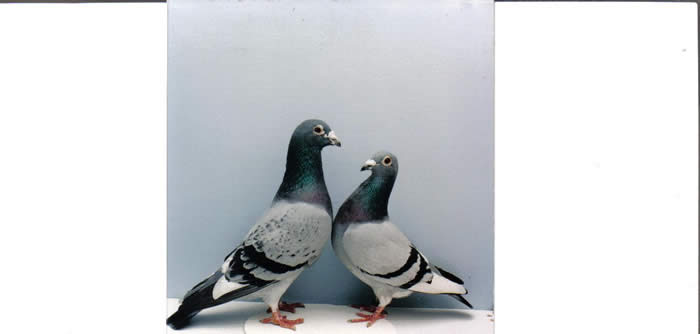
Digit's Parents
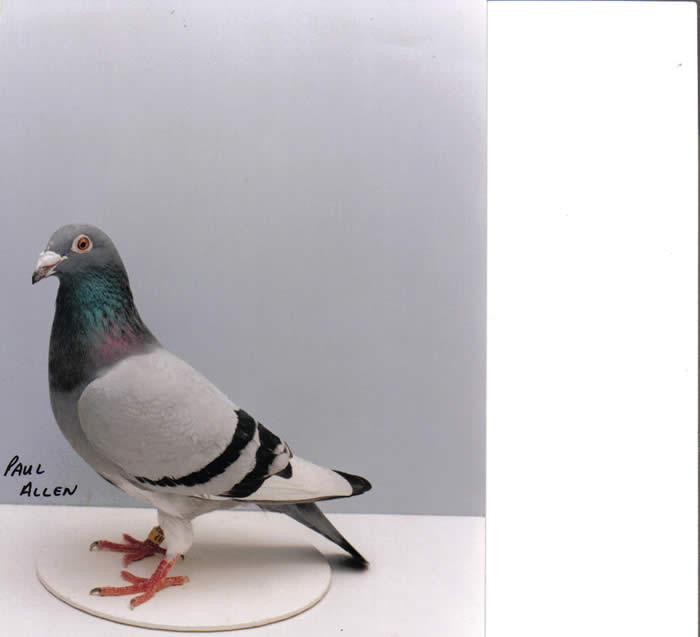
Digit
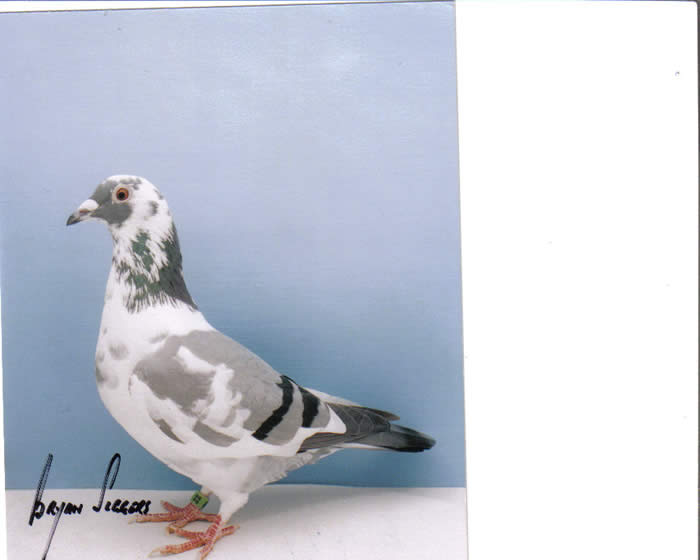
Starlett
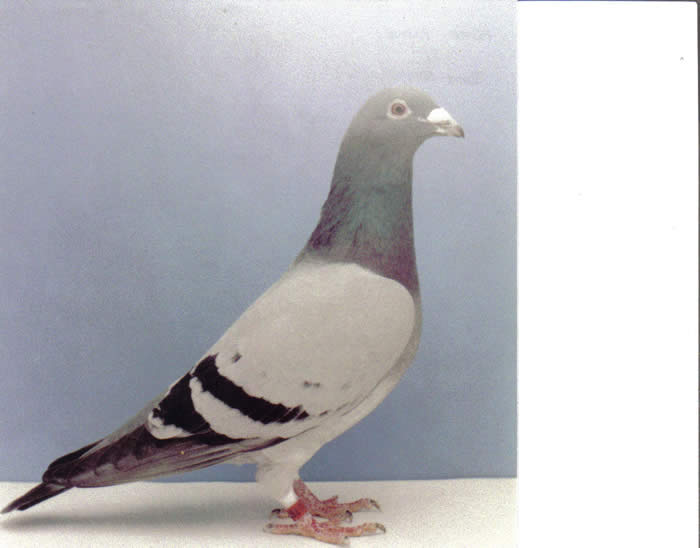
Home Alone
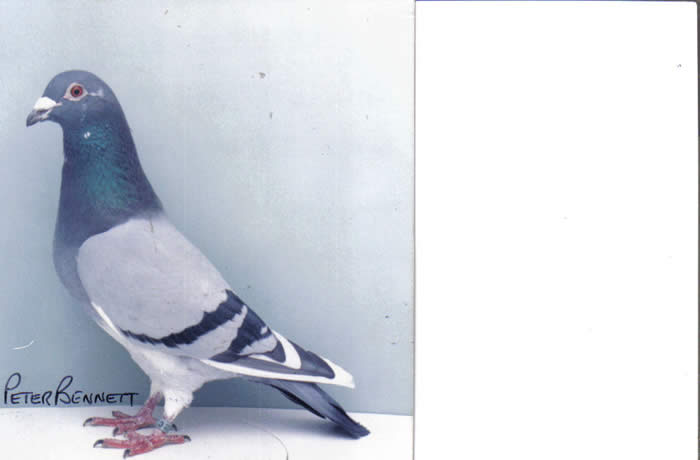
Perrott Filmstar
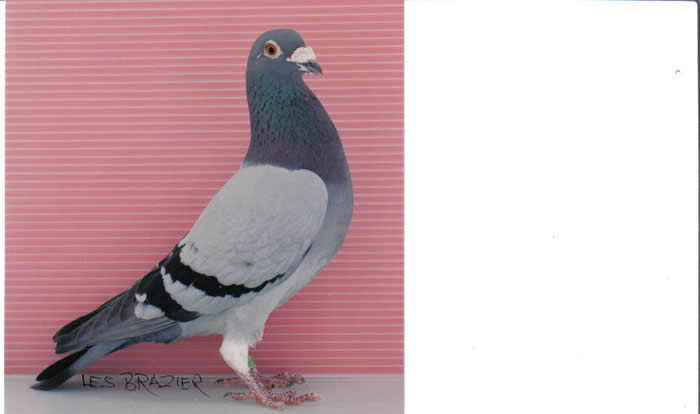
Perrott Paul